Pakistan China Defence Updates

Apart from getting new ADS elements like mentioned in previous posts, PAF must ensure that no air base is with single run way. We need air bases like Bohlari, Qadri etc. two run ways in parallel or Mehsaf with 2 run way crossing each other.
 
We also need to reform the expectations for our journalists and news channels in how they talk to foreign experts. This interview style hurts the ability for the public to hear out full answers and frustrates our guests, especially from China, who won’t say it, but will be more reluctant to come and speak other matter.

Society needs to “absorb” the transformation modern warfare requires; the priorities and development trends, what modern war is going to be like, and what sacrifices can they expect to have to plan for.

To view this content we will need your consent to set third party cookies.
For more detailed information, see our cookies page.
 
To view this content we will need your consent to set third party cookies.
For more detailed information, see our cookies page.
 

After DeepSeek, China's JC10 moment​


Imtiaz Gul
May 31, 2025

The writer heads the independent Centre for Research and Security Studies, Islamabad. He is currently a visiting Research Fellow at Fudan University, Shanghai

Amidst the intricate tapestry of Chinese intellectual and academic circles, a distinct sense of pride permeates the nation's achievements. The recent, albeit perilous, Indo-Pak confrontation (May 7-10) serves as a catalyst for this sentiment. As the ongoing war of information and propaganda intensifies, Chinese intellectuals eagerly celebrate the groundbreaking milestones achieved through their technological advancements, particularly in the domains of AI-driven satellites, jet fighters and missiles, in collaboration with the Pakistan Air Force. They find amusement in the spotlight that has been bestowed upon their defence hardware, which emerged triumphant after four days of engagement.

Following the DeepSeek, Beijing and Shanghai have experienced a collective sense of triumph akin to the JC10-PL15 Moment for most academics. This moment is fueled by the successful demonstration of their technology, which has garnered widespread attention.

An excerpt from The National Interest elucidates the recriminations between the Indian and French governments over access to source codes for the Rafale jets. These events have engendered both anger in India and amusement in Beijing.

Chinese social media platforms have been abuzz with these developments, as they find amusement in the circumstances. After all, why should they not? Chinese weapons and warplanes exceeded expectations during the conflict. When news emerged of India's inability to access Dassault's source code, coinciding with India's capture of an intact Chinese PL-15 missile, one of Beijing's "wolf warrior", diplomats took to X to mock New Delhi: "India invested $288 million per Rafale, yet they lack access to the source code. Furthermore, they assert their ability to 'extract the software' from the wreckage of a PL-15 missile. However, they are unable to access the fundamental functions of their own Rafale jets."

While exuberance is understandable, it should not be construed as complacency. The Indo-Pak confrontation has only served as a catalyst for further pursuit of excellence through meticulous deliberation and strategic planning, both domestically and internationally.

Discussions at universities, think tanks and official quarters continue to be influenced by the recent four-day conflict between nuclear rivals, India and Pakistan. The episode appears to have energised Chinese academia to engage in forward planning and explore options for enhanced and more effective cooperation with partner countries, particularly Pakistan.

Why is this the case? Consistency is ensured by the Communist Party, which underpins China's entire political economy and the intellectual growth led by a dedicated leadership that ascends the political ladder through a rigorous accountability process. Only those with the utmost integrity and demonstrated commitment to the party and the people are successful in this process.

What unites these individuals is an unwavering faith in the well-being of citizens and the belief that investment in human resources is essential for progress.

Whether it is the iconic Great Wall in Beijing or Shanghai, Yiwu or Guangzhou, China's defence hi-tech capabilities, dozens of high-altitude glass bridges, or Shanghai's Global Finance Center, they all convey the same message: unwavering policy consistency, honesty and visionary leadership, coupled with absolute focus on the welfare and education of the people. These factors have transformed China and propelled it to a position where it is now asserting itself even against the United States. While President Trump's bullying tactics were met with resistance, China agreed to engage in diplomatic discussions but refused to yield.

The recent grand summit in Kuala Lumpur, which involved China, ASEAN and the GCC, provided a glimpse of Beijing's unwavering commitment to peaceful engagement and win-win cooperation rather than coercive diplomacy. While President Biden's Build Back Better World initiative has seemingly lost momentum, the Belt and Road Initiative (BRI) continues to thrive and attract an increasing number of countries.

Since Xi Jinping assumed the presidency in 2012, China has invested hundreds of millions of dollars in research and capacity building. Notably, the Chinese military has undergone a significant reduction in personnel, with nearly 300,000 personnel being eliminated. Additionally, the generals have been instructed to prioritise their professional duties and future challenges rather than engaging in commercial ventures. The People's Liberation Army (PLA) must maintain its focus on excellence and avoid any involvement in commercial activities. Both the PLA and the Communist Party have endured severe purges of high-ranking officials for corruption, inefficiency and betrayal of their responsibilities.

The driving force behind China's current success lies in an ecosystem anchored in solid planning, facilitated knowledge and skill development, and the pursuit of excellence. This system operates on merit and celebrates knowledge and skills.

Coincidentally, as I was concluding this article, a public service text message arrived on my mobile device, reminding us that May 30th is the 9th National Science and Technology Workers' Day and coincides with the 25th National Science and Technology Activity Week.

"We extend our utmost respect to all science and technology workers. Let us harness innovation as our guiding principle and hard work as our propulsion, collectively constructing the vision of a robust nation through science and technology," said the message from the ministry.

This inspiring message serves as a testament to the recognition of science and technology as the indispensable key to self-sufficiency and competitiveness, positioning China at a significant advantage over other nations.

It is unsurprising that China is experiencing a surge of technological achievements that few countries can boast of - something that instills a sense of confidence and fosters national pride.
 
Black__Bird
@Blaxk__Bird

HQ-19: More Than Just an Air Defense Upgrade, A Strategic Game-Changer for Pakistan

Many observers are mistakenly viewing Pakistan’s acquisition of the HQ-19 missile defense system as simply a better, more advanced air defense tool. While it is indeed an improvement over previous surface-to-air missile systems, this perception misses the far-reaching strategic implications of the HQ-19. This system marks a transformative upgrade in Pakistan’s defensive and offensive capabilities, especially in the realms of ballistic missile defense and counter-space operations.

Unlike traditional air defense systems that focus primarily on intercepting aircraft or short-range missiles, the HQ-19 employs cutting-edge hit-to-kill kinetic interception technology capable of engaging high-speed ballistic missiles during their midcourse and terminal phases, even at altitudes exceeding 150 kilometers in the near-space environment. This allows Pakistan to counter medium- and intermediate-range ballistic missiles, which have been a persistent threat.

What truly sets the HQ-19 apart is its credible anti-satellite (ASAT) capability. It can target and neutralize low Earth orbit (LEO) satellites, which are crucial to India’s Intelligence, Surveillance, and Reconnaissance (ISR) network. These satellites provide real-time target tracking, missile guidance data, and communication relay for India’s tri-service operations, especially enhancing the Air Force’s situational awareness and strike precision. By disrupting these space assets, Pakistan can degrade India’s missile guidance systems, battlefield command, and overall network-centric warfare advantage.

The HQ-19’s advanced propulsion and multi-mode seeker technology enable it to maneuver precisely against fast-moving satellites subjected to high-g forces in orbit. This reflects Pakistan’s strategic intent to contest India’s dominance in space, denying it the reconnaissance and communication advantages critical during conflict.

In essence, the HQ-19 represents a paradigm shift for Pakistan, from conventional air defense toward integrated missile and space defense, signaling the growing militarization of near-Earth space and a new chapter in multi-domain operations aimed at safeguarding national sovereignty. This system is not just an upgrade, it is a clear message that Pakistan is ready to challenge Indian space and missile superiority at a strategic level.


Image


1:00 AM · May 31, 2025
 
To view this content we will need your consent to set third party cookies.
For more detailed information, see our cookies page.
 
To view this content we will need your consent to set third party cookies.
For more detailed information, see our cookies page.
 
I think now the Indians will be desperate to get the Su-57

I don't know why they haven't already. Could be US pressure. Could be unreliability with russian parts (especially now). Could be that Russia doesn't offer bribes like France?

But they could take the Su57 and pimp it out, may be even locally assemble it.
 
To view this content we will need your consent to set third party cookies.
For more detailed information, see our cookies page.
 

Chinese defence stocks surge as Pakistan signals major arms deal: report


BR Web Desk
June 9, 2025

Shares of Chinese defence firms soared on Monday after Pakistan announced plans to acquire a significant package of military equipment from Beijing, including one of China’s most advanced stealth fighter jets, according to a Bloomberg report.

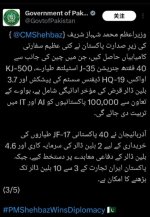
In a social media post last Friday, the government of Pakistan said it would purchase 40 J-35 fifth-generation stealth fighter jets, KJ-500 airborne early warning and control (AEW&C) aircraft, and HQ-19 ballistic missile defense systems.

China’s Ministry of Defense has not officially commented on the announcement.

Bloomberg reported that AVIC Shenyang Aircraft Company – which manufactures the J-35 fighter – surged by its 10 percent daily limit in Shanghai, marking the third straight session of gains.

The rally extended to other defence companies, including Aerospace Nanhu Electronic Information Technology Co., which saw its shares rise as much as 15 percent.

The rise in Chinese defence stocks comes amid growing confidence in the effectiveness of Chinese military hardware following recent border clashes between Pakistan and India.

Last month, Pakistan claimed that its Chinese-supplied J-10C fighter jets were involved in successfully shooting down six Indian aircraft, including French-built Rafale jets.

While India dismissed those claims and downplayed the performance of foreign-supplied weaponry, it later confirmed that it had lost an unspecified number of fighter jets during the conflict.

Indian Chief of Defense Staff Anil Chauhan acknowledged the losses during a May 31 interview, without providing further details.

Military tensions between the two nuclear-armed neighbours flared up in early May, with both sides reportedly engaging in air, drone and missile strikes, along with cross-border artillery and small-arms fire, particularly along the Line of Control (LoC).

Previous reports had highlighted the effectiveness of Chinese-made platforms like the J-10C in active combat has significantly raised their credibility in the global arms market.

According to Bloomberg, this latest deal would mark China’s first-ever export of the J-35 stealth fighter, which was first publicly unveiled at the 2024 Zhuhai Airshow.

The inclusion of KJ-500 AEW&C aircraft is expected to substantially improve Pakistan’s radar coverage, given the system’s advanced electronic warfare capabilities and operational agility.

The HQ-19 surface-to-air missile system would enhance Pakistan’s air defence, particularly against ballistic missile threats.

Defence analysts say the procurement reflects Pakistan’s ongoing efforts to upgrade its military preparedness amid sustained regional volatility.

At the same time, China continues to expand its influence as a global arms exporter by offering cutting-edge technology at relatively lower costs than its Western counterparts.

Despite facing periodic scrutiny over corruption in its military-industrial complex, China has accelerated the development of advanced defence platforms.

In December 2024, Beijing launched the world’s largest next-generation amphibious assault ships, drawing international attention.

Business Recorder also recently reported that Indonesia, traditionally reliant on military equipment from the United States and Russia, is now considering China’s offer to sell J-10 fighter jets, signalling a shift in regional defence procurement trends.

In a broader context, China’s military-industrial progress appears to be part of a strategic vision to extend influence not just in the arms sector but also in dual-use domains.

The J-35 sale, if confirmed, could further boost investor confidence in China’s ability to compete in the high-end defense export market dominated by the United States and European powers.

While formal details of the deal are still awaited, analysts say the announcement marks a milestone in Sino-Pakistan defence cooperation, with implications for both regional stability and global arms dynamics.
 

Users who are viewing this thread

Pakistan Defence Latest

Latest Posts

Back
Top