Pakistan Missiles - Updates, News & Discussion

BMs side seems okay,
Shaheen 1&2 should be pumped out in numbers for ARFC.
R&D for HGV should be done.
SCMs are are worthless, no point in Acquiring Supersonic tech when the world has already moved on to Hypersonic cruise missiles.
Shaheen 1&2 should be localized and built in thousands for the ARF they are good enough to the job done, the industry that would be built for the mass production of Shaheen 1&2 conventional versions, wil lay the basis for our hypersonics.
HCMs are exotic technologies not for an economy like pak. Gliders are well within our reach.
SCMs can be intercepted there is no cost benefit in them. BMs like S1&2 and HGVs will be more cost effective technologies for an economy like pak.
Only shaheen 1 should be conventional....
 
Thats a good strategy BUT:
1)Shaheen series should be only for nuclear role and should see increase in range and capabilities like maybe MaRv.....
2)We are far from ramjets tbh...even india coudnt make one without soviet/russian
help..brahmos is onix and akash is sa6 ginfall...but if we concentrate fully then we can
most probably can achive an ASSM lie the japanese ASM3 or chinese ones ..
3)last lines are on point...
i know them they will use shaheen 1 or abdali as fattah 5 and 6 with little changes may be little down graded to make them in numbers .as far as ramjet tech chinese are playing with scramjet with ease like its nothing for them all sort of Hypersonics will be showcased on sep 3 .now its the perfect time pak should step in ramjet atleast with chinese tot it can take time but if we have some sort of base for ramjet we can transition to scramjet then. to go for hypersonics directly can only be for nuclear strike which will not be tot will be a direct purchase means no good numbers also as things stands nor we can make it numbers nor can purchase in numbers the hypersonic ones also will china give its a big guestion supersonic cruise missile tech china can agree to give in tot i think just an assumption .
 
Last edited:
BMs side seems okay,
Shaheen 1&2 should be pumped out in numbers for ARFC.
R&D for HGV should be done.
SCMs are are worthless, no point in Acquiring Supersonic tech when the world has already moved on to Hypersonic cruise missiles.
Shaheen 1&2 should be localized and built in thousands for the ARF they are good enough to the job done, the industry that would be built for the mass production of Shaheen 1&2 conventional versions, wil lay the basis for our hypersonics.
HCMs are exotic technologies not for an economy like pak. Gliders are well within our reach.
SCMs can be intercepted there is no cost benefit in them. BMs like S1&2 and HGVs will be more cost effective technologies for an economy like pak.
Directly going for hypersonic is out of our league for now atleast also BABUR NG i would have used for only conventional role not for nuclear strike strike we cant make hypersonics in great numbers even somehow if we get them.for nuclear strike MIRV is the way to go as all great powers do.
 
Directly going for hypersonic is out of our league for now atleast also BABUR NG i would have used for only conventional role not for nuclear strike strike we cant make hypersonics in great numbers even somehow if we get them.for nuclear strike MIRV is the way to go as all great powers do.
HCM is out of league for
Shaheen 1&2 will become form the back bone of ARFC for now especially when striking targets in eastern India. Right now if there able to get S1 and S2 in numbers would be more than enough.
HGV program should be initiated it will take us a decade but we will get there.
 
Only shaheen 1 should be conventional....
Why?, it only has a range of 900km they at least need a missiles with 2000km range missiles to "start from the east"
Shaheen 1 and 2 could be modified by lower their warhead weight. 300-500 kg warhead at hypersonic speed is more than enough to smack Indian targets.
 
You are assuming gloom at conditions of R&D versus achievements based on 20% competence.

Shaheen series story I sat across Dr SM and asked and it was basically nuclear scientists finding books ok rocketry and learning delivery systems.

Guidance was in house - to the point guidance for babur is in house and I still have in a ssd the first iteration of the code / built for a TI floating point DSP + FPGA combo.

Guidance then for all series is in house - chipset design is in house. It is sent to China to manufacture and then assembled in Pakistan.

That isn’t the issue - the issue is that where there was great opportunity to make advances in other parts of systems design and otherwise it so happens either vested interest or plain incompetence by someone appointed unqualified leads to things being left out.

This applies to everything from engine metallurgy to propellant to MIRV bus design.
But there is progress in other areas
Coatings
Evasive technologies
Decoys

How much is actually implemented is anyone’s guess.

But, there are a lot of squandered opportunities which is where is gloom

And I don’t assume malice where plain incompetence will suffice
@Oscar Interesting sharing.....

Regarding Dr Samar Mubarakmand...........that guy is a typical example of how someone so knowledgeable and experienced in one field cannot be considered equally capable in another domain.......that Thar Coal Gasification project was a complete 150 Million USD worth of waste and a botched attempt. Lying in ruins and worth scrap as of now.

He should have remained R&D head for nuclear/missiles related industry.
 
At least 2 from following should be pursued and become Fatah-4 instead of subsonic CM, because May 2025 Conflict shows that in short time fast movers will be main stay of the war to deliver hard punch and fast response, while subsonic CMs will be in secondary role till war turns into longer and larger one where subsonic will shine.
 

Attachments

  • Canva-Photo-2025-08-20T150051.webp
    Canva-Photo-2025-08-20T150051.webp
    50.6 KB · Views: 17
Pakistan missile program progress has been showdown.. in comparison of last 1.5-2 decades back ..

May be our focus has been changed ... Or finding has been diverted ..
 

The race for the two miles-a-second super weapons that Putin says turn targets to dust​

Frank Gardner
BBC Security correspondent

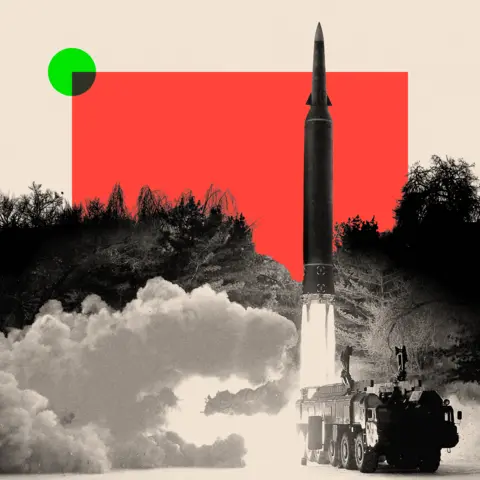
EPA-EFE/KCNA A treated image of a hypersonic missile North Korea claims to have test-fired


EPA-EFE/KCNA

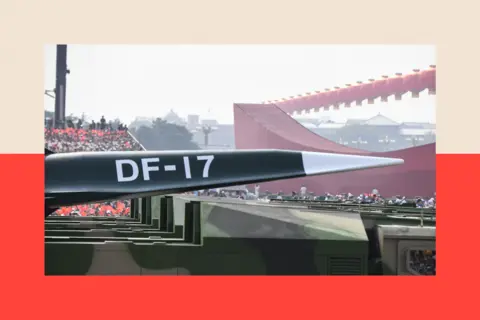
Glinting in the autumn sun on a parade ground in Beijing, the People's Liberation Army missiles moved slowly past the crowd on a fleet of giant camouflaged lorries.

Needle-sharp in profile, measuring 11 metres long and weighing 15 tonnes, each bore the letters and numerals: "DF-17".

China had just unveiled to the world its arsenal of Dongfeng hypersonic missiles.

That was on 1 October 2019 at a National Day parade. The US was already aware that these weapons were in development, but since then China has raced ahead with upgrading them.

Thanks to their speed and manoeuvrability – travelling at more than five times the speed of sound – they are a formidable weapon, so much so that they could change the way wars are fought.

Which is why the global contest over developing them is heating up.

AFP via Getty Images A DF-17 missile is presented during a military parade at Tiananmen Square in Beijing
AFP via Getty Images

China unveils its arsenal of DF-17 hypersonic missiles at a military parade in 2019
"This is just one component of the wider picture of the emerging geopolitical contest that we're seeing between state actors," says William Freer, a national security fellow at the Council on Geostrategy think tank.

"[It's one] we haven't had since the Cold War."

Russia, China, the US: a global contest​

The Beijing ceremony raised speculation about a possible growing threat posed by China's advancements in hypersonic technology. Today it leads the field in hypersonic missiles, followed by Russia.

The US, meanwhile, is playing catch-up, while the UK has none.

Mr Freer of the Council on Geostrategy think tank, which received some of its funding from defence industry companies, the Ministry of Defence and others, argues that the reason China and Russia are ahead is relatively simple.

"They decided to invest a lot of money in these programmes quite a few years ago."

Meanwhile, for much of the first two decades of this century, many Western nations focused on fighting both jihadist-inspired terrorism at home, and counter-insurgency wars overseas.

Back then, the prospect of having to fight a peer-on-peer conflict against a modern, sophisticated adversary seemed a distant one.

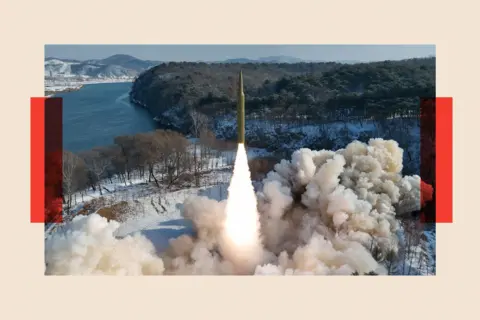
Shutterstock Test fire of a missile shown mid air in a rural scene in North Korea
Shutterstock

Test fire of an intermediate-range solid-fuel ballistic missile loaded with a hypersonic manoeuvrable controlled warhead in North Korea

"The net result is that we failed to notice the massive rise of China as a military power," admitted Sir Alex Younger, soon after retiring as chief of Britain's Secret Intelligence Service in 2020.

Other nations are also racing ahead: Israel has a hypersonic missile, the Arrow 3, designed to be an interceptor.

Iran has claimed to have hypersonic weapons, and said it launched a hypersonic missile at Israel during their brief but violent 12-day war in June.

(The weapon did indeed travel at extremely high speed but it was not thought to be manoeuvrable enough in flight to class as a true hypersonic).

North Korea, meanwhile, has been working on its own versions since 2021 and claims to have a viable, working weapon (pictured).

The US and UK are now investing in hypersonic missile technology, as are other nations, including France and Japan.

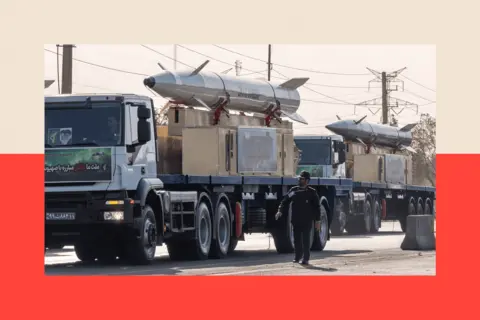
Morteza Nikoubazl/NurPhoto via Getty Images Iran's first-ever hypersonic missile, Fattah, and the Iranian Kheibar Shekan Ballistic missile, are carried by trucks during a military parade


Morteza Nikoubazl/NurPhoto via Getty Images

Iran said it launched a hypersonic missile at Israel during the 12-day war in June
The US appears to be strengthening its deterrence, and has debuted its "Dark Eagle" hypersonic weapon.

According to the US Department of Defense, the Dark Eagle "brings to mind the power and determination of our country and its Army as it represents the spirit and lethality of the Army and Navy's hypersonic weapon endeavours".

But China and Russia are currently far ahead - and according to some experts, this is a potential concern.

Hyper fast and hyper erratic​

Hypersonic means something that travels at speeds of Mach 5 or faster. (That's five times the speed of sound or 3,858 mph.) This puts them in a different league to something that is just supersonic, meaning travelling at above the speed of sound (767 mph).

And their speed is partially the reason that hypersonic missiles are considered such a threat.

The fastest to date is Russian - the Avangard – claimed to be able to reach speeds of Mach 27 (roughly 20,700mph) - although the figure of around Mach 12 (9,200mph) is more often cited, which equates to two-miles-a-second.

In terms of purely destructive power, however, hypersonic missiles are not hugely different from supersonic or subsonic cruise missiles, according to Mr Freer.

"It's the difficulty in detecting, tracking and intercepting them that really sets them apart."

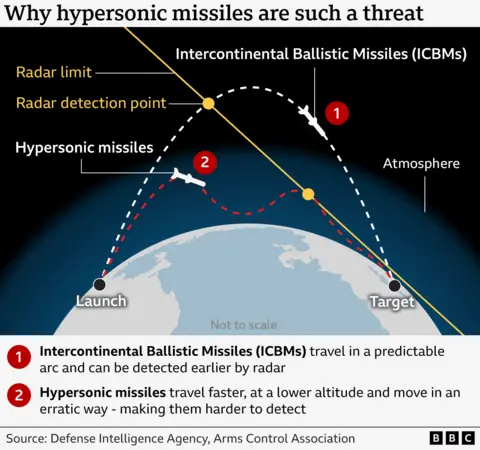
Graphic comparing flight paths of ICBMs and hypersonic missiles: ICBMs follow a high, predictable arc detectable by radar; hypersonic missiles travel faster, lower, and erratically, making detection harder. The diagram shows radar limits, launch and target points, and atmospheric layers. Source: Defense Intelligence Agency, Arms Control Association


There are basically two kinds of hypersonic missile: boost-glide missiles rely on a rocket (like those DF-17 ones in China) to propel them towards and sometimes just above the Earth's atmosphere, from where they then come hurtling down at these incredible speeds.

Unlike the more common ballistic missiles, which travel in a fairly predictable arc – a parabolic curve - hypersonic glide vehicles can move in an erratic way, manoeuvred in final flight towards their target.

Then there are hypersonic cruise missiles, which hug terrain, trying to stay below radar to avoid detection.

They are similarly launched and accelerated using a rocket booster, then once they reach hypersonic velocity, they then activate a system known as a "scramjet engine" that takes in air as it flies, propelling it to its target.

These are "dual-use weapons", meaning their warhead can be either nuclear or conventional high explosive. But there is more to these weapons than speed alone.

 
President Vladimir Putin said that the weapon travelled at a speed of Mach 10.

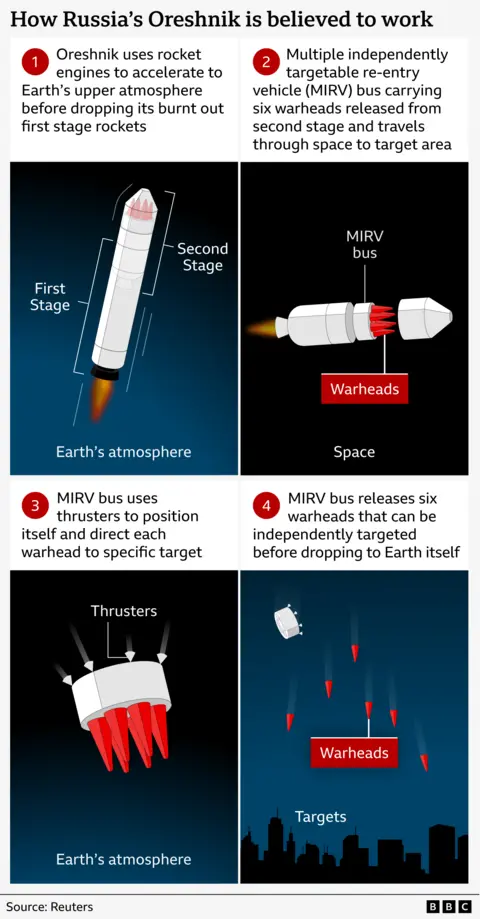
Diagram showing the operation of Russia's Oreshnik missile system: first it uses rocket engines to launch the missile into the upper atmosphere before discarding the first stage, a MIRV bus carrying six warheads is released from the second stage and travels to the target area, it then uses thrusters to position and direct each warhead to separate targets before releasing them and dropping to Earth itself. Source: Reuters


Its warhead is reported to have deliberately fragmented during its final descent into several, independently targeted inert projectiles, a methodology dating back to the Cold War.

Someone who heard it land told me that it was not particularly loud but there were several impacts: six warheads dropped at separate targets but as they were inert, the damage was not significantly greater than that caused by Russia's nightly bombardment of Ukraine's cities.

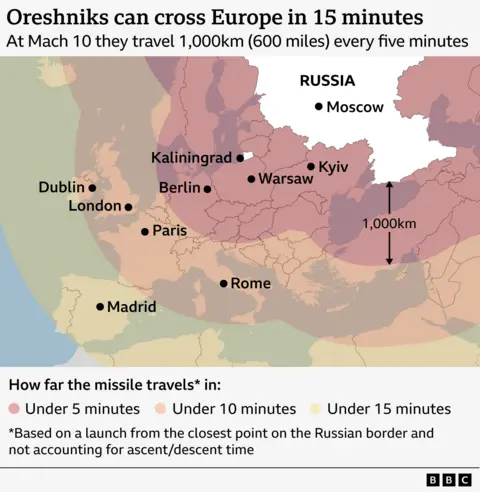
For Europe, the latent threat to Nato countries comes primarily from Russia's missiles, some of which are stationed on the Baltic coast in Russia's exclave of Kaliningrad. What if Putin were to order a strike on Kyiv with an Oreshnik, this time armed with a full payload of high explosive?


Map showing how quickly Oreshnik missiles would reach different cities in Europe if launched from the Edge of Russian territory, including Kaliningrad. It shows Kyiv, Warsaw and Berlin would all be reached in under five minutes, Dublin, London, Paris and Rome in less than 10 minutes and Madrid in under 15 minutes. It notes that a missile travelling at Mach 10 travels about 1,000km every five minutes.


The Russian leader claimed this weapon was going into mass production and that they had the capacity, he said, to turn targets "to dust".

Russia also has other missiles that travel at hypersonic speeds.

Putin made much of his air force's Kinzhal (Dagger) missiles, claiming they travelled so fast it was impossible to intercept. Since then, he has fired plenty of them at Ukraine — but it turns out that the Kinzhal may not be truly hypersonic, and many have been intercepted.


Getty Images Russian President Vladimir Putin talks to Chinese President Xi Jinping


China and Russia have stolen a march when it comes to developing hypersonic missiles

Of concern to the West is Russia's super-fast and highly manoeuvrable Avangard. At a ceremony for its unveiling in 2018 – along with five other so-called 'superweapons' - Putin declared it was unstoppable.
 
Pakistan should also look into that type of system as we have used C-130s as bomb trucks in previous wars, it will be huge force multiplier.

To view this content we will need your consent to set third party cookies.
For more detailed information, see our cookies page.
 
Are there any working Taimoors or is it just for defence exhibitions?
also the route to SCALP is not open for us so why dont we go to some other
source like the EDGE group of UAE their main base is engineers from denel...
 
Are there any working Taimoors or is it just for defence exhibitions?
also the route to SCALP is not open for us so why dont we go to some other
source like the EDGE group of UAE their main base is engineers from denel...
SOM CMs should be tested as they are capable platforms with stealth capability specially F-35 compateble SOM-J.
 
Are there any working Taimoors or is it just for defence exhibitions?
also the route to SCALP is not open for us so why dont we go to some other
source like the EDGE group of UAE their main base is engineers from denel...

The EDGE group owns/is part of Israeli defense companies with, and as such I personally do not see UAE as a trust worthy source of weapons for Pakistan.
 

Users who are viewing this thread

Pakistan Defence Latest

Back
Top