The race for the two miles-a-second super weapons that Putin says turn targets to dust
Frank Gardner
BBC Security correspondent
EPA-EFE/KCNA
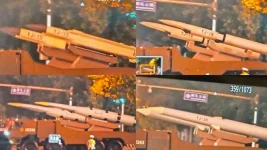
Glinting in the autumn sun on a parade ground in Beijing, the People's Liberation Army missiles moved slowly past the crowd on a fleet of giant camouflaged lorries.
Needle-sharp in profile, measuring 11 metres long and weighing 15 tonnes, each bore the letters and numerals: "DF-17".
China had just unveiled to the world its arsenal of Dongfeng hypersonic missiles.
That was on 1 October 2019 at a National Day parade. The US was already aware that these weapons were in development, but since then China has raced ahead with upgrading them.
Thanks to their speed and manoeuvrability – travelling at more than five times the speed of sound – they are a formidable weapon, so much so that they could change the way wars are fought.
Which is why the global contest over developing them is heating up.
AFP via Getty Images
China unveils its arsenal of DF-17 hypersonic missiles at a military parade in 2019
"This is just one component of the wider picture of the emerging geopolitical contest that we're seeing between state actors," says William Freer, a national security fellow at the Council on Geostrategy think tank.
"[It's one] we haven't had since the Cold War."
Russia, China, the US: a global contest
The Beijing ceremony raised speculation about a possible growing threat posed by China's advancements in hypersonic technology. Today it leads the field in hypersonic missiles, followed by Russia.
The US, meanwhile, is playing catch-up, while the UK has none.
Mr Freer of the Council on Geostrategy think tank, which received some of its funding from defence industry companies, the Ministry of Defence and others, argues that the reason China and Russia are ahead is relatively simple.
"They decided to invest a lot of money in these programmes quite a few years ago."
Meanwhile, for much of the first two decades of this century, many Western nations focused on fighting both jihadist-inspired terrorism at home, and counter-insurgency wars overseas.
Back then, the prospect of having to fight a peer-on-peer conflict against a modern, sophisticated adversary seemed a distant one.
Shutterstock
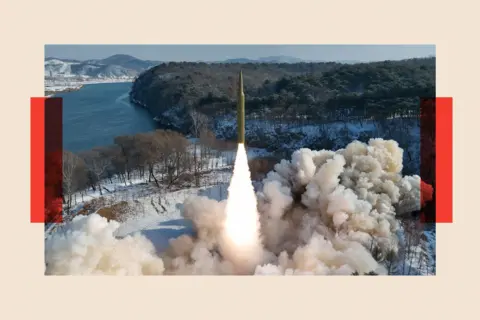
Test fire of an intermediate-range solid-fuel ballistic missile loaded with a hypersonic manoeuvrable controlled warhead in North Korea
"The net result is that we failed to notice the massive rise of China as a military power," admitted Sir Alex Younger, soon after retiring as chief of Britain's Secret Intelligence Service in 2020.
Other nations are also racing ahead: Israel has a hypersonic missile, the Arrow 3, designed to be an interceptor.
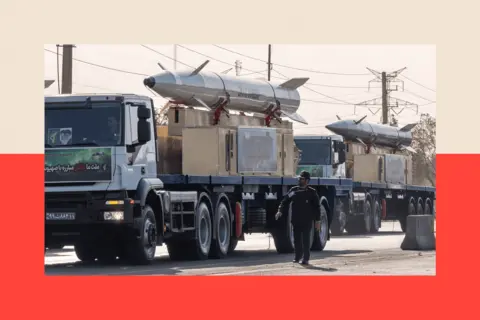
Iran has claimed to have hypersonic weapons, and said it launched a hypersonic missile at Israel during their brief but violent 12-day war in June.
(The weapon did indeed travel at extremely high speed but it was not thought to be manoeuvrable enough in flight to class as a true hypersonic).
North Korea, meanwhile, has been working on its own versions since 2021 and claims to have a viable, working weapon (pictured).
The US and UK are now investing in hypersonic missile technology, as are other nations, including France and Japan.
Morteza Nikoubazl/NurPhoto via Getty Images
Iran said it launched a hypersonic missile at Israel during the 12-day war in June
The US appears to be strengthening its deterrence, and has debuted its "Dark Eagle" hypersonic weapon.
According to the US Department of Defense, the Dark Eagle "brings to mind the power and determination of our country and its Army as it represents the spirit and lethality of the Army and Navy's hypersonic weapon endeavours".
But China and Russia are currently far ahead - and according to some experts, this is a potential concern.
Hyper fast and hyper erratic
Hypersonic means something that travels at speeds of Mach 5 or faster. (That's five times the speed of sound or 3,858 mph.) This puts them in a different league to something that is just supersonic, meaning travelling at above the speed of sound (767 mph).
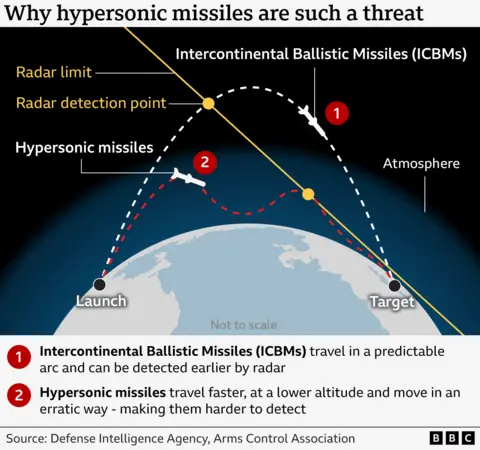
And their speed is partially the reason that hypersonic missiles are considered such a threat.
The fastest to date is Russian - the Avangard – claimed to be able to reach speeds of Mach 27 (roughly 20,700mph) - although the figure of around Mach 12 (9,200mph) is more often cited, which equates to two-miles-a-second.
In terms of purely destructive power, however, hypersonic missiles are not hugely different from supersonic or subsonic cruise missiles, according to Mr Freer.
"It's the difficulty in detecting, tracking and intercepting them that really sets them apart."
There are basically two kinds of hypersonic missile: boost-glide missiles rely on a rocket (like those DF-17 ones in China) to propel them towards and sometimes just above the Earth's atmosphere, from where they then come hurtling down at these incredible speeds.
Unlike the more common ballistic missiles, which travel in a fairly predictable arc – a parabolic curve - hypersonic glide vehicles can move in an erratic way, manoeuvred in final flight towards their target.
Then there are hypersonic cruise missiles, which hug terrain, trying to stay below radar to avoid detection.
They are similarly launched and accelerated using a rocket booster, then once they reach hypersonic velocity, they then activate a system known as a "scramjet engine" that takes in air as it flies, propelling it to its target.
These are "dual-use weapons", meaning their warhead can be either nuclear or conventional high explosive. But there is more to these weapons than speed alone.
Russia and China are leading the global race in hypersonic missiles - how worried should we be that the US is playing catch up and the UK has none?

www.bbc.com