Pakistan Solar Power: News & Updates

Solar panel manufacturing: Chinese cos officials meet CM, ink agreements

Recorder Report Published April 8, 2026 Updated about 3 hours ago

LAHORE: A delegation of leading Chinese companies, Kunlun Group and Sunder Green Group called on Chief Minister Punjab Maryam Nawaz Sharif on Tuesday and agreements were reached to begin solar panel manufacturing in Lahore through joint collaboration.

It was also agreed to send 50,000 students to China for advanced vocational and industrial training.

In-principle approval was granted for the establishment of 1,000-acre industrial estate in Lahore, and discussions were held regarding transferring technology for producing petrochemical products from coal in Punjab.

The Chief Minister assured full support to both Chinese and local investors for the promotion of industrialization. During the briefing, it was informed that the new projects would generate approximately 18,000 job opportunities in Punjab.

The CM reiterated that the government is following the “Start Today” policy to promote industrial growth and stressed that the government’s role is to support entrepreneurs rather than engage in business itself.

The delegation included CEO Wang Jin Hunan Sheng from Inner Mongolia Coal Mine, CEO Zhao Gangbo from an investment company, Chairman Muhammad Abid of Sunder Green Group, CEO Azim Iftikhar, Director Rana Faisal Hayat, and CEO Danish Ahmad of Oasis, among others.

Copyright Business Recorder, 2026


We should be looking for prioritised initiative instead of political gimmicks. LAHORE don't need another industrial estate, it is too congested and too close to India. Punjab have the necessary depth and the proposed 1000 acre industrial estate can be placed anywhere else in Punjab that would proof helpfull in developing economy of that area as well as take some of the load from Lahore. I know it is something that Punjab government is doing and no body stopping sindh from doing the same. But still it will cost public money, money that can be spend in more productive ways.

Similarly, Punjab do not produce enough cola to require petrochemical production from coal units. Instead these are much needed in Thar. And other parts of sindh producing excellent amounts of coal.

Apart from these, sending 50,000 students to China for vocational training will cost the same as building a vocational training institute of Chinese high standards that can easily train 5000 students every year.

I think we (all politicians and parties) should now start looking to things from a national perspective instead of political and provincial perspective. Pakistanis Have been through too much of that bullish!t.
 
Such a high figure in just 2 years?
I find it hard to believe.

19/03/2026: Pakistan solar capacity hits impressive 51 GW milestone: PV KnowHow

Kisi ne bullet se pocha kay itna taiz q chalti ho , to bullet ne jawab dia kay mere pichwaary pe aag lagi hoti hy is waja se taiz chalti hun. You are doubting the resolve and commitment of the Pakistani governments. They have pushed citizens to a level where they have no other options but to do everything by themselves.
 
We should be looking for prioritised initiative instead of political gimmicks. LAHORE don't need another industrial estate, it is too congested and too close to India. Punjab have the necessary depth and the proposed 1000 acre industrial estate can be placed anywhere else in Punjab that would proof helpfull in developing economy of that area as well as take some of the load from Lahore. I know it is something that Punjab government is doing and no body stopping sindh from doing the same. But still it will cost public money, money that can be spend in more productive ways.

Similarly, Punjab do not produce enough cola to require petrochemical production from coal units. Instead these are much needed in Thar. And other parts of sindh producing excellent amounts of coal.

Apart from these, sending 50,000 students to China for vocational training will cost the same as building a vocational training institute of Chinese high standards that can easily train 5000 students every year.

I think we (all politicians and parties) should now start looking to things from a national perspective instead of political and provincial perspective. Pakistanis Have been through too much of that bullish!t.

Its private China investment, you can't force them to chose location. If they think somewhere near Lahore is ideal then so be it.
 
Its private China investment, you can't force them to chose location. If they think somewhere near Lahore is ideal then so be it.

You know what will be more beneficial for your country ? To have a national development policy planning for 5-15 year. So that when investor comes to you they have 500 different options to invest in, All while being beneficial to your country in all senses. This random development and initiatives wont help us doesn't matter if it's government initiatives or private investments.

Good luck to that company, and good luck to Punjab government.
 

Bilawal to launch Phase-II of Solar Home Systems project today

M.B. Kalhoro
April 15, 2026

1776250240517.png

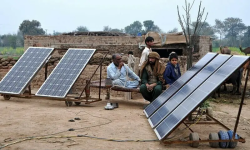
Villagers relax on a farm outside Sheikhupura next to their panels. —APP

LARKANA: The second phase of provincial government’s Solar Home Systems (SHS) project will be inaugurated by Pakistan Peoples Party (PPP) Chairman Bilawal Bhutto-Zardari and Sindh Chief Minister Syed Murad Ali Shah on Wednesday, it is learnt.
 
IMG-20260418-WA0019.jpg

EDITORIAL: As summer approaches, households and industries across the country are again facing prolonged power outages as night-time electricity demand, driven by cooling needs, far exceeds the available supply. To contain the power shortages, the government is running its costly furnace oil-based power plants at full capacity and delaying maintenance of its nuclear facilities.

The Middle East crisis and LNG supply disruptions are chiefly to blame for the shortage, which has been exacerbated by reduced hydropower availability as rainfall and lower irrigation demand have limited the release of water from reservoirs. The power minister says that LNG-fired plants, with an approximate capacity of 6,000 MW, are producing only around 500 MW due to gas shortages, while hydropower output has fallen to about 1,600 MW — roughly half the level of last April.

With Qatar declaring force majeure after nearly 17pc of its gas production went offline last month, following Iran’s missile strikes on its gas fields, prolonged power outages were anticipated once summer kicked in. The petroleum minister says the country intends to purchase expensive spot LNG cargoes to offset the supply crunch from Qatar, but the move will strain the finances of both government and consumers.

Read full editorial: https://www.dawn.com/news/1992785/
 

Bilawal to launch Phase-II of Solar Home Systems project today

M.B. Kalhoro
April 15, 2026

View attachment 192408

Villagers relax on a farm outside Sheikhupura next to their panels. —APP

LARKANA: The second phase of provincial government’s Solar Home Systems (SHS) project will be inaugurated by Pakistan Peoples Party (PPP) Chairman Bilawal Bhutto-Zardari and Sindh Chief Minister Syed Murad Ali Shah on Wednesday, it is learnt.
That picture is from my village which is near Sheikupura. Almost all tubewells are now run by solar power as well as homes in the village.
 
That picture is from my village which is near Sheikupura. Almost all tubewells are now run by solar power as well as homes in the village.
sir same case in Rahim yar khan solar tube wells solar charger when herd grazers have solar plates with them during day time for charging etc one plate on shoulder. whole RYK is adopting roof solar system with batteries .
 

Solar net metering averts daytime outages as 8,000MW capacity offsets power shortfall​


Solar net metering has prevented daytime load shedding in Pakistan by supplying up to 8,000MW to the grid, offsetting a large portion of power shortfall caused by a sharp decline in LNG-based and hydropower generation, according to a news report.


Power Minister Awais Leghari said solar generation has reduced load shedding by around four hours, ensuring an uninterrupted electricity supply during daytime hours despite ongoing supply constraints.

However, the shift to solar has pushed peak demand to nighttime, where the system faces greater pressure, with demand reaching up to 20,000MW and resulting in load shedding of six to seven hours.

The minister said the shortfall has been driven by disruptions in LNG supplies linked to the Iran-US conflict and the closure of the Strait of Hormuz, which have significantly reduced fuel availability.

LNG-based generation has dropped to around 500MW from a total capacity of about 6,000MW, as gas supply to most plants remains suspended.


Hydropower generation has also declined to around 1,600–1,671MW from approximately 3,200MW last year due to lower water releases from Tarbela and Mangla reservoirs.

To manage the gap, furnace oil-based plants are operating at full capacity, while maintenance at nuclear facilities has been delayed.

The minister said load management is being implemented mainly during evening peak hours, with roughly one hour of outages required for every 500–600MW of shortfall.

Electricity demand has remained volatile, ranging between 9,000MW and 20,000MW in April, reflecting pressure on the system amid supply disruptions.

He added that although Pakistan has an installed capacity of around 46,000MW, actual generation remains constrained due to fuel shortages, limiting the ability to meet demand.
 

Solar net metering averts daytime outages as 8,000MW capacity offsets power shortfall​


Solar net metering has prevented daytime load shedding in Pakistan by supplying up to 8,000MW to the grid, offsetting a large portion of power shortfall caused by a sharp decline in LNG-based and hydropower generation, according to a news report.


Power Minister Awais Leghari said solar generation has reduced load shedding by around four hours, ensuring an uninterrupted electricity supply during daytime hours despite ongoing supply constraints.

However, the shift to solar has pushed peak demand to nighttime, where the system faces greater pressure, with demand reaching up to 20,000MW and resulting in load shedding of six to seven hours.

The minister said the shortfall has been driven by disruptions in LNG supplies linked to the Iran-US conflict and the closure of the Strait of Hormuz, which have significantly reduced fuel availability.

LNG-based generation has dropped to around 500MW from a total capacity of about 6,000MW, as gas supply to most plants remains suspended.


Hydropower generation has also declined to around 1,600–1,671MW from approximately 3,200MW last year due to lower water releases from Tarbela and Mangla reservoirs.

To manage the gap, furnace oil-based plants are operating at full capacity, while maintenance at nuclear facilities has been delayed.

The minister said load management is being implemented mainly during evening peak hours, with roughly one hour of outages required for every 500–600MW of shortfall.

Electricity demand has remained volatile, ranging between 9,000MW and 20,000MW in April, reflecting pressure on the system amid supply disruptions.

He added that although Pakistan has an installed capacity of around 46,000MW, actual generation remains constrained due to fuel shortages, limiting the ability to meet demand.

Pakistan Net Metering Capacity Growth (2016–2026)

Year / PeriodCumulative Installed Capacity (MW)Key Milestones & Market Drivers
2016 – 2019~50 MWEarly adoption phase. Initial regulations introduced in 2015, but growth remained extremely slow due to high upfront costs and a lack of market awareness.
2020~150 MWGradual uptake begins, primarily driven by early commercial and industrial adopters looking to hedge against rising energy costs.
2021~350 MWGrowth begins to accelerate as global solar panel prices drop and the regulatory process for securing net metering licenses becomes slightly more streamlined.
2022 (FY21-22)633 MWA major turning point. Awareness spreads rapidly among upper-middle-class residential consumers as grid tariffs begin their sharp upward climb.
2023 (FY22-23)1,317 MWCapacity effectively doubles in a single year. Rapid inflation and a widening energy crisis push consumers to seek self-generation.
2024 (FY23-24)2,498 MWNEPRA reports an unprecedented 294% surge compared to 2022. Grid electricity tariffs surpass PKR 40+ per unit, making the payback period for solar highly lucrative (often under 3-4 years).
2025~6,000 MWA record-shattering year. Global solar panel prices crash by over 40%, triggering a massive import wave of Chinese modules. Net-metered capacity crosses the 5.3 GW mark by mid-year and finishes above 6 GW.
2026 (Up to April)~8,000 MWCurrent estimates. The rapid scaling prompts the government to introduce stricter regulations, transitioning away from traditional net metering to "net billing" due to heavy revenue losses for distribution companies.
Net metering growth will slow down with introduction of new policy. Along with lithium batteries becoming cheaper.
 
Corrupt govt. officials, bodies like NEPRA and lawmakers trying to earn more $$$ and making sure these sinking ship energy companies like K-Electric and WAPDA remain floating all at the expense and damage of people. This is what is so frustrating about this and the establishment while taking every internal matter into their own hands, does not bat an eye over how these looters and corrupt politicians are leeching out the people.
 

Users who are viewing this thread

Back
Top