Pakistan Solar Power: News & Updates

@Fatman17 sb

All these knee jerk reactions are useless. Eventually batteries will become cheaper, and the con(pro)sumers who have already installed solar plants will put in battery storage and rather than export power to the grid will use it in non-solar hours. The solar movement in PAK has acquired its own momentum and is globally a success story.

Regards
But still a long way to go. The government is putting in all these tariffs so that they (public) pays for the circular debt which is in the trillions.
 
@Fatman17 sb

Yes, that is true and very unfortunate. But the public will find a way of escaping the dragnet.

Regards
 
Pakistan Solar Panels & Allied Equipment Manufacturing Policy 2026-2035

Between 2023 and 2025, Pakistan experienced an unprecedented, consumer-led solar boom, importing over 17 gigawatts (GW) of panels in 2024 alone. While this solved the immediate energy crisis for many households, it drained billions of dollars in foreign exchange.

This new 10-year policy is the government's aggressive strategy to flip the script: transitioning Pakistan from a country that imports $2.1 billion worth of Chinese solar gear annually to a country that manufactures and exports it.

Here is a breakdown of the policy's core framework and targets:

1. The Big Targets (By 2035)​

  • Massive Capacity: The primary goal is to scale domestic solar PV manufacturing capacity to 10 GW by 2030, culminating in 25 GW (25,000 MW) by 2035.
  • Foreign Investment: The government is targeting a cumulative Foreign Direct Investment (FDI) inflow of $4 billion over the 10-year period, specifically relying on Business-to-Business (B2B) joint ventures with major Chinese OEMs.
  • The Export Mandate: This isn't just for local rooftops. The policy mandates that 50% of all locally manufactured solar panels and equipment must be exported by 2035, positioning Pakistan as a regional alternative to Chinese manufacturing.

2. Deep Localization (The "Made in Pakistan" Push)​

The policy doesn't just want companies snapping together imported parts; it demands deep, vertical integration.

  • 80% Localization: The goal is to have 80% of the solar value chain localized by the end of the policy period.
  • Raw Materials: By 2030, the policy mandates the establishment of Pakistan’s first fully integrated polysilicon, ingot, and wafer production facility. This means making the actual raw technology from scratch on Pakistani soil.

3. How the Government is Forcing the Shift​

To get global giants to actually build these factories, the policy uses a "carrot and stick" financial approach:

  • The Carrot (Incentives): A massive $600 million Production Linked Incentive (PLI) scheme. The government will literally pay manufacturers a premium (e.g., $0.03 per Watt for high-efficiency modules) for what they produce locally.
  • The Stick (Tariffs): To stop companies from just importing cheap finished goods, the government is implementing a "cascading tariff structure." Import duties on finished, fully assembled solar panels will steadily rise from 3% in 2026 up to 30% by 2035. If a company wants to sell in Pakistan without paying heavy taxes, they must manufacture locally.

Expected Impact​

If successful, this 10-year roadmap is projected to create 100,000 direct and indirect jobs, reduce national CO₂ emissions by 25 million tons annually, and generate $2.5 billion in annual import-substitution savings.
 

Pakistan’s solar boom shielding country from Hormuz disruptions: study

Zaki Abbas
March 17, 2026

ISLAMABAD: Pakistan’s solar boom, which was driven by the installation of rooftop solar panels, is shielding the country from supply disruptions and price shocks due to the closure of the vital energy route, the Strait of Hormuz.

According to an analysis published by Renewables First and the Centre for Research on Energy and Clean Air, Pakistan would be far more exposed to the price shocks now rippling out of the Middle East without the growth of distributed solar.

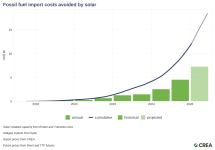
The study noted that Pakistan has avoided more than $12 billion in oil and gas imports since 2018, which would have been needed to meet domestic energy demand.

This “represents not just fiscal relief, but a structural reduction in geopolitical risk exposure that no LNG contract or hedging strategy could have delivered at equivalent scale or speed”, it added.

“At the prices the market expects for this year, Pakistan could save a further $6.3 billion by the end of the year,” the study claimed.

Despite the solar cushion, the Strait of Hormuz remains important for Pakistan.

“In 2024, and despite reducing its reliance, Pakistan still ranked third globally in LNG dependence on Hormuz-transiting cargoes as a share of total consumption, and fifth for oil,” it said, adding that any sustained disruption to the strait would send immediate shockwaves through Pakistan’s energy system.

However, due to rapid solarisation, this imported energy dependence is decreasing. “As rooftop panels spread across homes, farms, and factories, demand for LNG has fallen. The clearest signal sits in Pakistan’s long-term LNG contracts, where some shipments have been diverted to international markets, and the government has been actively renegotiating terms as solar-driven displacement reduces the need for imported volumes.”
 
According to the study, had it not been for the deployment of rooftop solar, which reduced the reliance on grid power and imported gas, load-shedding and other measures to restrict power supply during peak hours would have been considered during this energy crisis.

“The fact that load shedding and other measures to restrict power supply during peak demand periods are not currently being considered shows how solar is both saving money and providing additional power.”

It may be noted that the government has taken a series of measures to ration fuel amid the closure of the Hormuz Strait. A recent government briefing revealed that the country would run out of LNG by April 14 due to the suspension of its supply from Qatar.

“Pakistan’s solar revolution wasn’t planned in Islamabad — it was built on rooftops. But as tensions around the Strait of Hormuz escalate, those panels are proving to be one of the country’s most effective energy security strategies, with distributed solar now shouldering a growing share of the country’s electricity needs,” said Rabia Babar, energy data manager at Renewables First.
 
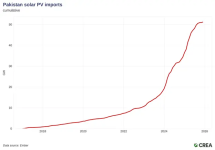
The analysis attributed Pakistan’s solar story to market forces and consumers. It also gave credit to the government for maintaining a “zero-rated tax regime on solar PV imports”, which turbocharged such imports from under 1GW in 2018 to over 51GW by early 2026 — one of the “fastest consumer-led energy transitions on record, and one that drove a 40pc drop in oil and gas imports between 2022 and 2024”.

1773760898728.png


A graph showing solar PV imports in Pakistan. — via Centre for Research on Energy and Clean Air

The 2022 energy crisis, after the Ukraine invasion and the “precipitous fall in costs of solar manufacturing in China,” was a catalyst for this solar surge.

“This grassroots solar surge has gathered pace since the energy crisis of 2022 and has quietly delivered what years of state energy policy had not thus far: falling fuel import dependence, stronger energy security, and a measure of relief from spiralling electricity costs for millions of households.”

Lauri Myllyvirta, co-founder at the Centre for Research on Energy and Clean Air, said Pakistan’s solar boom was acting “like an insurance policy against oil and LNG shocks” in this energy crisis.
 
The study also compared Pakistan with other Asian states, pointing out that other countries such as China, India, and South Korea were “disproportionately exposed” due to disruptions in Hormuz because of their reliance on LNG. Although Pakistan still appears prominently in both the volume and dependency rankings for Hormuz-transiting energy, the trajectory is downward, it added.

“China, India, South Korea and most other Asian economies have increased their LNG imports, while Pakistan’s energy curve has bent the other way,” it said, adding that any sustained disruption would continue to hit Asian economies hardest.

According to the analysis, it is renewables, not oil and gas, that offer the lowest-cost path to energy access for low- and middle-income households, and “every gigawatt of distributed solar deployed is, in effect, a hedge against the brewing energy crisis”.
 

Pakistan’s solar boom shielding country from Hormuz disruptions: study

Zaki Abbas Published March 17, 2026 Updated March 17, 2026 01:17pm

https://whatsapp.com/channel/0029VaMc238IiRov8okfYy3n
ISLAMABAD: Pakistan’s solar boom, which was driven by the installation of rooftop solar panels, is shielding the country from supply disruptions and price shocks due to the closure of the vital energy route, the Strait of Hormuz.

According to an analysis published by Renewables First and the Centre for Research on Energy and Clean Air, Pakistan would be far more exposed to the price shocks now rippling out of the Middle East without the growth of distributed solar.


The study noted that Pakistan has avoided more than $12 billion in oil and gas imports since 2018, which would have been needed to meet domestic energy demand.

This “represents not just fiscal relief, but a structural reduction in geopolitical risk exposure that no LNG contract or hedging strategy could have delivered at equivalent scale or speed”, it added.

“At the prices the market expects for this year, Pakistan could save a further $6.3 billion by the end of the year,” the study claimed.

Despite the solar cushion, the Strait of Hormuz remains important for Pakistan.

“In 2024, and despite reducing its reliance, Pakistan still ranked third globally in LNG dependence on Hormuz-transiting cargoes as a share of total consumption, and fifth for oil,” it said, adding that any sustained disruption to the strait would send immediate shockwaves through Pakistan’s energy system.

However, due to rapid solarisation, this imported energy dependence is decreasing. “As rooftop panels spread across homes, farms, and factories, demand for LNG has fallen. The clearest signal sits in Pakistan’s long-term LNG contracts, where some shipments have been diverted to international markets, and the government has been actively renegotiating terms as solar-driven displacement reduces the need for imported volumes.”

A graph showing fossil fuel import costs avoided by solar. — via Centre for Research on Energy and Clean Air
According to the study, had it not been for the deployment of rooftop solar, which reduced the reliance on grid power and imported gas, load-shedding and other measures to restrict power supply during peak hours would have been considered during this energy crisis.

“The fact that load shedding and other measures to restrict power supply during peak demand periods are not currently being considered shows how solar is both saving money and providing additional power.”

It may be noted that the government has taken a series of measures to ration fuel amid the closure of the Hormuz Strait. A recent government briefing revealed that the country would run out of LNG by April 14 due to the suspension of its supply from Qatar.

“Pakistan’s solar revolution wasn’t planned in Islamabad — it was built on rooftops. But as tensions around the Strait of Hormuz escalate, those panels are proving to be one of the country’s most effective energy security strategies, with distributed solar now shouldering a growing share of the country’s electricity needs,” said Rabia Babar, energy data manager at Renewables First.

The analysis attributed Pakistan’s solar story to market forces and consumers. It also gave credit to the government for maintaining a “zero-rated tax regime on solar PV imports”, which turbocharged such imports from under 1GW in 2018 to over 51GW by early 2026 — one of the “fastest consumer-led energy transitions on record, and one that drove a 40pc drop in oil and gas imports between 2022 and 2024”.

A graph showing solar PV imports in Pakistan. — via Centre for Research on Energy and Clean Air
The 2022 energy crisis, after the Ukraine invasion and the “precipitous fall in costs of solar manufacturing in China,” was a catalyst for this solar surge.

“This grassroots solar surge has gathered pace since the energy crisis of 2022 and has quietly delivered what years of state energy policy had not thus far: falling fuel import dependence, stronger energy security, and a measure of relief from spiralling electricity costs for millions of households.”

Lauri Myllyvirta, co-founder at the Centre for Research on Energy and Clean Air, said Pakistan’s solar boom was acting “like an insurance policy against oil and LNG shocks” in this energy crisis.

The study also compared Pakistan with other Asian states, pointing out that other countries such as China, India, and South Korea were “disproportionately exposed” due to disruptions in Hormuz because of their reliance on LNG. Although Pakistan still appears prominently in both the volume and dependency rankings for Hormuz-transiting energy, the trajectory is downward, it added.

“China, India, South Korea and most other Asian economies have increased their LNG imports, while Pakistan’s energy curve has bent the other way,” it said, adding that any sustained disruption would continue to hit Asian economies hardest.

According to the analysis, it is renewables, not oil and gas, that offer the lowest-cost path to energy access for low- and middle-income households, and “every gigawatt of distributed solar deployed is, in effect, a hedge against the brewing energy crisis”.
 

Pakistan’s solar boom shielding country from Hormuz disruptions: study

Zaki Abbas Published March 17, 2026 Updated March 17, 2026 01:17pm

https://whatsapp.com/channel/0029VaMc238IiRov8okfYy3n
ISLAMABAD: Pakistan’s solar boom, which was driven by the installation of rooftop solar panels, is shielding the country from supply disruptions and price shocks due to the closure of the vital energy route, the Strait of Hormuz.

According to an analysis published by Renewables First and the Centre for Research on Energy and Clean Air, Pakistan would be far more exposed to the price shocks now rippling out of the Middle East without the growth of distributed solar.


The study noted that Pakistan has avoided more than $12 billion in oil and gas imports since 2018, which would have been needed to meet domestic energy demand.

This “represents not just fiscal relief, but a structural reduction in geopolitical risk exposure that no LNG contract or hedging strategy could have delivered at equivalent scale or speed”, it added.

“At the prices the market expects for this year, Pakistan could save a further $6.3 billion by the end of the year,” the study claimed.

Despite the solar cushion, the Strait of Hormuz remains important for Pakistan.

“In 2024, and despite reducing its reliance, Pakistan still ranked third globally in LNG dependence on Hormuz-transiting cargoes as a share of total consumption, and fifth for oil,” it said, adding that any sustained disruption to the strait would send immediate shockwaves through Pakistan’s energy system.

However, due to rapid solarisation, this imported energy dependence is decreasing. “As rooftop panels spread across homes, farms, and factories, demand for LNG has fallen. The clearest signal sits in Pakistan’s long-term LNG contracts, where some shipments have been diverted to international markets, and the government has been actively renegotiating terms as solar-driven displacement reduces the need for imported volumes.”

A graph showing fossil fuel import costs avoided by solar. — via Centre for Research on Energy and Clean Air
According to the study, had it not been for the deployment of rooftop solar, which reduced the reliance on grid power and imported gas, load-shedding and other measures to restrict power supply during peak hours would have been considered during this energy crisis.

“The fact that load shedding and other measures to restrict power supply during peak demand periods are not currently being considered shows how solar is both saving money and providing additional power.”

It may be noted that the government has taken a series of measures to ration fuel amid the closure of the Hormuz Strait. A recent government briefing revealed that the country would run out of LNG by April 14 due to the suspension of its supply from Qatar.

“Pakistan’s solar revolution wasn’t planned in Islamabad — it was built on rooftops. But as tensions around the Strait of Hormuz escalate, those panels are proving to be one of the country’s most effective energy security strategies, with distributed solar now shouldering a growing share of the country’s electricity needs,” said Rabia Babar, energy data manager at Renewables First.

The analysis attributed Pakistan’s solar story to market forces and consumers. It also gave credit to the government for maintaining a “zero-rated tax regime on solar PV imports”, which turbocharged such imports from under 1GW in 2018 to over 51GW by early 2026 — one of the “fastest consumer-led energy transitions on record, and one that drove a 40pc drop in oil and gas imports between 2022 and 2024”.

A graph showing solar PV imports in Pakistan. — via Centre for Research on Energy and Clean Air
The 2022 energy crisis, after the Ukraine invasion and the “precipitous fall in costs of solar manufacturing in China,” was a catalyst for this solar surge.

“This grassroots solar surge has gathered pace since the energy crisis of 2022 and has quietly delivered what years of state energy policy had not thus far: falling fuel import dependence, stronger energy security, and a measure of relief from spiralling electricity costs for millions of households.”

Lauri Myllyvirta, co-founder at the Centre for Research on Energy and Clean Air, said Pakistan’s solar boom was acting “like an insurance policy against oil and LNG shocks” in this energy crisis.

The study also compared Pakistan with other Asian states, pointing out that other countries such as China, India, and South Korea were “disproportionately exposed” due to disruptions in Hormuz because of their reliance on LNG. Although Pakistan still appears prominently in both the volume and dependency rankings for Hormuz-transiting energy, the trajectory is downward, it added.

“China, India, South Korea and most other Asian economies have increased their LNG imports, while Pakistan’s energy curve has bent the other way,” it said, adding that any sustained disruption would continue to hit Asian economies hardest.

According to the analysis, it is renewables, not oil and gas, that offer the lowest-cost path to energy access for low- and middle-income households, and “every gigawatt of distributed solar deployed is, in effect, a hedge against the brewing energy crisis”.
Posted already bro
 

Pakistan’s solar boom shielding country from Hormuz disruptions: study

Zaki Abbas Published March 17, 2026 Updated March 17, 2026 01:17pm

https://whatsapp.com/channel/0029VaMc238IiRov8okfYy3n
ISLAMABAD: Pakistan’s solar boom, which was driven by the installation of rooftop solar panels, is shielding the country from supply disruptions and price shocks due to the closure of the vital energy route, the Strait of Hormuz.

According to an analysis published by Renewables First and the Centre for Research on Energy and Clean Air, Pakistan would be far more exposed to the price shocks now rippling out of the Middle East without the growth of distributed solar.


The study noted that Pakistan has avoided more than $12 billion in oil and gas imports since 2018, which would have been needed to meet domestic energy demand.

This “represents not just fiscal relief, but a structural reduction in geopolitical risk exposure that no LNG contract or hedging strategy could have delivered at equivalent scale or speed”, it added.

“At the prices the market expects for this year, Pakistan could save a further $6.3 billion by the end of the year,” the study claimed.

Despite the solar cushion, the Strait of Hormuz remains important for Pakistan.

“In 2024, and despite reducing its reliance, Pakistan still ranked third globally in LNG dependence on Hormuz-transiting cargoes as a share of total consumption, and fifth for oil,” it said, adding that any sustained disruption to the strait would send immediate shockwaves through Pakistan’s energy system.

However, due to rapid solarisation, this imported energy dependence is decreasing. “As rooftop panels spread across homes, farms, and factories, demand for LNG has fallen. The clearest signal sits in Pakistan’s long-term LNG contracts, where some shipments have been diverted to international markets, and the government has been actively renegotiating terms as solar-driven displacement reduces the need for imported volumes.”

A graph showing fossil fuel import costs avoided by solar. — via Centre for Research on Energy and Clean Air
According to the study, had it not been for the deployment of rooftop solar, which reduced the reliance on grid power and imported gas, load-shedding and other measures to restrict power supply during peak hours would have been considered during this energy crisis.

“The fact that load shedding and other measures to restrict power supply during peak demand periods are not currently being considered shows how solar is both saving money and providing additional power.”

It may be noted that the government has taken a series of measures to ration fuel amid the closure of the Hormuz Strait. A recent government briefing revealed that the country would run out of LNG by April 14 due to the suspension of its supply from Qatar.

“Pakistan’s solar revolution wasn’t planned in Islamabad — it was built on rooftops. But as tensions around the Strait of Hormuz escalate, those panels are proving to be one of the country’s most effective energy security strategies, with distributed solar now shouldering a growing share of the country’s electricity needs,” said Rabia Babar, energy data manager at Renewables First.

The analysis attributed Pakistan’s solar story to market forces and consumers. It also gave credit to the government for maintaining a “zero-rated tax regime on solar PV imports”, which turbocharged such imports from under 1GW in 2018 to over 51GW by early 2026 — one of the “fastest consumer-led energy transitions on record, and one that drove a 40pc drop in oil and gas imports between 2022 and 2024”.

A graph showing solar PV imports in Pakistan. — via Centre for Research on Energy and Clean Air
The 2022 energy crisis, after the Ukraine invasion and the “precipitous fall in costs of solar manufacturing in China,” was a catalyst for this solar surge.

“This grassroots solar surge has gathered pace since the energy crisis of 2022 and has quietly delivered what years of state energy policy had not thus far: falling fuel import dependence, stronger energy security, and a measure of relief from spiralling electricity costs for millions of households.”

Lauri Myllyvirta, co-founder at the Centre for Research on Energy and Clean Air, said Pakistan’s solar boom was acting “like an insurance policy against oil and LNG shocks” in this energy crisis.

The study also compared Pakistan with other Asian states, pointing out that other countries such as China, India, and South Korea were “disproportionately exposed” due to disruptions in Hormuz because of their reliance on LNG. Although Pakistan still appears prominently in both the volume and dependency rankings for Hormuz-transiting energy, the trajectory is downward, it added.

“China, India, South Korea and most other Asian economies have increased their LNG imports, while Pakistan’s energy curve has bent the other way,” it said, adding that any sustained disruption would continue to hit Asian economies hardest.

According to the analysis, it is renewables, not oil and gas, that offer the lowest-cost path to energy access for low- and middle-income households, and “every gigawatt of distributed solar deployed is, in effect, a hedge against the brewing energy crisis”.

Good opportunity for Pakistan to get out of LNG contract for good. Increase local production which has been curbed because of surplus LNG cargos.
 

Users who are viewing this thread

Pakistan Defence Latest

Latest Posts

Back
Top