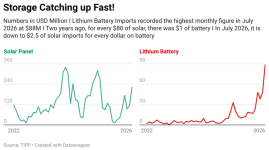
The first wave was driven almost entirely by falling panel prices. Those prices have already fallen from around USD0.38 per watt in 2017 to nearly USD0.10 through 2026, leaving progressively less room for another price driven buying frenzy. Batteries, by contrast, are still climbing the adoption curve.
Import data increasingly reflects that reality. Panel imports remain substantial and have regained momentum over the past few months after an earlier slowdown. The market for new solar capacity is alive and well. But the fastest growing opportunity is no longer generation alone. It is generation paired with storage.
The implications extend well beyond import statistics. Pakistan already has tens of gigawatts worth of solar panels brought into the country over the past few years, far exceeding officially net metered capacity.
Much of that installed base represents future demand for storage. Every rooftop system is a potential battery customer once the economics make sense.
That is why July’s numbers deserve attention. The $88 million monthly import bill is noteworthy in its own right. The far bigger story is what it represents. Consumers appear to be moving from asking how to generate cheaper electricity to asking how to use it whenever they choose.
The first phase of Pakistan’s solar revolution challenged the economics of grid supplied daytime electricity. The second could challenge the need for the grid long after the sun goes down.
If July is any indication, that transition may be arriving much faster than policymakers, utilities and even the market itself expected.