SoulSpokesman
Trusted Member

Here's my friend Professor sb on Pakistan's storage boom

 www.riazhaq.com
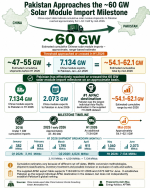
After installing over 50 GW of solar panels as of early 2026, Pakistanis are now adding batteries at a rapid pace. The country has imported nearly 7.6 GWh of batteries, with nearly 60% of that total arriving during 2025 alone. Pakistanis are now installing batteries at a rate exceeding 5 GWh annually, according to a recent report by Renewable First. Batteries enable consumers to store excess solar electricity generated during daylight hours for use at night and to smooth out demand on the grid. Batteries also contribute to national grid stability, reducing costs and improving overall energy security for energy-import-dependent Pakistan.
By FY25, 7.3 million households in Pakistan had solar installed on their rooftops; out of a total 40 million households in the country, that makes nearly 1 in 5 of all Pakistani homes, the report says. With the battery boom gaining pace, around 282,000 solarized households, roughly 4%, now have BESS storage installed at home. That's 1 in every 26 solarized households, a share that is rising fast as storage costs continue to fall.
Battery prices have declined about 75% over the past decade, from over $460 per kWh in 2015 to approx. $110 per kWh in 2024, with forecast of further declines through 2027. The introduction of sodium-ion technology is likely to further accelerate widespread adoption of battery storage. Sodium-ion batteries are expected to replace lithium-ion (specifically low-cost LFP) batteries in most stationary (non-ev) applications by reducing prices by 30% to 50%.
A big chunk of Pakistan's import bill goes to pay for energy imports. Last fiscal year, which ended in June, 2026, Pakistan imported oil and gas worth $17 billion, exacerbating the current account deficit. By one estimate, Pakistan avoided over $12 billion in oil and gas import costs between 2021 and February 2026 because of its consumer-led solar revolution. A further ~$6.3 billion hydrocarbon import savings are projected by the end of 2026. Energy imports are the most volatile part of Pakistan's imports because of oil shocks such as the one created by the US-Iran war and the resulting closure of the Strait of Hormuz.
The ongoing solar revolution and battery boom in Pakistan will help reduce energy costs, improve energy security and help deal with the impact of climate change. Pakistan government policies should fully support this consumer-led movement toward the country's energy independence.
Regards
Solar Energy Revolution Sparks Battery Boom in Pakistan
News, analysis and opinions about India, Pakistan, US, Canada, Europe, Mid East, South Asia, Silicon Valley, High Technology, Economy, Politics, World
After installing over 50 GW of solar panels as of early 2026, Pakistanis are now adding batteries at a rapid pace. The country has imported nearly 7.6 GWh of batteries, with nearly 60% of that total arriving during 2025 alone. Pakistanis are now installing batteries at a rate exceeding 5 GWh annually, according to a recent report by Renewable First. Batteries enable consumers to store excess solar electricity generated during daylight hours for use at night and to smooth out demand on the grid. Batteries also contribute to national grid stability, reducing costs and improving overall energy security for energy-import-dependent Pakistan.
By FY25, 7.3 million households in Pakistan had solar installed on their rooftops; out of a total 40 million households in the country, that makes nearly 1 in 5 of all Pakistani homes, the report says. With the battery boom gaining pace, around 282,000 solarized households, roughly 4%, now have BESS storage installed at home. That's 1 in every 26 solarized households, a share that is rising fast as storage costs continue to fall.
Battery prices have declined about 75% over the past decade, from over $460 per kWh in 2015 to approx. $110 per kWh in 2024, with forecast of further declines through 2027. The introduction of sodium-ion technology is likely to further accelerate widespread adoption of battery storage. Sodium-ion batteries are expected to replace lithium-ion (specifically low-cost LFP) batteries in most stationary (non-ev) applications by reducing prices by 30% to 50%.
A big chunk of Pakistan's import bill goes to pay for energy imports. Last fiscal year, which ended in June, 2026, Pakistan imported oil and gas worth $17 billion, exacerbating the current account deficit. By one estimate, Pakistan avoided over $12 billion in oil and gas import costs between 2021 and February 2026 because of its consumer-led solar revolution. A further ~$6.3 billion hydrocarbon import savings are projected by the end of 2026. Energy imports are the most volatile part of Pakistan's imports because of oil shocks such as the one created by the US-Iran war and the resulting closure of the Strait of Hormuz.
The ongoing solar revolution and battery boom in Pakistan will help reduce energy costs, improve energy security and help deal with the impact of climate change. Pakistan government policies should fully support this consumer-led movement toward the country's energy independence.
Regards