Pakistani Dragon
Elite Member


Ahsan vows to elevate Pakistan’s satellite technology, launch 15 space shuttles in five years
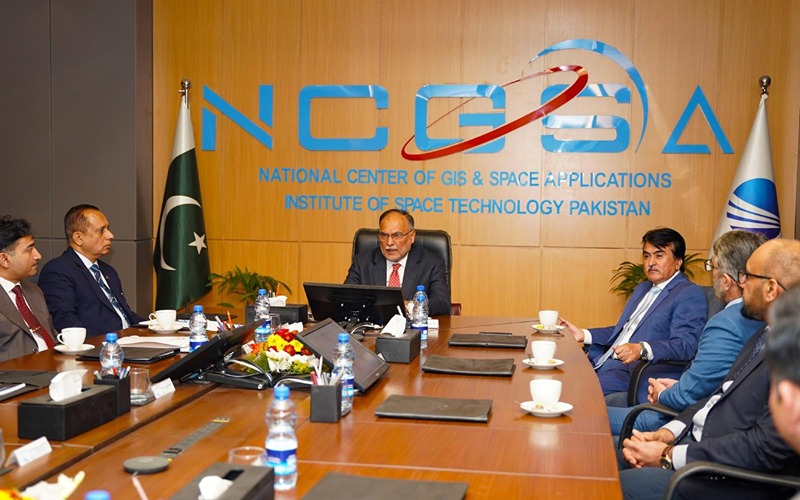
ISLAMABAD, Jan 24 (APP): Minister for Planning, Development and Special Initiatives Professor Ahsan Iqbal on Friday expressed strong conviction of the government to enhance the country’s satellite technology, aligning it with international standards.
Addressing the national space symposium “Sitaroun Se Agay Jahan Aur Bhi Hain” (Beyond the Stars, There are More Worlds), he announced the government’s plan to launch 15 space shuttles over the next five years as part of its broader efforts to boost Pakistan’s capabilities in space research.
The event, held in collaboration with SUPARCO, Pakistan’s National Space Agency, and the Institute of Space Technology (IST), Islamabad, was themed “Harnessing Space Sciences and Technology for Socio-Economic Transformation in Pakistan.” It brought together leading experts, policymakers, and academics to explore the transformative potential of space technology for Pakistan’s development.
The minister stressed the need for increased collaborative research with international space agencies and the establishment of a platform for university students and young scientists to explore space and showcase their capabilities.
Ahsan Iqbal also proposed launching the Annual Space Innovation Challenge program, in collaboration with the Ministry of Planning, the URAAN PAKISTAN initiative, and SUPARCO, for university students across the country. This initiative would allow them to showcase their projects and research in space technology.
He advocated for developing a pool of at least 50,000 youth experts over the next five years to capture both local and international markets in space, satellite, science and technology.
“Today, space technology is being utilized commercially across various sectors, and for Pakistan to achieve economic growth, we must embrace technological innovation,” he remarked.
The minister also mentioned the government’s intention to introduce space and satellite education at the school level to inspire students’ interest in astronomy and broaden their horizons.
He called for a revival of the past glory of Muslim scientists whose groundbreaking research on the nature of light, models of planetary motion and technology in astronomy predated Western scientific advancements.
Ahsan Iqbal highlighted the importance of leveraging space sciences for socio-economic transformation and commended SUPARCO’s contributions, reiterating the government’s commitment to integrating space technologies into national strategies to achieve the “Digital Pakistan” goals.
The minister emphasized the importance of knowledge, science and technology in ensuring sustainable development across the country, underscoring that research and innovation are critical to driving national progress.
He mentioned Pakistan’s significant achievements in space exploration and reiterated the government’s commitment to fostering scientific advancements through the URAAN PAKISTAN program, which aims to ensure equitable development nationwide.
“To achieve sustainable development, collective efforts are essential,” Ahsan Iqbal said, adding that modern research is the easiest pathway to growth. “We must make national progress our foremost priority.”
He stressed the need to accelerate development through contributions from every sector and called for the modernization of libraries and laboratories with cutting-edge technologies.
Discussing the Vision 2025 framework, Ahsan Iqbal expressed confidence that Pakistan would emerge as one of the world’s top ten developed economies. With 60 percent of the population comprising youth, he emphasized the need to align the nation’s policies with global trends and technological advancements.
Mohammad Yousuf Khan, Chairman of SUPARCO; Major General Amer Nadeem (Retd), Ex-Chairman of SUPARCO; Ambassador Tahir Andarabi, Director General of ACDIS at the Ministry of Foreign Affairs of Pakistan; Dr. Raashid Wali Janjua, Director of IPRI; and Dr. Messam Abbas, CEO of NaqCode Technologies, were also present at the occasion.
SUPARCO Chairman Yousuf Khan reaffirmed the organization’s vision to position Pakistan as a leading spacefaring nation, despite challenges such as fiscal constraints and technological limitations.
ISLAMABAD, Jan 24 (APP): Minister for Planning, Development and Special Initiatives Professor Ahsan Iqbal on Friday expressed strong conviction of the government to enhance the country’s satellite technology, aligning it with international standards.
Addressing the national space symposium “Sitaroun Se Agay Jahan Aur Bhi Hain” (Beyond the Stars, There are More Worlds), he announced the government’s plan to launch 15 space shuttles over the next five years as part of its broader efforts to boost Pakistan’s capabilities in space research.
The event, held in collaboration with SUPARCO, Pakistan’s National Space Agency, and the Institute of Space Technology (IST), Islamabad, was themed “Harnessing Space Sciences and Technology for Socio-Economic Transformation in Pakistan.” It brought together leading experts, policymakers, and academics to explore the transformative potential of space technology for Pakistan’s development.
The minister stressed the need for increased collaborative research with international space agencies and the establishment of a platform for university students and young scientists to explore space and showcase their capabilities.
Ahsan Iqbal also proposed launching the Annual Space Innovation Challenge program, in collaboration with the Ministry of Planning, the URAAN PAKISTAN initiative, and SUPARCO, for university students across the country. This initiative would allow them to showcase their projects and research in space technology.
He advocated for developing a pool of at least 50,000 youth experts over the next five years to capture both local and international markets in space, satellite, science and technology.
“Today, space technology is being utilized commercially across various sectors, and for Pakistan to achieve economic growth, we must embrace technological innovation,” he remarked.
The minister also mentioned the government’s intention to introduce space and satellite education at the school level to inspire students’ interest in astronomy and broaden their horizons.
He called for a revival of the past glory of Muslim scientists whose groundbreaking research on the nature of light, models of planetary motion and technology in astronomy predated Western scientific advancements.
Ahsan Iqbal highlighted the importance of leveraging space sciences for socio-economic transformation and commended SUPARCO’s contributions, reiterating the government’s commitment to integrating space technologies into national strategies to achieve the “Digital Pakistan” goals.
The minister emphasized the importance of knowledge, science and technology in ensuring sustainable development across the country, underscoring that research and innovation are critical to driving national progress.
He mentioned Pakistan’s significant achievements in space exploration and reiterated the government’s commitment to fostering scientific advancements through the URAAN PAKISTAN program, which aims to ensure equitable development nationwide.
“To achieve sustainable development, collective efforts are essential,” Ahsan Iqbal said, adding that modern research is the easiest pathway to growth. “We must make national progress our foremost priority.”
He stressed the need to accelerate development through contributions from every sector and called for the modernization of libraries and laboratories with cutting-edge technologies.
Discussing the Vision 2025 framework, Ahsan Iqbal expressed confidence that Pakistan would emerge as one of the world’s top ten developed economies. With 60 percent of the population comprising youth, he emphasized the need to align the nation’s policies with global trends and technological advancements.
Mohammad Yousuf Khan, Chairman of SUPARCO; Major General Amer Nadeem (Retd), Ex-Chairman of SUPARCO; Ambassador Tahir Andarabi, Director General of ACDIS at the Ministry of Foreign Affairs of Pakistan; Dr. Raashid Wali Janjua, Director of IPRI; and Dr. Messam Abbas, CEO of NaqCode Technologies, were also present at the occasion.
SUPARCO Chairman Yousuf Khan reaffirmed the organization’s vision to position Pakistan as a leading spacefaring nation, despite challenges such as fiscal constraints and technological limitations.