Pakistan UAVs News & Discussions

Yes, new LM.
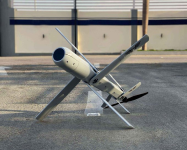
Tbh I quite disappointed they are copying Raads old fin profile
I mean with an amazing defense industry as theirs way go so down
Even we have abondened that fin profile
 
why cant they? what stops them from doing so lol. Do GIDS not do it with Burq? Faaz? etc
If our Chinese friends have no objection on all this then what's the issue? Why it's a matter of shame? How do you know what's the arrangement between the two sides?
 
Does anyone know whats the case with ANKA? It was said to have been procured and maybe even built here..how did that deal went? and do we operate any?
@Ak01 , @farooqbhai
 
What's the difference between this and the countless RC planes flown by hobbyists? 🤔

To view this content we will need your consent to set third party cookies.
For more detailed information, see our cookies page.

This gets asked a lot so I'll try to answer this once and then just refer to this post here on.

Short answer: Basically everything.

Not so long answer: For a fighter program like Kaan, you need to a) gather lots of flight data, and b) test lots of algorithms. Now you could do both of those on prototypes. However, a prototype is millions of dollars, piloted by a person, takes years to build, and very complicated and expensive to fly per hour. So what almost all aircraft R&D places do is build scaled technology demonstrators, which can do 90% of the things in a) and b) at 0.001% of the cost and complexity.

Long answer:
Making a scaled aircraft is not as simple as just making the RC jet in your video. On top of having the same aerodynamic shape you need to make sure that the mass and moments of inertia (how mass is distributed) are carefully scaled values derived from the actual aircraft and the scaling factor.

Weight and Inertia:
To give you an idea, the toy in your video maybe weighs 30kg. Iqbal weighs more than 3 times that due to scaling reasons. You can't see this and this is why you think it is a toy.

Structural capacity:
Since Iqbal is mimicking Kaan, it can actually pull all of the Gs your Kaan can. Your RC toy will rip itself apart at a quarter of those loads. Iqbal's internal structure is VERY different than your RC toys.

Stability:
Like most modern jets Kaan is also relaxed stability: this means its center of gravity is in a position that makes the jet close to unstable or unstable at subsonic speeds. Toys like the ones in your video (even toys that look like unstable jets) never do this. They always make their jets super stable. Iqbal on the other hand is mimicking Kaan so it does not have the luxury of an artificially stabilized CG location. Again, something you can't see.

Flight-control system:
Iqbal actually has a flight-control system that is close to that of Kaan's. You fly Iqbal like you fly Kaan. The toys in your video are flown through direct control of the surfaces. Iqbal has a full-blown FLCS. Again, something you can't see.

Advanced guidance loops:
Kaan is to have many many advanced features like auto-landing, auto ground collision avoidance, terrain following. You could test these on simulators and prototypes. You can also do a much better test on Iqbal. There would be no point in testing these algorithms on your RC toy if it only looked like your aircraft but behaved like a toy.

Gathering aerodynamic data:
Iqbal is heavily instrumented and logs tonnes of data. This is part of its mission. Your toy RC jets don't have all of the sensors that Iqbal has. You can do dangerous things like spin testing on Iqbal, which is almost impossible in CFD, super difficult in wind tunnels, super dangerous and expensive on prototypes.

Cost comparison:
A fighter prototype at the very least costs $50 million dollars. Iqbal costs less than half a million. You can build 200 Iqbals for the cost of one super cheap prototype (this is such a low estimate it is likely way more).

@That_Guy @Ak01
@kimjongun
 
Last edited:
... Weight and Inertia:
To give you an idea, the toy in your video maybe weighs 30kg. Iqbal weighs more than 3 times that due to scaling reasons. You can't see this and this is why you think it is a toy. ...
That helps me understand it much better. Thanks.
 
This gets asked a lot so I'll try to answer this once and then just refer to this post here on.

Short answer: Basically everything.

Not so long answer: For a fighter program like Kaan, you need to a) gather lots of flight data, and b) test lots of algorithms. Now you could do both of those on prototypes. However, a prototype is millions of dollars, piloted by a person, takes years to build, and very complicated and expensive to fly per hour. So what almost all aircraft R&D places do is build scaled technology demonstrators, which can do 90% of the things in a) and b) at 0.001% of the cost and complexity.

Long answer:
Making a scaled aircraft is not as simple as just making the RC jet in your video. On top of having the same aerodynamic shape you need to make sure that the mass and moments of inertia (how mass is distributed) are carefully scaled values derived from the actual aircraft and the scaling factor.

Weight and Inertia:
To give you an idea, the toy in your video maybe weighs 30kg. Iqbal weighs more than 3 times that due to scaling reasons. You can't see this and this is why you think it is a toy.

Structural capacity:
Since Iqbal is mimicking Kaan, it can actually pull all of the Gs your Kaan can. Your RC toy will rip itself apart at a quarter of those loads. Iqbal's internal structure is VERY different than your RC toys.

Stability:
Like most modern jets Kaan is also relaxed stability: this means its center of gravity is in a position that makes the jet close to unstable or unstable at subsonic speeds. Toys like the ones in your video (even toys that look like unstable jets) never do this. They always make their jets super stable. Iqbal on the other hand is mimicking Kaan so it does not have the luxury of an artificially stabilized CG location. Again, something you can't see.

Flight-control system:
Iqbal actually has a flight-control system that is close to that of Kaan's. You fly Iqbal like you fly Kaan. The toys in your video are flown through direct control of the surfaces. Iqbal has a full-blown FLCS. Again, something you can't see.

Advanced guidance loops:
Kaan is to have many many advanced features like auto-landing, auto ground collision avoidance, terrain following. You could test these on simulators and prototypes. You can also do a much better test on Iqbal. There would be no point in testing these algorithms on your RC toy if it only looked like your aircraft but behaved like a toy.

Gathering aerodynamic data:
Iqbal is heavily instrumented and logs tonnes of data. This is part of its mission. Your toy RC jets don't have all of the sensors that Iqbal has. You can do dangerous things like spin testing on Iqbal, which is almost impossible in CFD, super difficult in wind tunnels, super dangerous and expensive on prototypes.

Cost comparison:
A fighter prototype at the very least costs $50 million dollars. Iqbal costs less than half a million. You can build 200 Iqbals for the cost of one super cheap prototype (this is such a low estimate it is likely way more).

@That_Guy @Ak01
@kimjongun
thanks a lot for yor time.its helpful for me to get the idea what iqbal is. thanks for educating people like me
 
@JamD

Brother, what exactly is Iqbal?
  • Is it a UAV / UCAV that looks-like KAAN?
  • Is it being funded by Turkiye to be built in Pakistan?
  • Is it just a technology demonstrator to test if Pakistani engineers can handle such a project?
  • What is the end goal here?
 
@JamD

Brother, what exactly is Iqbal?
  • Is it a UAV / UCAV that looks-like KAAN?
  • Is it being funded by Turkiye to be built in Pakistan?
  • Is it just a technology demonstrator to test if Pakistani engineers can handle such a project?
  • What is the end goal here?
i think option c is iqbal.
 
@JamD

Brother, what exactly is Iqbal?
  • Is it a UAV / UCAV that looks-like KAAN?
  • Is it being funded by Turkiye to be built in Pakistan?
  • Is it just a technology demonstrator to test if Pakistani engineers can handle such a project?
  • What is the end goal here?
C. A tech demonstrator to train Pakistani engineers to take on more complex projects later should the PAF buy into one of TAI's programs, e.g., Hurjet, ANKA-3, and/or KAAN. It's a preemptive goodwill situation by TAI to show the PAF that if the PAF buys into a Turkish aircraft program, TAI will re-invest a big chunk of the PAF's spending back into Pakistani aerospace by expanding TAI Pakistan, giving Pakistani engineers more work, investing in and integrating the Pakistani industry into production, and so on.
 
@JamD

Brother, what exactly is Iqbal?
  • Is it a UAV / UCAV that looks-like KAAN?
  • Is it being funded by Turkiye to be built in Pakistan?
  • Is it just a technology demonstrator to test if Pakistani engineers can handle such a project?
  • What is the end goal here?
All three and what @puttputt said.
 

Users who are viewing this thread

Back
Top