Pakistan UAVs News & Discussions

So to clarify, wootech is a private company or is it an extension of one of our military conglomerates?

Are it's products being sold to the Pakistan military, or on the international market?
Clearly private. They did create a presence in KSA under the name of Anka but don’t know how successful it was.

There products seem to be developed to the requirements of the forces and LEAs.
 
So to clarify, wootech is a private company or is it an extension of one of our military conglomerates?

Are it's products being sold to the Pakistan military, or on the international market?
It's a private firm who had deliver many system to Arm forces of Pakistan; during my discussion with company representatives in IDEAS -2024 he claimed that all the systems shown in that exhibition were operational with Pakistan's Arm forces.
 
It's a private firm who had deliver many system to Arm forces of Pakistan; during my discussion with company representatives in IDEAS -2024 he claimed that all the systems shown in that exhibition were operational with Pakistan's Arm forces.

That's good to hear and we should encourage as many private firms to establish themselves as possible

I've heard of this company over the last few years and seen their products and I was encouraged by a private firm taking the initiative but I was worried if they were actually selling anything especially to our own military and would eventually bankrupt itself

But we need to encourage private investment and companies to start making products for sale both to the Pakistani market and international market


I think PAF is waiting for the resolution of engine issue. Maybe waiting for TF6000 based variant.
 
To view this content we will need your consent to set third party cookies.
For more detailed information, see our cookies page.
 
IMG_5680.jpeg
This is a 3D-printed ABS material finishing of the drone. Its scalability will for sure be an issue. Please don't bring the Ukraine example, they have a decentralized/distributed setup with 1000+ printers in households.
We don't allow private 3D-printer imports in pakistan without NOC from interior ministery.
This design can be mass-produced via injection moulding OR even cheaper vacuum-forming. The question is- where is the Industrialisation taking place?
 
This is a 3D-printed ABS material finishing of the drone. Its scalability will for sure be an issue. Please don't bring the Ukraine example, they have a decentralized/distributed setup with 1000+ printers in households.
We don't allow private 3D-printer imports in pakistan without NOC from interior ministery.
This design can be mass-produced via injection moulding OR even cheaper vacuum-forming. The question is- where is the Industrialisation taking place?
The distributed model of Ukraine is due to constant Russian attacks on their facilities. Over here, most likely we will have 3D printer farm in one of our organizations and it does not need super high end printers either, Bambu lab printers will do.

The point about injection molding is very valid, but good only if we don’t plan to evolve the design rapidly and put a design freeze to take mold cost and lead time into consideration.

Sorry, I have to bring Ukraine up which is producing thousands of interceptors per day with 3D printer produced bodies. The cost is also $2000-5000 which is an order of magnitude less than a Shahid type drone making it a very viable option.
 
Bambu lab
Bambu Lab and 'not super high end' in the same sentence is crazy. Bambus are for people who don't want the hassle of regular 3D printing and just want a printer that works. It's like the Apple of 3D printers ,proprietary software and super expensive to buy and maintain.

And its not made for farms. You need different printers for farms. But they should not be difficult to buy

but good only if we don’t plan to evolve the design rapidly
wouldnt it be waste of time to overengineer them and keep changing desings .
imo it would better to have few small farms for prototyping and small scale production so when they are ready you use injection molding for mass production
 
Bambu Lab and 'not super high end' in the same sentence is crazy. Bambus are for people who don't want the hassle of regular 3D printing and just want a printer that works. It's like the Apple of 3D printers ,proprietary software and super expensive to buy and maintain.
I meant super high end half million to million dollar plus industrial printer that do metal parts.
 
Last edited:
wouldnt it be waste of time to overengineer them and keep changing desings .
imo it would better to have few small farms for prototyping and small scale production so when they are ready you use injection molding for mass production
They HAVE to evolve because the threat keeps on evolving. You might think of Shahid as a static capability, it’s not. They are constantly tweaking it to counter the counter systems. Evolving in speed, avoidance maneuvers (yes, they sense incoming threats and do evasive actions), jamming being bolted own, new and evolving swarm algorithms being plugged in.
 
The point about injection molding is very valid, but good only if we don’t plan to evolve the design rapidly and put a design freeze to take mold cost and lead time into consideration.
Each design iteration prerequisites, after a review, a semi-design freeze. I get the point that we might not have the CNC capabilities to create injection molds on scale in Pakistan. No reason behind that is because we don't have a consumer industrial base which is shooting out 100'000s of plastic parts/day.

Now to this idea of procuring 3D-Printers; our import regulations don't support the vast decentralised ABS-parts-farming.

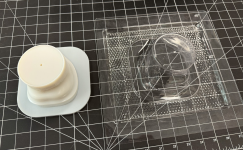
But rather than "Design to Function" we could go for "Design to Process". Which means that you design to your established industrial capacity/capability, without first investing too much in a technology whcih an alien in your local envoirment (aka. 3D-Printing/ABS-cassettes/ .stl files etc ). A repeatable, high-quality workflow like vacuum-forming for example could be explored IMO. Image below is one example. The same result can be replicated using different thickness of pvc-sheets etc.
1780386826905.png
credit: https://techfoundry.ucdavis.edu/vacuum-forming
 
Each design iteration prerequisites, after a review, a semi-design freeze. I get the point that we might not have the CNC capabilities to create injection molds on scale in Pakistan. No reason behind that is because we don't have a consumer industrial base which is shooting out 100'000s of plastic parts/day.

Now to this idea of procuring 3D-Printers; our import regulations don't support the vast decentralised ABS-parts-farming.

But rather than "Design to Function" we could go for "Design to Process". Which means that you design to your established industrial capacity/capability, without first investing too much in a technology whcih an alien in your local envoirment (aka. 3D-Printing/ABS-cassettes/ .stl files etc ). A repeatable, high-quality workflow like vacuum-forming for example could be explored IMO. Image below is one example. The same result can be replicated using different thickness of pvc-sheets etc.
View attachment 199791
credit: https://techfoundry.ucdavis.edu/vacuum-forming
I acknowledge we have a pretty decent size plastic molding industry. I was pointing to the nature of this product where rapid evolution and tweaks are warranted. While this industry’s economics work because it has to churn out the same design in hundreds of thousands to millions. In that case we will inevitably hit the bottleneck of mold lead times and also the cost of change.

Also like I said, it won’t be a distributed model in our case. The capability will/can be built in one of the defence production orgs. Because we are not facing the same kind of daily threat as Ukraine.

I will admit I am not aware how vacuum forming blow forming works. If it doesn’t have the mold bottle neck then potentially it does provide a pathway.
 
Last edited:

Users who are viewing this thread

Country Watch Latest

Back
Top