Pakistan Weather News / Updates

Heavy downpour lashes Islamabad, over 145mm rain recorded​


Authorities issues high alerts in twin cities amid rising water levels in major nullahs

Our Correspondent
July 21, 2025

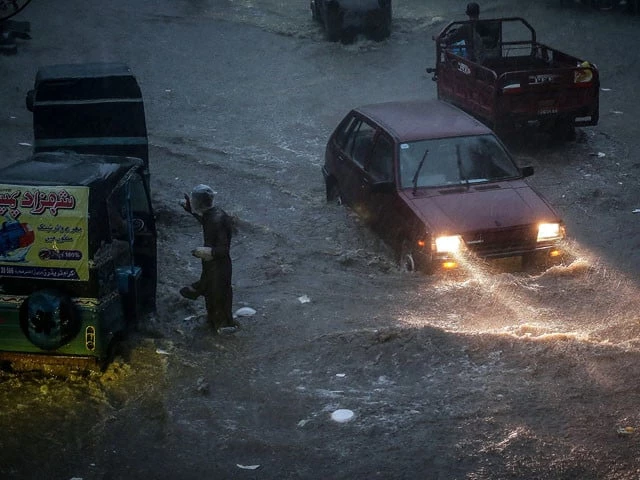
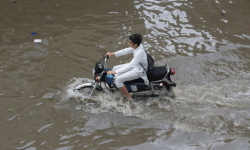
commuters make their way through a flooded street during heavy monsoon rains in hyderabad on july 14 2025 photo afp


Commuters make their way through a flooded street during heavy monsoon rains in Hyderabad on July 14, 2025. Photo:AFP

ISLAMABAD: Torrential rain battered Islamabad, causing urban flooding, damaging homes, and submerging a vehicle, as authorities issued high alerts in both the capital and neighbouring Rawalpindi amid rising water levels in major nullahs.

According to the Water and Sanitation Agency (WASA) Rawalpindi, Saidpur Village received 145mm of rainfall within 3.5 hours, triggering flash floods in seasonal streams. Water flowed above bridge levels in several areas, while a car was swept away by the current. The vehicle has since been retrieved.
 

At least 8 killed in rain-related incidents in K-P, G-B​


Flash floods in G-B kill three, while three children die in roof collapse and two swept away by rainwater drain in K-P

Web Desk
July 22, 2025

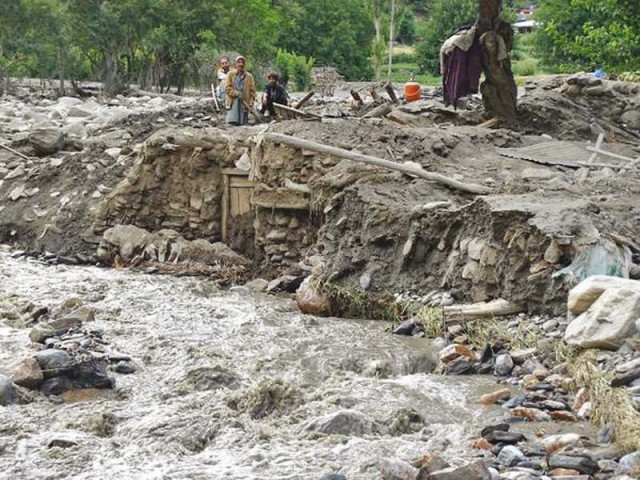
landslide due to floods in chitral photo k p information department s twitter account


Landslide due to floods in Chitral. PHOTO: K-P INFORMATION DEPARTMENT’S TWITTER ACCOUNT

In a devastating turn of events, eight tourist vehicles were swept away by a flash flood in the Babusar Pass area of Gilgit's Ghizer district. The disaster, triggered by rising water levels, landslides, and heavy flooding, has resulted in the loss of at least three lives, with over 15 individuals still missing.

According to Express News, the Babusar road, which runs through the pass, was severely affected after flash floods hit the area. The rising water levels, combined with landslides and the overflow of river water, led to widespread destruction.

As the floodwaters surged, eight vehicles carrying tourists were swept away. Rescue teams managed to save four individuals, but the bodies of three others were recovered from the wreckage. Over 15 tourists remain missing, and an extensive search operation is underway.

Faizullah Faraq, a spokesperson for the Gilgit-Baltistan (G-B) government, confirmed that one of the rescued tourists is in critical condition. The situation has been dire, with the region's communication network disrupted, leaving thousands of stranded tourists without contact with their families.
 
To view this content we will need your consent to set third party cookies.
For more detailed information, see our cookies page.


To view this content we will need your consent to set third party cookies.
For more detailed information, see our cookies page.
 

Officials say over 200 stranded tourists rescued amid GB floods; govt issues landslide alert


Imtiaz Ali Taj | Dawn.com | Umar Bacha
Published July 22, 2025

1753183808187.png

Local people rescue a tourist amid flooding in GB’s Diamer district. — Photo by Imtiaz Ali Taj
https://whatsapp.com/channel/0029VaMc238IiRov8okfYy3n
Over 200 trapped tourists have been rescued in Gilgit-Baltistan’s Diamer after flash floods triggered by heavy rain swept through the district, the local government spokesperson said on Tuesday.

Meanwhile, the National Disaster Management Authority (NDMA) has issued a landslide alert for various areas in GB, Khyber Pakhtunkhwa and Azad Jammu and Kashmir.

A day ago, at least four tourists were killed, two others injured, and 15 went missing due to the floods in Diamer’s Babusar area. The devastating impacts of climate change have become more visible in GB as cloudburst-induced floods wreaked havoc across the region.

Government spokesperson Faizullah Faraq said in a statement, “More than 200 rescued tourists have been shifted to Chilas and provided shelter in hotels and guest houses.”

He added that the tourists were now able to contact their families after being stranded for hours.

The death toll since yesterday currently stands at five, according to Diamer District Commissioner Attaullah Kakar.

Kakar detailed that rescue operations were still underway to look for missing tourists, while four of the five deceased have been identified. According to Senior Superintendent of Police (SSP) Abdul Hameed, 20 to 30 tourists from different parts of the country might be missing.

“The military is participating in the rescue operation and evacuating tourists to safer places,” he said in a statement.
 

What are flash floods and landslides and why do they occur?

An NDMA report reveals that a total of 234 people, including 112 children, have died across the country since June 26.

Dawn.com
July 22, 2025
1753184491174.png

With the onset of the monsoon season in Pakistan, which typically lasts from late June to September, different parts of the country are witnessing heavy rainfall and a heightened risk of extreme weather events like flash floods and landslides, especially in its northern and western regions.

According to the Global Climate Risk Index, Pakistan ranks as the fifth most vulnerable country to climate change. Devastating flash floods in 2022 killed at least 1,700 people, affected more than 33 million, swept away swathes of agricultural land, and caused losses worth $30 billion, according to governmental estimates.

This year, floods and rain-related incidents like roof collapses and electrocution have killed at least 234 people, including 112 children, since June 26, according to a report by the National Disaster Management Authority (NDMA).
1753184468465.png

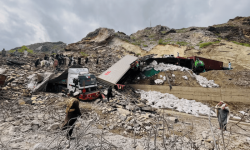
A view of trucks loaded with supplies are seen trapped in a landslide on the road close to the Torkham border, Pakistan. — Reuters

According to the World Meteorological Organisation (WMO), flash flood is “a flood of short duration with a relatively high peak discharge in which the time interval between the observable causative event and the flood is less than four to six hours.”

It is generally characterised by raging torrents after heavy rains, a dam or levee failure or a sudden release of water in a previously stopped passage that rips through riverbeds, urban streets, or mountain canyons, sweeping away everything in its path.

They differ from riverine floods in terms of their rapid onset and decline, high intensity, and unpredictability as well as their usually more localised impact in hilly and mountainous areas rather than the plains.

The Pakistan Meteorological Department (PMD) has previously highlighted the danger to local and seasonal streams in areas like Murree, Galiyat, Mansehra, Kohistan, Dir, Swat, Shangla, Nowshera, Swabi, Islamabad, Rawalpindi, Dera Ghazi Khan, northeastern Punjab, and Kashmir.
1753184416024.png

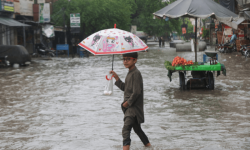
A child holds an umbrella as he wades through a flooded street after a downpour in Lahore, Pakistan on July 9, 2025. — Reuters

Besides natural causes, a number of anthropogenic (deriving from human activity) factors contribute to either creating the conditions that favour the development of flash floods or increase the associated risk, such as settlements on flood plains, urbanisation, deforestation, and failure to maintain or manage drainage systems.
A landslide, on the other hand, is defined as the movement of a mass of rock, debris, or earth down a slope. The term encompasses five modes of slope movement: falls, topples, slides, spreads, and flows.

Landslides usually have multiple causes. Slope movement occurs when forces acting down-slope (mainly due to gravity) exceed the strength of the earth materials that compose the slope.

Causes include factors that increase the effects of down-slope forces and factors that contribute to low or reduced strength.
1753184373975.png

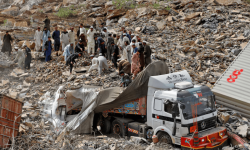
People search for survivors next to a damaged supply vehicle after a landslide close to the Torkham border, Pakistan on April 18, 2023. — Reuters
According to the NDMA, communities and individuals can take several preventive measures to reduce the impact of flash floods as well as landslides. These include:
  1. Stay informed about weather forecasts and flood alerts.
  2. Evacuate to higher ground immediately if advised by authorities.
  3. Assess property damage and prioritise safety during cleanup efforts.
  4. Prepare an emergency kit with essentials like food, water, medications, and documents.
  5. Avoid walking or driving through floodwaters; they may be deeper or faster-flowing than they appear.
  6. Seek medical attention for injuries or illnesses related to the flood.
  7. Follow instructions from emergency services and local authorities.
  8. Organise community cleanup efforts to remove debris and restore infrastructure.
  9. Establish and maintain early warning systems to alert residents of potential floods.
  10. Engage volunteers for emergency response and build shelters for displaced residents.
  11. Provide support services such as counselling and relief assistance to affected individuals and families.
  12. Conduct drills and exercises to practice evacuation procedures.
  13. Coordinate with neighbouring communities and authorities for flood conditions, mutual aid and support.
  14. Implement long-term flood mitigation measures like improving drainage systems and resilience.
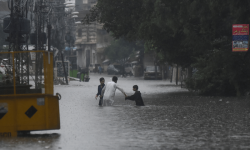
1753184346607.png

People wade through the flooded street after during the monsoon rain in Rawalpindi, Pakistan on July 17, 2025. — Reuters
 

Monsoon devastation continues as death toll reaches 242​


Over past 24 hours, 21 more deaths and six injuries reported with K-P suffering highest number of casualties

Our Correspondent
July 22, 2025


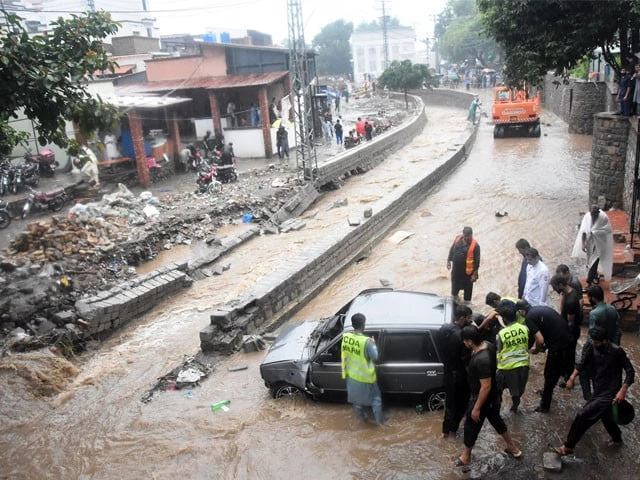
rescue workers and locals busy in drowned car lifting up in a nullah at saidpur village on july 21 photo online


Rescue workers and locals busy in drowned car lifting up in a Nullah at Saidpur village on July 21.


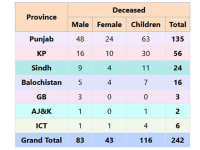
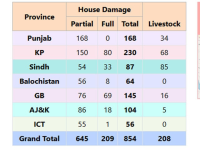
ISLAMABAD: At least 242 people have been killed and nearly 600 injured in torrential rains, devastating floods and storms that have swept across Pakistan since the onset of monsoon season in late June, the National Disaster Management Authority (NDMA) reported on Tuesday.

The majority of casualties were reported in Punjab, where 135 people have lost their lives so far, while Khyber-Pakhtunkhwa recorded 56 fatalities. Other regions severely affected include Sindh with 24 deaths, and Balochistan with 16.

In Islamabad, six people, including four children, were swept away by the floods. Three fatalities were reported in Gilgit-Baltistan, and two deaths occurred in Azad Kashmir. The total toll includes 116 children, 43 women, and 83 men, according to NDMA.
 
When you raze all natural landscape features that protect you by mitigating weather patterns - through mining or plain blasting for housing colonies - deforest all trees that help meditate both extreme rain and reduce greenhouse heat - the word isn’t best suited because it refers to the loss of life - but enjoy.

Keep the real estate bubbles going and enjoy the fruits of that venture.
 
Most Pakistani Engineers (the good ones) have long left for Middle East and Europe or America.

The left over , are just crude pavers , who just Pour concrete everywhere they can see a spot for it.

The sudden intensity in rain can also be artificially induced with Chemicals in air (The possibility can't be excluded)

I think UAE recently banned any entity from spraying Accelerator for rain in their air space for any purpose not long ago

Perhaps Pakistan should also check the flight logs to check who was flying around Rawalpindi / Islamabad airspace , if all Air traffic belonged to Pakistani airlines
  • Never hurts to check flight logs around time when heavy rains suddenly materialized
  • For artificial "Seeding" just need a plane to fly over clouds to discharge chemicals

Manipulation of Weather is fast Emerging as a potential weapon which is a soft way to put pressure on other nations , without being too obvious


I recall that Spanish head of state was making certain claims about GAZA and shortly after Spain was hit with "Torrential Rain" almost identical intensity as what happened in Pakistan only last year. For me the timing of events look odd , it was too much coincidental. Also on social media I started to see trend asking for Head of state in Spain to step down due to failure about rain protection for Civilians.


All I am saying is I don't remember before Islamabad or Rawalpindi getting this much water before
 
Last edited:
To view this content we will need your consent to set third party cookies.
For more detailed information, see our cookies page.
 
The way we are loosing people to these floods is a true testament of our incompetence. All it would take is some 5 DJI flycart 30 drones per district. These VTOL drones have range of 15+ kms and can carry 30-40 kg of first aid, life jackets, ropes, water filtration tablets etc.

I mean if a similar VTOL drones was available to rescue 1122 in swat back when 15 humans lost their life, this one drone could have delivered life jackets to them and saved their lives.

1000 drones for whole of Pakistan, each costing $20,000. We can resolve this issue once and for all by spending only $20 million. But $20 million is more important than loves of 200+ Pakistanis that we lost just to this monsoon alone.


To view this content we will need your consent to set third party cookies.
For more detailed information, see our cookies page.


Here is another drone that cost less than $10,000 and can carry an 80-90 kg human being to safety.

To view this content we will need your consent to set third party cookies.
For more detailed information, see our cookies page.
 
Last edited:
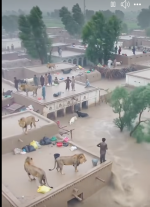
Situation , flood or getting eaten by Lions once they get hungry
Seems like keeping lion as pet is a thing in Pakistani Villages
1753301865394.png
 

Thousands stranded as more landslides block KKH

Thousands stranded as more landslides block KKH


Jamil Nagri
July 24, 2025

1753358822710.png

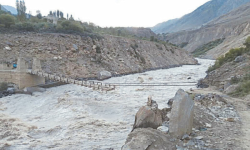
ASKOLI (Gilgit-Baltistan): The Hotu suspension bridge, which connects K2 base camp and some eight villages with the rest of the country, was badly damaged by raging meltwater from the Baltoro glacier, leaving many trekkers and locals stranded on both sides.—Photo by the writer

• Mobile, internet services disrupted after damage to fibre optic cable
• Tourists rescued from Babusar Pass, given free lodging in Chilas
• GB chief minister declares flood-hit areas in Diamer as disaster zones
• 40 stranded in Manogah Nallah; dy speaker calls for helicopter rescue


GILGIT: Thousands of people, including foreign tourists, remained stranded at multiple locations in Gilgit-Baltistan due to blocked roads, including the Karakoram Highway (KKH), due to landslides. Mobile and internet services across the region were also disrupted after fibre optic cables were damaged in several areas.

Gilgit-Baltistan government spokesperson Faizullah Faraq confirmed that KKH is blocked at Achar Nallah in the Kohistan district of Khyber Pakhtunkhwa. Thousands of passengers, including tourists, travelling to and from GB are stranded on both sides of the highway.

He said that while KKH has been reopened for traffic within GB, restoration work is underway in Kohistan. The Babusar Pass Road is also blocked at several locations.

Mr Faraq assured that all tourists stranded on the Babusar route have been safely evacuated and search operations for missing individuals are underway. Those rescued from Babusar Pass have been brought to Chilas, where local hoteliers and government authorities have arranged complimentary accommodation.

The mobile and internet communication systems in the region were severely damaged, leaving the majority of residents without service for up to six hours on Wednesday. The region’s communication system relies on an optical fibre cable connecting GB with Rawalpindi.

According to the Special Communications Organisation (SCO), recent flash floods in Babusar Valley caused significant damage to the main optical fibre cable. Emergency alternative satellite arrangements were made, but consumers faced slow mobile and internet connectivity. Mr Faraq said that work has begun to restore the communication system.

Meanwhile, Deputy Speaker of the Gilgit-Baltistan Assembly Sadia Danish expressed concern over the safety of 40 individuals stranded in Danyore’s Manogah Nallah in Gilgit. In a statement, she urged the government to initiate a helicopter rescue operation immediately.

Ms Danish emphasised tha protecting human lives should remain the top priority and recognised the efforts of the provincial government, the Pakistan Army, volunteers and residents in the rescue operations during the flood emergency.

She also commended the generosity of residents, who opened their homes, mosques, imambargahs and hotels to shelter stranded tourists.

Moreover, river erosion caused the collapse of the Hotu suspension bridge in Shigar, cutting off the only access to the K2 base camp. A large number of foreign expedition members and trekkers were stranded, while eight villages were also disconnected.

Officials from the National Disaster Management Authority (NDMA) said that a C130 sortie will be arranged from Gilgit to Islamabad to airlift stranded travellers.

Stranded tourists are expected to receive airlifts free of charge on Thursday (today) in an operation overseen by Gilgit’s additional deputy commissioner.

GB Chief Minister Haji Gulbar Khan has assured that the rescue operations will continue until all stranded people in Babusar are rescued.

He also declared the flood-affected areas of Thaki, Niyat, Khunra and Thor in Diamer as disaster zones. He also announced that the families of those who died in the floods at Babusar will receive death compensation under the government policy.

The chief minister ordered urgent measures to restore drinking water, electricity, irrigation channels and road communications in the flood-affected areas of Thor. He also visited the flood-affected areas to oversee the recovery efforts along with Adviser on Forests Haji Shah Baig and GB Minister for Agriculture Engineer Anwar.

Published in Dawn, July 24th, 2025
 

Users who are viewing this thread

Pakistan Defence Latest

Country Watch Latest

Back
Top