Pakistan Weather News / Updates

Monsoon 2025 death toll mounts to 271​


PDMA issues flood alert for Chenab, Jhelum rivers, especially July 29–31

Web Desk
July 27, 2025
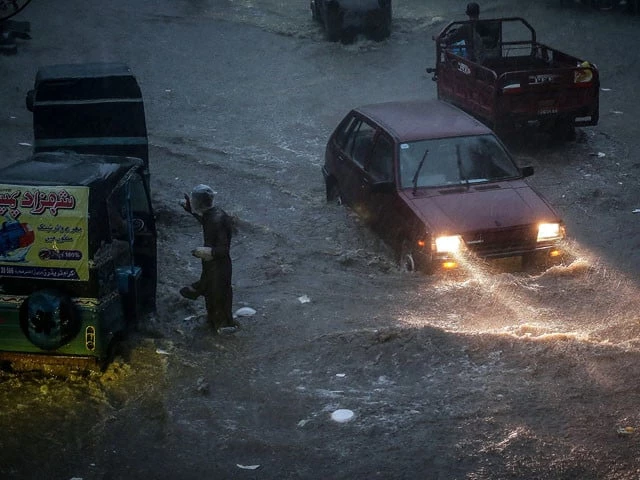
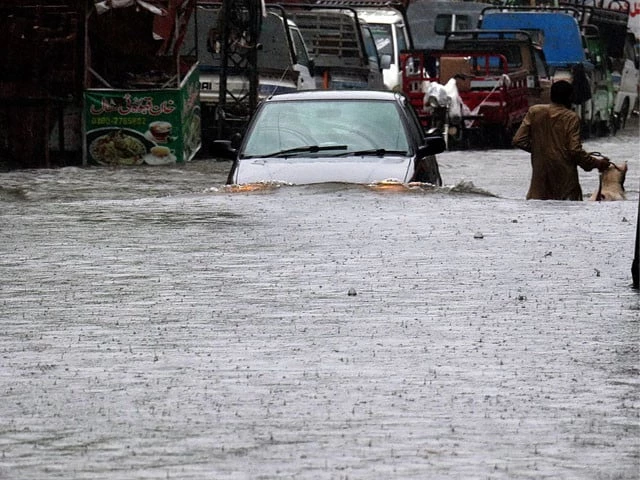
commuters make their way through a flooded street during heavy monsoon rains in hyderabad on july 14 2025 photo afp


Commuters make their way through a flooded street during heavy monsoon rains in Hyderabad on July 14, 2025. Photo:AFP


At least six more people lost their lives and 22 others were injured in rain and flood-related incidents across the country in the past 24 hours, the National Disaster Management Authority (NDMA) reported.

According to the NDMA, the latest casualties were reported from Punjab and Balochistan, where two and four deaths occurred, respectively. The fatalities were caused by flooding, collapsing roofs, and drowning incidents.

The authority further stated that since the beginning of the monsoon season on June 26, a total of 271 people have died, and 655 others have been injured in various rain-related incidents nationwide.

The Pakistan Meteorological Department (PMD) has forecast mostly cloudy weather with chances of light drizzle in Karachi over the next three days, along with stronger-than-usual daytime winds.

Drizzle is likely during the night or early morning on Tuesday, while sea breezes are expected to remain fully active.

Daytime temperatures in the city are expected to range between 33°C and 35°C. Humidity levels may reach up to 80% in the morning and 65% in the evening.

Elsewhere in Sindh, hot and humid weather is expected to persist, but areas in Tando Allahyar, Umerkot, Mirpurkhas, Sanghar, Tharparkar, Mithi, Thatta, and Badin may experience gusty winds, thunderstorms, and rainfall.

Light drizzle is also expected along Pakistan’s broader coastal belt. Meanwhile, due to recent heavy rainfall in the north, low-level flooding continues at Guddu and Sukkur barrages, though the Kotri barrage is reporting normal water flow.

Separately, the PMD has forecast more monsoon rains accompanied by wind-thundershowers across the country beginning Monday.

A fresh westerly wave is expected to enter on Tuesday, which may further intensify the weather system.

The rainfall could lead to flash floods in local nullahs and streams, and urban flooding in low-lying areas of major cities.

Landslides and mudslides may block roads in hilly areas such as Khyber-Pakhtunkhwa, Gilgit-Baltistan, Murree, Galliyat, and Kashmir.

The Punjab Disaster Management Authority (PDMA) has issued a flood alert for the Chenab and Jhelum rivers and surrounding tributaries, warning of possible low to medium-level flooding from July 29 to 31.

Authorities have been directed to take precautionary measures, while Rescue 1122 teams and emergency control rooms remain on high alert.

Morning temperatures recorded today were: Islamabad 28°C, Lahore 29°C, Karachi and Peshawar 30°C, Quetta, Gilgit, and Muzaffarabad 24°C, and Murree 15°C.
 
Since 1970's , people just talk

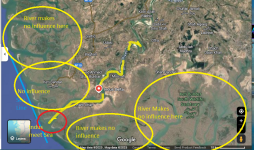
Lets Look at satellite photo actual common sense review

The sea only meets river at small point (the red spot only 1 km width)

95% OF Land the flow of Indus river has 0% impact on water channel (yellow zones), only small tiny spot in red is actual zone where river indus meets sea , build a sea wall to control water release outward only

People assume all the area will submerge in sea (no false claim)
If river indus dries up 100% (in theory) the yellow zone will look same

Make wall at red spot to control water release into sea
Yellow area will remained unchanged


1753628869998.png


PPP politician scare everyone by claiming the Sea will submerge all Sindh with sea , and farming will be impossible

They scare farmers by claiming you won't be able to farm

These are all false claims

Sea does not , climbs up higher ground
 
Last edited:
To view this content we will need your consent to set third party cookies.
For more detailed information, see our cookies page.
 

Rain, flash floods forecast from July 27: PMD​


Strong winds, lightning may damage weak structures, poles, solar panels, billboards

Web Desk
July 26, 2025

a view of vehicle passing through flooded road during heavy monsoon rains in rawalpindi on july 17 photo inp


A view of vehicle passing through flooded road during heavy monsoon rains in Rawalpindi on July 17.

The Pakistan Meteorological Department (PMD) has forecasted widespread rain with wind-thundershowers and isolated heavyfalls across much of the country from July 27 to 31, warning of flash floods, urban flooding, and landslides in several vulnerable areas.
 
A westerly wave is expected to approach by July 29, further strengthening the weather system.

Rain with isolated heavy falls is expected in Kashmir (including Neelum Valley, Muzaffarabad, Rawalakot, and Mirpur) and Gilgit-Baltistan (including Skardu, Astore, and Hunza) from July 27 to 31.

In Khyber-Pakhtunkhwa, districts such as Swat, Mansehra, Kohistan, and Peshawar are likely to receive rain and thunderstorms from July 28 to 31.

Punjab and Islamabad will see rain with scattered heavyfalls from July 28 to 31, affecting areas such as Rawalpindi, Lahore, Gujranwala, and Sialkot. Rain is also likely in southern Punjab (DG Khan, Bahawalpur, Rahimyar Khan) from July 29 to 31.

Balochistan’s northeastern and southern districts, including Quetta, Barkhan, and Zhob, may receive rain from the night of July 29 to July 31.

In Sindh, hot and humid weather will persist, though rain is forecast for July 30 and 31 in districts such as Tharparkar, Sanghar, Sukkur, and Larkana.

The PMD has warned that heavy rain could trigger flash floods in hill streams of Chitral, Swat, and other northern regions.

Urban flooding is likely in low-lying areas of Islamabad, Lahore, Rawalpindi, and Sialkot.

Landslides or mudslides may occur in hilly areas of Khyber Pakhtunkhwa, Gilgit-Baltistan, Murree, and Kashmir.

Strong winds and lightning may damage weak infrastructure, including kacha houses, electric poles, solar panels, and billboards.

The public, travellers, and tourists have been advised to stay informed and avoid unnecessary travel to vulnerable areas.

Authorities have been urged to remain alert and take precautionary measures.

The latest weather updates are available on the PMD website and the Pak Weather mobile app.
 
Sindhis are not claiming that sea water will climb the land. They are saying that without indus outflows into the sea, under ground water will turn salty and will not be able to support agriculture. I think Thattha and Badin are low lying areas.
 
Sindhis are not claiming that sea water will climb the land. They are saying that without indus outflows into the sea, under ground water will turn salty and will not be able to support agriculture. I think Thattha and Badin are low lying areas.
 
More rains are blessing. Pakistan can irrigate large tract of land in Thal, Cholistan semi deserts with modern irrigation. Make recharge pit mandatory for every tubewell.

Only people suffering are those who build near nalas, rivers.
 
Kalabagh Dam isnt happening for multiple reasons. One of them is the usual poor treatment of KPK where hydel payments are always 10 years behind schedule. But biggest problem with the dams is the canals that are taken out of them for irrigation , overwhelmingly in Punjab. This means Sindh loses the water that it was originally getting in the rivers.

This is why for electrical generation and some flood control, alternative dams are being built in KPK, Azad Kashmir and Northern Areas, but whose water cannot be used for irrigation canals.

There are those on the forum who justify the shabby treatment of smaller provinces in various ways, such as claiming better ROI from Punjab rather allegedly "backward barbaric vile" people living in the smaller provinces, but that is the wrong approach and an example of what's wrong with Pakistan in the first place.
Build a dam on the Soan river not at kalabagh. It solves most the same problems, it continues water to sindh in accordance with present agreements.

Btw, on the topic of floods, if India is not sending data, can’t our data experts use AI to monitor and predict when water would be let go and build reserves of water as well as build flood prevention took infrastructure to manage the water when it comes.

Supposedly with the Field Marshall’s visit to China, CPEC 2.0 is back on, and hopefully that means the dam building initiative will be sped up.
 

Poor planning drowns the city yet again​

With a lack of pumping and storage facilities, stagnant water continues to irk locals across residential areas

Muhammad Ilyas
July 27, 2025

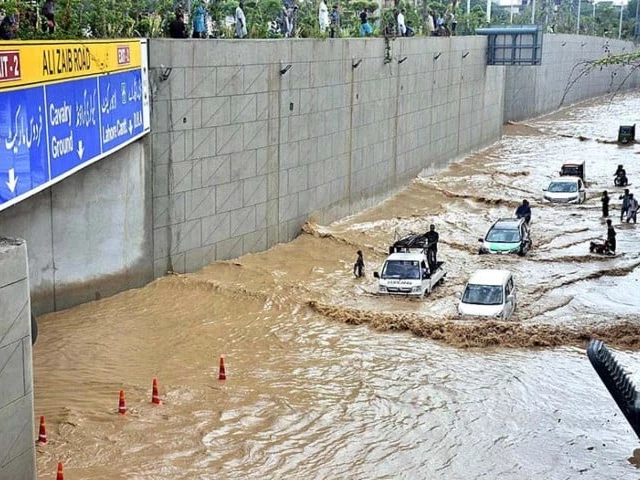
vehicles passing through rain water accumulated on the kalma chowk underpass road during rain that experienced in the city on july 7 2023 photo app


Vehicles passing through rain water accumulated on the Kalma Chowk underpass road during rain that experienced in the city on July 7, 2023. Photo: APP


LAHORE:
In the aftermath of the recent rains, even though the government has managed to drain rainwater from the roads through improved management, stagnant water remains accumulated at parks and green belts across various residential colonies.

Reportedly, the Parks and Horticulture Authority (PHA) till date has no plans for draining water from inundated parks. Instead, all administrative bodies are waiting for the weather to change and the rains to stop, after which it is expected that the ground will absorb the water naturally. In some cases, water drained from roads is being offloaded by water tankers into parks and green belts.

As a result, in addition to the rainwater already present, tanker water is also being dumped into most parks in Lahore. This water could be stored as part of a government plan, but instead, it is being disposed of in this manner.

The Water and Sanitation Agency (WASA) claims to have built underground tanks at 14 key locations to improve the water table. They are also dumping water into parks to recharge the groundwater, claiming it will improve the water level. However, last year and in the current financial year, the water collected in parks due to rains has led to the breeding of dengue mosquitoes.

Even now, due to continuous rains, water is standing several feet deep in parks, resulting in a foul smell and the breeding of mosquiotos.

Muhammad Osama, a resident of F-Block Johar Town, revealed that water stood accumulated in parks for several days in his area and other blocks as well. “Despite complaints, the PHA takes no action. Last year, as well, stagnant water led to fever outbreaks caused by dengue mosquitoes in my residential area. The district government conducts surveys to check for larvae, and if found, cases are registered against households,” said Osama.

Another resident, Mohsin Jat, echoed similar concerns, stating that water drainage in housing societies was almost non-existent since sewers were overflowing, and water remained in parks for several days.
“The government makes no effort to use pumps to drain the parks.

Suction machines are only used in high-profile residential areas where politicians or bureaucrats live. Right now, instead of channeling rainwater from roads into canals, it is being dumped into parks in various areas.
 
Suction machines are only used in high-profile residential areas where politicians or bureaucrats live. Right now, instead of channeling rainwater from roads into canals, it is being dumped into parks in various areas.

As a result, rainwater is still standing in residential parks across many locations. These include over a dozen blocks of Johar Town, as well as areas like Allama Iqbal Town, Gulshan Ravi, WAPDA Town, Model Town, Township, Samanabad, Jilani Park, and other housing society grounds,” noted Jat.
Former Chief Engineer and town planner Khushal Khan stated that measures should be taken to raise the groundwater level.

“For this purpose, wells should be constructed to channel the rainwater underground, which would help replenish the water table. The "Gharki system" could also be established to manage water more effectively. This would not only prevent water from standing in parks but also improve groundwater levels.
 
The government needs to take action and if proper planning is done now, it will be beneficial in the future. While some of the water in parks does gradually seep underground, the process needs to be made more efficient. Lahore's underground water level is currently low, and steps must be taken in various areas to improve it,” implored Khan.

Sources have revealed that a meeting was held under the chairmanship of the Lahore Deputy Commissioner to discuss the situation arising from rainwater accumulation in the coming days. However, no solid measures have been taken yet due to the continued spell of rainfall.
 
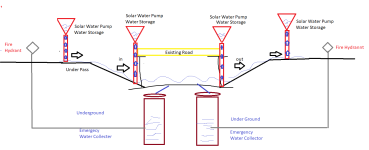
The under passes are a "Death Trap" how they are engineered all over Pakistan, there is no process to remove water

Concrete , does not absorb water you need drainage connecting to city Sewage line to get rid of access water which will not happen

Should install a very simple storage tank to suck up the water to storage tanker above , which can be used to water plants on main road , later in year, used by Municipality

Problem like this are solved by your "Engineering" Department if it exist
Solar motor to suck up water to storage container

No more "Death" Trap

1753644744451.png


Ye bhi ab Foreign Consultant Bana Ker Dega
  • Send ishaq dar to take up another 2 billion USD loan (Sarcasm)

In Pakistan because most work force is "Uneducated" they just pour the road material with a spreader , and it stop water flow to soil

This issue is "man made" human Engineering Error

Every thing is done , "without planning"


Lets go , pour over the coaltar , our job is done , hell with planning for water
 
Last edited:

Preparing for a future of floods


July 26, 2025
EDITORIAL:

The ongoing monsoon season has already claimed over 265 lives since June, and the worst may not be over. Meanwhile, a recent study published in the leading scientific journal Nature warns that Pakistan is likely to face more frequent and severe floods in the years ahead. This, the authors argue, may become the “new normal” — driven by both extreme rainfall events and human development encroaching on natural floodplains.


Monsoon-related flooding has increased in intensity, frequency, and unpredictability during the recent years. Urban centres, rural communities, and agricultural lands alike have suffered heavy losses, with the poorest hit the hardest, as seen during the unprecedented 2022 floods that submerged a third of the country and killed over 1,700 people. Some of the worst-hit areas in rural Sindh have yet to fully recover from that devastating event.

The Nature study calls the 2022 floods a “forewarning of elevated future flood risks.” Following a multiyear drought, pre-monsoon rainfall that year was 111 percent higher than the long-term average (1951–2021), increasing soil moisture by 30 percent across the Indus Basin floodplains. The result: river water levels surpassed even those recorded during the catastrophic floods of 2010 and 2015.

To mitigate these risks, the study makes three critical recommendations: restore natural floodplains, improve drainage infrastructure, and relocate populations living in high-risk zones. All three require long-term vision and political will — not a strong strength point of our policymakers.

Restoring floodplains is essential. Years of unregulated construction and encroachment have blocked natural rainwater paths and diminished the land’s capacity to absorb floodwaters. Allowing rivers space to overflow unhindered would reduce disaster risk and restore ecological balance.

Equally urgent is the need for modernising our urban drainage systems. Almost all of our cities rely on outdated, inadequate, and poorly maintained infrastructure that cannot handle heavy downpours. Provincial governments (local governments either do not exist or the ones that do are powerless) must invest in durable drainage solutions, both in urban and rural areas.

Nature-based solutions like rain gardens, already operational in parts of Lahore, should be expanded nationwide to reduce surface runoff and improve groundwater recharge. The most difficult yet necessary task is relocating vulnerable populations from flood-prone areas along riverbanks.

This needs to be done with proper planning, offering affected families with dependable alternative housing, employment opportunities, and essential services in safer areas. Conducted carefully, relocation can save lives and reduce the long-term costs of repeated disaster response.

Needless to say, climate change is no longer a distant threat, it is already upon us. With rising temperatures, shrinking glaciers, and what the study calls the “compounding effects of rain-on-snow,” Pakistan must shift from reactive crisis management to proactive planning. Flooding may become the new normal, but devastation and loss must not. The time to act is now.

Copyright Business Recorder, 2025
https://www.facebook.com/sharer/sha...er.com/news/40374611&display=popup&ref=plugin
 

Users who are viewing this thread

Pakistan Defence Latest

Country Watch Latest

Back
Top