Pakistan Weather News / Updates

All embankments along Chenab secure: Jhang district administration


The Jhang district administration has stated that all embankments on the Chenab River are secure, District Information Officer Riaz Marath has told Dawn.com.

“Yesterday, the embankment near Rewaz Bridge was breached in order to save Jhang city and the Trimmu Barrage,” the spokesperson said. “Floodwater has entered more than 100 rural settlements and crops, but people and their animals have been evacuated.”
 

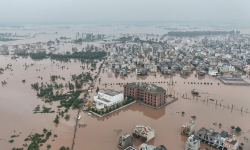
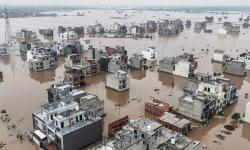
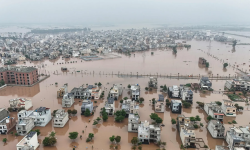
PHOTOS: Residential buildings partially submerged in floodwater in Lahore


1756555506971.png

This aerial view shows partially submerged residential buildings following the overflowing of the Ravi River in Lahore on August 30, 2025. — AFP


1756555523188.png

This aerial view shows partially submerged residential buildings following the overflowing of the Ravi River in Lahore on August 30, 2025. — AFP

1756555540957.png


This aerial view shows partially submerged residential buildings following the overflowing of the Ravi River in Lahore on August 30, 2025. — AFP
 

Army conducts rescue operations in various Punjab districts


The Pakistan Army has conducted rescue operations in flood-affected areas of Punjab, including Jhang, Faisalabad, Chiniot, and Toba Tek Singh, state media PTV reports.

It said that the army personnel were evacuating people to safe locations using helicopters and boats. “Out of 15,800 people stranded in villages of Faisalabad, 14,050 individuals have been rescued,” it added.
 
Jinnah Hospital, Lahore.


To view this content we will need your consent to set third party cookies.
For more detailed information, see our cookies page.
 

Editorial:

The state must treat displacement as a policy priority, not an after-event improvisation


WITH floodwaters surging yet again through Punjab, the country is faced with an all too familiar crisis — rehabilitation.

Officials report nearly 300,000 displaced from the province alone and more than a million affected as the Ravi, Sutlej and Chenab overflowed their banks. This latest emergency comes while the country is still reeling from lethal flash floods in KP and as a 7-km-long lake formed after a landslide blocked a river in Gilgit-Baltistan, forcing precautionary evacuations. It has been a season of peril, from the mountains to the plains.

Following the cataclysmic floods of 2022 that put a third of the country under water, affected 33m and displaced nearly 8m, the government and international donors produced a Post-Disaster Needs Assessment and launched the Resilient Recovery, Rehabilitation and Reconstruction Framework (4RF). Donors pledged over $9bn at Geneva to ‘build back better’ in housing, livelihoods and public services. The commitments set a bar we have yet to meet.
 
Punjab’s set-up of hundreds of relief and medical sites demonstrates mobilisation capacity, yet there is still no published nationwide rehabilitation blueprint for this year comparable to 4RF: no clear calendar for resilient housing grants, no transparent, countrywide registry of climate-displaced households, no public dashboard tracking delivery by district.

What must be done is no rocket science. The state must treat displacement as a policy priority, not an after-event improvisation. It must legislate a climate-displacement framework that guarantees registration, interim shelter, core-housing grants tied to resilient designs, and portable access to health, education and social protection (through BISP) for uprooted families. Second, set aside and fast-track rehabilitation finance — including Geneva pledges — with independent audits and open data, so money reaches the last mile.
 
Rebuild in ways that can withstand climate risks: multi-purpose elevated shelters across riverine belts; enforceable zoning to keep construction off floodplains; city drainage upgrades; and accelerated glacial-lake early-warning and downstream evacuation routes in the north. Finally, make communities co-designers: women, sharecroppers and landless labourers must be at the centre of relocation and livelihood plans.

The latest devastation in Punjab should not become another chapter in our cycle of disaster, ‘relief’ and neglect. The state has planned before. It must deliver now so that those repeatedly uprooted by a changing climate can rebuild lives rather than wait for the next siren.

Published in Dawn, August 30th, 2025
 
Jinnah Hospital, Lahore.


To view this content we will need your consent to set third party cookies.
For more detailed information, see our cookies page.

Can you post the map of river Ravi natural path and constructions in its path.
 
Can you post the map of river Ravi natural path and constructions in its path.

To view this content we will need your consent to set third party cookies.
For more detailed information, see our cookies page.
 

Monsoon devastation claims 831 lives across Pakistan​


2,300 villages submerged, over 1.5 million people affected

Web Desk
August 30, 2025


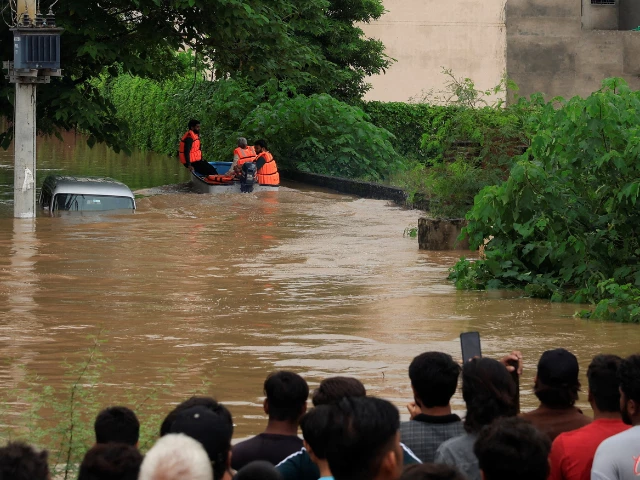
volunteers from rescue 1122 search for residents in a flooded area following monsoon rains and rising water levels in sialkot punjab province pakistan august 27 2025 photo reuters


Volunteers from Rescue 1122 search for residents in a flooded area, following monsoon rains and rising water levels in Sialkot, Punjab province, Pakistan, August 27, 2025. Photo: Reuters

The National Disaster Management Authority (NDMA) has reported 16 deaths during the last two days, raising the toll to 831 over the past two months.

The floods, triggered by torrential rains and excessive discharge of water from India, have wreaked havoc, leaving thousands of people marooned and displaced while causing severe damage to property, infrastructure and ready crops.

Three transboundary rivers that cut through Punjab, which borders India, have swollen to exceptionally high levels, affecting more than 2,300 villages.

According to NDMA, the hardest-hit provinces are Khyber-Pakhtunkhwa (K-P) with 480 deaths while Punjab reported 191 fatalities. Sindh recorded 58 deaths, Balochistan 24, and Gilgit-Baltistan 41. Azad Kashmir has reported 29 fatalities, while Islamabad reported eight deaths. Children have borne the brunt of the disaster, with 219 minors among the deceased. The floods have also claimed the lives of 128 women and 484 men.

The impact on the country’s infrastructure has been devastating, with 238 bridges washed away and 661 kilometers of road networks submerged. The floods have also destroyed 9,000 homes and led to the loss of over 6,000 animals.

More than 35,000 people have been displaced due to the floods, many of whom are now living in relief camps. K-P has the highest number of displaced individuals at 26,000, followed by 6,000 in Punjab and 3,000 in Gilgit-Baltistan.
 
Funny govt minister ....India didn t tell how much water they will release ...lolllllllllllllllllllllllll.. Khwaja Asif saying something else ..lollllllllllll
 
To view this content we will need your consent to set third party cookies.
For more detailed information, see our cookies page.

Land mafia ....few days before flood Mariam award new contracts to Aleem Khan ...
 
To view this content we will need your consent to set third party cookies.
For more detailed information, see our cookies page.
 
To view this content we will need your consent to set third party cookies.
For more detailed information, see our cookies page.
 
To view this content we will need your consent to set third party cookies.
For more detailed information, see our cookies page.
 

Users who are viewing this thread

Latest Posts

Back
Top