PM Shehbaz Approves $6 Billion Refinery Upgrades Plan

1. The Core Structural Problem


  • Idle Capacity vs. Missing Capacity: Pakistan’s installed refining capacity is 20.5 MTPA (449,400 bpd), but actual throughput is only ~10 MTPA, resulting in a utilization rate of 48.8%.
  • Furnace Oil (FO) Bottleneck: Because local power generation has shifted away from FO toward hydel, nuclear, Thar coal, and RLNG (FO share in power generation dropped from 9.1% in FY22 to 1.0% in FY26), refineries cannot offload FO. High FO yields (~21% of throughput) choke processing capacity and force refineries to export FO at steep discounts.

2. Policy Incentives & Financing Structure

The policy establishes a partially self-funding escrow mechanism:

  • Tariff Protection (Deemed Duty): 10% deemed duty on Motor Spirit (MS/Petrol) and High-Speed Diesel (HSD) for 7 years.
  • Escrow Account Allocation: 10% of MS duty and 2.5% of HSD duty are routed into a joint escrow account.
  • Withdrawal Caps: Refineries can withdraw up to 27.5% of total project costs for importing new machinery (or 24.5% for used machinery) upon meeting project milestones.
  • Tax Relief: Imports of upgrade-related equipment are exempted from sales tax under the FY27 Finance Act.
  • New Proposed Protection Clauses: Proposed 2026 amendments add stability/parity clauses (protecting against adverse tax/regulatory changes) and permit onshore foreign currency (FX) accounts.

3. Sector-Wide Output Transformation

Once fully upgraded, the sector's product slate will shift dramatically toward high-value Euro-V fuels:
ProductPre-Upgrade OutputTarget Post-Upgrade Output% Change
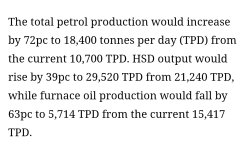
Motor Spirit (MS / Petrol)~10,702 tons/day~21,251 tons/day+99%
High-Speed Diesel (HSD)~21,237 tons/day~31,288 tons/day+47%
Furnace Oil (FO)~15,417 tons/day~3,414 tons/day-78%

4. Refinery-by-Refinery Breakdown

RefineryTechnologyCapEx (USD)CompletionMS Output Shift (tons/day)HSD Output Shift (tons/day)FO Output Shift (tons/day)Escrow Collection vs. Withdrawal Cap
PARCOMild Conversion$1.40 Bn20293,678 $\rightarrow$ 5,493 (+49%)5,600 $\rightarrow$ 8,082 (+44%)3,290 $\rightarrow$ 212 (-94%)Collects ~PKR 175Bn; Withdraws ~PKR 108Bn
ATRLHydroskimming$0.60 Bn20291,923 $\rightarrow$ 2,379 (+24%)2,071 $\rightarrow$ 2,008 (-3%)1,024 $\rightarrow$ 908 (-11%)Collects ~PKR 72Bn; Withdraws ~PKR 46.2Bn
PRLHydroskimming$1.70 Bn2028783 $\rightarrow$ 4,854 (+520%)1,793 $\rightarrow$ 6,111 (+241%)1,350 $\rightarrow$ 167 (-88%)Collects ~PKR 50Bn; Withdraws ~PKR 131Bn
NRLLube + Hydroskimming$1.00 Bn2029818 $\rightarrow$ 2,025 (+148%)3,273 $\rightarrow$ 4,087 (+25%)2,253 $\rightarrow$ 1,127 (-50%)Collects ~PKR 45Bn; Withdraws ~PKR 77Bn
Cnergyico (CPL)Hydroskimming$1.00 Bn20303,500 $\rightarrow$ 6,500 (+86%)8,500 $\rightarrow$ 11,000 (+29%)7,500 $\rightarrow$ 1,000 (-87%)Collects ~PKR 44Bn; Withdraws ~PKR 77Bn

5. Key Execution Bottlenecks & Risks

  1. Slow Execution Timeline: PRL is the only refinery that has signed the Upgrade Agreement so far. PARCO and Cnergyico (representing over 50% of national capacity) had not signed as of mid-2024 / late 2024. Refineries failing to sign by October 22, 2024, faced a penalty reduction in HSD deemed duty from 7.5% to 5%.
  2. Financing Limits of Local Banks: Domestic banking capacity is insufficient to absorb $6 billion in consortium loans. Refineries and the government are forced to look outward to entities like US EXIM Bank, DFC, and foreign Export Credit Agencies (ECAs).
  3. Tight Timeline vs. Moving Capex Targets: Final project costs only solidify after Front-End Engineering Design (FEED), but lenders are required to commit under a tight 6-month window to achieve financial close after signing.
  4. IMF Approval: Policy implementation faces potential delays pending formal clearance from the IMF.
 
No one can stop people from day dreaming. Just read the Dawn article I just posted when you wake up.

IMF will not matter once USA approve $10bn facility. In any case IMF will have to be convinced because FX saving from this are worth it.
 

1. The Core Structural Problem


  • Idle Capacity vs. Missing Capacity: Pakistan’s installed refining capacity is 20.5 MTPA (449,400 bpd), but actual throughput is only ~10 MTPA, resulting in a utilization rate of 48.8%.
Instead of increasing utilization, you are increasing capacity. Increasing capacity is a capex that can generate corruption. Increasing utilization does not generate that income.
 
Instead of increasing utilization, you are increasing capacity. Increasing capacity is a capex that can generate corruption. Increasing utilization does not generate that income.

Did you even read, old refineries cannot be used at full capacity before upgradation.
 
What do you think all these agreements with Saudi, Kuwait, Qatar etc entail???


We need to ensure the Hindus are thrown out of the Muslim world

I do not know about Kuwait, Qatar. But Saudis would rather have the jobs in Saudi Arabia not Pakistan
 
IMF will not matter once USA approve $10bn facility. In any case IMF will have to be convinced because FX saving from this are worth it.
First understand how the Exchange Stabilization Fund works, for example, how it was deployed in Argentina. It cannot subsitiute for an IMF loan. Pakistan will still have to abide by IMF conditions.
 
I hope India stop any further plans for refinery expansion because Pakistan is back in the business.
Please stop embarrassing yourself. Firstly, refined oil exports come from specific refineries with competitive advantage, not generically from India or any other country. Most of India's fuel exports come from Ambani's Jamnagar refinery, which is the largest and most complex ( based on Nelson Complexity Index) in the whole world. No other refinery in the world can compete with it in economies of scale and their ability to use crude oil from anywhere in the world. Secondly, there is a physical limit to how much gasoline and diesel you can get from distillation of crude. You have to find uses for other byproducts like LPG, Furnace Oil, Kerosene, Naptha, Asphalt, etc. Ambanis are highly backward and forward integrated, owning oil and gas fields, petrochemicals business, textiles business, global fuel distribution business. They are in a position to optimize the refining economics like no other player can. This, along with the ability to mix blende from all over the world, including sanctioned countries, is the reason they have emerged as the swing refiner and no other refinery anywhere in India, Pakistan or anywhere else in the world can match them. They will still be viable if , tomorrow, the refining capacity shortage abates and export demand falls off.

The world is moving to Euro VII. Pakistan is still stuck on Euro II. When Pakistan's refineries can't even meet domestic requirements and the country has to import refined product, it is pure delusion to think any Pakistani refinery will be able to outcompete Ambanis in exporting refined products.
 
Did you even read, old refineries cannot be used at full capacity before upgradation.
What you wrote

There is another expansion plan going on to take overall capacity to 33mt by 2035. India days of easy refined petrol exports will be over soon.


You can operate at full capacity even today, but your refineries produce 20% furnace oil and your marketing team has not been able to find buyers for it ever since your power plants stopped using it.

India exports around 1.5 billion USD of furnace oil every year. You can crank up your refineries and try to take that market away from India. That will give you an idea about what you are up against when you try to compete with India on petrol or diesel.

Actually, your marketing teams have already tried that and have had to sell furnace oil at significant discount. Which is why your refineries are operating at 50%.
 
What you wrote

There is another expansion plan going on to take overall capacity to 33mt by 2035. India days of easy refined petrol exports will be over soon.


You can operate at full capacity even today, but your refineries produce 20% furnace oil and your marketing team has not been able to find buyers for it ever since your power plants stopped using it.

India exports around 1.5 billion USD of furnace oil every year. You can crank up your refineries and try to take that market away from India. That will give you an idea about what you are up against when you try to compete with India on petrol or diesel.

Actually, your marketing teams have already tried that and have had to sell furnace oil at significant discount. Which is why your refineries are operating at 50%.

In 2029 Pakistan will produce 4-5mt of surplus diesel, it will have to sell it one way or another. It will be race to the bottom thats why Indians should think about their expansion plans as another player is about to enter.

In 10 years Pakistan will be able to export 15mt of refined diesel and petrol.

And if Gulf build strategic reserves in Pakistan then only sky is the limit.
 
In 2029 Pakistan will produce 4-5mt of surplus diesel, it will have to sell it one way or another. It will be race to the bottom thats why Indians should think about their expansion plans as another player is about to enter.

In 10 years Pakistan will be able to export 15mt of refined diesel and petrol.

And if Gulf build strategic reserves in Pakistan then only sky is the limit.
Pakistan has not been able to compete with India on furnace oil. What makes you think they will compete in diesel or petrol.

The Gulf already has strategic reserves buried deep in their ground millions of years ago. They don't need to put more in Pakistan.

Strategic reserves are crude oil. Not refined oil. It is more difficult to store refined products. So your refineries will not be required for strategic reserves.
 
1000084010.jpg


Since only HSD is going to be surplus, that's ~11000 TPD (18000 TPD is consumption) or ~4.16 MMT.
Assuming that all of it is exported and all the crude is imported,

diesel exports at $850/T = ~$3.5B total revenue.

Net foreign exchange, at ~$18/bbl crack spread= ~$600M

Total merchandise exports rise from ~$30B to ~$34B
And a net inflow of ~$600M

India exports ~27 MMT diesel, ~45% of overall ~$55B,
Pakistan will start exporting $3.5B (i.e ~7% of India's) and it's already "back in business", "eating India's share" and all other assorted bakwaas.
 
In 2029 Pakistan will produce 4-5mt of surplus diesel, it will have to sell it one way or another. It will be race to the bottom thats why Indians should think about their expansion plans as another player is about to enter.

In 10 years Pakistan will be able to export 15mt of refined diesel and petrol.

And if Gulf build strategic reserves in Pakistan then only sky is the limit.

Dude I really wanna meet you in real life once :ROFLMAO:
 

Users who are viewing this thread

Pakistan Defence Latest

Latest Posts

Back
Top