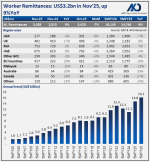
Remittances from Overseas Pakistanis - Updates

Currency experts believe remittance growth this year is weaker than in FY25. They cite concerns over a “managed” exchange rate, suggesting some inflows may be diverted away from official banking channels. Despite the rupee’s appreciation over the past two months, market participants argue the current rate may not reflect true market parity.

The government received $38bn in remittances in FY25 and has set a target of $40bn for the current fiscal year. Currency analysts believe maintaining FY25’s inflow level would support exchange rate stability.
 
Currency experts believe remittance growth this year is weaker than in FY25. They cite concerns over a “managed” exchange rate, suggesting some inflows may be diverted away from official banking channels. Despite the rupee’s appreciation over the past two months, market participants argue the current rate may not reflect true market parity.

The government received $38bn in remittances in FY25 and has set a target of $40bn for the current fiscal year. Currency analysts believe maintaining FY25’s inflow level would support exchange rate stability.

I think $43bn remittances is on cards this FY, beating combined exports of goods and services!
 
Inflows through the Roshan Digital Account (RDA) clocked in at $196 million in September, reflecting an increase of 20% compared to $164 million in August 2025, the State Bank of Pakistan (SBP) said on Tuesday.

Out of the total September inflows, $19 million has so far been repatriated, while funds to the tune of $117 million have been utilised locally.

The central bank shared that the total number of RDA accounts opened reached 862,357 from 851,756 a month ago at the end of August, showing a month-on-month increase of 10,601 accounts.

As per the latest data available on the SBP’s website, the cumulative RDA inflow clocked in at $11.11 billion by the end of the previous month, out of which $1.878 billion has so far been repatriated, while funds to the tune of $7.118 billion have been utilised locally.

Consequently, total net repatriable liability stands at $2.112 billion as of September-end.

Out of the total outstanding liability, an amount of $1,469 million is with Naya Pakistan Certificates, with $490 million in conventional NPCs and $979 million in Islamic instruments.

Similarly, an amount of $495 million is ‘balances in accounts’, the SBP data showed.

Meanwhile, Roshan Equity Investments stood at $95 million, registering a monthly increase of 16%.
 
Overseas Pakistanis don't care about Cartoon-e-Azam Imran Khan. It's that simple.

Nobody in their right mind would sacrifice their own family for Toshakhana Daku's politics.
 
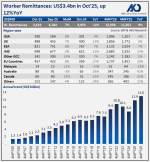
ISLAMABAD: Pakistan witnessed a significant increase in remittance inflows, 11.3 percent in September against the same month a year ago and a disturbing 55.5 percent decline in foreign direct investment - from USD417.4 million in September 2025 to USD185.6 million in September 2026 - giving a cumulative total foreign investment decline of 64.5 percent last month as opposed to the same month in 2024 - USD446.9 million to (-) USD361.1 million.

This was revealed in the Monthly Economic Update and Outlook October 2025, released by the Finance Division here on Monday.
 

November remittances hit $3.19bn​

Workers’ remittances climb 9% year-on-year to $16.145 billion in first five months of FY26​


Business
By Business Desk
December 09, 2025
  • facebook
  • twitter
  • whatsapp

A foreign currency dealer counts US dollar notes at a currency market in Karachi on July 19, 2022. — AFP/File
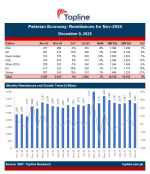
Workers’ remittances to Pakistan climbed 9% year-on-year to $16.145 billion in the first five months of the financial year 2025-26 (July-November), even as monthly inflows dropped to $3.19 billion in November, State Bank of Pakistan (SBP) data showed.

According to the SBP, remittances in November 2025 were 9% higher than the $2.92 billion recorded in November 2024, but stood 7% below October 2025’s $3.42 billion.

The July–November tally compares with roughly $14.77 billion in the corresponding period of FY25, underscoring a 9% YoY rise.

Saudi Arabia remained the largest source of inflows in November, with overseas Pakistanis sending $753 million, followed by the United Arab Emirates, which sent $675 million.

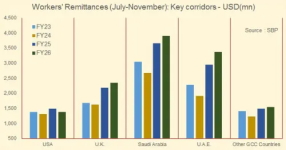
Over the first five months of FY26, remittances from Saudi Arabia amounted to $3.90 billion, from the UAE to $3.36 billion, and from the United Kingdom to $2.34 billion. In the same period, inflows from the United States stood at $1.38 billion.

Arif Habib Limited noted that remittances by overseas Pakistanis increased 9% year-on-year to $3.19 billion in November 2025 from $2.92 billion a year earlier, while declining 7% on a month-on-month basis.


It added that cumulative remittances in 5MFY26 rose 9% YoY to $16.14 billion.

In an economy alert issued today, Topline Securities said Pakistan’s remittances “came in at” about $3.2 billion in November, up 9% YoY and down 7% month-on-month, taking 5MFY26 inflows to $16.145 billion, also 9% higher than the same period of FY25.


According to Topline Research, the current remittance growth is being supported by higher manpower exports in previous years, a narrower gap between formal and informal exchange-market rates and the continuation of the remittance incentive package.

The brokerage maintained its FY26 remittance forecast at $41 billion, which would be 7.5% higher than FY25’s level of $38 billion.

 
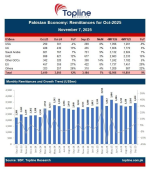
The inflow of overseas workers’ remittances into Pakistan stood at $3.2 billion in November 2025, the State Bank of Pakistan (SBP) data showed on Tuesday.

Remittances increased by nearly 9.4% year-on-year (YoY), compared to $2.9 billion recorded in the same month last year. Monthly remittances were down by 7%, compared to $3.4 billion in October.

During the first five months of the fiscal year (5MFY26), remittance inflows stood at $16.1 billion, up from $14.8 billion in 5MFY25, a jump of 9.3%.

“Remittances growth momentum is continuing on the back of higher manpower exports in previous years, lower differential in formal and informal exchange market and continuation of remittances incentive package,” said Topline Securities.

“We maintain our FY26 remittances target of $41 billion, up 7.5% from the FY25 level of $38 billion,” it added.

Meanwhile, Waqas Ghani of JS Global noted that UAE remittances have regained momentum in recent months, with their share at 21% in Nov-2025 from a low of 18% in FY24.

“Dubai in particular has seen a steady pick-up, reflecting improved inflows from Pakistani expatriates owing to some relaxation in emigration policies,” he told Business Recorder.

“Remittances from KSA and UAE continued to dominate, accounting for 45% of total inflows (vs. a 44% average over the last two years),” read a JS Global report.

“We expect this share to improve further in the coming periods, supported by increasing emigration to the region.”

Remittances play a significant role in supporting the country’s external account, stimulating Pakistan’s economic activity, and supplementing the disposable incomes of remittance-dependent households.
 
The government promotes remittances through incentives and formal channels to sustain steady growth and ensure their role in economic stability.

Back in August, SBP noted that since 2009, the Pakistan Remittance Initiative (PRI) has been working to enhance home remittances through formal channels in Pakistan. As a result of active engagements with financial institutions (FIs), the number of FIs on the PRI network has increased from around 25 in 2009 to more than 50 in 2024. The FIs include conventional banks, Islamic banks, microfinance banks, and Exchange Companies (ECs).

Further, Electronic Money Institutions (EMIs) are also allowed to receive home remittances through banks. The number of international entities has increased from around 45 in 2009 to around 400 at present.

Breakdown of remittances

Overseas Pakistanis in Saudi Arabia remitted the largest amount in November 2025 as they sent $753 million during the month. The amount was up 3% on a yearly basis, but 10% below the $838 million sent by the expatriates in the same month of the previous year.

Inflows from the United Arab Emirates (UAE) rose by 9% on a yearly basis, from $619 million to $675 million in November 2025.

Remittances from the United Kingdom (UK) amounted to $481 million during November 2025, down by 4% compared to $499 million in October 2025. YoY inflows from the UK were up by 17%.

Overseas Pakistanis in the US sent $277 million in November 2025, a YoY decrease of 4%, down 8% on a monthly basis.

Meanwhile, remittances from European Union (EU) countries clocked in at $417 million in November, recording a significant increase of 29% on a yearly basis.
 

Remittances rise 9.4pc in November

Shahid Iqbal
December 10, 2025

KARACHI: Remittances from overseas Pakistanis, the country’s most reliable source of foreign exchange, remained strong in November, raising hopes the government will be able to manage a widening current account deficit.

The State Bank of Pakistan (SBP) reported on Monday that remittances grew 9.4 per cent year-on-year to $3.2 billion in November, a trend that has remained intact since the beginning of the current fiscal year.

“Cumulatively, with an inflow of $16.1bn, workers’ remittances increased by 9.3pc during Jul-Nov FY26 compared to $14.8bn received during the same period last year,” it added.

In the wake of declining exports, the importance of remittances has further increased. The government is seeking to send more workers abroad, particularly to the Middle East, in the hope of securing higher inflows in the coming months and years.

However, hundreds of thousands of Pakistanis have left the country due to rising poverty and to seek jobs abroad, a trend experts criticise as a “brain drain”. At the same time, at least nine multinational companies have exited Pakistan, reflecting growing unease among foreign investors
 
Experts say the government is chasing remittances rather than pursuing a durable strategy to keep trade and current account balances under control. Most of the remittances, which the government expects to reach about $40bn this fiscal year, are likely to be used to narrow the trade deficit and current account gap.

Remittances also provide dollars to the State Bank, which is a regular buyer from the market for partial payments of external debt servicing. The bulk of the external debt is typically rolled over. Saudi Arabia recently rolled over $3bn for another year.

The SBP data shows that the highest remittances came from Saudi Arabia, with inflows rising 6.8pc to $3.902bn during July-November. During the same period last year, the growth from the kingdom had exceeded 36pc.

The second-highest inflows came from the UAE, totalling $3.363bn, a growth of 14pc compared to 55pc in the same period of last year.

Other major corridors included the UK ($2.384bn), the US ($1.385bn), EU countries ($2.118bn), and other GCC states ($1.544bn).

Higher remittance inflows have helped keep the exchange rate broadly stable for more than a year, providing some comfort to both importers and exporters.

Some exporters argue that the rupee is overvalued against the US dollar, citing the greenback’s recent weakness against major international currencies and stressing that there is room for a controlled depreciation to encourage exports. However, the SBP has so far shown little inclination to move in that direction.
 

BR RESEARCH:

Remittances – a lifeline with limits

BR Research
December 12, 2025

Pakistan’s remittances continued their strong momentum in Nov-25, providing the crucial support to the external account that remains fragile amid weak exports and minimal foreign investment.

According to the State Bank of Pakistan, workers abroad sent home $3.2 billion in Nov-25—slightly lower month-on-month but still far higher than last year. This brought total inflows in 5MFY26 to $16 billion, making it one of the strongest five-month periods on record.


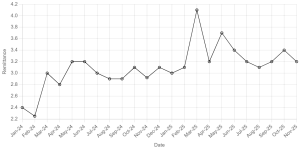
The year so far has shown consistently elevated monthly inflows, outperforming both FY24 and FY25. From July to November, remittances remained in the $2.8–3.4 billion range.

The strength reflects better compliance and pricing in the formal market, seasonal adjustments, tighter regulation of currency dealers, and higher oil-sector hiring in Saudi Arabia and the UAE. Corridor-wise data reinforces this trend: inflows from Saudi Arabia surpassed $4 billion in 5MFY26, the UAE approached $3.5 billion, and the UK and USA continued posting steady growth as diaspora incomes improved.
 
1765574152294.png

Although November softened slightly compared to October’s spike, analysts attribute the dip to the rupee’s temporary stability and slower onboarding of new overseas workers rather than a structural shift. Year-on-year momentum remains firmly positive.

Despite the upbeat numbers, the broader context is less comfortable. News reports highlight widespread abuse of Pakistani workers in the Gulf, even as their remittances rise. This illustrates a deeper issue: Pakistan’s external account is increasingly being stabilized by labour exported under harsh conditions abroad. The dependence is structural and growing.

While policymakers have celebrated rising remittances for keeping the current account deficit manageable, a more cautious reading is necessary. Historically, rising remittances have also fuelled higher imports, especially of consumer and non-essential goods.

The scatter plot visualises this correlation: higher remittances correlate with higher import spending. Thus, remittances simultaneously ease the external account by boosting inflows and strain it by raising import-driven outflows. Without a deeper understanding of this dynamic, Pakistan risks treating a temporary breather as if it were a lasting fix.
 

Users who are viewing this thread

Pakistan Defence Latest

Latest Posts

Back
Top