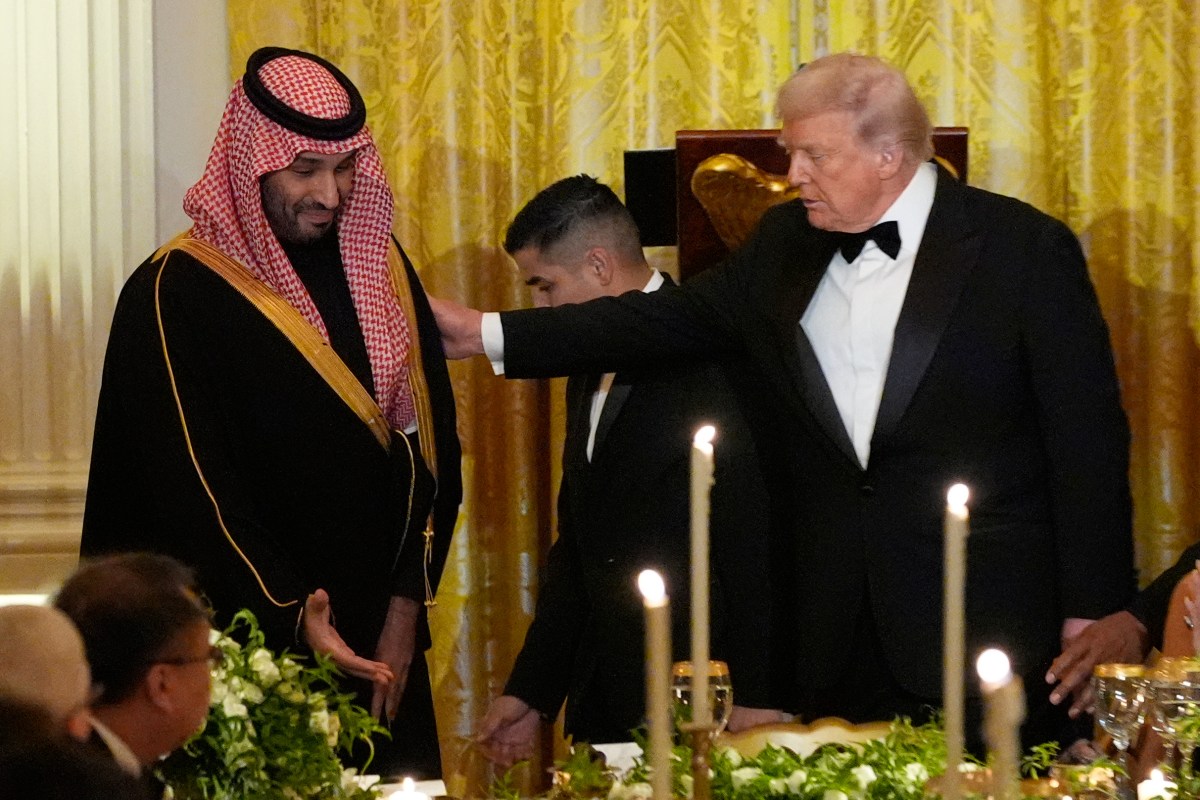
This is not the flex you think it is.
How is an personal observation/assumption that I recall even Trump saying once, a flex, LOL?
The flex here would be the enormously strategic deals on almost every imaginable front that KSA has signed with the world's foremost technological, military and economic superpower.
US, Saudi Arabia sign the Strategic Artificial Intelligence Partnership
The US and Saudi Arabia signed the Strategic Artificial Intelligence (AI) Partnership this week after
the historic White House meeting between President Donald Trump and Saudi Crown Prince Mohammed bin Salman.
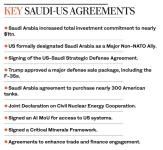
On Tuesday, Trump and MBS signed the US–Saudi Strategic Defense Agreement (SDA) and the US president formally designated the Kingdom as a major non-NATO ally (MNNA).
The following is the full statement, explaining what the AI deal entails:
“On the occasion of the signing by His Highness Prince Faisal bin Farhan bin Abdullah Al Saud, the Minister of Foreign Affairs of the Kingdom of Saudi Arabia, and The Honorable Secretary of State of the United States of America, Mr. Marco Rubio, of the Strategic Artificial Intelligence (AI) Partnership between the two countries, His Highness and Secretary Rubio affirmed that the signing of the Strategic AI Partnership is a historic step that establishes a new milestone in the strategic relationship between the two countries.
It reflects the firm commitment of both sides to advance innovation and technological progress, pursuing a long-term, comprehensive economic security partnership to deepen shared security commitments and foster economic prosperity, utilizing advanced and future technologies for the mutual benefit of our two great countries.
The two sides noted that this strategic partnership encompasses the supply of advanced semiconductors, the development of AI applications, building and developing advanced AI infrastructure, building national capabilities, and expanding high-value investments between the two countries. This partnership will contribute to boosting productivity and innovation, growth and prosperity, and achieve economic and social returns for both countries.
This Strategic AI Partnership capitalizes on the Kingdom of Saudi Arabia's competitive advantages in available land, energy resources, and geographic location to build AI technology clusters to serve local, regional, and global demand for AI and cloud computing services. This partnership also leverages the United States’ unique technology ecosystem as an engine for economic growth.
The two sides highlighted the importance of this partnership in strengthening economic relations between Saudi and American companies in future technologies, which will pave the way for developing innovative and promising solutions in various critical industries such as health, education, energy, mining, and transportation.”
The US and Saudi Arabia signed the Strategic Artificial Intelligence (AI) Partnership this week after the historic White House meeting between President

english.alarabiya.net
US, Saudi Arabia strike deal to build rare earths refinery in the Kingdom
Rare earths company MP Materials is partnering with the
US military and Saudi Arabia’s flagship mining company to build a rare earth refinery in the Kingdom, in a move that aims to diversify the global critical minerals supply chain.
Saudi Arabian Mining Company (Maaden) and the Pentagon will create a joint venture to process rare earth materials from Saudi Arabia and other parts of the world to supply the US and Saudi manufacturing and defense sectors.
Washington and Riyadh signed the Critical Minerals Framework during Crown Prince Mohammed bin Salman’s visit to the White House this week to deepen collaboration to diversify critical mineral supply chains.
“The formation of a joint venture to build a rare earth refinery in Saudi Arabia is a pivotal step toward rebalancing the global rare earth supply chain and aligns with US economic and national security interests,” MP Materials said in a statement. “The joint venture will leverage Saudi Arabia’s competitive energy base, world-class infrastructure, strategic location, and significant untapped rare earth resource potential to advance a stable and secure supply chain for rare earth materials.”
MP CEO James Litinsky said the deal would fundamentally strengthen and diversify the supply chain, adding that it further aligns US and Saudi interests.
For his part, Maaden CEO Bob Wilt hailed the “significant step forward” in developing the sector. “I am proud of the role that Maaden plays as Saudi Arabia’s national mining champion, and through our significant growth ambitions, we will continue to develop this strategic sector as an integral pillar of the Kingdom’s economy,” Wilt said.
Under the deal, MP Materials and the Pentagon will hold 49 percent of the joint venture, and Maaden will have “no less than” 51 percent. The US military will finance the joint venture, not MP Materials. It is unclear how much that investment will be.
MP Materials said it was also in talks to support or collaborate on magnet manufacturing inside Saudi Arabia.
“The joint venture will also deepen economic and security ties between the United States and Saudi Arabia and support industrial resilience without reliance on adversarial sources,” MP Materials said.
MP Materials is expected to begin construction on its second magnet manufacturing facility in the US. The company operates the world’s second-largest rare-earth mine in California.
Rare earths company MP Materials is partnering with the US military and Saudi Arabia’s flagship mining company to build a rare earth refinery in the
english.alarabiya.net
US names Saudi Arabia a major non-NATO ally as Trump, MBS sign Strategic Defense Agreement
Deals on Saudi civil nuclear energy program and critical minerals framework were also signed at the White House
President Donald Trump and Crown Prince Mohammed bin Salman
signed the US–Saudi Strategic Defense Agreement (SDA) on Tuesday, and the American president formally designated the Kingdom as a major non-NATO ally (MNNA).
Trump approved a major defense sale package, including future F-35 deliveries, after a White House meeting with MBS. As part of the arms package, Saudi Arabia will also buy nearly 300 American tanks, according to the White House.
The White House said the deals would make it easier for US defense firms to operate in the Kingdom, secure new “burden-sharing funds from Saudi Arabia to defray US costs,” and affirm that Riyadh views the US as its primary strategic partner.
Saudi Defense Minister Prince Khalid bin Salman said the SDA “underscores both nations’ firm commitment to deepening their strategic partnership, enhancing regional security, and advancing global peace and stability.”
The MNNA status, under US law, “provides foreign partners with certain benefits in the areas of defense trade and security cooperation,” but does not provide any security commitments. Other Middle Eastern countries that have previously been designated include Bahrain, Egypt, Israel, Jordan, Kuwait, and Qatar.
Separately, a Joint Declaration on the Completion of Negotiations on Civil Nuclear Energy Cooperation was signed, which, according to the White House, confirms that the US and American companies will be the Kingdom’s civil nuclear cooperation partners of choice. The agreement also ensures that all cooperation will be done in a manner consistent with “strong nonproliferation standards.”
The Critical Minerals Framework will deepen collaboration to diversify critical mineral supply chains. And the AI Memorandum of Understanding gives Saudi Arabia access to world-leading American systems “while protecting US technology from foreign influence, ensuring that American innovators will shape the future of global AI.”
Both sides agreed to pick up negotiations in the coming weeks on trade issues, including reducing non-tariff barriers and improving the investment environment.
Meanwhile, the Treasury Department and the Saudi Ministry of Finance signed agreements to enhance collaboration on capital markets technology, standards, and regulations, and deepen their partnership in international financial institutions.
During their Oval Office meeting, MBS said his country would increase investments in the United States to $1 trillion from $600 billion. “I believe, Mr. President, today and tomorrow, we’re going to announce that we are going to increase that 600 billion to almost $1 trillion investment, real investment and real opportunity by details in many areas,” the Crown Prince told the US president.
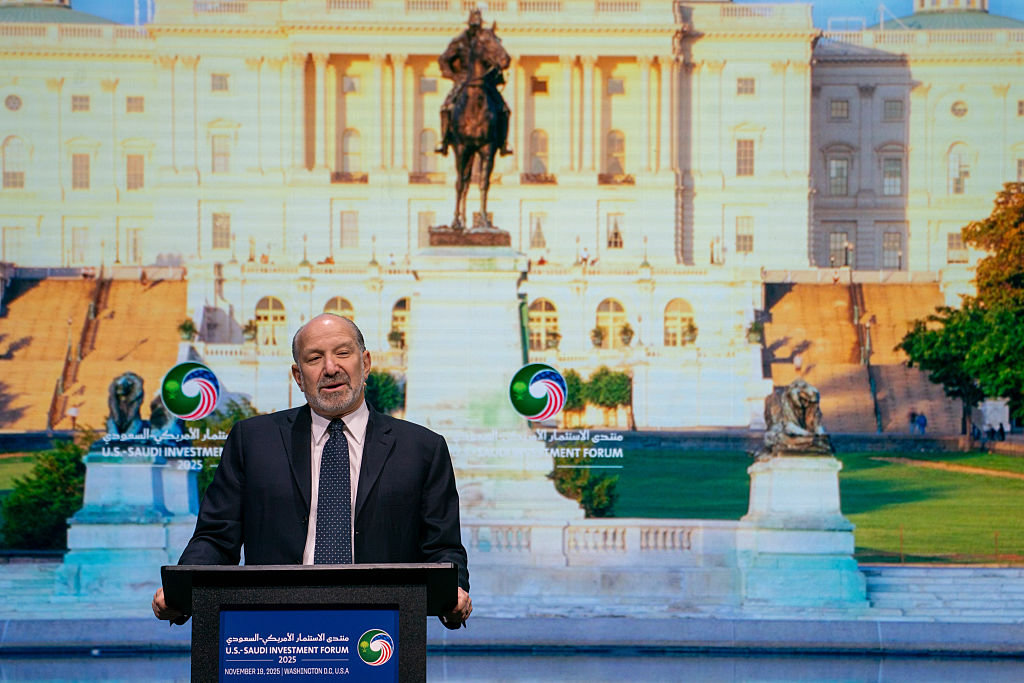
On Wednesday, Trump, MBS and over 400 CEOs from Saudi and US companies will attend the US-Saudi Investment Forum. Trump will deliver remarks, the White House announced late Tuesday.
President Donald Trump and Crown Prince Mohammed bin Salman signed the US–Saudi Strategic Defense Agreement (SDA) on Tuesday, and the American president
english.alarabiya.net
Adobe, Qualcomm partner with Humain on generative AI for Middle East
Adobe and Qualcomm said on Wednesday they are partnering with Humain, the artificial intelligence firm backed by Saudi Arabia’s sovereign wealth fund, to help the AI company develop tools for generating content in Arabic and for the broader Middle East.
The deal is one of several expected on Wednesday at a US-Saudi investment forum being held as Saudi Crown Prince Mohammed bin Salman visits Washington. MBS on Tuesday met with US President Donald Trump, who hosted a dinner with the Crown Prince and US government and business leaders.
Adobe said it will integrate Allam, a large language model trained in Arabic, into its suite of apps used to create marketing campaigns, films and television shows. Humain will in turn use what the San Jose, California, company calls Adobe Foundry to “create tailored, generative AI models unique to the Arab world,” according to an announcement from the firms.
The AI systems will run in data centers being developed by Humain and use chips from Qualcomm, which last month introduced new chips called the AI200 and AI250. Qualcomm’s chips will handle the work of generating videos created by the models Humain is developing.
“We are building a new creative intelligence that understands our language, our values, our heritage, and our future with Adobe,” Tareq Amin, CEO of Humain, said in a statement. “With the addition of Qualcomm into the collaboration, we will redefine the silicon that powers the next era of generative AI. Together, we are leading in developing creative AI for a new global era.”
Adobe and Qualcomm said on Wednesday they are partnering with Humain, the artificial intelligence firm backed by Saudi Arabia’s sovereign wealth fund, to
english.alarabiya.net
Trump sees $270 billion in agreements at US-Saudi investment conference
US President Donald Trump said on Wednesday that $270 billion in agreements and sales were being signed at a US-Saudi investment conference in Washington.
US President Donald Trump said on Wednesday that $270 billion in agreements and sales were being signed at a US-Saudi investment conference in
english.alarabiya.net
AMD, Cisco and Saudi’s Humain launch AI joint venture, land first major customer
Advanced Micro Devices, Cisco Systems and Saudi Arabian artificial intelligence startup Humain are forming a joint venture to build data centers in the Middle East and have landed their first customer, CEOs at the three companies told Reuters in an interview on Tuesday.
The yet-to-be-named joint venture will kick off with a 100-megawatt data center project in Saudi Arabia - the computing capacity of which Humain has contracted to supply generative video startup Luma AI, according to Humain CEO Tareq Amin. The size of the project and the first customer have not been reported before.
“They will be the first customer of this cluster,” Amin said, adding that Luma has contracted to purchase the entire 100-megawatt capacity.
The joint venture between the companies is a byproduct of a flurry of deals announced when US President Donald Trump visited Riyadh in May, and more collaboration is expected as Saudi Crown Prince Mohammed bin Salman and Trump meet in Washington this week. Saudi Arabia’s sovereign wealth fund has backed Humain and its plans to produce significant data center buildouts across the country because of abundant, available property and cheap power.
US tech firms such as Nvidia, Qualcomm also secured agreements in May.
In May, AMD said it formed a $10 billion collaboration with Humain that included purchases of AMD’s advanced AI chips. In the joint venture, AMD and Cisco are minority shareholders and will share in the profit and loss of the endeavor, the executives said. Humain will take the lead, AMD CEO Lisa Su said.
“We will together really have responsibility for ensuring that it’s successful,” she said.
The companies did not disclose additional financial details.
The joint venture aims to serve a market that includes Asia, Europe, India, the Middle East and Africa, Amin said, with a total market of roughly 4.5 billion people.
The plans include building up to one gigawatt of new data centers to support the joint venture by 2030.
For the initial buildout of 100 megawatts, Cisco will provide the networking equipment and other infrastructure and AMD will provide its MI450 AI chips. The first stage is planned for construction in 2026 and will use renewable energy entirely, Amin said.
Humain is receiving purchase orders for some of the future building as well. Construction has not yet begun on the various projects, Amin said.
In addition to providing infrastructure equipment, Cisco will also use its salesforce to help sell capacity in the yet-to-be-built data centers. Cisco CEO Chuck Robbins said that the company has a 25-year history of putting together incentives for its sales teams and plans to use that expertise to help Humain sell its data center capacity.
Advanced Micro Devices, Cisco Systems and Saudi Arabian artificial intelligence startup Humain are forming a joint venture to build data centers in the
english.alarabiya.net
Saudi Arabia, US sign ‘historic, multi-billion-dollar’ deal on civil nuclear cooperation
Saudi Arabia and the United States have signed a joint declaration on civil nuclear energy that “builds the legal foundation for a decades-long, multi-billion-dollar nuclear energy partnership,” the White House announced in a statement on Tuesday.
The agreement also confirms “that the United States and American companies will be the Kingdom’s civil nuclear cooperation partners of choice; and ensures that all cooperation will be conducted in a manner consistent with strong nonproliferation standards,” the statement added.
For his part, US Energy Secretary Christopher Wright said the “historic” deal was made possible because of US President Donald Trump’s “broad vision of prosperity at home and peace abroad, transforming the Middle East into a region now focused on commerce, not conflict.”
“Today was historic as the US and Saudi Arabia came together on a civil nuclear cooperation deal. Together, with bilateral safeguard agreements, we want to grow our partnership, bring American nuclear technology to Saudi Arabia and keep a firm commitment to nonproliferation,” he said in a post on X.
The announcement comes as the two countries signed several
other landmark bilateral agreements during a White House meeting between Crown Prince Mohammed bin Salman and President Trump, according to Saudi Ambassador to the United States Princess Reema bin Bandar.
Trump also announced that he was
designating Saudi Arabia as a major non-NATO ally, and the two sides revealed they had signed agreements on arms sales, artificial intelligence and critical minerals.
During a formal black-tie dinner at the White House later on Tuesday, Trump said he was “taking our military cooperation to even greater heights” by designating Saudi Arabia a major non-NATO Ally, a status that provides a US partner with military and economic privileges but does not entail security commitments.
The White House fact sheet statement also said the two sides signed a Strategic Defense Agreement, which “fortifies deterrence across the Middle East,” makes it easier for US defense firms to operate in the country and secures “new burden-sharing funds from Saudi Arabia to defray US costs.”
The White House also revealed Trump had
approved future deliveries of F-35 fighter jets and the Kingdom had agreed to purchase 300 American tanks.
The sale of the stealth fighter jets to the Kingdom, which has requested to buy 48 of the advanced aircraft, would mark the first US sale of the advanced fighter jets to Riyadh, a significant policy shift.
Until now, Israel has been the only country in the Middle East to have the F-35.
During the meeting at the Oval Office with President Trump, the Saudi Crown Prince said that the Kingdom will increase investments in the United States to $1 trillion.
“I believe, Mr. President, today and tomorrow, we’re going to announce that we are going to increase that 600 billion to almost $1 trillion investment, real investment and real opportunity by details in many areas,” MBS told Trump during a press conference in the Oval Office.
Saudi Arabia and the United States have signed a joint declaration on civil nuclear energy that “builds the legal foundation for a decades-long,
english.alarabiya.net
Saudi Aramco announces 17 MoUs with US firms potentially worth over $30 bln
Saudi state oil producer Aramco announced on Wednesday 17 memoranda of understanding and agreements with US companies with potential total value exceeding $30 billion.
It said the projects span LNG, financial services, advanced materials manufacturing and procurement of materials and services.
The CEOs from Chevron, Qualcomm, Cisco, General Dynamics and Pfizer are attending the US-Saudi Investment Forum at the Kennedy Center in Washington on Wednesday, according to the event’s program, as well as senior executives from IBM, Alphabet’s Google, Salesforce, Andreessen Horowitz, Boeing, Halliburton, Adobe, State Street and Parsons Corp.
US President Donald Trump and Crown Prince Mohammed bin Salman are attending the investment forum event that will include a wide range of companies, many of which are expected to announce investments in Saudi Arabia.
In May, during Trump’s four-day Middle East trip, the US and Saudi Arabia announced billions of dollars in investments in both countries that included defense and AI deals.
Saudi state oil producer Aramco announced on Wednesday 17 memoranda of understanding and agreements with US companies with potential total value exceeding
english.alarabiya.net
The F-35 in Saudi Arabia: A gamechanger in the region?
An F-35 jet performs performs at the Dubai Airshow in Dubai, United Arab Emirates, November 17, 2025. (Reuters)
Before the visit of Saudi Arabia’s Crown Prince Mohammed bin Salman to Washington DC had even begun, US President Donald Trump on Monday announced his plans for the US to sell the F-35 fighter plane to the Kingdom.
“They want to buy it, they’ve been a great ally,” Trump told reporters in the Oval Office. He then added: “Yeah, I will say that we will be doing that. We’ll be selling F-35s.”
On Tuesday, US Treasury Secretary Scott Bessent voiced support for the sale during an interview with Fox News, praising Saudi Arabia as a “valuable” ally in the region.
While many details have yet to be revealed about the deal and while the sale is still subject to approval by the US Congress, here’s what we know about the F-35 jets.
Under the radar
Built by US aerospace and defense company Lockheed Martin, the F-35 Lightning II, more commonly known as the F-35, is a fighter plane produced since 2004. It entered US service in 2015. There are three different subtypes: the F-35A Lightning II, the F-35B Lightning II and the F-35C Lightning II.
With speed levels of 1.6 Mach (about 1.200 mph) with full internal weapons load, a combat radius of 450 nautical miles (833 km) to 600 nautical miles (1,100 km), and ranges from 900 nautical miles (1,667 km) toto 1,200 nautical miles (2,200 km) according to its producer Lockheed Martin, it is among the fastest and most far-reaching of its generation.
In addition to speed and weapons capabilities, the F-35 has the ability to avoid and complicate detection by enemy radar due to its shape and internal sensors, earning it the nickname “the stealth jet.” Furthermore, it functions as an airborne data hub collecting and sharing battlefield information due to advanced sensor fusion automatically analyzing data from sensors and merging it into relevant information for pilots.
With costs between $80 million and $110 million, it is among the most expensive fighter aircraft currently in service.
Breaking the monopoly
In addition to US service, the F-35 is operated by several American allies and partners, including Belgium, Czech Republic, Germany, Greece, Finland, Israel, Japan, Poland, Romania, Singapore, South Korea and Switzerland.
Lockheed Martin has a long business history in the Middle East and sold defense equipment to allies and partners across the region, including Saudi Arabia.
For now, Israel has exclusive access to the F-35 in the Middle East. Delivering F-35 fighter aircrafts to Saudi Arabia would therefore usher in a new area of US weapon sales to the country and further strengthen the Kingdom’s already well-equipped and efficient armed forces.
Before the visit of Saudi Arabia’s Crown Prince Mohammed bin Salman to Washington DC had even begun, US President Donald Trump on Monday announced his
english.alarabiya.net
What does it mean for Saudi Arabia to be classified as a non-NATO ally of the US?
US President Donald Trump and Crown Prince and Mohammed bin Salman of Saudi Arabia attend the US-Saudi Investment Forum in Washington, D.C., U.S., November 19, 2025. (Reuters)
Saudi Crown Prince Mohammed bin Salman’s official visit to the US marked a leap in the defense partnership between the two countries as President Donald Trump officially
designated the Kingdom as a “major non-NATO ally” and approved the sale of F-35 fighter jets to Saudi Arabia.
Here’s a breakdown of what the designation means.
Military and defense cooperation
The designation undoubtedly represents the highest level of military and security cooperation that the US can grant to a non-NATO country, making the Kingdom a Major Non-NATO Ally (MNNA).
The classification grants the designated country significant advantages, particularly in terms of facilitating military and defense cooperation and the possibility of
purchasing advanced American weapons on favorable terms.
It will also grant the Kingdom priority access to US military defense equipment, as well as access to defense research and development programs and participation in joint military technology development projects.
Furthermore, it allows for collaboration in the production of weapons and defense systems as well as the exchange of intelligence information and the coordination of military operations.
In addition, this classification makes it easier for a non-NATO allied country to participate in exercises and maneuvers with the US military, as well as receive logistical support and military funding.
‘Most important countries’
Former US official Amos Hochstein explained to Al Arabiya that the US needs strong partners, stressing that Saudi Arabia is extremely important in this regard, as it is the largest country in the Gulf and one of the
“most important countries” in the Islamic world and the Arab world.
Meanwhile, former US Deputy Assistant Secretary of Defense Mike Milroy said that Saudi Arabia’s designation as a major non-NATO ally and its peaceful nuclear cooperation with the US strengthens Riyadh’s position as a strategic partner.
Milroy also emphasized that the approval to sell F-35 fighter jets to Saudi Arabia was an exception not granted to any other country in the Middle East.
Other developments
During the two-day visit to the US, the Saudi Crown Prince also signed a number of strategic deals including: the Strategic Defense Agreement, the
Strategic Partnership for Artificial Intelligence, the joint declaration on the completion of negotiations on cooperation in the field of civil nuclear energy, and the Strategic Framework for Cooperation in Securing supply chains for uranium, metals, permanent magnets, and critical minerals; a strategic framework for streamlining procedures to accelerate Saudi investments; financial and economic partnership arrangements; arrangements related to cooperation in the financial markets sector; and mutual recognition in accordance with US federal vehicle safety standards, in addition to a memorandum of understanding in the field of education and training.
Saudi Crown Prince Mohammed bin Salman’s official visit to the US marked a leap in the defense partnership between the two countries as President Donald
english.alarabiya.net