The SC
INT'L MOD

Saudi space sovereignty: from reconnaissance to military communications
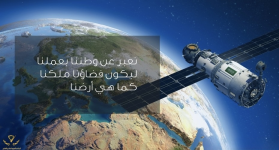
The protection of states in the modern era is no longer dependent on the accumulation of traditional military power or the mobilization of armies alone. Rather, the battle has become conducted in a higher and more complex layer, “space.” In this silent and invisible space, movements are monitored before they turn into a threat, information is collected moment by moment, and operations are managed based on a continuous and secure flow of data and communications.
For the Kingdom of Saudi Arabia, with its wide geographical reach and vital facilities with global influence, possessing advanced space capabilities in reconnaissance, remote sensing, and secure space communications was a strategic necessity, not a technical option. Satellites are no longer supportive tools, but rather have become the backbone of the command, control, and intelligence system, linking land, air, and naval units, supporting the operation of drones, and securing encrypted communications in complex operational environments.
The Saudi trend towards building national space capabilities, supported by international partnerships and advanced technologies, reflects a deep understanding of the nature of modern conflict, where battles are resolved with information before weapons, and with secure communication before field movement. From this standpoint, space today has become one of the first lines of defense for Saudi national security, and an essential pillar for protecting sovereignty and enhancing intelligence and military superiority in the face of changing threats.
Space as a military operations environment
Space is no longer a technical field limited to scientific research or civilian communications. Rather, in recent decades, it has transformed into a full-fledged military operations environment, which today stands side by side with the fields of land, sea, air, and cyberspace. In modern wars, control of space has become a basic condition for achieving operational superiority and ensuring the security of military decisions.
Satellites are the backbone of this environment, as they play the role of the eye that sees before arrival, the nerve that transmits information, and the memory that documents every movement. Through space, it is possible to monitor military movements over long distances, secure encrypted communications, support command and control systems, and provide early warning against missile and air threats.
The danger of military space lies in its silent and invisible nature, where the battle is conducted without noise, and superiority is decided before the direct confrontation begins. A country that possesses advanced space awareness can predict threats, reduce reaction time, and deprive the opponent of the element of surprise.
With the development of sensing, communications, and artificial intelligence technologies, satellites are no longer secondary support tools, but rather have become active elements in operational planning and implementation, used to direct forces, manage drones, monitor land and sea theaters, and link various military branches within a unified operational picture.
Whoever realizes the importance of space as a military operations environment does not leave his security dependent on the data of others, which explains the early Saudi trend towards possessing national satellites that serve reconnaissance, communication, and intelligence.
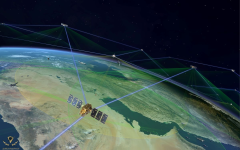
History of Saudi satellites: Steps towards space sovereignty
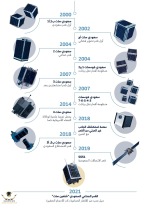
The Kingdom of Saudi Arabia's entry into the field of space dates back to 1976, with the establishment of the Arab Satellite Organization (Arabsat), in an early strategic step aimed at enhancing communications independence regionally. This trend culminated in 1985 with the launch of the first Arabsat satellites in cooperation with France, which gave the Kingdom practical experience in operating and managing space systems.
The fundamental shift in the Saudi space program came in 1998, with the establishment of the Satellite Center of the Space Research Institute at King Abdulaziz City for Science and Technology, which represented the transition point from external dependence to national industrialization and development. In 2000, the Kingdom launched the first Saudi-made satellite (SaudiSat-1), announcing its effective entry into the club of satellite manufacturing countries.
During the period from 2000 to 2021, Saudi Arabia succeeded in manufacturing, developing and launching 17 satellites, designated for civil and scientific uses, in addition to security and military missions, which contributed to building an accumulated national base of technical expertise and operational capabilities.
Saudi eyes in space: National security and defense satellites
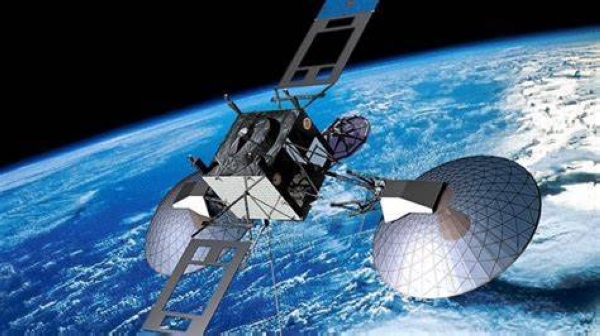
Saudi satellites for military and security use are used within an integrated system that includes image intelligence (IMINT), geographic image analysis (GEOINT), in addition to supporting encrypted communications and command and control of unmanned systems, including drones. The data of these satellites is being integrated with ground command and analysis centers to enhance field awareness and support operational decision-making.
 SaudiSat-2
(reconnaissance satellite).
Security and military tasks:
❖ Image Intelligence (IMINT)
❖ Monitoring
❖Support geographic image analysis (GEOINT)
❖Enhancing field awareness
SaudiSat‑3 satellite(High-precision reconnaissance and remote sensing satellite).
Security and military tasks:
❖Imagery Intelligence (IMINT)
❖ Geospatial image analysis (GEOINT)
❖ Continuous monitoring
❖ Support operational planning
Saudi Satellites SaudiSat‑5A / 5B(High-resolution imaging and multi-spectral sensing satellites).
Security and military tasks:
❖Imagery Intelligence (IMINT)
❖ Geographical analysis (GEOINT)
❖ Support military planning
❖ Monitoring vital facilities and areas with high accuracy
ShaheenSat satellite(A maritime and land reconnaissance and surveillance satellite - a new generation of small satellites)
ShaheenSat represents a qualitative shift in the Kingdom’s trend towards small, multi-mission satellites, as it combines high-resolution imaging and maritime traffic monitoring, making it an effective tool in supporting maritime awareness and coastal surveillance within the national security system.
Security and military tasks:
❖Maritime and Land Intelligence (IMINT / Maritime ISR)
❖ Monitoring coastal and border activity
❖ Support maritime security
❖ Combating smuggling and piracy
❖ Protection of ports and shipping lines
SaudiGeoSat-1 satelliteThe first Saudi communications satellite wholly owned by the Kingdom
SaudiGeoSat-1 is a strategic shift in the field of secure space communications, as it is the first Saudi communications satellite wholly owned by the Kingdom of Saudi Arabia, and designed to provide high-speed and stable communications services across space. The satellite is a pivotal element in connecting manned aircraft, drones, ships, ground units, and command and control centers within an encrypted and independent communications network, which enhances the ability to command and control in diverse operational environments.
The satellite provides safe, secure, jam-resistant, and viable global communications for high-priority land, sea, and air military assets, making it an essential pillar of the national command and control system.
Security and military tasks:
❖Encrypted and secure communications
❖ Connecting drones, ships, and ground forces
❖ Command and control support (C2/C4ISR)
❖ Continuity of communications in emergency situations
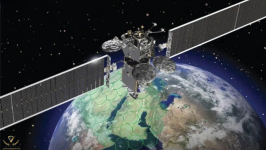
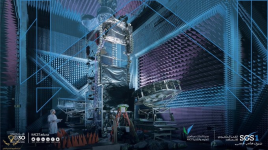
Radar sensing
Dual-frequency radar (SAR) satellite...an eye unaffected by circumstances
Unlike electro-optical imaging satellites that rely on light, SAR (Synthetic Aperture Radar) satellites have a unique ability to see day and night, and in all weather conditions, including dense clouds and sandstorms, which are common conditions in the Kingdom’s regional environment. This feature makes radar sensing one of the most reliable reconnaissance tools in sensitive military and security missions.
The importance of the dual-frequency radar satellite is highlighted in its ability to operate in two different frequency bands, which allows improving monitoring accuracy, increasing penetration depth, and diversifying imaging patterns depending on the nature of the target, whether it is land movements, maritime activity, or subtle changes in the terrain and facilities. This versatility gives intelligence analysts greater flexibility in extracting information than single-frequency satellites.
Based on these requirements, King Abdulaziz City for Science and Technology (KACST) is developing a dual-frequency SAR radar satellite as part of a national project aimed at filling a strategic gap in space sensing capabilities and enhancing independence in the field of continuous, highly reliable monitoring. This project complements the national electro-optical satellites, forming an integrated satellite reconnaissance system that is not affected by time or weather.
Dual-frequency radar satellite (national project).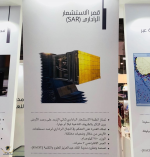
Security and military tasks:
❖Continuous radar reconnaissance
❖ Monitoring land and sea movements
❖Night surveillance and in difficult weather conditions
❖ Space intelligence support
Partnerships and participation in space capabilities
In addition to developing and launching its national satellites, the Kingdom of Saudi Arabia has taken a complementary path by utilizing advanced foreign satellites through strategic partnerships and agreements, ensuring access to high-precision and immediate space capabilities without waiting for long development cycles.
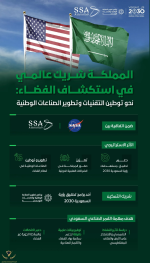
In this context, the Kingdom is the first country in the world, alongside the United States, to obtain the ability to directly control and receive high-resolution images from the WorldView satellites, under a special agreement that allows access to data immediately and with an accuracy of up to 30 cm, and not as a traditional commercial user who relies on archived images or deferred requests.
This capability provides the Kingdom with a strategic advantage in image intelligence (IMINT) and geographical analysis (GEOINT), allowing monitoring of vital facilities and areas with high accuracy and integrating data with national satellites to enhance military planning and operational decision support.
Strategic acquisition: Saudi Arabia accesses data from 77 global satellites
The Kingdom of Saudi Arabia has sought to enhance its national space capabilities beyond traditional satellites, through strategic partnerships and investments.
In this context, the Public Investment Fund, represented by NewSpace Global (NSG), acquired in 2025 the company UP42, which specializes in satellite data analysis, radar imaging (SAR) services, and geospatial intelligence.
This acquisition gives the Kingdom access to a network of more than 77 satellites around the world, including satellites with a resolution of up to 15 cm, enhancing the ability to:
❖ High-resolution image analysis using artificial intelligence.
❖ Integrate multi-source data, including SAR data, to provide an integrated and real-time intelligence picture.
❖Support command and control, operational planning, and national defense at the land, sea, and air levels.
These trends represent a crucial stage in the Kingdom’s military and security space strategy, as the ability to monitor, analyze, and communicate through space becomes a pivotal part of national defense and intelligence superiority.
The role of artificial intelligence in analyzing satellite images
Converting space data into immediate intelligence information
With the increasing number of satellites and imaging capabilities, the vast amount of space data has become too large for humans to analyze quickly and effectively. Here the role of artificial intelligence (AI) appears in analyzing satellite images and converting them into intelligence information usable for military and security use.
Main applications of artificial intelligence:
Automatic target detection
Identify vehicles, ships, facilities, or any changes on the ground quickly and accurately.
Change Detection
Compare multiple images at different time periods to detect any abnormal activity or potential threats
Pattern Recognition
Classification of types of ships, vehicles, facilities, or troop movements to support operational planning.
Data Fusion
Combining electro-optical images, radar, and AIS data from various satellites to produce a comprehensive and immediate intelligence picture.
Rapid Decision Support
Enabling KACST's ground intelligence and analysis centers to provide rapid recommendations to military command based on accurate and real-time analyses.
Ground infrastructure and control centers
The beating heart of Saudi space intelligence capabilities
No military space system is complete without a strong and integrated ground infrastructure, as it represents the heart of command and control over satellites, transforming raw data into field-applicable intelligence information. In the Kingdom, all national and foreign satellites are controlled and monitored through the Remote Sensing Center of the King Abdulaziz City for Science and Technology (KACST), ensuring advanced and reliable management of space operations.
The main components of the ground structure:
 Ground Control Stations
 Orbit management and satellite movement controlPayload guidance (cameras and radars)Implementing daily operational programs and redirecting satellites when neededAll operations are done centrally through the Remote Sensing Center at KACST
 Data Receiving StationsReceiving images, video and scientific data directly from satellitesSupporting live broadcasts from national satellites and capabilities rented from abroadProcessing data and converting it into information usable for military use
 Mission & Analysis CentersAnalysis of satellite images and maps (IMINT / GEOINT)Integrating satellite data with drones and ground radarsSupporting military planning and strategic decision-making
Strategic advantages:
Direct link between satellites and land, air and sea unitsControl the times and areas of filming to achieve prior intelligenceIntegrating national and foreign data to provide a comprehensive and immediate intelligence pictureIn short, the Remote Sensing Center at KACST represents the main nerve that transforms all Saudi satellite capabilities into operational superiority on land, sea and air.
The future of Saudi space capabilities
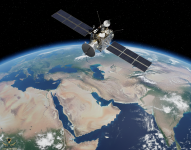
Strategic indicators indicate that the Kingdom of Saudi Arabia does not view space as a temporary support capability, but rather as one of the foundations of long-term national security. After the phase of building national capabilities and launching multi-mission satellites, the Kingdom is moving towards expanding and deepening the role of space in military and defense systems, keeping pace with the nature of modern threats and the requirements of high-tech warfare.
In 2017, reports revealed that part of the Saudi-American defense cooperation package, estimated at approximately $110 billion, was allocated to support the Kingdom’s military space capabilities. The most prominent details of this allocation are:
About $800 million to purchase two satellites for reconnaissance, monitoring, and precise sensing of strategic targets and areas.About $4 billion to develop two satellites for secure military communications and missile early warning, including support for air and missile defense systems, early warning, and guidance of interceptor missiles.This trend shows the importance of the Kingdom’s military space, not only as a reconnaissance tool, but as part of the integrated national defense system, ensuring intelligence and strategic superiority and rapid response to any potential threat.
It is also expected that the future of Saudi space capabilities will include:
Developing satellites more specialized in radar sensing and early warningEnhancing the integration of artificial intelligence into space data analysis and decision-makingRaising the level of technical independence in design, operation and controlExpanding advanced space partnerships to reach highly sensitive capabilities in short periods of timeIn light of the geopolitical transformations and the rapid development of space technologies, it seems that the Kingdom is moving towards consolidating its position as a regional power possessing advanced space awareness, and capable of using space not only for protection and defense, but as a tool of deterrence and a force multiplier in the comprehensive national security system.
Strategic conclusion: Space as a guardian of national security
National satellites and strategic partnerships represent a direct extension of the Kingdom's capabilities in intelligence, surveillance, communications, and defense.
Through this space system, the Saudi leadership possesses advanced field awareness, the ability to respond quickly, and a strategic influence in protecting sovereignty.
The continued investment in the development of satellites, radar sensing, and artificial intelligence reflects the Kingdom’s vision for the future of modern defense, where superiority is determined by information before weapons, and space becomes the first line of defense against changing threats.
Source:
Multiple sources
Multiple sources