Tang dynasty battles with the caliphate

I am very well know what about the Turks Oghuz or Kipchak


Oghuz Turks :
Turkiye , Azerbaijan , Turkmenistan , also Turks in Iran , Iraq , Syria

Kipchak Turks :
Kazakhstan , Uzbekhstan , Kyrgyzstan , also Uygurs , Tatars , Cumans , Bashkirs , etc


The Oghuz and Kipchak Turks are belong to in general same DNA lineage R1a and R1b

-------------------------------------------------------------------------

The reason for Turkiye's mixed population is the multi-ethnic structure of the Ottoman Empire and the significant migration Turkiye received from the Balkans and the Caucasus between 1821 and 1980.

Also, the Arab and Kurdish populations are large in Turkiye

but in general The Oghuz and Kipchak Turks are belong to same DNA lineage R1a and R1b
 
Kardeşim, ben zaten “Türk değildik” gibi bir şey söylemedim. Konu o değil. Benim anlattığım şey şu: Avrupa’daki Hun Türkleri ile Orta Asya’daki Türkler tamamen farklı dönemlerde ve farklı coğrafyalarda yaşadı. Aynı çağda, aynı siyasi ortamda değillerdi.

Bunu ilk okul talebesi bile biliyor
Uzun yazında daha degişik şeyler söylüyorsun ve bazı yerleri tamamen yanlış

Çinlilerin de hoşuna gidip like atıyorlar
Farklı zamanlarda yaşamış olsa da gerek Oguz Turkü ve gerekse de Kıpcak Turkü aynı DNA yı taşır ( r1a ve r1b )

Mogollar ise Turklerin kuzenleri olsa da degişik bir DNA taşırlar ( DNA haplogroup of C2 and Q2 )

------------------------------------------------------------------------

Even a primary school student knows this.

In your long post, you say different things, and some parts are completely wrong.


Although they lived at different times, both Oghuz Turks and Kipchak Turks carry the same DNA (r1a and r1b).

Mongols, although cousins of Turks, carry a different DNA (DNA haplogroup of C2 and Q2)
 
There is no such thing as a separate biological "race" for Hun, Turkmen , Kazakh, Uzbek, Uyghur, Kyrgyz, Azeri, Tatar , Bashkir or Chuvash

All of them are Turkic Peoples ( Oghuz Turk or Kipchak Turk )

Genetics has proven that there are no sharp biological boundaries separating human populations. This is especially true for Turkic history. Groups like the Huns or Göktürks were never a single, genetically uniform family.

They were vast political and cultural confederations made up of various nomadic Turkic clans that merged over centuries.
 
But the founders and rulers of the Turkic Empires have always been Turk

Let's look at the Ottoman Empire... a vast geography encompassing 44 countries and dozens of different nations.

Now, 2000 years later, it's possible to say that the Ottoman Empire wasn't a Turkish State... that Arabs were in the majority, or that its name wasn't Turkish but Ottoman


Hunnic Turk METE KHAN who ruled the Great Hun Empire from 209 BC to 174 BC celebrated for uniting all nomadic Turkic tribes under a single banner for the first time in history
Turkish history officially begins with the Great Hun Empire.
 
Bunu ilk okul talebesi bile biliyor
Uzun yazında daha degişik şeyler söylüyorsun ve bazı yerleri tamamen yanlış

Çinlilerin de hoşuna gidip like atıyorlar
Farklı zamanlarda yaşamış olsa da gerek Oguz Turkü ve gerekse de Kıpcak Turkü aynı DNA yı taşır ( r1a ve r1b )

Mogollar ise Turklerin kuzenleri olsa da degişik bir DNA taşırlar ( DNA haplogroup of C2 and Q2 )

------------------------------------------------------------------------

Even a primary school student knows this.

In your long post, you say different things, and some parts are completely wrong.


Although they lived at different times, both Oghuz Turks and Kipchak Turks carry the same DNA (r1a and r1b).

Mongols, although cousins of Turks, carry a different DNA (DNA haplogroup of C2 and Q2)
Kardeşim, ben zaten “kan bağı yok” demedim. Elbette Oğuz Türkleri, Kıpçaklar, hatta bazı Hun grupları arasında ortak genetik hatlar var. Bu normal — sonuçta hepsi geniş Türk dünyasının parçaları. Ama benim söylediğim şey kan bağıyla kültürün aynı şey olmadığı.

Ege Türkü ile Karadeniz Türkü bile kültürel olarak farklıdır. Horon başka, zeybek başka; yemekler, müzikler, gelenekler farklı. Bu onların Türk olmadığı anlamına gelmiyor — sadece farklı coğrafyalarda farklı kültürler geliştiğini gösteriyor.

Aynı mantık tarih için de geçerli.Hun Türkleri Avrupa’ya gidip Roma sınırlarında yaşamış, oradaki halklarla temas etmiş, Avrupa’nın siyasi ortamından etkilenmiş bir topluluktu. Oğuzlar ise 1000 yıl sonra batıya göç edip İran, Anadolu ve Balkan halklarıyla karışarak bambaşka bir kültürel yapı oluşturdu. Bu iki grubu “aynı dönem, aynı kültür” gibi göstermek tarihsel olarak doğru değil.

Uyghurlar da aynı şekilde Orta Asya–Çin sınır bölgesinde gelişmiş, Çin hanedanlarıyla, Tarım Havzası kültürleriyle etkileşime girmiş bir topluluk. Hunların Avrupa’da aldığı kültürel etkilerle, Uyghurların doğuda aldığı etkiler doğal olarak farklıdır.
 
Kardeşim, ben zaten “kan bağı yok” demedim. Elbette Oğuz Türkleri, Kıpçaklar, hatta bazı Hun grupları arasında ortak genetik hatlar var. Bu normal — sonuçta hepsi geniş Türk dünyasının parçaları. Ama benim söylediğim şey kan bağıyla kültürün aynı şey olmadığı.

Cultural differences don't concern us, genetics concern us, that is, blood ties.

And you're going to completely abstract Turks and almost start Turkish history from 1071

Also, no one mentioned the European Huns

I emphasized the Asian Huns. I gave the example of METE KHAN, who established the first regular Turkish Army ...... not ATILLA

------------------------------------------------------------------------

Kültürel farklar bizi ilgilendirmez ,, Genetik ilgilendirir yani kan bagı

Ve Sen cıkıp Turkleri tamamen soyutlaştırıp neredeyse Türk tarihini 1071 den başlatacaksın

ayrıca Avrupa Hunlarından bahseden olmadı ,,
Asya Hunlarına vurgu yaptım . ilk düzenli Turk Ordusunu kuran METE HAN ı örnek gösterdim .. ATILLA yı degil
 
Cultural differences don't concern us, genetics concern us, that is, blood ties.

And you're going to completely abstract Turks and almost start Turkish history from 1071

Also, no one mentioned the European Huns

I emphasized the Asian Huns. I gave the example of METE KHAN, who established the first regular Turkish Army ...... not ATILLA

------------------------------------------------------------------------

Kültürel farklar bizi ilgilendirmez ,, Genetik ilgilendirir yani kan bagı

Ve Sen cıkıp Turkleri tamamen soyutlaştırıp neredeyse Türk tarihini 1071 den başlatacaksın

ayrıca Avrupa Hunlarından bahseden olmadı ,,
Asya Hunlarına vurgu yaptım . ilk düzenli Turk Ordusunu kuran METE HAN ı örnek gösterdim .. ATILLA yı degil
You can believe what you want.

I don't see Turks and Mongols as same people.
 
You can believe what you want.

I don't see Turks and Mongols as same people.

Kardeşim dalgamı geciyorsun .. Kimse Turkler ile Mogollar aynı halk demedi

Nobody said Turks and Mongols are the same people.
even I gave detailed info ...

Oghuz Turks and Kipchak Turks carry the same DNA (r1a and r1b).

Mongols carry a different DNA (DNA haplogroup of C2 and Q2)
 
The Mongols established a great empire once in history, under the leadership of Genghis Khan ( Mogol )

The Turkic Peoples on the other hand, did so 16 times, including the Great Hun Empire under the leadership of Mete Khan ( Turk )


Both of these leaders united the Turks and Mongols under one banner.

Even Genghis Khan's Army consisted of 80% Turkic soldiers
 
People often throw every steppe group into one basket — Huns, Mongols, Xiongnu, Xianbei, Uyghurs, Oghuz — as if they were all one unified “Turkic super‑tribe.” But historically, these groups were very different from each other, even if some of them interacted, mixed, or shared cultural elements over long periods.

The Huns are a good example. They were a multi‑ethnic confederation that included early Turkic‑speaking tribes, but they weren’t identical to later Turks. Their empire stretched from Central Asia to Europe, and they influenced both the steppe world and the Roman frontier. They’re part of the broader Turkic story, but not in the same way as the Oghuz or the Göktürks.

Anatolian Oghuz Turks — the ancestors of modern Turks in Türkiye — followed a completely different historical path from groups like Uyghurs or Mongolians. Once the Oghuz moved west, they mixed with Persians, Arabs, Greeks, Armenians, and other Near Eastern peoples. Their culture, religion, and political systems evolved in the Persian‑Byzantine world, not the Chinese‑Mongolian one. That’s why Anatolian Turks today differ so much from Central Asian Turks in language accents, appearance, and cultural habits.

Uyghurs, on the other hand, developed inside the eastern steppe and Chinese frontier zone. Their history is tied to the old Uyghur Khaganate, the Tarim Basin, Buddhist and later Islamic influences, and long interaction with Chinese dynasties. They’re Turkic, but their cultural evolution is completely different from the Oghuz.

Mongolians are even more distinct. They’re not Turkic, but they share a long history of cultural exchange with Turkic tribes — horse nomadism, Tengri beliefs, steppe warfare, clan structures. The closeness is mostly cultural and political, not genetic. Mongols absorbed many Turkic tribes during the empire, and Turkic groups absorbed Mongolic elements in return, but they remain separate peoples.

As for the Xianbei, they were an ancient nomadic group from northern China and Mongolia, usually classified as proto‑Mongolic. They interacted with early Turkic tribes, and some Xianbei clans later merged into Turkic or Mongolic confederations. They’re part of the steppe mosaic, but not a Turkic people themselves.

So yes — Turkic history is broad and interconnected, but it’s not a single straight line. Huns, Oghuz, Uyghurs, Mongols, Xianbei — all played roles in the wider steppe world, yet each followed its own path. That’s why modern Turkic peoples can share linguistic roots while still looking, living, and thinking very differently today.

Hope this helps.
Such a detailed explanation. benefit a lot. Thank you. But I've read that the DNA of modern Türkiye is close to that of Greece. What's going on?
 
Its just tiring people keep trying to lump every Turkic‑related group into one single identity ... Huns, Uyghurs, Oghuz, Mongols, Xiongnu, Xianbei — as if they were all the same people living in the same era. But historically, these groups lived in completely different regions, under different empires, and followed totally different cultural paths. It makes no sense to mix the Huns who were fighting Rome with the Turkic tribes living under the Tang Dynasty a thousand years later.

The Oghuz Turks .. the ancestors of modern Turks in Anatolia — developed in a very different world from Uyghurs and other Central Asian Turks. Once the Oghuz moved west, they entered the Persian‑Arab‑Byzantine sphere. They mixed with Greeks, Balkan, Slav peoples, and the descendants of Roman Anatolia. Their culture shifted toward Islam , and Mediterranean influences. That’s why Anatolian Turks today look, speak, and live differently from Uyghurs or Kazakhs, even though they still share Turkic linguistic roots and some deep ancestry.

Uyghurs and other eastern Turkic groups evolved inside the Chinese‑Mongolian frontier zone. Their history is tied to the old Uyghur Khaganate, the Tarim Basin, Buddhist traditions, and later Islamic influences. They interacted heavily with Chinese dynasties and Mongolic tribes. Their cultural development is eastern, not western. They’re Turkic, but their path diverged from the Oghuz long before the Seljuks ever set foot in Iran or Anatolia.

Meanwhile, the Huns represent an even earlier chapter. They were a multi‑ethnic confederation that included early Turkic tribes(A lot of Germans), but they were not identical to later Turks and yet I still feel closer to Oghuz Turks and Anatolians. What matters is where they were: in Europe. Hunnic forces were on the Danube, in Gaul, and at the gates of Rome around 500 years before the Oghuz Turks migrated into Anatolia. The Hunnic Turkic presence in Europe belongs to Late Antiquity, not the medieval Turkic migrations. Mixing those two timelines together is historically inaccurate.

And then there are groups like the Xianbei, who were proto‑Mongolic nomads in northern China and Mongolia. They interacted with early Turkic tribes, and some clans later merged into Turkic or Mongolic confederations, but they were not Turks themselves. They’re part of the wider steppe mosaic, not part of the Oghuz lineage.

So yes — Turkic peoples share linguistic roots and some ancient blood ties, but they were never one uniform nation. The Oghuz Turks who shaped Anatolia are not the same as the Uyghurs of the Tarim Basin, and neither are the same as the Huns who fought Rome. Different eras, different regions, different histories — connected, but not interchangeable.
A nation that is not good at warfare cannot have a large population, but has long disappeared into the long river of history. If Chinese people are not good at war, they will not control all the best lands in East Asia, will not have the largest ethnic group in the world, and will not have almost pure bloodline and uninterrupted historical and cultural heritage.
 
Chinese never had ability to rule Worldwide .... never
Chinese tried once, and in 751 the Karluk Turks stopped the Chinese


-- Turkic Dynasties ruled India and Iran for 800-900 years
-- Turkic Dynasties ruled Russians until 1570s
-- Turkic Dynasties ruled Egypt , North Africa , Greece , all Balkans and Middle East for centuries

-- Turkic People would be able to rule China
but a highly conscious and strategic decision not to settle in China or directly govern its massive population to avoid assimilation


Turkic Empires always were destroyed by another Turkic Empires

16 great Turkic Empires
View attachment 211837
View attachment 211836

okya.

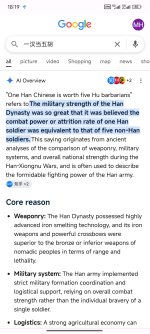
Let me tell you an East Asian proverb about the combat effectiveness of Han soldiers. "一汉抵五胡". It means: One Han Chinese is worth five Hu Barbarians.

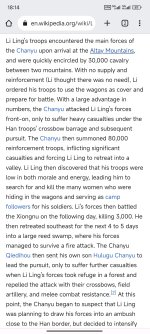
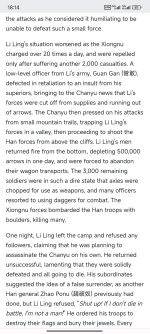
In order to give you some understanding of the difference in combat effectiveness between Han Chinese soldiers and Xiongnu soldiers, I will also provide you with a screenshot of the best performance of Xiongnu soldiers in the Battle of Juyan during the Han Xiongnu War. Even if the imperial guards of the Xiongnu royal court ambushed 5k ordinary border troops of the Han Dynasty with 110k soldiers, they barely won the war with a very high exchange ratio. This war is a representative manifestation of the individual combat effectiveness of soldiers from both sides.


btw:When you belittle the combat effectiveness of the Han people, I remind you to think about how many ethnic groups have been annihilated by the Han people in thousands of years of history. Guifang, Rongdi, Donghu, Xiongnu, Wuhuan, Xianbei, Gaoche, Turkic, Huihe, Khitan, Dangxiang... More than two thousand ethnic groups were annihilated by the Han people and left their names recorded in history. There are even thousands without a named record. If the Han ethnic group is not a fighting nation, then what are these losers? Yes, the population is sparse north of the Great Wall. But do you really think the reason is that those nomadic peoples don’t like to have children?


Screenshot_2026-08-22-18-19-45-592_com.android.chrome.jpg


Screenshot_2026-08-22-18-14-23-847_com.android.chrome.jpg
Screenshot_2026-08-22-18-14-31-336_com.android.chrome.jpg
 
Last edited:
A nation that is not good at warfare cannot have a large population, but has long disappeared into the long river of history. If Chinese people are not good at war, they will not control all the best lands in East Asia, will not have the largest ethnic group in the world, and will not have almost pure bloodline and uninterrupted historical and cultural heritage.
I know nothing about Chinese history.

Wouldn't be fair to comment.
 
okya.

Let me tell you an East Asian proverb about the combat effectiveness of Han soldiers. "一汉抵五胡". It means: One Han Chinese is worth five Hu Barbarians.

In order to give you some understanding of the difference in combat effectiveness between Han Chinese soldiers and Xiongnu soldiers, I will also provide you with a screenshot of the best performance of Xiongnu soldiers in the Battle of Juyan during the Han Xiongnu War. Even if the imperial guards of the Xiongnu royal court ambushed 5k ordinary border troops of the Han Dynasty with 110k soldiers, they barely won the war with a very high exchange ratio. This war is a representative manifestation of the individual combat effectiveness of soldiers from both sides.


btw:When you belittle the combat effectiveness of the Han people, I remind you to think about how many ethnic groups have been annihilated by the Han people in thousands of years of history. Guifang, Rongdi, Donghu, Xiongnu, Wuhuan, Xianbei, Gaoche, Turkic, Huihe, Khitan, Dangxiang... More than two thousand ethnic groups were annihilated by the Han people and left their names recorded in history. There are even thousands without a named record. If the Han ethnic group is not a fighting nation, then what are these losers? Yes, the population is sparse north of the Great Wall. But do you really think the reason is that those nomadic peoples don’t like to have children?


View attachment 211862


View attachment 211863
View attachment 211864
Lol, the Turks in history tried hard to invade and conquer China in the Sui and Tang dynasties. Instead, they were smashed into pieces, totally defeated and chased away to far away corners from China. Now talk of hypothetical wet dream that they would had conquered and ruled China as if real history didn't happen.
 
Lol, the Turks in history tried hard to invade and conquer China in the Sui and Tang dynasties. Instead, they were smashed into pieces, totally defeated and chased away to far away corners from China. Now talk of hypothetical wet dream that they would had conquered and ruled China as if real history didn't happen.
Battle reports may lie, but the battle lines do not. We only need to see who occupies East Asia and who has fled to Europe.
 
  • Like
Reactions: ety

Users who are viewing this thread

Pakistan Defence Latest

Back
Top