Nuclear Proliferation Issues
This appendix is based on paper by Michael Wilson, 1995, The Nuclear Future: Asia and Australia and the 1995 Conference on Non-Proliferation, publ. by Griffith University. Used with author's permission.
Pakistan (along with India and Israel) was originally a "threshold" country in terms of the international non-proliferation regime (see page on
Safeguards to Prevent Nuclear Proliferation), possessing, or quickly capable of assembling one or more nuclear weapons. Their nuclear weapons capability at the technological level was recognised (all have research reactors at least) along with their military ambitions.
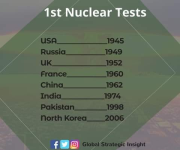
Then in 1998 India and Pakistan's military capability became more overt. All three remained outside the 1970 Nuclear Non-Proliferation Treaty (NPT), which 186 nations have now signed. This led to their being largely excluded from trade in nuclear plant or materials, except for safety-related devices for a few safeguarded facilities.
Regional rivalry
Relations between Pakistan and India are tense and hostile, and the risks of nuclear conflict between them have long been considered quite high.
In 1974 India exploded a "peaceful" nuclear device and then in May 1998 India and Pakistan each exploded several nuclear devices underground. This heightened concerns regarding an arms race between them.
Kashmir is a prime cause of bilateral tension, its sovereignty being in dispute since 1948. There is persistent low-level military conflict due to Pakistan backing a Muslim rebellion there.
Both countries engaged in a conventional arms race in the 1980s, including sophisticated technology and equipment capable of delivering nuclear weapons. In the 1990s the arms race quickened.
In 1994 India reversed a four-year trend of reduced allocations for defence, and despite its much smaller economy, Pakistan pushed its own expenditures yet higher. Both then lost their patrons: India, the former USSR, and Pakistan, the USA.
Pakistan has offered to disarm and join the NPT if India would, although both countries see the NPT as unfair and India would prefer other international arrangements for limiting weapons proliferation.
Pakistan's weapons technology is based on the production of highly enriched uranium suitable for nuclear weapons, utilising indigenous uranium. It has at least one small centrifuge enrichment plant.
In 1990 the US administration cut off aid because it was unable to certify that Pakistan was not pursuing a policy of manufacturing nuclear weapons though this was relaxed late in 2001.
In 1996 the USA froze export loans to China because it was allegedly supplying centrifuge enrichment technology to Pakistan.