Trainer Aircraft of Pakistan Air Force

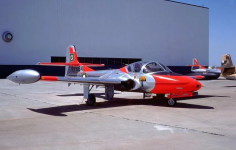
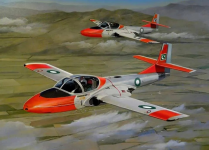
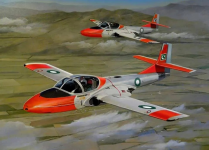
Unique Livery of PAF T-37.

FfSCb14XkAQO6kB
 
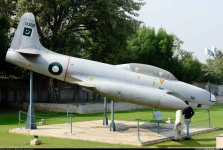
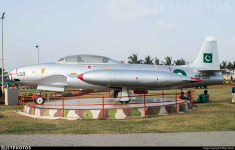
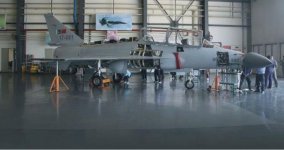
Lockheed T-33A Shooting Star
Serial #: 8598

1706200741588.png
 
Last edited:

FINAL FIVE NIGERIAN SUPER MUSHSHAKS DELIVERED​

  1. Aviation Features
  2. Final five Nigerian Super Mushshaks delivered


By Dave Allport 15th February 2018
FEATURE

img_23-4_2.jpg

The final five NAF Super Mushshaks awaiting reassembly after arriving at Kaduna.
NAF
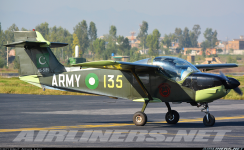
NIGERIA HAS taken delivery of the final five Super Mushshak trainers ordered from Pakistan. The dismantled aircraft arrived at Nigerian Air Force (NAF) Base Kaduna on board an Il-76 transport aircraft on January 14.
They were due to be reassembled by a team of NAF and Pakistan Air Force (PAF) technicians, before being test flown and formally inducted into service.
The NAF signed a contract for ten Super Mushshaks on October 21, 2016 after primary flying training had almost completely ceased the previous year, leading to an urgent requirement for a new type.
The aircraft will be flown by 401 Flying Training School at Kaduna. The first five were delivered on July 14 last year (see Nigeria receives newbuild Super Mushshaks, September 2017, p22), although prior to this the NAF had temporarily loaned four aircraft from PAF stocks to meet its urgent training requirements.
These stopgap aircraft (NAF 260, 392, 394 and 395) were airfreighted back to Pakistan on October 23 last year – see Loaned Nigerian Mushshaks returned to Pakistan, December 2017.
 
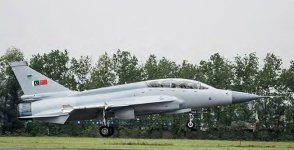
On April 27, the first prototype of the two-seat JF-17B Thunder multi-role fighter performed its maiden flight at Chengdu, China. This version was unveiled by CAC/CATIC at the 2013 Paris Air Show and thereafter the design evolved. Most obviously, the new aircraft features not only a second, aft cockpit and a dorsal spine accommodating the relocated avionics, but also has a slightly taller and more prominently swept tailfin: features that change the look of the fighter from the single-seat variant.

Overall the JF-17B is based on the current Block II JF-17A configuration featuring an inflight refuelling probe and other systems inherited from the forthcoming Block III JF-17A; an enlarged forward fuselage section and radome to house an active electronically-scanned array radar – most likely a KLJ-7A – and a new three-axis fly-by-wire flight control system. Manufacture of the first prototype (c/n 01) had started by early May 2016 and was reportedly complete by December. Reports prior to its maiden flight suggest a first taxi test was performed on April 21. The JF-17B trainer has been built primarily to meet the needs of prospective export customers, which require a dedicated trainer for conversion training. In Pakistan Air Force service, the JF-17B could therefore be used most of all as a lead-in-fightertrainer. Reportedly three JF-17Bs are currently on the production line and two of them will later be delivered to the Pakistan Air Force.
img_5-2_8.jpg
 
img_5-1_7.jpg

The Kaduna-based 301st Flight Training School accepted the first four of ten Super Mushshak trainers on December 5, 2016. The new trainers will supersede the Dana Air Beetle.
Nigerian Air Force
 
img_66-2_44.jpg
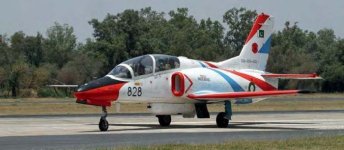
Although acquired as a trainer, the Pakistan Air Force’s K-8P can be fitted with a 23mm cannon in a centreline pack to fulfil a secondary attack role. K-8P serial 08-09-828 serves with 1 Fighter Conversion Unit at PAF Base M M Alam.
Alan Warnes
The K-8W doesn’t have radar but can provide a useful ‘bang for the buck’ with its five hardpoints. A 23mm gun or laser targeting pod can be mounted on the centreline, while ‘smart’ weapons, such as 50kg or 100kg (110 or 220lb) LS-6 laser-guided bombs, HF-20 rocket launchers and PL-5E or YJ-9E missiles, can be fitted to the outer underwing pylons. The inner pylons can accommodate 6kg, 11kg and 50kg (13lb, 24lb or 110lb) training bombs.

Owing to military sanctions, AVIC only offers K-8s with the Ukrainian Motor Sich AI-25TLK turbofan engine, which has suffered spare parts shortages in the past. Co-developer Pakistan meanwhile operates its K-8P trainers with Honeywell TFE731 turbofans.
 
img_26-1_0.jpg

JF-17B 17-601 was being fitted with an air-to-air refuelling system in late April.
Alan Warnes

PAKISTAN’S FIRST JF-17B, 17-601, is receiving an air-to-air refuelling system. The two-seater, known as P1, arrived in Pakistan in March last year and was expected to commence aerial refuelling trials by the end of May. To date, the aircraft has completed around 100 hours of flight testing in both China and Pakistan. The trials programme, being carried out by the Pakistan Air Force’s (PAF’s) Flight Test Group, will soon be boosted by the arrival of a second dual-seater.

Air Marshal Ahmer Shahzad, chairman of Pakistan Aeronautical Complex (PAC) Kamra, recently confirmed to AFM that the contract for 26 JF-17Bs, signed in late 2017, will lead to assembly of the first eight platforms at Kamra during the second half of this year, followed by another 14 in 2020 and the last four in 2021.

The PAF hopes to start inducting the first JF-17Bs next year in a bid to speed up the training of JF-17 pilots, who are currently flying on Mirages, F-16s or F-7PGs before progressing to the new fighter. It’s also hoped a dual-seater will contribute to the sales drive which is being shared between PAC and the Aviation Industry Corporation of China (AVIC).
 
Syria begins flying Mushshaks again

AN IMAGE posted on social media on May 30 reveals that the Syrian Arab Air Force has brought at least one of its MFI-17 Mushshak trainer aircraft back to airworthy condition. The photo, taken by the pilot from inside the aircraft, shows it undertaking an aerobatic manoeuvre over an unidentified air base.

Six of the type were delivered from Pakistan in 1994 for advanced training and are believed to have been based at Jirah/ Kshesh but have not been reported operational for many years. The country’s civil war has made it impossible to accurately confirm details of the status of these aircraft, although Jirah is believed to have been inactive since around 2013, so the current location of the Mushshaks is unknown. They could now be housed at Rasin el Aboud, where other training assets are based, including SIAT 223K-1 Flamingos and L-39ZA Albatros. It’s also unclear whether more than one of the type is now active again. Dave Allport.
 
1707511415186.png


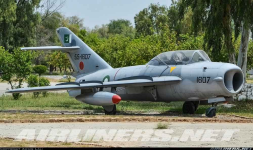
FT-5
 

Users who are viewing this thread

Latest Posts

Back
Top