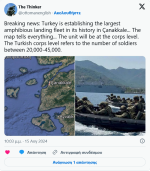
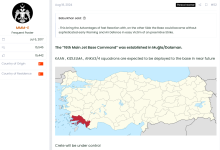
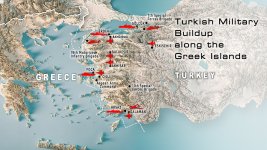
One violates treaty, the other doesn't.
That's what I'm fucking tired again and again: It doesn't.
It only proves your narrative is full of hypocrisy and double standards
“Greece systematically violates the internationally recognized demilitarized status of the Eastern Aegean islands; because of this violation Turkey may challenge Greece’s sovereign titles to the Aegean islands and the rights of these islands to maritime zones of their own”. In our opinion, these are mock arguments.
Ab initio (first) and
in principio (foremost, in principle), in none of the international treaties, which describe and define the territorial sovereignty in the Aegean islands, the Greek sovereignty
depends on or was granted under the clause of a “demilitarization”. Nor the so-called “demilitarization” status (where, as and
if applicable)
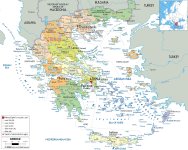
was set as a prerequisite for the recognition of Greek sovereignty in the Aegean islands conceded to Greece, namely those that are far from 3 miles from the Turkish coastline of the Aegean (except Imbros, Tenedos, and the Rabbit Islands, which remained under Turkish sovereignty). Finally, it is both a legal and a logical distortion to allege that alongside sovereignty Turkey may also challenge the rest of the rights of the Greek islands in the Aegean regarding all (!) their maritime zones (that is, the Greek national territorial sea, the potential continental shelf, and the EEZ)! Even a non-lawyer or a first-year law student can perceive the flimsiness of the aforementioned Turkish arguments and legal claims. Then, what’s the point for Turkish officials to circulate such defective assertions if they understand that these claims would be refuted and dismissed in any international court of justice
? Because, in our opinion, the above Turkish positions do not constitute legal argumentation, but covert, though direct, threats against the territorial integrity of Greece.
Contrary to the above Turkish assertions, the Greek counterarguments are well-founded from every point of view (legal, and so on). It is worth adding one more syllogism in favor of the Greek positions, which is curiously still absent from the Greek quiver. From the moment Greece, like Turkey, de jure joined the NATO military alliance as a full member without any exceptions or “asterisks” (1952), all previous provisions of the international treaties on the limited “militarization” (1923 Lausanne Treaty) or the complete “demilitarization” (1923 Lausanne Treaty, 1947 Paris Treaty) of the Greek islands in the Eastern Aegean became implicitly though de facto inactive.
Otherwise, what would be the point and value of full membership in a defensive military alliance when large portions of the territory of an allied country would remain under a regime of partial or full demilitarization, hence considered also as areas for a limited deployment of military forces? What kind of a defensive umbrella could the NATO alliance “fully” provide, and how exactly could NATO “fully” defend and protect a “partially demilitarized and defenseless” allied country? Isn’t it inherently incompatible for a “military alliance” to bear “extended demilitarized zones” on the territory of one of its member-states?
Consider for a moment the following paradox: the mutual defensive zone of NATO’s southeastern flank running through Greece and Turkey from the Turkish border in the Caucasus to the Greek islands in the Ionian Sea and almost at the “joining point” of this common defense area a misplaced “partial or complete demilitarized zone” existing from Samothraki in the north to the Dodecanese in the south! Does anyone honestly think this makes sense: the absurd notion of a “military vacuum” that disrupts the cohesion and tears apart the defense of the entire southeastern flank of NATO?
Finally, we point out the best riposte – according to our opinion – against Turkey’s illusion on the issue:
whereas, according to the Potsdam Conference and the accompanying agreements (1945), the defeated in WW II and unconditionally surrendered
Germany was fully demilitarized, in the end, both post-war German states (West Germany and East Germany), were fully militarized de facto once they joined the two rival alliances, NATO and the Warsaw Pact respectively. Therefore, the same should be considered to apply de facto for Greece though a completely different case compared to Germany.
Turkey’s unsubstantiated claims about the military status of Greece’s Eastern Aegean basin become even more frivolous if someone takes into consideration the fact that during the 1950s and the 1960s the USA, Greece, Turkey, and several other NATO allies conducted large aeronautical and military exercises (for example, “Operation Longstep”) in Greek, Turkish and international waters in the Aegean Sea (in the Gulf of Smyrna, the Chios Straits, or on the sea and shorelines of the Northern Aegean)! After all, according to NATO (I quote): “
the defence of Greece’s northern border was crucial, so was that of its endless coastline and myriads of islands”; so, “
NATO created” “
a military command called Allied Land Forces Southeastern Europe (LANDSOUTHEAST) […] responsible for an area that stretched from the Caucasus to the western shores of Greece”! So, a
s early as 1952, NATO de facto canceled the partial or complete demilitarization of those “partially or fully demilitarized” island regions of Greece.
Therefore, the selective memory of Turkish officials aims not at enlightening but at distorting events and facts, as well as misinforming and deceiving foreign officials, various international organizations, and the public opinion of the world. Now that Russia has turned again into a “strategic opponent” of NATO, it is perhaps an opportunity for the Greek government to issue a note verbale to remind that Greece was admitted into the NATO alliance for securing the defense of its whole territory on land and in the seas, and to reiterate that the “militarization” of the Aegean Greek islands provides a “strategic depth” to the defense of the southeastern flank of the Alliance, at whose disposal the Greek military forces stationed there will be placed whenever needed! Moreover, it is worth skillfully emphasizing to the rest of our NATO allies that Turkey’s objections and claims against Greece on this particular issue, not only do not serve the Alliance’s interests but instead aim ultimately at weakening the defense of NATO’s southeastern flank.




 Turkey was helping Iran during the Iran-Israel war - Yasar Guler, Defense Minister of Turkey