Navigation
Install the app
How to install the app on iOS
Follow along with the video below to see how to install our site as a web app on your home screen.
Note: This feature may not be available in some browsers.
More options
Style variation
You are using an out of date browser. It may not display this or other websites correctly.
You should upgrade or use an alternative browser.
You should upgrade or use an alternative browser.
US Economy - News, Updates and Discussion
- Thread starter Get Ya Wig Split
- Start date
More options
Who Replied?
Davey Crockett
Elite Member
Hedge funds are making a multi-billion-dollar gamble against the US economy, betting Donald Trump's presidency will result in a massive market crash that could devastate 401(k)s, pensions, and household savings across America.
Hedge funds massive bet on stock market crash raises alarm for 401k's https://www.dailymail.co.uk/news/ar...tml?ito=native_share_article-nativemenubutton
Hedge funds massive bet on stock market crash raises alarm for 401k's https://www.dailymail.co.uk/news/ar...tml?ito=native_share_article-nativemenubutton
Davey Crockett
Elite Member
Davey Crockett
Elite Member

Hamartia Antidote
Elite Member
People living in San Jose one of the most expensive markets in the US

 gvwire.com
In Today's Housing Market, Many Families Find the American Dream Out of Reach
gvwire.com
In Today's Housing Market, Many Families Find the American Dream Out of Reach
So why are you crying??? Whut??
Hey I want to play in the NBA but alas the players in the NBA are really good. I don't want to play in the minors because it doesn't pay big money...the current basketball system sucks because it is working against me!! I should be able to play in the NBA.
In Today's Housing Market, Many Families Find the American Dream Out of Reach
Rising costs and limited supply are reshaping the American dream of homeownership, forcing many to reconsider their housing options.
gvwire.com
that sucksThe 42-year-old chiropractor had hoped she and her husband, Steve, a 39-year-old dental hygienist, would have bought a house by now. But when they can afford a bigger place, it will have to be another rental. Petersen has done the math: With mortgage rates and home prices stubbornly high, there’s no way the couple, who make about $270,000 a year and pay about $2,500 in monthly rent, can afford a home anywhere in their area.
That sucks tooAccording to October data from the Federal Reserve Bank of Atlanta, a San Jose family with a median income of $156,700 would need to spend 80% of their income on housing — including an $8,600 monthly mortgage payment — to own a median-priced $1.54 million home. That’s far higher than the general rule of thumb that people should pay no more than 30% of their income on a mortgage or rent.
WTF!!!! Let me get this straight...you want to live there because it pays good money..but you are upset because there are also many other people there who also get paid good money thus increasing housing competition and causing housing prices to rise.Moving out of state is out of the question for the Petersens — they have strong family ties to the area and their income would plummet if they move to a lower cost-of-living area. “I’m not willing to give up my job and close connections with my family for a house,” Petersen said.
So why are you crying??? Whut??
Hey I want to play in the NBA but alas the players in the NBA are really good. I don't want to play in the minors because it doesn't pay big money...the current basketball system sucks because it is working against me!! I should be able to play in the NBA.
Last edited:
Hamartia Antidote
Elite Member
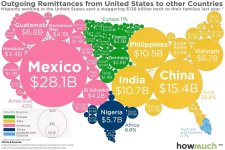
Nigeria $5.7B...wtf?? Is this including scamming?

Davey Crockett
Elite Member
Nigeria $5.7B...wtf?? Is this including scamming?


RabzonKhan
Trusted Member

How Trump's tariffs on China delivered a 'double-whammy' to Temu and Shein
By business reporter Kate Ainsworth 2/6/2025
It was always a matter of when, not if, Donald Trump would introduce a fresh set of tariffs on his return to the White House.
Within a fortnight of taking office for his second term, the US president cracked down on a measure that puts him at odds with his Reagan-inspired campaign battle cry: "Are you better off than you were four years ago?"
While his tariffs on Canada and Mexico have been given a 30-day reprieve, China hasn't been so lucky, with all Chinese products imported to the US now attracting a new 10 per cent tariff.
At the same time, the US has cracked down on a little-known tax loophole that allows millions of parcels into the country every week from cheap e-commerce retailers, including Shein and Temu.
A cost-of-living crisis turbocharged both companies' presence in the US, and Mr Trump's first presidency ironically helped them gain a strong foothold in the country.
But now, the double-whammy of new tariffs and the suspension of a tax loophole will see everyday Americans pay an even higher price.
One loophole, millions of parcels
Since 2015, Americans have been able to buy items from overseas without getting hit with an import tax — so long as the value of the parcel is under $US800 ($1,275).It operates the same as a duty-free allowance, but it has a more complex-sounding name: the de minimis exemption.
The loophole had been publicly questioned long before Mr Trump's inauguration, with the Biden administration announcing last September that it was looking to take action against the volume of de minimis shipments arriving in the country.
At the time, the Biden administration said the actions were about addressing the "significant increased abuse of the de minimis exemption", with a focus on Chinese-founded e-commerce platforms, such as Shein and Temu.
Data released by the US Customs and Border Protection Agency last November illustrated how big of a problem de minimis shipments had become in the country.
In 2024, the agency estimated it processed more than 4 million de minimis shipments into the US on a daily basis — more than double the volume it had processed in 2021 — with Shein and Temu accounting for more than 30 per cent of the total packages.
The sheer volume of parcels arriving in the US has made it impossible for customs officials to examine the shipments and "intercept unsafe and illegal goods".
But Mr Trump's first presidency laid the groundwork for the ballooning to take place, after imposing a series of tariffs on Chinese goods in 2018.
China responded by waiving the export tax Chinese-based companies had to pay its government when sending their goods overseas.
In effect, Chinese companies were no longer paying taxes of 13 per cent for every parcel they sent abroad.
Coupled with the de minimis exemption, it meant Chinese businesses were better off when shipping products to the US — and cheap online retailers such as Shein and Temu were well-positioned to strike during the COVID-19 pandemic and cost-of-living crisis that followed.
Trump tariffs, take two
Even before returning to the White House, Mr Trump had said tariffs on China were about stemming the flow of illicit substances into the US — in particular, the synthetic opioid fentanyl.US customs officials have also commented that the volume of de minimis packages has made it "almost impossible" for them to detect illicit substances.
While targeting the de minimis loophole was not explicitly on Mr Trump's agenda during his presidential campaign or after his election victory, analysts say it was a natural progression of his broader agenda.
"There has been some evidence that suggests that people are using that loophole to be able to import the ingredients of fentanyl into the US, so that's certainly one reason," said Harry Murphy Cruise, the head of China and Australia economics at Moody's Analytics.
"The second is what it means for US retailers. They're often buying from the same factories that Temu is selling from, but they're buying in bulk.
Mr Trump's Secretary of State, Marco Rubio, is also a long-time critic of China and its alleged use of forced labour.
As a senator, Mr Rubio was a lead sponsor for the Uyghur Forced Labor Prevention Act, which bans imports to the US from China's Xinjiang region over claims that the minority ethnic group is subjected to human rights abuses. (China has repeatedly denied the allegations.)
Mr Rubio has previously criticised Shein and Temu over their alleged use of slave labour in their supply chains.
A day after the new tariffs took effect, Semafor reported that the Trump administration was considering adding Shein and Temu to the US Department of Homeland Security's forced labour list.
If that were to occur, it would prohibit goods from the Xinjiang region sold by Shein and Temu from entering the US.
hein has frequently stated it has zero tolerance for forced labour, and Temu has regularly denied it has links to the practice.
"I think [Mr Trump's] motivations for doing so [suspending de minimis] are probably more around the fentanyl and domestic competition argument, but I certainly think there are many questions still around that forced labour, and Rubio has made that a point to call out," Mr Murphy Cruise said.
Mr Murphy Cruise noted that Mr Trump's decision to impose a universal 10 per cent tariff on all Chinese imports to the US would be in addition to past tariffs levied against the country.
Disadvantaging the disadvantaged
The new tariffs and the closure of the de minimis loophole will see Americans foot the bill when their orders from sites such as Shein and Temu arrive in the US.For example, a $US100 order from Temu would attract an import duty of $US20 — and past research indicates that it is lower-income households that would be disproportionately affected, as they have become increasingly reliant on the cheap retailers.
International shipment data, analysed by economists Pablo Faigelbaum and Amit Khandemwal, signalled a correlation between de minimis packages arriving in the US from China and household incomes.
Their findings, published last October, concluded that eliminating the de minimis threshold would "disproportionately hurt lower-income and minority consumers" and reduce aggregate welfare by up to $US13 billion.
"73 per cent of direct shipments imported by the poorest zip codes are de minimis compared to 52 per cent for the richest zip codes," they wrote.
"The share of de minimis shipments from China also declines with income: 48 per cent for the poorest zip codes compared to 22 per cent for the richest.
The pair also examined transaction data from credit cards, and found low-income households were shopping with Shein and Temu at a higher rate than wealthier households, and their business models leveraged the de minimis exemption.
Shein and Temu have separately rejected suggestions that their businesses depend on de minimis in the past.
When contacted by the ABC, representatives for Temu declined to comment on changes to the de minimis threshold and the impact of the tariffs imposed on China by the US.
Shein did not respond before publication
Household pain for minimal gain
The double-whammy of removing the de minimis exemption and an additional 10 per cent tariff also risks worsening inflation in the US, explained Dean Baker, a senior economist from the Center of Economic and Policy Research in Washington DC."Obviously, inflation was a major issue in our election. The inflation rate has come down. It's almost back to the Fed's target, but nonetheless, it was an issue. That's indisputable," he said.
"But there's no doubt if you have a lot of tariffs, that raises inflation.
"If you impose high tariffs on much of your imports, that's going to raise prices. That means higher inflation."
In practice, that will hit lower-income American households the hardest, Mr Murphy Cruise said.
"When inflation rises, it predominantly hurts lower socio-economic groups. They use more of their income, proportionately, on what they need, the essentials," he said.
"So when prices for those types of things go up, the hit to them is far higher than it is to higher income earners.
On Tuesday, the United States Postal Service (USPS) announced it would no longer accept parcels arriving from China and Hong Kong, before reversing its decision a day later.
The USPS has not disclosed the reasoning behind the short-lived ban, but reiterated its commitment to helping US Customs and Border Protection with its collection of the import duties to avoid delivery delays.
For Mr Baker, the objective of Mr Trump's tariffs and his campaign messaging contrasted against their practical implications have created an unusual juxtaposition.
"It's a tax on imports, and it's paid overwhelmingly by people in the United States, and I really don't think most of the people who thought his tariffs were a good idea understood that," he said.
"He was saying we're going to make ourselves rich by having high tariffs. But if you understand what a tariff is, you understand this is a tax on imports.
"I think a lot of the people who voted for him and [were] thinking tariffs were a great idea, they really don't understand what he was saying.
"If he … imposes high tariffs, they'll see it and they're going to pay more.
Is it too much, too late?
There is every chance though that Temu and Shein will avoid the worst of Mr Trump's latest round of tariffs and de minimis changes, at least in the near-term, explained Joe Kaziukenas, the founder of e-commerce intelligence firm Marketplace Pulse."I don't think they've Trump-proofed themselves because so many of their goods do come from China … but they have tried to reduce their reliance on de minimis quite aggressively," he said.
"It now, quite often, comes from local warehouses, and that also has an additional benefit of faster delivery speeds.
"It's still Chinese sellers, but that inventory is now in the US, and thus it has paid import duties.
Another part of Temu's strategy in particular is its shifting away from the ultra-cheap prices it once boasted, tempting customers to "shop like a billionaire".
"One of the Temu people I've talked to have said that to me that they're moving away from cheap to affordable, which is I think a very good way to explain what they're doing," Mr Kaziukenas said.
In the same vein, the actions of the US government cracking down on de minimis may have come too late, he said, with the retailers having made a name for themselves in the minds of US shoppers for years.
"They have benefited from it as much as they can, especially in this period of their growth, and then in the future, they're hoping to rely less on it," Mr Kaziukenas said.
"So by the time the loophole is closed, they're no longer reliant on it 100 per cent."
What does it mean for Amazon?
In theory, Mr Kaziukenas said, Mr Trump's tariff and de minimis decision would also impact Amazon in the US."Half of its sellers come from China, and it's almost hidden in plain sight," he said.
"When most people shop on Amazon, they don't really think that they're shopping from a marketplace. They also don't really think that that marketplace is actually just a bunch of sellers in China.
"That's one of the topics that I'm sure [Amazon founder] Jeff Bezos thinks about a lot, is how do they manage the US and China's relationship? Because any changes to that has a massive impact to prices on Amazon."
It's unclear exactly how much of Amazon's business model relies on Chinese-based sellers, but filings to the US Securities and Exchange Commission last year stated that they made a significant contribution to its revenue from third parties, and any regulatory or trade restrictions "could adversely affect our operating results".
There is also the possibility that Amazon may be granted an exemption by Mr Trump to avoid the tariffs altogether, economist Dean Baker says.
"He's already announced that he would exempt Apple with their iPhones from the tariff because the head of Apple made a big contribution to his Inaugural Committee," he said.
"That would further cripple Temu or any Chinese company because they're disadvantaged, so maybe Amazon could bring in their goods from China at half price.
"I don't know what he might do, but the point is he has no qualms about being selective and treating different companies in a different way."
Amazon did not respond to the ABC's request for comment.
RabzonKhan
Trusted Member
Visualizing America's $29 Trillion Economy 


California, Texas, New York Drive U.S. Economy
California had the largest economy out of all states by a wide margin, driven by the state's strong presence in a diverse range of industries including its technology sector in Silicon Valley, entertainment industry in Hollywood, and agricultural sector in the Central Valley.According to IMF data, the Golden State had the world's fifth largest economy in the world for seven consecutive years, as of its 2023 GDP.
After California, Texas has the second-largest state economy at $2.7 trillion. Texas is the top energy producer in the country, and also has a significant presence in manufacturing, including aerospace and aviation.

The SC
INT'L MOD
Trump: TSMC chips manufacturer will invest at least $ 100 billion in the United States
Trump: TSMC intends to build 5 additional chips' factories in the United States
Trump: The semi -conductors are the cornerstone of the economy in the current century
Trump: The semiconductor industry is linked to our national security
@AJABreaking
Trump: TSMC intends to build 5 additional chips' factories in the United States
Trump: The semi -conductors are the cornerstone of the economy in the current century
Trump: The semiconductor industry is linked to our national security
@AJABreaking

FuturePAF
THINK TANK: CONSULTANT
But will this make it such that the company can function/survive outside of Taiwan, such that Taiwan could reunify with China and the US would be less likely to intervene?Trump: TSMC chips manufacturer will invest at least $ 100 billion in the United States
Trump: TSMC intends to build 5 additional chips' factories in the United States
Trump: The semi -conductors are the cornerstone of the economy in the current century
Trump: The semiconductor industry is linked to our national security
@AJABreaking
Davey Crockett
Elite Member
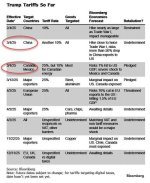
A snapshot of all proposed and implemented Trump tariffs so far is below.
 www.zerohedge.com
"No Room Left" For Canada, Mexico To Avoid Tariffs Trump Says Hours Before They Go Live | ZeroHedge
ZeroHedge - On a long enough timeline, the survival rate for everyone drops to zero
www.zerohedge.com


drkrn86
Registered Member

Despite the negative publicity, Nigeria is a rising star in the economic landscape of Africa. Many people would have migrated and doing business there.Nigeria $5.7B...wtf?? Is this including scamming?
Users who are viewing this thread
Total: 1 (members: 0, guests: 1)


