US Perspective on the Iran - Israel / US War

It’s important for Pakistan to continue to mediate between these two. Iran is our Muslim brotherly neighbour we have a 900km border with them. Pakistan have a stake in what happens to Iran .
how long do they keep our twin cities on edge and shutdowns for the so-called security ?? What about our cost ? From schools to offices and work everyone is getting affected by this
 
To view this content we will need your consent to set third party cookies.
For more detailed information, see our cookies page.
 
Not good news for middle east oil exporters .... these countries will be lucky if they claw back 60% of their prewar exports.,.. Iranian dreams of sanctions relief and boom in oil export are just dreams

To continue ! Iran hasn't just got herself royally screwed , she got the entire region screwed along with her...not good for Pakistan either , lots of Pakistani expats in the gulf region will loose their jobs .... lesser remittances means balance of payment crisis will excessaberate.....

I have conducted business in the Gulf region for the past ten years. My perspective on the Gulf differs from that of others. While many individuals aim to establish a life there and raise a family, I have come to believe that this is an inappropriate approach, once I recognized that the environment is not conducive to such endeavors. Disregarding the issue of citizenship, it is evident that the Gulf was originally established as a transactional society bridging the East and the West.

Their society is built like a sand castle; as long as foreign investment flows strongly, it will expand. When it comes to shocks, it will contract, as shown in the past when Abu Dhabi had to inject capital to keep Dubai's real estate portfolio from collapsing. To give context, in 2009, Abu Dhabi lent Dubai $20 billion, and by 2014 and 2019, Abu Dhabi allowed Dubai to roll over $20 billion in debt. As of 2023, it has paid $5.5 billion in debt. It's to be seen how much debt Dubai will accumulate now due to the Iran-Israel/US War. Recently, they have needed a direct line to the Federal Reserve because liquidity is drying up.

Over the last two years, Saudi Arabia has begun cutting back on project investments, such as the Line (NEOM) and Cube City, which were unrealistic and depended on real estate investment. Their sovereign wealth funds aren't as productive, as they're investing in foreign stocks, bonds, and real estate, with no real incentive for those companies to build infrastructure to create jobs within. [I can go on with their sovereign wealth funds, but it's not what it's made out to be.]

Now, what this conflict has done to the Middle East's economies is cause long-term damage. First, the U.S. will most likely become Europe's largest oil and LNG supplier; past policies have cut off Russia, and current events will limit Middle Eastern oil. China, while having access to oil and gas, might reproach the rest of Asia for a lifeline to Russia. Do note: Before World War II, Japan imported 80% of its oil from the U.S. It's possible that it could ignore Russia and pursue a dual Canadian-U.S. oil deal.

Now, for the U.S., this conflict will have other costs; supply chain disruptions will increase costs across food and materials. It will squeeze the average American, who is already facing financial stress, credit card debt, foreclosures, etc.

118,727 properties had a foreclosure filing in Q1 — up 26% year‑over‑year. March 2026 alone saw 46,000 filings, up 18% from February and 28% from March 2025.


Bank repossessions climbed 45% year‑over‑year.


These are but a few examples; the commercial side isn't as healthy inside either. I will let other members do the digging.

Key point: While the U.S. exports light crude (shale), it imports heavy crude because that's the refining system it has set up. The balance between the two has allowed the United States to keep oil costs low; any shock to this balance, and the American public will pay the inflated costs determined by international commodity prices. The U.S. isn't "energy independent" in the way people think, as the U.S. isn't immune to global pricing.

The lack of imports of heavy crude does have a looped effect. Its pricing touches all aspects of American life.

U.S. Debt: This is a story we all know, and the debt will keep piling up to levels that will eventually become a focal point of contention. The U.S. is already having a low bid-to-cover ratio when selling its debt. Economic factors will push each country to sustain its internal macroeconomics and to invest and lend less to the U.S. over time. Americans will end up paying their own debt at lower interest rates and will see inflation erode their purchasing power over time. Recently, U.S. banks (primary dealers) were forced to purchase U.S. treasuries due to weakened demand, a last-resort strategy, by the Fed Repo Facility.

While some members are talking about the U.S. stacking Ws (wins), they fail to see the bigger picture.
 
Last edited:
I have conducted business in the Gulf region for the past ten years. My perspective on the Gulf differs from that of others. While many individuals aim to establish a life there and raise a family, I have come to believe that this is an inappropriate approach, once I recognized that the environment is not conducive to such endeavors. Disregarding the issue of citizenship, it is evident that the Gulf was originally established as a transactional society bridging the East and the West.

Their society is built like a sand castle; as long as foreign investment flows strongly, it will expand. When it comes to shocks, it will contract, as shown in the past when Abu Dhabi had to inject capital to keep Dubai's real estate portfolio from collapsing. To give context, in 2009, Abu Dhabi lent Dubai $20 billion, and by 2014 and 2019, Abu Dhabi allowed Dubai to roll over $20 billion in debt. As of 2023, it has paid $5.5 billion in debt. It's to be seen how much debt Dubai will accumulate now due to the Iran-Israel/US War. Recently, they have needed a direct line to the Federal Reserve because liquidity is drying up.

Over the last two years, Saudi Arabia has begun cutting back on project investments, such as the Line (NEOM) and Cube City, which were unrealistic and depended on real estate investment. Their sovereign wealth funds aren't as productive, as they're investing in foreign stocks, bonds, and real estate, with no real incentive for those companies to build infrastructure to create jobs within. [I can do on with their sovereign wealth funds, but it's not what it's made out to be.]

Now, what this conflict has done to the Middle East's economies is cause long-term damage. First, the U.S. will most likely become Europe's largest oil and LNG supplier; past policies have cut off Russia, and current events will limit Middle Eastern oil. China, while having access to oil and gas, might reproach the rest of Asia for a lifeline to Russia. Do note: Before World War II, Japan imported 80% of its oil from the U.S. It's possible that it could ignore Russia and pursue a dual Canadian-U.S. oil deal.

Now, for the U.S., this conflict will have other costs; supply chain disruptions will increase costs across food and materials. It will squeeze the average American, who is already facing financial stress, credit card debt, foreclosures, etc.

118,727 properties had a foreclosure filing in Q1 — up 26% year‑over‑year. March 2026 alone saw 46,000 filings, up 18% from February and 28% from March 2025.


Bank repossessions climbed 45% year‑over‑year.


These are but a few examples; the commercial side isn't as healthy inside either. I will let other members do the digging.

Key point: While the U.S. exports light crude (shale), it imports heavy crude because that's the refining system it has set up. The balance between the two has allowed the United States to keep oil costs low; any shock to this balance, and the American public will pay the inflated costs determined by international commodity prices. The U.S. isn't "energy independent" in the way people think, as the U.S. isn't immune to global pricing.

The lack of imports of heavy crude does have a looped effect. Its pricing touches all aspects of American life.
Oil prices effect every country USA is no exception..... USA has created structural problems in her economy that have little to do with the swings in oil prices....shale oil was considered profitable at 40$ a barrel or above...now it's profitable at $30 a barrel and America has huge reserves...my point is that it will be difficult for gulf states to get the share of the market back that it has lost cause of this war.....for the last decade or so there has been under the radar war going on between shale oil producers and gulfies , this war is going to intensify after the Iran war comes to a closure...oil prices will go down cause everyone will try to keep as much the market share as it can.
 
Oil prices effect every country USA is no exception..... USA has created structural problems in her economy that have little to do with the swings in oil prices....shale oil was considered profitable at 40$ a barrel or above...now it's profitable at $30 a barrel and America has huge reserves...my point is that it will be difficult for gulf states to get the share of the market back that it has lost cause of this war.....for the last decade or so there has been under the radar war going on between shale oil producers and gulfies , this war is going to intensify after the Iran war comes to a closure...oil prices will go down cause everyone will try to keep as much the market share as it can.

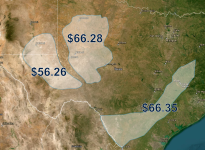
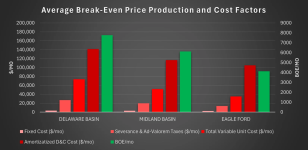
A pricing war could take place, as it had before. However, saying $30 will be profitable isn't supported by the data. During the previous pricing wars, U.S. shale producers cut costs by reducing production and investments to weather the impact. The flaw in that strategy was that it also harmed the GCC (OPEC) producers and eventually forced OPEC+ to coordinate with Russia and other producers.

While the GCC can sustain a low cost of $30 per barrel, the effect on its national budget will make it a temporary strategy; the GCC needs $60+ per barrel to run its budget.

This will result in a coordination again between OPEC+ to divvy up their market share.

For shale producer: The costs of producing an oil well were lower because acreage was untouched, capital was readily available, and, most importantly, interest rates were near zero. I do see their costs increasing over time.


1777149096368.png
1777149115001.png

 
A pricing war could take place, as it had before. However, saying $30 will be profitable isn't supported by the data. During the previous pricing wars, U.S. shale producers cut costs by reducing production and investments to weather the impact. The flaw in that strategy was that it also harmed the GCC (OPEC) producers and eventually forced OPEC+ to coordinate with Russia and other producers.

While the GCC can sustain a low cost of $30 per barrel, the effect on its national budget will make it a temporary strategy; the GCC needs $60+ per barrel to run its budget.

This will result in a coordination again between OPEC+ to divvy up their market share.

For shale producer: The costs of producing an oil well were lower because acreage was untouched, capital was readily available, and, most importantly, interest rates were near zero.


View attachment 194073
View attachment 194074

I don't disagree with the gist of what you are saying , however, you are not taking into consideration the technological improvements in shale oil production and resulting cost reduction along with economy of scale in its production.... another factor to consider is growing role of renewable energy.
 
I don't disagree with the gist of what you are saying , however, you are not taking into consideration the technological improvements in shale oil production and resulting cost reduction along with economy of scale in its production.... another factor to consider is growing role of renewable energy.

The technological improvements and economies of scale are already baked into the current pricing after the 2014-2019 pricing wars. Tier‑1 drilling locations are finite and largely depleted. Currently, new wells are being drilled into Tier-2 drilling locations in low-quality acreage, with higher break-even costs.

"As tier-1 acreage is exhausted, operators are pushed into tier-2 zones with thinner margins, amplifying cost pressures and investment risks."


As for renewables, they do have the intended cost effect for households in reducing electricity costs, but it still doesn't negate the effects of other products: Pharma, petrochemical industry, etc.
 
The technological improvements and economies of scale are already baked into the current pricing after the 2014-2019 pricing wars. Tier‑1 drilling locations are finite and largely depleted. Currently, new wells are being drilled into Tier-2 drilling locations in low-quality acreage, with higher break-even costs.

"As tier-1 acreage is exhausted, operators are pushed into tier-2 zones with thinner margins, amplifying cost pressures and investment risks."


As for renewables, they do have the intended cost effect for households in reducing electricity costs, but it still doesn't negate the effects of other products: Pharma, petrochemical industry, etc.
Thanks for showing other side of the coin that was out of my sight....
 
Thanks for showing other side of the coin that was out of my sight....

Anytime, bro. At the current rate of Shale production, going from Tier-2 to Tier-4, combined with exports and internal consumption, it's 34-40 years until they run dry. Thus, I've never been a believer in the U.S. being the largest long-term exporter of oil, and I just view it as a temporary phase at best.

*The Europeans know this, too; it's why they are against this conflict. Because of their own weakness, they know they've been hurt by not consuming Russian oil, caused by U.S. pressure, it's at this time that the European's grow a spine and chart their own path.
 
To view this content we will need your consent to set third party cookies.
For more detailed information, see our cookies page.
 
What do you mean by saying ! Blockade is an act of war....what were you doing before? Making love?
What I meant is that if the US already done one 'act of war', regardless of what that was, respecting territorial waters is of our own choosing.
 
then why are straits still closed ?
Iran 'closed' the strait, not thru any form of authority, ie legal, means, but thru military methods. In any war, the enemy will ALWAYS be able to do 'something' that you missed or failed to compensate for. But that does not change the fact that you have overwhelming success over his forces.
 
Iran 'closed' the strait, not thru any form of authority, ie legal, means, but thru military methods. In any war, the enemy will ALWAYS be able to do 'something' that you missed or failed to compensate for. But that does not change the fact that you have overwhelming success over his forces.
Militarily US is winning now and eventually but politically it is losing the war. It's losing its allies in NATO and elsewhere like the ME which is taking the brunt of the Iranian retaliation.
 

Users who are viewing this thread

Country Watch Latest

Back
Top