China’s Plans to Dominate at Sea in 2026
Published
Jan 01, 2026 at 03:30 AM EST
China, a top maritime rival of the United States, is expected to continue rapid naval modernization and expand its presence at sea in the new year, following the fielding of new warships and a growing reach in the Pacific in 2025, analysts told
Newsweek.
Liu Pengyu, spokesperson for
China's Embassy in Washington, D.C., told
Newsweek that China's military development is not directed at any third party. "They are solely for the purpose of safeguarding national sovereignty, security and development interests."
Why It Matters
China has built the
world's largest navy by hull count, with more than 370 ships and submarines, including three
aircraft carriers, as part of its push to field
a "world-class" military. In its latest annual report on
Chinese military developments, the Pentagon warned that China aims to displace the U.S. as the world's most powerful country.
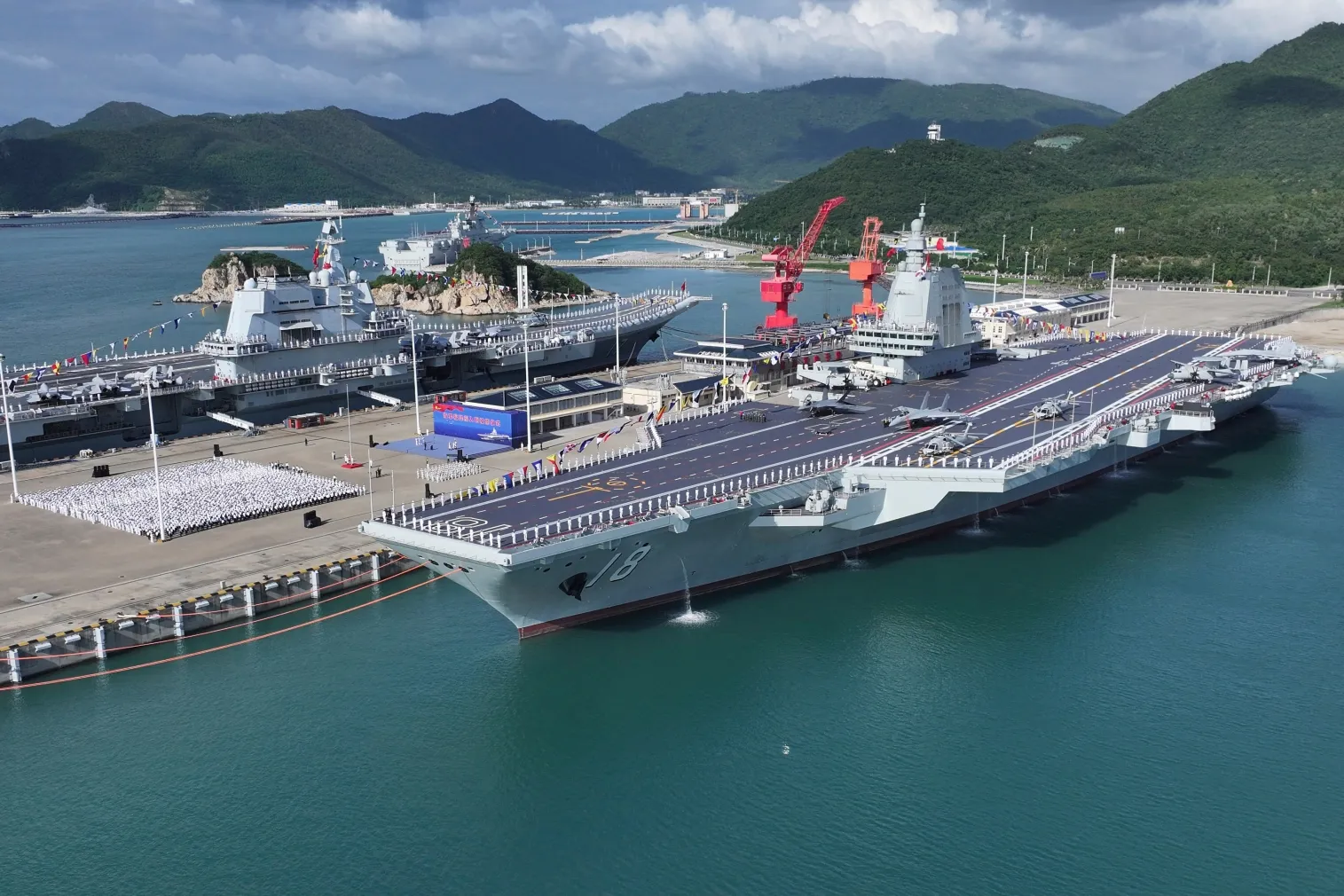
Over the past year, the Chinese navy has made significant advances in shipbuilding and force projection, from commissioning its
most advanced aircraft carrier, CNS
Fujian, to conducting two notable, distant deployments in the
broader western Pacific and
around Australia, showing it is increasingly capable of challenging
America's naval supremacy.
In this photo released by Xinhua News Agency, a commissioning and flag-presenting ceremony of CNS Fujian, China's third aircraft carrier, seen on righ...Read More | Xinhua via AP/Li Gang
Sea power, along with its
large missile arsenal, is vital to China's attempts to counter U.S. military presence across the
First Island Chain, a north-south defensive line that runs from the Japanese archipelago to the Malay Peninsula under a U.S. containment strategy. The Pentagon said Beijing considers this region its
strategic center of gravity.
Reinforcing With New Ships
The commissioning of the
Fujian and the apparent construction of
a nuclear-powered aircraft carrier underscore China's effort to build an aircraft carrier force designed for higher sortie rates, heavier payloads and more credible combat aviation,
Tom Shugart, an adjunct senior fellow at the Center for a New American Security, told
Newsweek.
The
Fujian is
a catapult-equipped aircraft carrier, enabling it to launch heavier aircraft, including the J-35 stealth fighter jet, which the analyst said reinforces that trajectory by pointing toward a "more survivable, long-range" air wing for China's aircraft carriers.
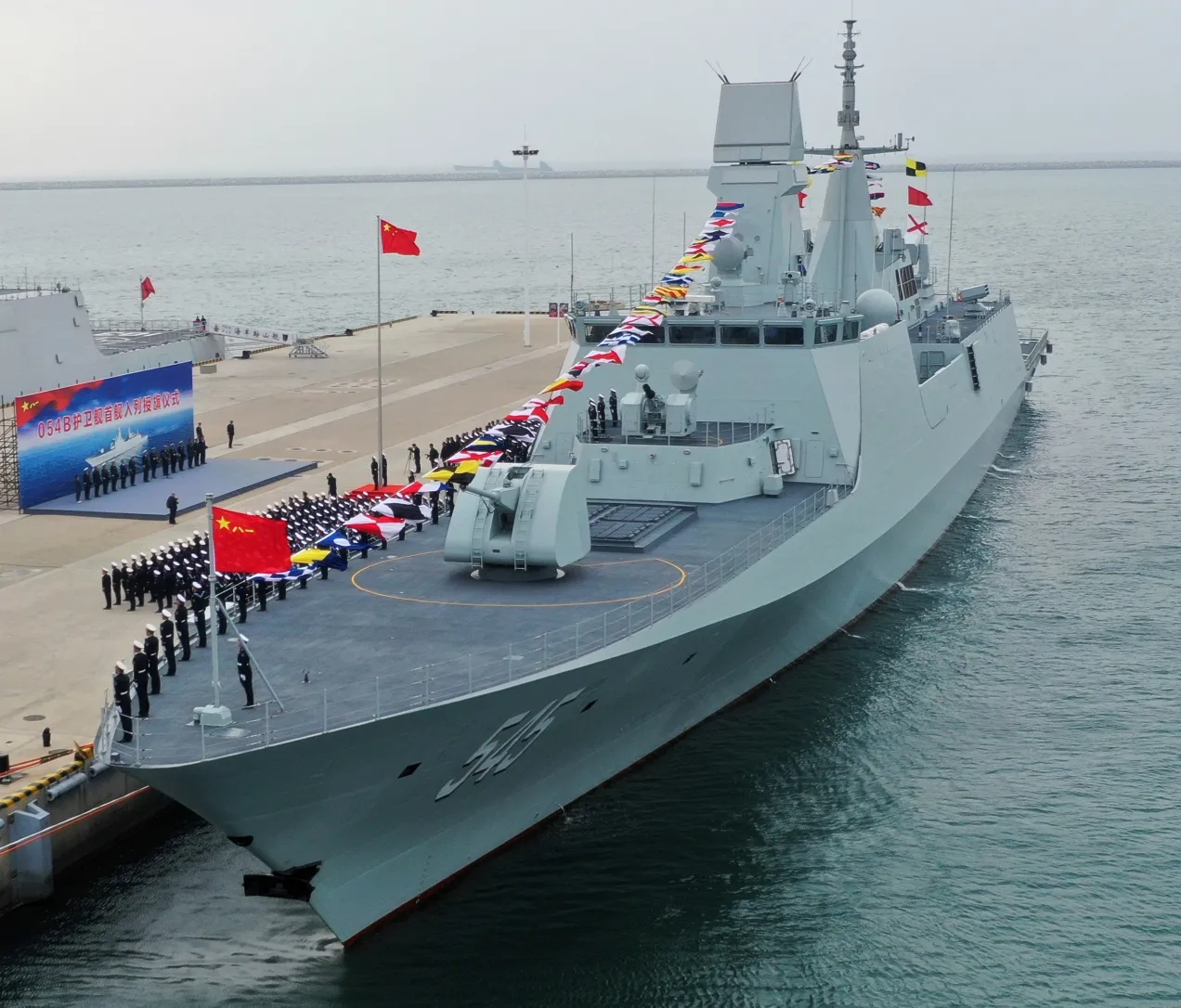
In 2025, the Chinese navy also commissioned its first
new-generation stealth frigate, the Type 054B, and commenced sea trials of the
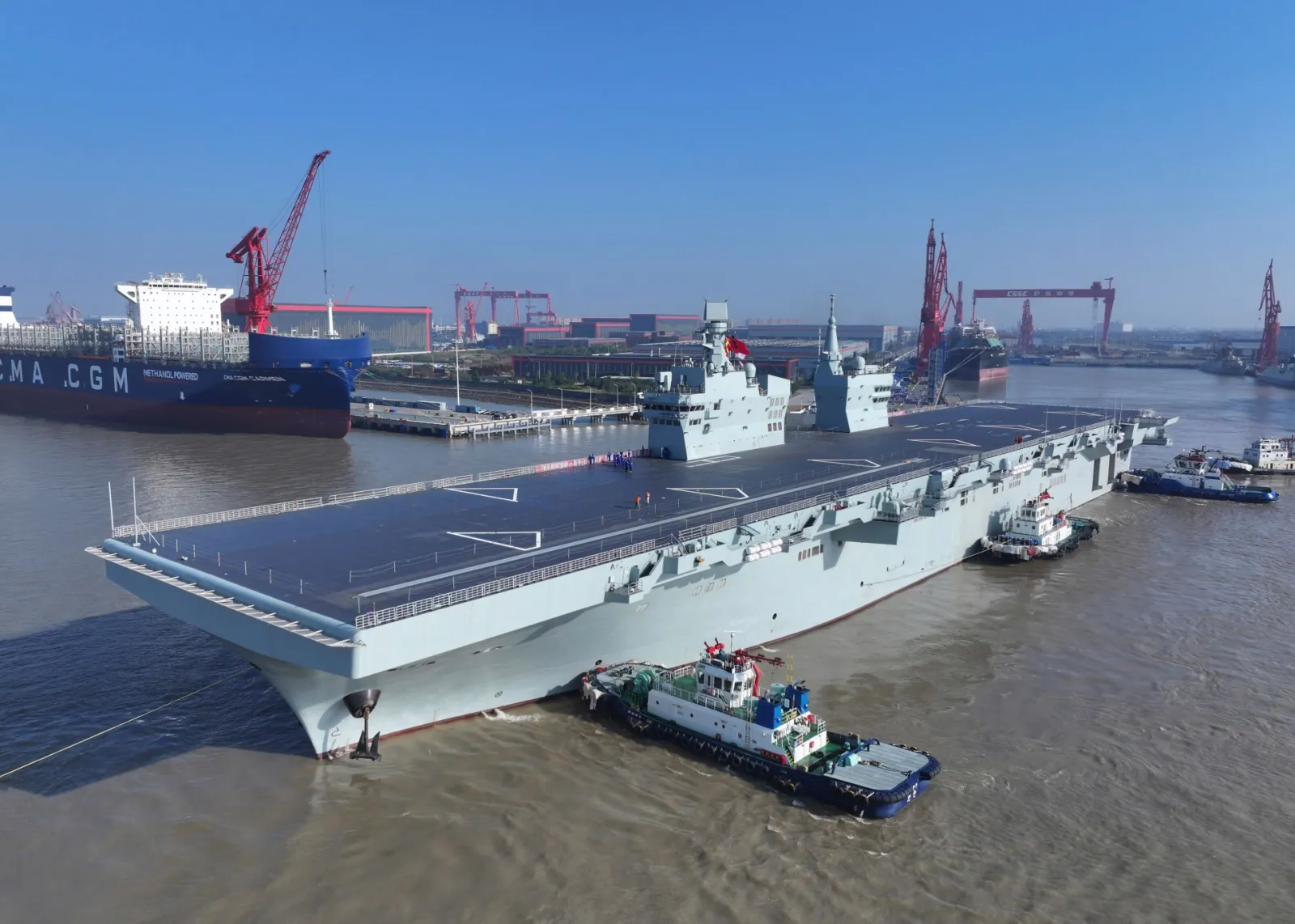
Type 076 amphibious assault ship—capable of launching aircraft with a catapult for projecting power from sea to shore.
Shugart said the new frigate highlights China's continued modernization of its surface fleet, including
more than 40 ships in the Type 054 frigate family across four variants.
China's first Type 054B frigate, CNS Luohe, is commissioned at a naval port in Qingdao, Shandong Province of China, on January 22, 2025. | VCG/VCG via AP
Meanwhile, the U.S. Navy recently made significant changes to its long-awaited frigate program, aiming to
launch its first vessel in 2028 under a tight construction deadline as part of President Donald Trump's "
Golden Fleet," which would include battleships.
The Type 076 amphibious warship is one of the unique vessels in China's naval fleet, serving as a maritime platform for both landing missions and drone flight operations, allowing the ship to conduct aerial reconnaissance and targeting, Shugart commented.
"I would say that its significance lies less in a
Taiwan scenario than in supporting expeditionary operations further afield, including in the
South China Sea or around the Senkakus, where aviation-enabled amphibious forces could play a key role," he added.
China has claimed sovereignty over Taiwan and has threatened to take the self-ruled island by force through
blockade-style war games. In the nearby
Senkaku Islands, administered by Japan, Beijing maintains a persistent coast guard presence to assert its claims over the uninhabited island group, also known as the Diaoyu Islands in China.
"These achievements illustrate the results of sustained development and innovation for China," Alex Luck, an Australia-based naval analyst, told
Newsweek, noting that the introduction of new vessels, including a new aircraft carrier, underscores the Chinese navy's confidence in its acquisition choices and that progress continues to accelerate.
"The rapid construction and fitting out of the Type 076, and the fact that the design as such does not exist anywhere else in the world, further reinforces this point," he said.
In this photo released by Xinhua News Agency, China's first Type 076 amphibious assault ship, CNS Sichuan, sets sail from Shanghai on November 14, 202...Read More | Xinhua via AP/Zhang Liang
Sailing Farther From Home
The circumnavigation of Australia and the dual aircraft carrier operation in the western Pacific show that China, which Shugart described as the premier maritime power in the world by most measures, is increasingly comfortable operating its navy at distance.
The analyst said these deployments helped China build experience in command and control and logistics while also normalizing the country's naval presence in regions where it has historically been limited, even as it still lacks true global persistence.
Unlike its U.S. counterpart, which has
a global basing network, the Chinese military currently operates
two outposts on foreign territory to support its overseas operations. The Pentagon assessed that China has likely considered a number of countries across Africa, Asia, the Caribbean and the Pacific for bases to project its air and naval power.
The U.S. and its allies
have been concerned about China's growing naval reach. In the case of the deployment near Australia, Luck said it appeared China was motivated by a desire to show it can operate near countries that
conduct presence missions in its more immediate areas of interest, including the South China Sea and the
Taiwan Strait.
"Recent events around the
Liaoning presence near Japan would seem to be an ominous indicator," he noted, referring to the
Chinese aircraft carrier deployment in December, which took place amid tensions between Tokyo and Beijing over remarks Japan made about
possible military intervention in the event of a Chinese blockade of Taiwan.
Both analysts told
Newsweek that the Chinese navy will likely extend its deployments in 2026, including increasing their frequency and duration and operating further afield.
"Far seas missions across the [International Date Line] will probably be part of that," Luck said when asked about China's possible attempt to expand its presence around the Third Island Chain, formed by Alaska's Aleutian Islands, Hawaii and New Zealand.
However, Luck emphasized that the Chinese navy's focus will remain on the western Pacific and adjacent Indian Ocean areas, while Taiwan, a U.S. security partner
supplied with advanced weapons, will continue to consume a significant portion of its resources.
Building a Stronger Fleet
In its latest assessment of China's military strength, the Pentagon made an eye-catching claim that China aims to have a total of
nine aircraft carriers, which would outnumber the U.S. Navy in the Pacific, which currently stations six aircraft carriers in the region.
"I hope to see some indicators on the speculation that Jiangnan will join Dalian in dual aircraft carrier construction," Luck said, referring to
two major Chinese shipyards that have built aircraft carriers—the
Fujian and CNS
Shandong, respectively—in the past.
China is also
expanding its submarine force to counter the
U.S. underwater fleet in the Pacific. "We will hopefully see more indicators of the Type 093B nuclear-powered attack submarine achieving operational status beyond commissioning," the analyst said. He also noted close attention to a new Chinese submarine class known as the
Type 041.
Another major expectation for China's naval development in 2026 is the continuous buildup of landing capability, which will include further integration of landing barges and the
use of civilian vessels in amphibious exercises, according to Luck and Shugart.
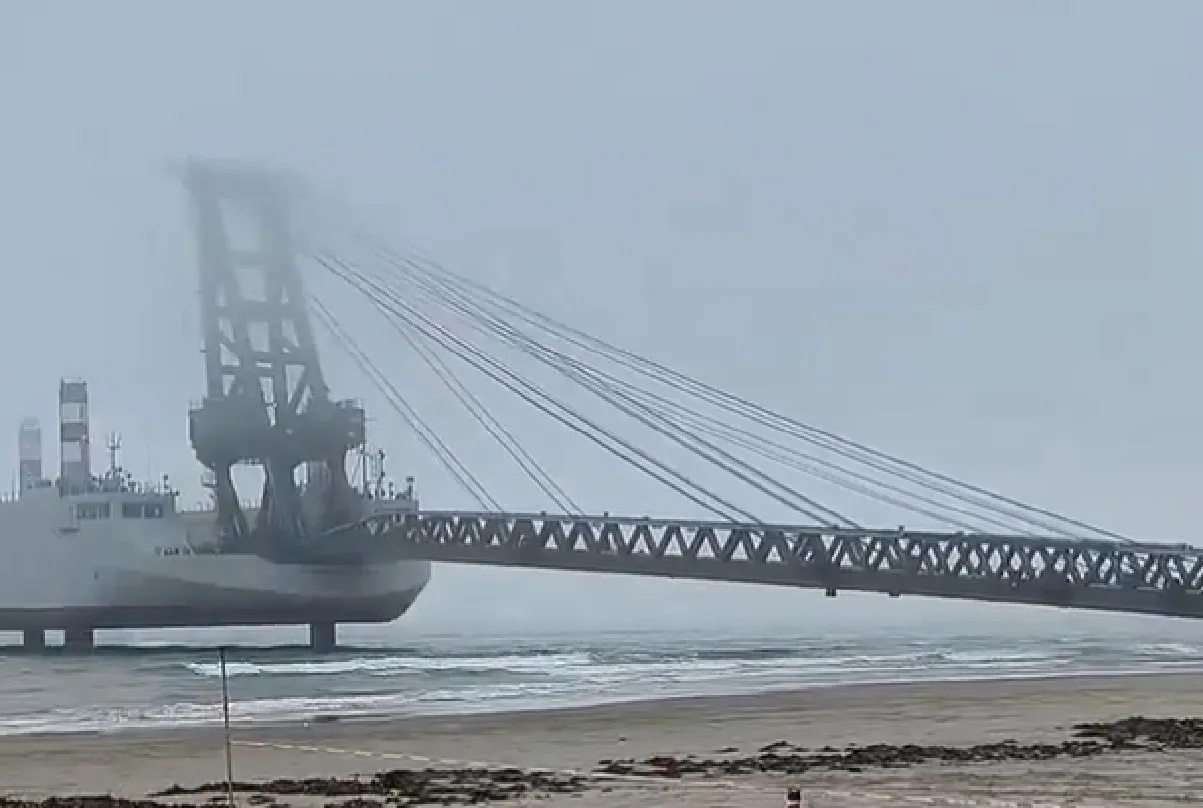
This screen grab shows one of China's landing barges, equipped with road spans analysts say could be used during an invasion of Taiwan. | WeChat/WeChat
This aligns with the Pentagon's warning that China aims to be able to win a war over Taiwan by the end of 2027. Trump previously said Chinese President Xi Jinping
gave a personal assurance that no invasion would take place while he was in the White House.
Landing barges, which Shugart called "modular bridge landing ships," are equipped with long ramps that allow military vehicles to bypass heavily defended beaches. They could be deployed during an
amphibious invasion of Taiwan across the Taiwan Strait.
Shugart, who tracks China's dual-use sealift fleet, said: "The recent appearance of civilian landing craft conducting direct beach-assault training is especially noteworthy and suggests continued experimentation with civil-military integration at sea."
What People Are Saying
Liu Pengyu, spokesperson for China's Embassy in Washington, D.C., told Newsweek: "The future development plans for China's aircraft carriers will be comprehensively considered based on national defense needs. It must be emphasized that China's socialist nature, its strategic choice to pursue a path of peaceful development, and its independent foreign policy of peace determine that China's defensive national defense policy will remain unchanged."
Tom Shugart, an adjunct senior fellow at the Center for a New American Security, told Newsweek: "Finally, the September parade offered a useful snapshot of where China is heading beneath the surface: apparent [intelligence, surveillance and reconnaissance] and minelaying [unmanned underwater vehicles], alongside a wide array of new anti-surface cruise missiles and hypersonic systems. Together, these point to growing emphasis on undersea warfare, sea denial, and long-range strike integration."
Alex Luck, an Australia-based naval analyst, told Newsweek: "I think it is likely we will see clarification on the nature of the construction in Dalian, speculated to be the fourth carrier. This seems almost certain now, but pending visual confirmation by traits distinct to an aircraft carrier. I suspect construction will start to assume a steady, relatively rapid pace in 2026 … Other than that I remain curious what the next steps for the frigate and amphibious vessel construction will be, including a notional second Type 076."
What Happens Next
It remains to be seen whether China will further strengthen its sea power, including the construction of new classes of vessels, as the U.S. ramps up its
efforts in shipbuilding and
forward-deploying forces to maintain its naval presence across the Pacific.


 ..
.. .
.