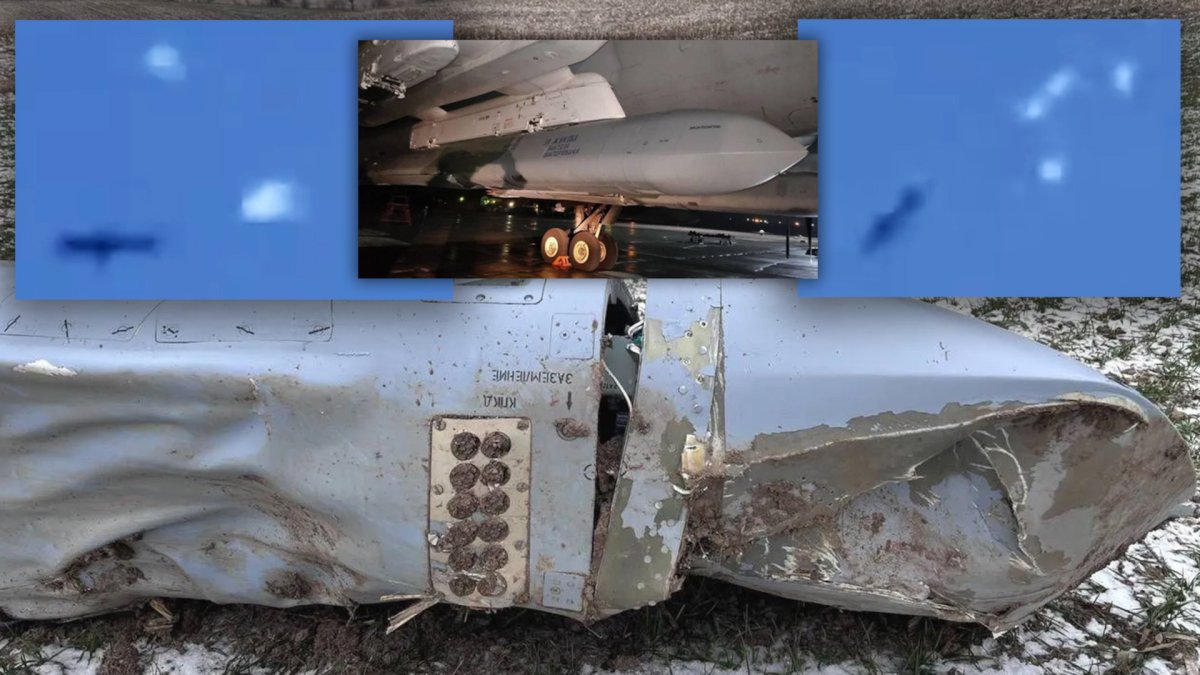
PAF Conducts Successful Test Launch of Taimoor ALCM

Ok so I will separate my thoughts in separate posts for clarity.

Taimoor is clearly a development of the Ra'ad 2. However, we should not think this is a simple progression. Ra'ad 2 is a nuclear delivery system so it a) has no need to be pinpoint accurate, and b) needs as much space as possible for its payload. This tells us that Taimoor very likely has a smaller space for its warhead. The weight of the seeker isn't huge (4 kg from above specs) but the space that the seeker takes up is significant. Regardless, for the kinds of mission Taimoor is meant for, this loss in boom matters naught.

Regarding what it takes to "add a seeker":
Ra'ad 2 has a guidance system based on INS (maybe TERCOM/DSMAC etc) and the entire flight software is designed for it. Now you add a seeker. You need to add some software and memory to be able to recognize targets. You need a system to feed it target picture before it is launched. Secondly, you need to add an end-game guidance based on the seeker inputs. This is an entirely new phase of flight, and what lets it hit targets so accurately. You need lots of simulation and testing to get this right. 4 km is more than enough range for this seeker. It only needs to track the target in the endgame. It is essentially a Ra'ad2 the rest of the way. The legacy guidance and navigation gets you in the vicinity of the target, and the new seeker+end-game guidance gets you to the target.
Babur had the same with a combo GPS/GLONASS chip which I've seen later variants of with Beidou and these RX/chipsets barely weigh a few grams.
The entire board on its own isn't the weight it's the overall packaging and spec cables.
The overall guidance chipset would be the size of a few tuc biscuits weighting in at barely a pound and then the I/O peripherals, cables and so on are heavy, bulky octopuses all around it.
 
I will respond to all of the comments/questions in a separate post:
with 600 km now what we can target?
More than 600 targets. I am not kidding. In 600KM from Pakistani borders, all their key FOBs even some MOBs, missile storages, ammunition dump, Cantts, C2 nodes, ADS batteries and many more are available as target. Now it is upto war situation or planning of PAF what they actually pick as target.
these are not going to be cheap , they will probably be for high value targets or targets that are too far for other systems . as @Bilal pointed azb lr kits are going to take that role of mass produced , cheapish and accurate weapon systems
This is very likely meant for high-value targets like a HAS housing an AWACs or a C&C node. Keep in mind this is an expensive system, which will be produced in low numbers, is complicated to launch, and must be prefed target information.


we don't have the source code , so cant do it without China .
pretty dumb to make a ALCM that your future jets cant carry , raad 2 was tested on mirages too before being integrated . you are making assumption out of nothing
source code of what?
helps that we can modify mirage without outside help
Actually, like I said in an earlier post, something like this needs very little software integration, except transfer alignment. So I believe this will eventually move to the JF-17, source codes for FMS or not. I've given the reasons for why Mirage is used for tests.


What's the development? Seeker? It would have been a development if this were a miniaturised Raad fired from a JF-17's wing hardpoint.
This developed missile, Raad has been in service for quite some this was just show India we have conventional version of Raad that's gonna hit, this is quite well in production missile
so its non nuclear raad with different name but conventional
So whats the difference between Taimoor and Raad now? Like in terms of guidance, flying profile, seekers, Launch platform????

Knowledgeable members please share what you can
Same as with Babur and Fatah-4. Its declared conventional system. Also it (Taimoor) has that giant optical seeker which we didn’t see on Raad/Raad-2.
Not only that, but also this has a IIR seeker. Overall improved guidance
I've detailed in the post how this addition of a seeker is non trivial.


Ground clearance brother it's been discussed before, it's not about source code or anything we can integrate whatever we want on Jeff's
Only block 3s have better ground clearance.
Though @side-winder can shed more light on this matter
I don't think ground clearance should be an issue (i don't have exact dimensions of taimoor) but here is visual comparison. 800 ltrs fuel pod on JF 17 vs taimoor on mirage.
View attachment 169554
I don't think there's any significant ground clearance difference between the blocks of JF-17. We know the JF-17 can at the very least carry the Ra'ad 1. Of course there are many more stages after that, which I've detailed in posts. I've talked about clearance in detail.


It is very clear that Pakistan is currently very focused on conventional delivery systems which is the need of the hour.
Indeed.


Anyone know what speeds it can travel at? Still subsonic?
Yes.


im guessing they probably do have some form of target recog, now obviously i dont know the ins and outs, but, based off of the lrashm, you can do some pretty cool things with a high fidelity seeker

To view this content we will need your consent to set third party cookies.
For more detailed information, see our cookies page.

If I was designing the end-game guidance for this missile, I'd do at least two modes. Top attack and horizontal attack. Obviously, this missile as target recognition. Some targets might require top-down attack, while others like a HAS might require horizontal terminal flight to go through the front door for example. The advantage of a subsonic CM is that you can actually plan things like that - especially since we're talking about stationary targets.

The purpose of IIR itself is to make a missile ATR. TERCOM/DSMAC allows the missile to fly to predetermined location. IIR allows it precisely target the data by comparing the images stored in the missile memory. Since we don't have live datalinks/satellite guidance/Man in the loop. So target reassignment/ Hitting target of opportunity in real time will obviously be missing from the feature set.

As far as I know, nope. If someone is guiding a missile, then it has to be a tv seeker. IIR makes the missile autonomous.
In the words it can't be jammed right?.
@Oscar did point to Babur being able to fly into a window.

And now with kids running image recognition algos on their PCs seems pretty much in the reach.
So Pilot still controls the target in the end using optical feedback like the H4 SOW? If the link stays connected, it will be deadly for S400 (the video shows a land target).

BTW, any basic info on how CM400 locked on the cheesboard? What if the cheeseboard was switched off like 10 sec before?
This is meant to hit HVTs that are preprogrammed as images to be recognized. There is no hope of updates at 600 km range, we are not the US.


affirm, it does hint at the paf wanting something more capable for anti shipping.

i wonder whether this could mean the pn would deploy these onboard sea sultans
Anti-ship role might be easy and hard. Targeting is easy because a ship stands out in the ocean. Hard because it is straightforward to shoot down a slow-moving Ra'ad.


Nope the pilot doesn't control it, TERCOM AND DSMAC AND INS guide the missile whilst in terminal stage IIR seeker takes over.
What ur saying is TV guidance
IIR seeker feeds the info to onboard computer with which then decide autonomously to target the desired location without any human intervention unlike H-4.. There are two features in IIR seeker based missiles.. Either you've pre-fed the targeting imagery and uploaded fixed way points to follow and pre-determined trajectory which is what Babur/Ra'ad 1 were.

Recent missiles tests are consistently mentioning advanced guidance and targeting features which alludes to AI based guidance which can decide how to target the enemy buildings/site with optimized path and trajectory in the terminal stage.
no expert but altimeter data is sufficient for terrain hugging inaddition navigation inputs. I don't think the memory is that much to store so many images.
I was asking bcz Ra'ad may have an optical modular block but if Taimor is built with it, what should be the targets? If Ra'ad could do the job then why we need Taimor. Therefore, itis built for different targets, preferably non-stationary.
Terrain hugging can benefit from terrain maps for any decently low altitude flight because you need to plan ahead - an altimeter only looks down and has no idea if there's K2 in front of you for example. Legacy terrain-following just used a radar but modern terrain-following utilizes maps. Furthermore, like I said in an earlier post, integration of a seeker is a non trivial addition. Furtherfuthermore, this is just for stationary targets IMHO because HVTs don't move that much (don't), the INS/TERCOM/DSMAC gets you to a preprgrammed point and the seeker only kicks in close to the target which better not have move out of your seeker's range, and recognizing and tracking moving targets will be much harder to do autonomously.


Sorry I am not weapons expert but seeing these slow/ bulky cruise missiles getting easily shot down in Ukraine war theatre …. Should we not instead be focusing on hypersonic systems like Indians are ?
Not Jammed. But shot down easily by an Infrared sam missile or by a radar guided missile. Afterall it is a slow moving target. Either you release this missile in saturation or do what russians did

There's a third option that USA uses. Superior intelligence is used to plan the path of your missile to avoid AD and EW is used for jamming and spoofing. With the relatively transparent intelligence environment of South Asia, this might be an option for us.


how complicated would it be to add flares to it like kh01 ?
Depends. Flares that release just before the endgame starts are easy because this just needs space and a timing logic. Intelligent countermeasure system where it detects it is being targeted and releases flares to spoof incoming missiles will be hard and require additional sensors like a mini MAWS and complicated logic, in addition to space.


Wait so no GPS guidance?
More and more it is becoming obvious that GNSS is more a liability than an asset because it is jammed WAY too easily and more importantly can be spoofed to mess up your navigation system. So if you can help it you avoid using GNSS. And for these cruise missiles, I believe you can help it using INS/TERCOM/DSMAC.
 
On the topic of the launch aircraft:

I had conjectured many years ago that the original Ra'ad could not be carried by the JF-17 for clearance reasons based on careful pixel counting:
View attachment 169663
However, on the very thread I had posted a plaque and we had later seen a picture that showed that Ra'ad 1 can be carried by the JF-17 on the wing:
View attachment 169664
So my pixel counting was slightly off (not shocking).

Why is Mirage used by all these tests? Many reasons IMHO:
1. AWC knows the mirage inside out - it understands it structure in a way that it does not understand the JF-17.
2. Mirage is analouge so there isn't any flight-control system that needs to know about payload carriage/release. The pilot just accounts for the big hunk of payload drop manually.
3. Mirage has a lot of internal space for all kinds of instrumentation to be mounted inside. Instrumentation that you likely need for these things.
4. For a system like Ra'ad/Taimoor, the carrier A/C doesn't do any targeting. The targeting info is fed on the ground, maybe there is an ability to update it but I'm not sure that there is. So it is mostly about carriage.
5. However, there is something called Transfer Alignment. This is where the much superior INS of the launch A/C initializes the INS of the launched system to give it the best initial condition for its INS. This requires communication between Ra'ad/Taimoor and the launch aircraft. Maybe this hasn't been figured out for the JF-17 yet and I'm sure for Mirage it is super easy.

I think eventually the Ra'ad/Taimoor role needs to be transferred to the JF-17 and it will be. The Mirages are too old. But above explains why Mirage the choice A/C for AWC tests.
Thanks for sharing your input. I believe this test was validation and test of the Taimoor ALCM and not of the launch aircraft itself. In due time I believe they will do the combined tests and move on to whether JF and J10s can carry it as well.
 
View attachment 169655

Looks same/similar but just 4 km? Would it give enough reaction time?

Also I think they got pitch and horizontal mixed up looking at the window having more space downwards it’s probably 20,-40 degree pitch.
In a subsonic missile , 4km is enough. For a supersonic missile, like Brahmos, one little error or a second of jamming throws it off target by a mile. thats why so many Brahmos were found in the fields and ditches. The few which did find the targets , also skimmed, not actually hit. As evident by the pictures the Indians keep posting.
Because PAF was actively jamming, and by the time the software kicks in the error correction, the missile is flying too fast to fully utilize it.

To PAF credit, they even jammed one of the world's most advanced cruise missile, the Storm Shadow, On a side note its made in Bolton England., so same way as India complains. Pakistan should complain to England .
Thats why Storm shadow was found fully intact in a field. That missile has all the anti jammig and course correction features, but still missed the target by quite a margine.
 
I will respond to all of the comments/questions in a separate post:


This is very likely meant for high-value targets like a HAS housing an AWACs or a C&C node. Keep in mind this is an expensive system, which will be produced in low numbers, is complicated to launch, and must be prefed target information.


Actually, like I said in an earlier post, something like this needs very little software integration, except transfer alignment. So I believe this will eventually move to the JF-17, source codes for FMS or not. I've given the reasons for why Mirage is used for tests.


I've detailed in the post how this addition of a seeker is non trivial.


I don't think there's any significant ground clearance difference between the blocks of JF-17. We know the JF-17 can at the very least carry the Ra'ad 1. Of course there are many more stages after that, which I've detailed in posts. I've talked about clearance in detail.


Indeed.


Yes.


If I was designing the end-game guidance for this missile, I'd do at least two modes. Top attack and horizontal attack. Obviously, this missile as target recognition. Some targets might require top-down attack, while others like a HAS might require horizontal terminal flight to go through the front door for example. The advantage of a subsonic CM is that you can actually plan things like that - especially since we're talking about stationary targets.


This is meant to hit HVTs that are preprogrammed as images to be recognized. There is no hope of updates at 600 km range, we are not the US.


Anti-ship role might be easy and hard. Targeting is easy because a ship stands out in the ocean. Hard because it is straightforward to shoot down a slow-moving Ra'ad.


Terrain hugging can benefit from terrain maps for any decently low altitude flight because you need to plan ahead - an altimeter only looks down and has no idea if there's K2 in front of you for example. Legacy terrain-following just used a radar but modern terrain-following utilizes maps. Furthermore, like I said in an earlier post, integration of a seeker is a non trivial addition. Furtherfuthermore, this is just for stationary targets IMHO because HVTs don't move that much (don't), the INS/TERCOM/DSMAC gets you to a preprgrammed point and the seeker only kicks in close to the target which better not have move out of your seeker's range, and recognizing and tracking moving targets will be much harder to do autonomously.


There's a third option that USA uses. Superior intelligence is used to plan the path of your missile to avoid AD and EW is used for jamming and spoofing. With the relatively transparent intelligence environment of South Asia, this might be an option for us.


Depends. Flares that release just before the endgame starts are easy because this just needs space and a timing logic. Intelligent countermeasure system where it detects it is being targeted and releases flares to spoof incoming missiles will be hard and require additional sensors like a mini MAWS and complicated logic, in addition to space.


More and more it is becoming obvious that GNSS is more a liability than an asset because it is jammed WAY too easily and more importantly can be spoofed to mess up your navigation system. So if you can help it you avoid using GNSS. And for these cruise missiles, I believe you can help it using INS/TERCOM/DSMAC.
Appreciate your kindness and patience to explain everythingfor people like me
 
I'm glad to see that there are no Indians in this post. Congratulations to our friends in Pakistan; you have enough weapons to defend your country. At the same time, you can deter countries that attempt to invade Pakistan.

I think this weapon would be mounted in the center position of the JF-17, with air-to-air missiles on both sides of the wings and an auxiliary fuel tank in the middle of the wings. I think this tactic is reasonable.

The Pakistani government is not like Western governments; it does not like using PowerPoint to brag about its combat capabilities. This gave us a surprise during the May conflict.

Pakistan is a friendly country and might have access to some advanced equipment for testing. This is also what I mentioned in my post about the J-10CP. After gaining war experience, pilots and commanders provide feedback on experiences and shortcomings to the company, which then improves these deficiencies and continues to equip. This is a procedure commonly carried out by Chinese military companies. I think this is also why the subsequent orders of the Pakistani J-10CP have not been delivered.
 
believe you can help it using INS/TERCOM/DSMAC.
Wouldn’t it not work or degrade the accuracy on super flat or shifting terrain like desert or over sea?

If only we could get our hands on something like this. I know, I know 🥲

 
Last edited:
Wouldn’t it not work or degrade the accuracy on super flat or shifting terrain like desert or over sea?
For Land:
It would and that is why the ability to plan your path comes in handy. So previously two factors were responsible for this:
1. Lack of terrain maps
2. Lack of time/compute to plan a path that avoids problematic terrain.
However, now we have detailed terrain maps (our enemy is just India while the USA has mapped the world well now I'm sure), and computation is fast and cheap.

So I am speculating here but for USA they probably do a path-planning problem that considers the terrain from the launch site to the target site right before launch because they have to deal with the flexibility of targets.

The upside of this being an expensive and rare system for us is that we have a Taimoor for target X, for which we have already computed paths for. Likely, we just modify these paths based on AD sites and let it rip.

For Sea:
Yes, this is kind of unavoidable. You need other kinds of guidance like maybe some kind of local radio beacons or really accurate INS. But I don't think Taimoor is really meant for an antishipping role at 600 km. Maybe for anti shipping we only want to hit targets up to 200 km. I am only speculating.
 
There's also something that I believe @Oscar has mentioned in passing.

We often see Raad/Babur/Taimoor flying pretty high and not doing terrain hugging (at least initially). While this might be due to the lack of terrain maps but it is very likely due to range reasons:

Turbojets (which power our cruise missiles) get REALLY bad fuel consumption at low altitudes compared to high altitudes. So this means MAYBE Taimoor's 600km range requires it to fly at 10000ft for 500km and maybe it can only do a purely terrain-hugging trajectory with a range of 200km.

Very few countries (USA) actually have turbofans on their cruise missiles, which suffer from this altitude-based loss of fuel-consumption performance much less than turbojets.
 
There's also something that I believe @Oscar has mentioned in passing.

We often see Raad/Babur/Taimoor flying pretty high and not doing terrain hugging (at least initially). While this might be due to the lack of terrain maps but it is very likely due to range reasons:

Turbojets (which power our cruise missiles) get REALLY bad fuel consumption at low altitudes compared to high altitudes. So this means MAYBE Taimoor's 600km range requires it to fly at 10000ft for 500km and maybe it can only do a purely terrain-hugging trajectory with a range of 200km.

Very few countries (USA) actually have turbofans on their cruise missiles, which suffer from this altitude-based loss of fuel-consumption performance much less than turbojets.
That is indeed the case. We have seen an older video of Raad doing a dive to low altitude flight in the last leg of its flight.

Here:
To view this content we will need your consent to set third party cookies.
For more detailed information, see our cookies page.
 
Last edited:
why did they not test it on thunders? if they are testing on mirages it means they will be hwrre around 2030
It possible that this version of Taimur ALCM is still under development as GIDS have 280km lighter version already pitched for exports since 2022.
 
There is no rocket booster - this thing is massive without it.n
Rocket booster in final version could be added as its not the final product, many tests and may be redesign may happen to make it fit for all PAF platforms excluding F-16s.
 

Users who are viewing this thread

Back
Top