View attachment 177384
To clarify the presence of manufactured products in Egypt, independent of Turkish weapons, the following article will be rewritten more professionally by an experienced and qualified arms expert with years of expertise. This expert can provide sound assessments, offer alternatives, and highlight the fact that Egypt has attracted Turkish manufacturers to become a manufacturing hub.
View attachment 177511
The main target is the Korean guided munitions, not the Turkish ones.
It's clear we are causing some discomfort to the Turkish youth, who believe they have gained something.
Clarification: Egypt's Ammunition Production
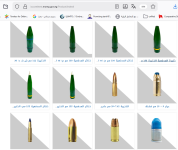
Regarding 155mm ammunition, it is already produced in Egypt in more than one factory. We also have better contracts with German and South Korean manufacturers.
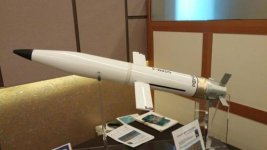
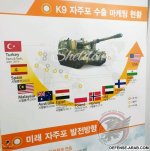
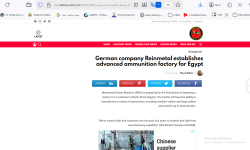
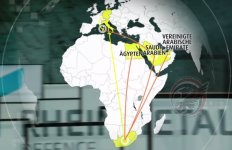
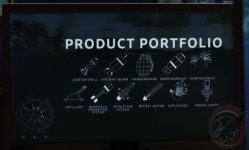
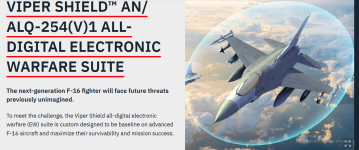
The matter is, of course, purely commercial. Egypt already produces K9 artillery ammunition locally, under a 2017 contract with South Korea, including K307 and K310 ammunition, as stated on the Egyptian Ministry of Military Production website. Egypt has been producing 155mm and 39mm ammunition for the M109/39 artillery since the 1980s. In addition to another factory, Egypt also acquired a completely new plant, built by Rheinmetall Defence, South Africa, between 2021 and 2023. The third Turkish plant is a joint venture with AOI and is dedicated entirely to export. European stocks of 155mm ammunition have been depleted, and there is high demand for this caliber. Egypt produced 73 million rounds of ammunition in previous years. It is believed that new production lines and machinery were added to the plant; according to reports published two years ago, 300 new machines were added as part of the plant's modernization and increased production capacity. Cooperation with South Korea is broader and more comprehensive, particularly in the area of long-range guided munitions (155mm and above), as well as 20mm and 40mm ammunition supplied to Egyptian naval vessels. The Turks seek to capitalize on Egypt's lower labor costs, which are around $160 per worker, compared to the minimum wage in Turkey of $800. Energy is also more readily available and less expensive in Egypt. Furthermore, Egypt manufactures Turkish-made weapons for Saudi Arabia, Sudan, Somalia, and other African countries. Egyptian military production is diverse, encompassing both Eastern and Western weaponry. In the 1980s, Egypt collaborated with the United States on the production of the M1A1 tank and, simultaneously, with Iraq, the T-72 tank. It also assembled F-6 and F-7 fighter jets with China and aspired to produce Mirage 2000 and F-20 Tiger Shark aircraft. Production of Western fighter jets, including the F-16, ceased in the 1980s, primarily due to funding shortages. For example, Turkey received $4 billion from the Gulf states to establish a Turkish Aerospace Industries (TAI) factory to produce F-16 fighter jets, while Egypt was unable to secure $1 billion to produce 120 F-20 fighter jets. Announcing cooperation with Turkey in the military industries is an effective means of exerting pressure on all parties. The United States is seeking to develop an AESA radar for the F-16 fighter jet, while the Koreans are pushing for the best possible manufacturing deal for the FA-50 using the latest available technologies. For example, the Koreans believe they are exerting pressure in the KALCM missile market simply by competing with the Russians, who offered to produce the Kh-69 missile for Egypt. The Chinese and Pakistanis are facing similar pressure. The same applies to the F-110 frigate deals with Spain. Egypt forced the Spanish to equip the frigates entirely with Egyptian-made munitions due to competitive offers from the Koreans and Turks, as well as price pressure exerted by Egypt on the Spanish to purchase the frigates and patrol boats, and even due to the level of technology available to Egypt. At the same time, the Italians were excluded from the Egyptian frigate and missile boat deals, and the Dutch took their place. This shows that Egypt is exploiting all available resources to achieve its military objectives. The Turks' involvement in purely commercial deals is, in itself, a capitulation to the Egyptian vision, as we mentioned earlier: produce weapons in Egypt, and we might buy from you.
View attachment 177510
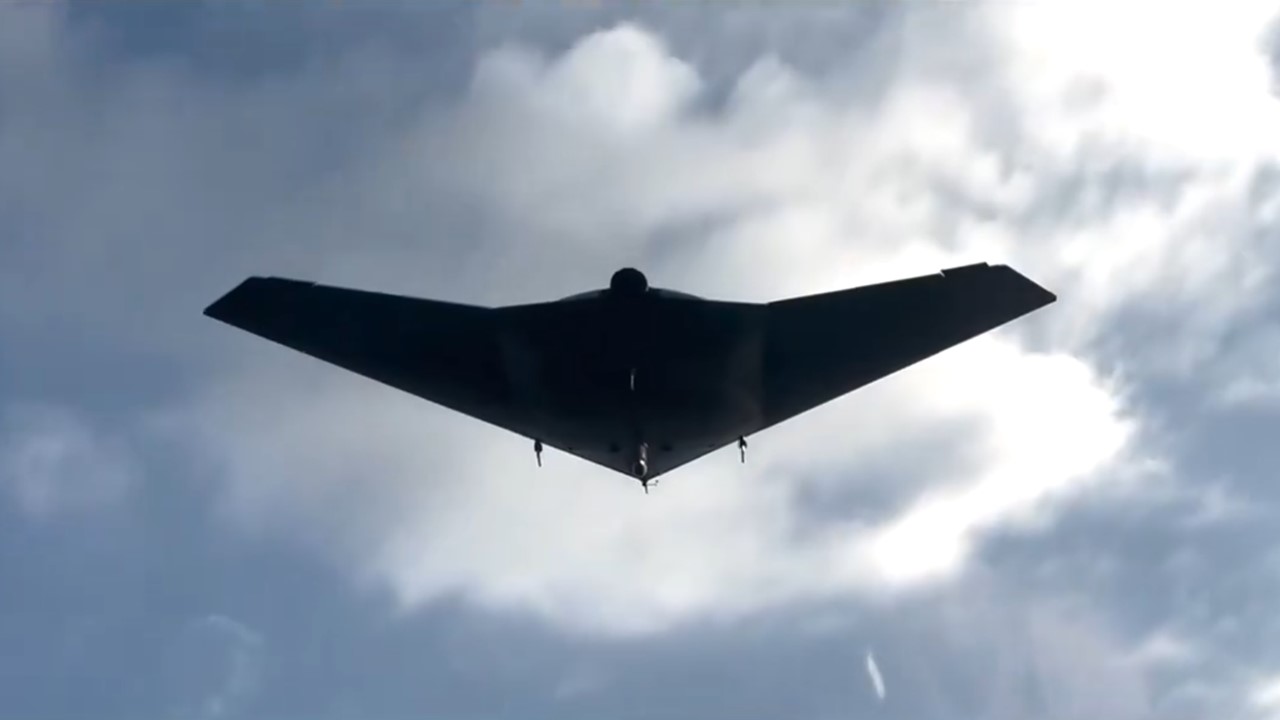
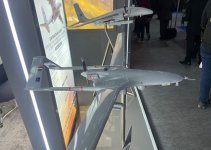
The alleged Turkish investment in drones: Egypt, of course, has drone manufacturing companies such as AMESTON, which produces the 6OCT, EJUNE-30SW, AHMOS, and Jabar families. The Chinese have established a drone manufacturing plant with a weekly production capacity of 12 aircraft to meet the needs of African countries on the Red Sea coast, according to what we have previously reported from Chinese sources in recent months. We find that the Turks want us to invest in a drone factory in Egypt, in an industrial city on the Mediterranean coast. In short, we are forcing all parties to invest in Egypt. The Chinese thought they were pressuring the Egyptians to transfer fighter jet technology. We put them in competition with the Koreans and the Turks, and the result was that the Chinese made better offers. Even when Sudan bought six Akanji drones, which were deployed at Egypt's Al-Uwaynat East Airport to carry out raids against the Rapid Support Forces (RSF), Egypt advised the Sudanese to have the Turks manage the airport's ground control stations. As a result, when the RSF shot down about four Akanji drones, the Turks were forced to compensate Sudan with replacements, as happened with Mali. Algeria shot down an Akanji drone. Consequently, the Turks sold six Akanji drones to Sudan for $120 million. Sudan received ten, meaning the Turks lost the deal.
Regarding the Turkish system, it's also essentially a commercial and industrial deal in Saudi Arabia's favor. Egypt has used this to attract the Turks by establishing joint domestic routes. In reality, Egypt produces a single Turkish drone called the BAHA, which competes with Cypriot versions like the H12 and the Chinese version called the HAMZA-3. Even the Amiston company has offered another new VTOL version, for which a contract has been signed. This means that at least three versions are actually being produced.
FOR TOLGA EGYPT HAVE ALTERNATIVE LOCAL SOLUTION
View attachment 177507
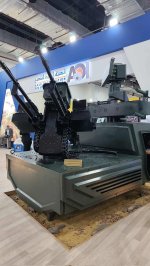
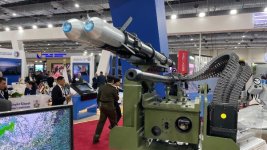
Egypt has already developed an air defense system similar to the Turkish one and showcased parts of it. A multi-purpose 23mm launcher equipped with ten 70mm guided missiles, including an AESA radar, is mounted on the Tesmah 4 armored vehicle and the locally produced Czech Patriot vehicle. At the EDEX exhibition, another system to counter drones, presented by the Arab Organization for Industrialization, is a multi-purpose 23mm launcher. It consists of a radar, a remote control platform with two 23mm cannons, an electro-optical detection system, and a jamming system. The system is also supported by artificial intelligence technologies and operates fully automatically. The same applies to the Arab International Optics Company, which presented a new anti-drone system for Egypt.
View attachment 177508
The Arab International Optics Company also unveiled a new anti-drone system for drones, helicopters, speedboats, and other targets. This system, the Thales LMM (Martlet), is produced by the Arab International Optics Company in partnership with the French company Thales. It has a range of over 6 kilometers and a speed of up to Mach 1.5. Some people don't understand that we are practicing medicine and treating the mental illnesses of some dwarfs. Simply put, this proves that the Turks came to exploit Egypt's comparative advantages in weapons production, while Egypt has readily available alternatives.
The fact that Egypt has attracted Turkish factories to become a manufacturing hub Clearly, we are causing some discomfort to the Turkish youth, who believe they have gained something.
Egypt uses any talks with a supplier as leverage against other suppliers. China and South Korea have restrictions on technology transfer, so Egypt opened avenues with the Turks when Italy imposed restrictions, particularly on FREMM frigates, and Germany restricted arms exports. We used SPAM for F-110 frigates with entirely Egyptian-made munitions. Egypt has aimed for 40 years to be a manufacturer of both Western and Eastern weapons. Financial constraints, or more accurately, mismanagement and corruption, have hindered this. When we were manufacturing the M1A1, we partnered with Iraq to produce the T-72. When we produced the F-6 and F-7, we aimed to produce Western fighters like the Mirage 2000 or F-20. The only obstacle at the time was the billion dollars needed to finance fighter production. When the Koreans wanted to impose their conditions for the FA-50, the Chinese alternative was ready.
Didn't we say from the beginning that if the Turks wanted to sell weapons to Egypt, they should establish production lines in Egypt, not just make sales deals? When what we said comes true, it doesn't anger us because it proves our vision correct. Some people have a certain mentality. Never abandon a child or teenager



 ..
..