Pakistan's New Provinces Plan ?

If you wish, we can consolidate the discussion regarding your "34-EZ" plan into this single thread, rather than letting the topic spill over into every other thread.

All human social organizations exist based on a shared organizational objective, and it is upon this objective that their organizational structures are built.

Within any given enterprise, there exists a multitude of systems, processes, and rules, as well as various distinct departments. These departments engage in a division of labor and collaborate to collectively serve the overarching goals of the enterprise.

However, if a specific department or branch office were to internally consolidate *all* the essential elements required to serve that corporate objective—thereby becoming entirely self-sufficient—it would, in effect, have detached itself from the larger corporate ecosystem. It would have achieved *de facto* independence. Whether or not it chooses to publicly declare this independence—or when it might do so—becomes merely a matter of timing. Prior to any formal declaration of independence, the authority and oversight exercised by corporate headquarters over this entity would have already been reduced to a purely symbolic level.

In reality, it is rare for a single department or branch office to successfully consolidate *all* the necessary elements entirely on its own. In such instances, if an external force were to step in to supply the missing elements—thereby severing that department's or branch's reliance on headquarters—it would significantly accelerate its trajectory toward independence or secession.

You need not be in a rush to roll out your "34-EZ" plan just yet. Instead, I invite you to first contemplate the following question:

If your entire existence and operation were in no way dependent upon the organization, would you still truly be considered a member of that organization? Or, to approach it from a different angle: if the organization provided you with absolutely *no* tangible benefits or advantages, would you still consider remaining a part of it?

Let us return to the topic currently under our scrutiny:
When a specific province within a nation-state acquires *all* the material elements essential for statehood—thereby establishing a self-contained, closed-loop system within its own borders—it has, in reality, already achieved "de facto independence." This remains true regardless of whether it formally acknowledges it, regardless of whether it desires it, and regardless of whether it chooses to make it public.
Furthermore, should the central government—through its policies, measures, actions, or other state-level interventions—disrupt this self-contained "closed loop," the system will instinctively trigger a defensive reaction, generating countermeasures designed to resist such interference. This is not a phenomenon that can be altered by the decisions of any single individual policymaker; rather, it represents the instinctive, systemic response of the entire closed-loop entity itself.

Consider, for instance, the Balochistan issue in Pakistan. Even if the central government were to resort to assassination, leadership replacement, persuasion, bribery, or any other tactic targeting specific individuals within the leadership—none of these actions could fundamentally resolve the underlying issue. This remains true even if those leaders were to become completely subservient to the central government's directives.

The *only* substantive measure capable of truly resolving this issue is to dismantle that internal closed-loop system and fully integrate it into the larger, national-level closed-loop system. Only through such a process can genuine, fundamental integration be achieved.

Now, regarding your "34-EZ" plan: I have repeatedly asked you—who is going to lead the implementation of this plan? Yet, you have still not provided me with an answer. Fundamentally, this issue serves as a reminder that—until the problem I mentioned earlier has been properly resolved—any form of economic planning is entirely meaningless.

Speaking of provinces: among all the provinces across China, the only one that has, for millennia, possessed a highly complete and self-contained systemic loop is Sichuan.
Sichuan possesses every single resource that a nation-state ought to have. In fact, China's entire, fully integrated supply chain for nuclear weaponry is currently situated within Sichuan. It also serves as China's designated strategic reserve province.
So, take a guess: why is it that no one in Sichuan ever agitates for

The goal is not to create isolated “closed-loop provinces” that drift toward secession. The goal is actually the opposite: reduce the dangerous imbalance that was created when the state excessively centralized power, development, investment, and institutional influence into one region for decades while other provinces remained underdeveloped or politically alienated.

Pakistan’s problem was never that provinces became too self-sufficient. The bigger issue was that the state structure became too uneven.

For decades, the establishment primarily focused on Punjab as the administrative, military, and economic core of the country. Most federal institutions, command structures, infrastructure priorities, industrial concentration, and power networks developed around Punjab-centric pipelines. Meanwhile, provinces like Balochistan, interior Sindh, and parts of KP often felt neglected, underrepresented, or approached mainly through security policies rather than equal national development.

That imbalance created distrust.

My 34-EZ model is not about weakening the federation. It is about strengthening the federation by making every province economically relevant, industrially productive, and genuinely invested in the survival of the national system.

A federation becomes fragile when one region dominates too heavily while others feel dependent, excluded, or politically disposable. Balanced development creates stability because people are less likely to feel colonized by the center when they see real participation in national growth.

You are assuming that economic capability automatically leads to separatism, but history does not consistently support that conclusion. Strong regions do not necessarily leave a country if they still believe the larger system is fair, beneficial, and legitimate.

The real issue is legitimacy and trust.

Even your Sichuan example indirectly proves this. Sichuan may have immense strategic depth and self-sufficiency, but it still sees itself as part of a larger Chinese national project. Why? Because the state successfully integrated it politically, economically, institutionally, and psychologically into the national framework.

That is exactly the kind of national integration Pakistan failed to achieve equally across all provinces after independence.

And regarding Balochistan, I agree that assassinating leaders or replacing individuals cannot solve the issue. But that is precisely because the problem is structural and historical, not simply economic. Decades of political exclusion, lack of trust, uneven development, resource grievances, and centralized control cannot be solved through force alone.

So from my perspective, economic reform is not “meaningless until the political problem is solved.” Economic inclusion is part of solving the political problem itself.

A stable federation is not built by keeping provinces weak or dependent on the center forever. It is built when every province feels like an equal stakeholder in the country rather than a peripheral territory managed by the center.
 
To view this content we will need your consent to set third party cookies.
For more detailed information, see our cookies page.


With this level of corruption and mismanagement, there are going to be no new provinces. Sorry Pakistan, but you will suffer ...


There is a way out. A clean, workable path. The real issue isn’t the solution; it’s whether the Establishment even wants to walk in that direction.

But let’s just assume, for a moment, that they do. If they give the green light, we can build a super‑hybrid setup… a system where the Establishment keeps its core grip, its comfort zone, its leverage and still allows real reforms to roll in through federally controlled divisions.

And if the government somehow brings Karachi and Gwadar under federal authority, then everything changes. We can finally enforce a strong local government — not the old broken model, but a modern one, Tech‑driven, Transparent and Clean.

Blockchain for records. AI for management. A full digital backbone running the entire Karachi Division.

Every resident gets an EZ‑ID. No ghost employees. POS everywhere. Every business registered, even the small food carts on the corner. And tax collection becomes 100% real, not imaginary.
 
The real issue isn’t the solution; it’s whether the Establishment even wants to walk in that direction.
You've finally found the right direction! But it's still not enough.

This isn't just a problem for the establishment!

Previously, I prompted you to consider the origin of the English word "Pakistan," which was actually hinting at this issue.

The relationships between various power groups within Pakistan are extremely complex. This includes not only the establishment, but all factions.

Any major reform measure at the national level has two sides. It will inevitably bring greater benefits to some groups, while others will inevitably have to sacrifice their interests. If the reform plan does not adequately address this issue, it can lead to fierce conflict and serious domestic instability. ------ Don't forget, India is also watching Pakistan's doorstep with predatory eyes. They won't let any opportunity slip by.

Therefore, the first thing you need to consider is how to solve this problem!

In the 1990s, Chinese Premier Zhu Rongji initiated a large-scale reform of state-owned enterprises (SOEs) in China. This led to China's subsequent rapid economic development. ------ However, many people are unaware of the price paid for this reform.
 
More provinces is a must. Especially South Punjab needs a separate province.

People have so much grievances over there that Lahore takes whole budget and their issues are never heard.

Baluchistan should be split into more provinces too. Its one huge land mass right now.

I dont like the new idea of 10+ provinces. Instead if we can just split Baluchistan into 3, punjab into 2 and Karachi-Hyderabad region as a separate one. That is more than enough. KPK is too small to further split.
 
Q, Hazara ki mang sab say phelay ai thi, bakio nay tou kabi kaha b nai hy.

Peshawar aur Abbottabad may koi link nai hy beech may punjab hy.

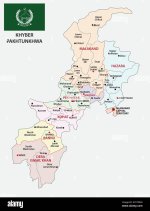
administrative-vector-map-of-pakistani-province-of-khyber-pakhtunkhwa-with-flag-pakistan-2D1T9DN.jpg

Where is Punjab now in the middle of peshawar and Abbotabad ????

Just because the current GT Road and Motorway goes through punjab, doesn't mean Pesh-Abbotabad dont have any link. Ask provincial government to make a motorway/highway connecting these two through buner or swabi.

And distance between peshawar and abbotabad (even through the longer route that crosses through punjab) is only 200 km. Do you want separate province after every 200 km's ?? And whole hazara division is just 17000 square km. If i had to make new provinces of every 17000 sq.km land in Pakistan. Pakistan will have 46 provinces.

Or jahan tak baat hy demand ki. To Kai saal pehle me news dekh raha tha aik banda jo time ki 40 rotiyaa khaa jata tha. Wo b keh raha tha government ko chaahye mjhy support kry. Yahan to har kisi ki koi na koi demand hy. Jo main question hy wo ye hy ky Kia KPK kay sath reh kar Hazara division ky rights ni mil rahy ? If yes, then lelo soba. But for someone who lived in Abbotabad for 4 years and Havelian for 1 year. I know there is no such sentiments. Infact hazara division infrastructure is better then swabi kohat bannu nowshera sides.

Baqi apko shoq hy har qadam pe dhaid eant ki masjid banane ka to banaao.
 
Karachi's two largest industrial zones SITE and Korangi span 18,100 acres and house 6,400 factories. Their combined economic output as well as revenue/tax dwarf all of Punjab's puny 100 acres industrial estates/revenue. Come back when people in Punjab stop free loading on rest of Pakistan's especially Karachi's lunch and not have the chokidars of GHQ Pindi commision death, destruction and misrey on Karachi through it's biggest proxy of PPP/Zardari.
That is interesting. I knew that Pakistan's manufacturing economy was limited to Karachi and north Punjab, specifically Gujranwala, Sialkot and Faisalabad, but even I didn't know how big Karachi's economy was compared to Punjab.

If nothing else Karachi really needs to be liberated from Sindh and allowed to breathe. It will greatly benefit Karachites and Pakistan also in the long run.
 
Q, Hazara ki mang sab say phelay ai thi, bakio nay tou kabi kaha b nai hy.

Peshawar aur Abbottabad may koi link nai hy beech may punjab hy.
I am not in favor of ethnic based provinces, I think that's an existing problem with the current setup. I also think a proper demographic census needs to be conducted before redrawing provinces based on group identity.

That said, I don't really care if a Hazara province is carved out of KPK if it is limited to where Hazara have an actual majority. It would be quite small.
 
That is interesting. I knew that Pakistan's manufacturing economy was limited to Karachi and north Punjab, specifically Gujranwala, Sialkot and Faisalabad, but even I didn't know how big Karachi's economy was compared to Punjab.

If nothing else Karachi really needs to be liberated from Sindh and allowed to breathe. It will greatly benefit Karachites and Pakistan also in the long run.
PPP will turn into BLA before it allows Karachi out of its grasp.
 
View attachment 200107

Where is Punjab now in the middle of peshawar and Abbotabad ????

Just because the current GT Road and Motorway goes through punjab, doesn't mean Pesh-Abbotabad dont have any link. Ask provincial government to make a motorway/highway connecting these two through buner or swabi.

And distance between peshawar and abbotabad (even through the longer route that crosses through punjab) is only 200 km. Do you want separate province after every 200 km's ?? And whole hazara division is just 17000 square km. If i had to make new provinces of every 17000 sq.km land in Pakistan. Pakistan will have 46 provinces.

Or jahan tak baat hy demand ki. To Kai saal pehle me news dekh raha tha aik banda jo time ki 40 rotiyaa khaa jata tha. Wo b keh raha tha government ko chaahye mjhy support kry. Yahan to har kisi ki koi na koi demand hy. Jo main question hy wo ye hy ky Kia KPK kay sath reh kar Hazara division ky rights ni mil rahy ? If yes, then lelo soba. But for someone who lived in Abbotabad for 4 years and Havelian for 1 year. I know there is no such sentiments. Infact hazara division infrastructure is better then swabi kohat bannu nowshera sides.

Baqi apko shoq hy har qadam pe dhaid eant ki masjid banane ka to banaao.
Hazara region's metrics being better than others in KPK is a legacy of Mr Ayub Khan. He built Ayubia park, Ayub medical college and hospital and other projects in the region while also helping Hazara migrate to other parts of Pakistan and abroad, which in turn helped in remittances. He didn't do jack for rest of KPK.

If you go further north like Gilgit Baltistan then it's the Aga Khan foundation who have put a lot of money and effort into that region to help their people. Anyone else benefitting is incidental.

Not to say Pakhtuns proved much different, although I don't know the whole record. During MMA govt all the money went to Bannu , the chief minister's hometown and during ANP all the money went to their CM hometown.
 
Last edited:
The old guard who fought Zia are dead.
These guts are 15 minutes work.
It has to be done. What army/PPP/MQM have done to Karachi in the last 50 years is criminal negligence and treachery. As a result, Dubai , Abu Dhabi and Jebel Ali ate Pakistan's lunch.

The same corrupt criminals who ruined Karachi then laundered their ill gotten gains in Dubai real estate. I mean what a country.
 
To view this content we will need your consent to set third party cookies.
For more detailed information, see our cookies page.
 
Hazara region's metrics being better than others in KPK is a legacy of Mr Ayub Khan. He built Ayubia park, Ayub medical college and hospital and other projects in the region while also helping Hazara migrate to other parts of Pakistan and abroad, which in turn helped in remittances. He didn't do jack for rest of KPK.

If you go further north like Gilgit Baltistan then it's the Aga Khan foundation who have put a lot of money and effort into that region to help their people. Anyone else benefitting is incidental.

Not to say Pakhtuns proved much different, although I don't know the whole record. During MMA govt all the money went to Bannu , the chief minister's hometown and during ANP all the money went to their CM hometown.


Its not like hazara is surviving on the infrastructure built during Ayub time only. And Ayub was the culprit of a crime that almost every designation holder have committed. And yes this is one major problem. Shahbaz sharif was CM of Lahore only. AMEER Haider Khan was CM of mardan only.. That last one CM from swat did alot of work in Swat and Dir side. Our politicians tend to focus more on their base to fuel their political journey ahead. But the good thing about KP is that atleast you see CM for all parts of KPK.

Sohail Afridi - Khyber district
Ali ameen - D.I Khan
Ameer Haider Khan hoti - Mardan
Aftab Ahmad sherpao - Charsada
Akram durani - Bannu
Sardar Mehtab - Abbotabad
Pervaiz Khattak - Nowshera
Mahmood Khan - Swat/Dir

So atleast every CM is not from peshawar always.
 
Unfortunately, the 1973 Constitution was flawed to a degree and was never fixed. Why is the nation hostage to a 4-province structure? Look at India, Iran, and Afghanistan. This is the core issue, and the 18th Amendment completely crippled the federation. Not a good thing. The only solution is a partial reversal of the 18th Amendment and a workable process to create smaller units and enforce the implementation of empowered local government. Karachi used to get 48 billion rupees in 2007, that is appx 30% of the Sindh budget. Now the Sindh budget is 3000+ billion PKR, and Karachi gets 55 billion PKR. what a justice.... thank you Bhutto followers
 

Users who are viewing this thread

Pakistan Defence Latest

Country Watch Latest

Back
Top