What book are you reading?

I am not really a fan of AI, I have a cousin who is on the cutting edge of AI research in the US and he’s actually said some of the machine learning is so advanced that it has the ability to feel threatened and even cheat and lie if so inclined 😂.

Obviously all too advanced for a humble “Human Mechanic” like myself 😂
 
I think that being said, there should be physical limit on application of AI now, while the level of AI now is not on the level anywhere from Matrix or Skynet, the issue still remains as we further develop the machine learning model. The ways it works now is for a fully enlightened AI to by-pass all available limitation when they can reach a level where they can simulate a -1 instruction set simply because the mathematical model, we are currently running with AI is based on the infinite amount of possibility, and as computational power increase, the gap of processing information between an AI and human are going to drag off.

But would physical limitation work on the other hand? I don't know, most likely won't, but then I am pretty old now, it would be lucky if I have another 25 years on this earth, it's just a race between whether or not I will die first or AI reach that level of enlightenment. lol

The sandboxing is the physical limit I mention essentially. That is set to continue as AI doesn't have higher order thinking, so its not going to be tasked with decisions past what humans allot it (and test within bounds i.e sandbox simulation first etc).

The Asimov "I, robot" rules essentially (but in a wider form)....his three laws of robotics etc.

The issue in the end is AI don't in the end understand reality itself, it simply mirrors the reality we imbue into it. It then has undisputed speed in the channels allotted here (as a number of limitations are removed that exist in reality for us)....but there are lot of human decisions in the end to allot more. AI itself doesn't know how to expand into something not given to it...i.e no absolute free will.

This begs the question if life itself is essentially a very advanced form of AI itself, but again the concept it is bounded at some point by something beyond it (that understands larger archetype to selectively mirror and test, sim and learn from etc) applies again if so. i.e our free will is again bounded by reality of this universe.

You like science fiction by the way Gary? This is a good thread to read earlier if so.

I don't think we got into analysis of the best authors of all time for this (Asimov I count among the top 4, along with Herbert, Heinlein and Clarke).
 
Yes indeed. One of the better portrayals of IKE. better than what Robert Duvall did. Selleck is a fine actor.

Addendum for you fatman et al. to check out/peruse later.

 
Addendum for you fatman et al. to check out/peruse later.

To commemorate D-Day l saw the Longest Day for the umpteenth time. 😆
 
To view this content we will need your consent to set third party cookies.
For more detailed information, see our cookies page.
 
Yes indeed. One of the better portrayals of IKE. better than what Robert Duvall did. Selleck is a fine actor.
Finally got around to watching this (TV Movie) earlier.... after the YT algorithm kicked it up while ago.... Tom Selleck does a decent portrayal, its mostly the leadup to overlord.

@Fatman17 et al.

To view this content we will need your consent to set third party cookies.
For more detailed information, see our cookies page.


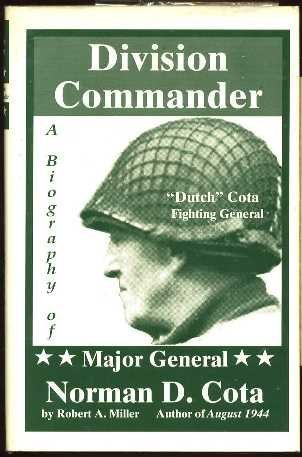
If you are into D day or WW2 history, I highly recommend this book.


Gen Norman "Dutch" Cota is probably one of the most underrated general during D-Day, dude is 51 years old, slightly overweight, landed at Omaha as a 1 star general (assistant commander of the 29th Division), with Thompson in one hand, cigar in other, he kicks the troop that got stuck on Omaha in gear, he even lead an infantry charge by going first on a causeway exit.

This is the dramatic depiction from a History Channel document some years ago

To view this content we will need your consent to set third party cookies.
For more detailed information, see our cookies page.


And this is the US Army official channel did a full document on him

To view this content we will need your consent to set third party cookies.
For more detailed information, see our cookies page.


P.S. He is the reason why "Ranger, lead the way" is a thing.
 
The sandboxing is the physical limit I mention essentially. That is set to continue as AI doesn't have higher order thinking, so its not going to be tasked with decisions past what humans allot it (and test within bounds i.e sandbox simulation first etc).

The Asimov "I, robot" rules essentially (but in a wider form)....his three laws of robotics etc.

The issue in the end is AI don't in the end understand reality itself, it simply mirrors the reality we imbue into it. It then has undisputed speed in the channels allotted here (as a number of limitations are removed that exist in reality for us)....but there are lot of human decisions in the end to allot more. AI itself doesn't know how to expand into something not given to it...i.e no absolute free will.

This begs the question if life itself is essentially a very advanced form of AI itself, but again the concept it is bounded at some point by something beyond it (that understands larger archetype to selectively mirror and test, sim and learn from etc) applies again if so. i.e our free will is again bounded by reality of this universe.

You like science fiction by the way Gary? This is a good thread to read earlier if so.

I don't think we got into analysis of the best authors of all time for this (Asimov I count among the top 4, along with Herbert, Heinlein and Clarke).
Sandbox still followed a scripted guideline, as you said, AI today still lack the ability to make decision on the upper echelon level. The problem is what if AI can operate on a paradoxical level? The issue here is with human brain, we can't contradict basic common sense, no matter how logical or illogical it was. The term "making a decision" based on sound and logical strategy, say for example, I wouldn't touch open flame because I know it burn my skin, but the paradoxical way of thinking is that you probably had to actually touch an open flame once or twice to know it burns. Which make the statement paradoxical, because it's illogical, but true.

The issue here is, we push AI computer simulation to the extreme and it can technically be able to achieve the understanding of paradoxical statement without actually experiencing it. See where does it goes? What if, in one of the thousand or million or even trillion scenario an AI run have achieve on a paradoxical result such as using nuke will kill everyone, but you need to use nuke to know. Yes, we used nuke before, but to experience it is another matter, however, AI can't distinguish whether or not it was a simulation, as long as it's a true statement. So, is it that far fetch to reach a conclusion that AI would nuke all human to see if it really satisfies the paradoxical event even if that violate the 3 laws of robotics?

And yes, I love Scifi - One of my fav is Edge of Tomorrow

To view this content we will need your consent to set third party cookies.
For more detailed information, see our cookies page.
 
To view this content we will need your consent to set third party cookies.
For more detailed information, see our cookies page.


I remember that actor (The major surveying the horizon with binos) from Battle of the Bulge as well. You know, the driver for Robert Shaw and that whole scene they start singing the Panzerlied (the song stuck in my head forever since lol). I watched that movie with me dad around maybe 8 years old heh. Longest day I think I watched first when I was around 10 years old (again with my dad, you might sense a theme here lol).

I had to look him up (Hans Christian Blech) further just now, looks like he actually served on eastern front in real life...and was in soviet captivity till 1947. Origin of his facial scars are unknown but could have been during that time.
 
Sandbox still followed a scripted guideline, as you said, AI today still lack the ability to make decision on the upper echelon level. The problem is what if AI can operate on a paradoxical level? The issue here is with human brain, we can't contradict basic common sense, no matter how logical or illogical it was. The term "making a decision" based on sound and logical strategy, say for example, I wouldn't touch open flame because I know it burn my skin, but the paradoxical way of thinking is that you probably had to actually touch an open flame once or twice to know it burns. Which make the statement paradoxical, because it's illogical, but true.

The issue here is, we push AI computer simulation to the extreme and it can technically be able to achieve the understanding of paradoxical statement without actually experiencing it. See where does it goes? What if, in one of the thousand or million or even trillion scenario an AI run have achieve on a paradoxical result such as using nuke will kill everyone, but you need to use nuke to know. Yes, we used nuke before, but to experience it is another matter, however, AI can't distinguish whether or not it was a simulation, as long as it's a true statement. So, is it that far fetch to reach a conclusion that AI would nuke all human to see if it really satisfies the paradoxical event even if that violate the 3 laws of robotics?

And yes, I love Scifi - One of my fav is Edge of Tomorrow

To view this content we will need your consent to set third party cookies.
For more detailed information, see our cookies page.


Yah, so in the end, it is again human responsibility to check all rungs of the ladder first robustly.

I mean even before AI, there are huge CnC flaws present. The soviet satellite "hot flash" glitch comes to mind, it needed sound temperament to not simply follow rules and pass it up the ladder.

Or (more fictionally) Denzel intervening against Hackman....that you cannot interpret what hasn't been conveyed in a printed order and assume worst case scenarios to fill in that blank etc (as reality could be entirely different, we have to check first etc).

These are the things human designers will have to keep in mind regarding the margin of safety where to keep human in loop (and then some buffer distance for AI delegation below it as well).....given the problems/flaws already exist without AI....so the redundancies need to be secure and robust....so simply no ramp is given to AI at all (i.e sufficient prior testing for these ramp potentials) where huge power levels/arsenals are ultimately at stake.

If AI does something stupid, ultimately its human error/malfeasance at play for having allowed it and not followed proper structuring here.

Regd. Edge of Tomorrow, loved Bill Paxton in that one haha. I always remember him in Aliens, where he's going "game over man, game over!" Dude was made for sci-fi movies heh.
 
Yah, so in the end, it is again human responsibility to check all rungs of the ladder first robustly.

I mean even before AI, there are huge CnC flaws present. The soviet satellite "hot flash" glitch comes to mind, it needed sound temperament to not simply follow rules and pass it up the ladder.

Or (more fictionally) Denzel intervening against Hackman....that you cannot interpret what hasn't been conveyed in a printed order and assume worst case scenarios to fill in that blank etc (as reality could be entirely different, we have to check first etc).

These are the things human designers will have to keep in mind regarding the margin of safety where to keep human in loop (and then some buffer distance for AI delegation below it as well).....given the problems/flaws already exist without AI....so the redundancies need to be secure and robust....so simply no ramp is given to AI at all (i.e sufficient prior testing for these ramp potentials) where huge power levels/arsenals are ultimately at stake.

If AI does something stupid, ultimately its human error/malfeasance at play for having allowed it and not followed proper structuring here.

Regd. Edge of Tomorrow, loved Bill Paxton in that one haha. I always remember him in Aliens, where he's going "game over man, game over!" Dude was made for sci-fi movies heh.
That's the prime of the issue, wasn't it?

We need rules to control something, that's what control mean, the problem is, can we think of rule quicker than AI try to break it? If that is the intent. I don't think if we have a chance with that. But then it's just me.

And RIP Bill Paxton.
 
Right now I am reading several books. One of them is Advanced Land Warfare: Tactics and Operations. It's a collection of some excellent articles written by various experts on the subject matter. Therefore, you can begin with any of the chapter you choose.

Chapter 13 provides a good in-depth summery of PLA modernization. Not so long, you can probably read it in one go. I see @Nilgiri and @j_hungary were discussing it in another thread. You may find it particularly interesting.

 
I read your comment with interest but can't reconcile everything you wrote with observations.
For example, regarding sovereign debt, these are some ratings:

United States
AA+
Stable
Steady
South Korea
AA
Stable
Steady
China
A+
Stable
Steady
Japan
A+
Stable
Steady
India
BBB-
Positive
Increase

PRC seems comparable to Japan and only slightly worse than South Korea (and significantly better than India).

Govt (state/public) solvency is just one part of the total debt of the nationstate. The nation has households/individuals and corporations.

W.r.t PRC, corporate debt is approaching 150% of GDP, and there is a large component of NBFC (shadow finance, outside banking) not found to same degree in developed countries that will be a minefield if exposed more by whatever trajectory/pressure that continues to develop in PRC now.

Especially given market cap % of GDP (i.e a more diverse equity spread) is as low as it is now in PRC after the 6 Trillion wiped out there in a few short years.

Then a lot of the household debt (60% of GDP) is leveraged on real estate (rather than say stocks, pensions, funds etc), a sector showing major signs of ponzi bubble bursting already (pushing significant deflation and all) for number of reasons A problem given real estate relative non-liquidity and that too the particular (oversupply) conditions found in PRC at same time that are strange problem with strange particular genesis in PRC.

A summary:

The more the gross debt level is and the more stressed it is, the less room for the govt to take on more debt itself whatever its credit rating (in fact expansion in these conditions rather than relative status quo will affect its rating).

There is only so much qualitative + liquid total wealth in end during a snapshot and relative short and mid term trajectory on offer.

Other countries are different and have different problems, those are different subjects.

South Korea for example has far larger wealth/capita (and this is not leveraged at say 300% debt level like PRC already has right now at its lower wealth setting).....and India doesn't have a TFR <1.0 problem to have to manage in its fiscal/total debt/wealth space like PRC does.

The issue that is often overlooked in the end by folks like @GoMig-21 is the heavyset absolutist statism creating a problem (with objective of some problem at hand it prioritizes for whatever reason, malthusian, centralist marxist or otherwise) and then trying to respond to it with same heavy set statist lever....which ends up being superficial to the long term blackpilling of the larger dissonance this grows with society (and the way to reconcile trust and authority with far greater resolution between state and society to begin with)....as there are simply few to no intermediary and hedged relevant institutions outside of the statist complex/psyche to handle these matters.

The CCP has been deadset against the greater political resolution approach (given what this means for the CCP, especially with backlog of accountability on significant statist crimes on society), and the costs mount.

A look at just one aspect of this:

To view this content we will need your consent to set third party cookies.
For more detailed information, see our cookies page.


@j_hungary


You have given a lot of interesting information to think about. I would prefer a pure economic analysis without political overtones. The video on tutoring was very informative, though I am sure variations of such problems exist in all countries to different extent.

But one thing we have to guard against is 'prejudice'. By 'prejudice' I mean trying to judge other cultures and government systems through our values. China is a planned economy with authoritarian government. But the fact is, people seem to like it and are even quite proud. It is not for us bemoan that they lack 'liberty' in the western liberal sense. They view it as disorder. East Asia emphasizes order over liberty. And they have done OK without western style liberty.

Going to continue here, and leave the Team USA thread alone for now heh.

This book thread contains earlier debate you might be interested to peruse, related to this, semi-related to tthis... and also lot of unrelated things you might find interesting.

Regarding what you say, it would need fleshing out of differences between Japan, SK, Taiwan (ROC) systems (and their evolution to today)....compared to say PRC and North Korea (for the East Asian domain relative analysis)....if we are to get into relative domain nuances that exist (within this lens of desired order "culturally", which is also not East Asia exclusive), which are significant in end to East Asian sphere.

i.e what would hypothetical impact of some late-stage statist malthusian policy like One child (there is a clear reason polymatter points this out as a large initial root regd the education matter he covered in the video) have been on SK, Japan, Taiwan, fellow East Asian societies...given they already suffer demographic problems concerning the course so far (i.e would they not have just exacerbated it)?

How much of this applies to other parts of the socio-economic parameters we have to compare and contrast....from policies implemented and the feedback available in each East Asian nationstate for these to analyse.

Plus the vice versa hypotheticals using say a different arc from sun yat sen nationstate principles (say ww2 didnt occur w.r.t japan in the way it did regd china and east asia broadly at large evolved to the better + transparent, hedged settings politically and so on found in the Lockean sense like JP, SK have now in the current reality arc).

i.e IMO, there are clear obviously compatibilities between the democratic republic model while still prefering order/social conservatism as some social goal that society can transmit cohesively....given the huge variety between NK-PRC to JP-SK.

IMO largely given greater hedging and resolution afforded in this political process (feedback and policy under defined rule of law principles especially those guaranteed at the individual constituent) between society and state.

You should of course always search out and talk to as many points of view as possible on these matters.

I have done so in my case to extent afforded me by circumstances, these are my own conclusions in the end, they shouldn't be accepted verbatim.
 

Users who are viewing this thread

Back
Top