Indian Americans - USA and Western politics

Why Diwali spending is primed to rocket in the US​

8 November 2023

As Diwali festivals become increasingly mainstream, businesses are hoping to capture celebrants' holiday dollars.

For many businesses, holiday spending is a major part of Q4 revenue – think Halloween, Thanksgiving, Christmas and Kwanzaa. Now, as it gains national recognition, US merchants are increasingly embracing Diwali, the Hindu festival of lights, for its commercial potential.

While every region in India has traditions for commemorating this holiday, most celebrants broadly see Diwali as the triumph of good over evil, light over darkness and wisdom over ignorance. Also marked by Jains and Sikhs, it is celebrated every year in October or November, precipitating a range of private and public celebrations.
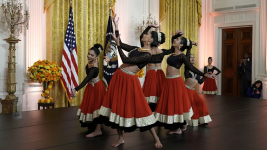
Diwali's profile is growing, particularly in the US. In 2022, President Joe Biden marked Diwali at the White House with the biggest-ever celebration. (y) Recognition has also appeared at the state and city levels: the Pennsylvania State Senate passed a bill earlier in April this year making Diwali an official holiday state holiday; and in New York City, Mayor Eric Adams announced in June that Diwali will become a school holiday in the city's public school system, the largest in the country. (y)

"Diwali is coming out from a liminal space and becoming a part of our national lexicon of holidays," says Soni Satpathy-Singh, a New York-based entrepreneur, who owns meal delivery review site Meal Matchmaker and works as a private chef and content creator.
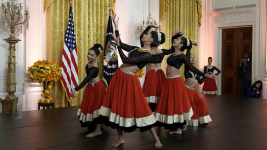
Diwali's profile is growing, particularly in the US. In 2022, President Joe Biden marked Diwali at the White House with the biggest-ever celebration. Recognition has also appeared at the state and city levels: the Pennsylvania State Senate passed a bill earlier in April this year making Diwali an official holiday state holiday; and in New York City, Mayor Eric Adams announced in June that Diwali will become a school holiday in the city's public school system, the largest in the country.

"Diwali is coming out from a liminal space and becoming a part of our national lexicon of holidays," says Soni Satpathy-Singh, a New York-based entrepreneur, who owns meal delivery review site Meal Matchmaker and works as a private chef and content creator.

1729129090038.png

Major retailers such as Target, Walmart and Costco have begun to cater to Diwali in the past few years, stocking shelves with Diwali-specific goods, including decorative productive products for the home, food and gift boxes. Greeting card aisles also display Diwali-themed cards alongside Christmas ones.

"I was more surprised to have recently visited my local TJ Maxx store and see a section dedicated specifically to Diwali with an array of brass and painted clay diyas, blinged out candles, mirror-work table runners, lanterns, acrylic rangolis and even Hindu deity idols," says Satpathy-Singh. "Right there, in between Halloween decor and Thanksgiving goods, was half an aisle full of Diwali decor items."

In India, consumers who celebrate Diwali represent a major revenue opportunity for businesses – and research shows purchasing from this group may grow this year, with approximately 70% of Indians ready to spend more this Diwali than last. Among those who planned to spend more, 68% said they are more likely to increase spending on new clothes, 65% on gold and jewellery, 64% on Diwali food items and gifts for family and 64% on friends and colleagues.

US retailers offering Diwali-related products are hoping these commercial trends will go international – Kumar says businesses are eager to tap into the spending power of Indian- and South Asian-American purchasers who hold celebrations.

And there's a big potential market. At nearly 4.4 million, the Indian-American population has grown by more than 50% between 2010 and 2020, according to 2020 US Census data, which includes groups that celebrate Diwali. The median household income among the country's Indian-American population was $119,000 (£96,220) in 2019, according to Pew Research Center, standing significantly higher than median incomes for the broader US population.

Kumar adds many of the celebratory aspects of Diwali – including ornate displays and firecrackers – also appeal to a broader population beyond South Asian communities. Although it may be difficult to quantify the magnitude of interest in the festival among mainstream American shoppers, a Pinterest-GWI global research study conducted in July showed searches for the term "Diwali celebration" were up 60% year over year.
For Satpathy-Singh, of the requests she received to cater Diwali parties this year, many were from non-South Asian Americans and companies. "You may not celebrate Diwali yourself, but you may know someone who does and will have 'stuff' to gift them with everything that is now made available in the US market such as cards, food, decor, to list just a few things," she says.

As major retailers add Diwali merchandise to cater to this broader appeal, speciality stores and brands also stand to earn, too.

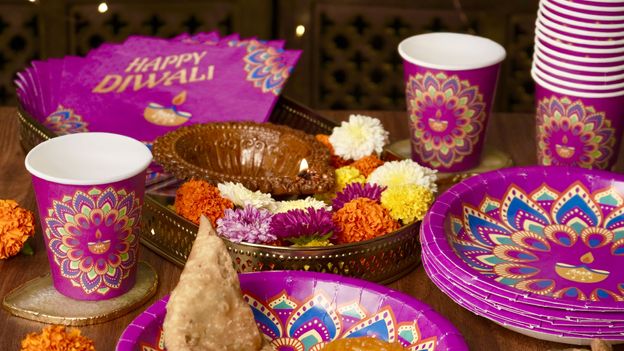
Patel Brothers, an Indian grocery marketplace chain with 51 US stores, has offered Diwali-related goods since its founding 49 years ago. Initially focused on food items, the company more recently expanded to accessories, including diya lamps, trinkets and party supplies. This year, the company debuted a line of patterned paper plates and cups, marking the growth of Diwali as an American holiday.

"We found a supplier to get paper plates, paper cups and napkins that have a Diwali theme on them," says Swetal Patel, a partner at Patel Brothers. "When you have a football party, you'll have paper plates that have a football theme or whatever. This is the first time we've brought in stuff like this." Before, they hadn't been able to find a vendor – now, the landscape has changed.

The rise of Diwali as a commercial occasion in the US, says Satpathy-Singh , likely saw a boost from the e-commerce boom of recent years, in which specialised brands were more easily able to send a range of Diwali offerings to a recipient's doorstep.
 

Attachments

  • 1729128444209.png
    1729128444209.png
    1.1 MB · Views: 0
Maybe JD just has yellow fever towards Asians because he is a right wing racist White Supremacist

how do you see news of my last post#137

we now find Hindus "Dipawali" in as School holidays in US :coffee:
 
Maybe JD just has yellow fever towards Asians because he is a right wing racist White Supremacist

here, how do you see the news as below? :coffee:

=> (y)
According to the QS Global 200 Business Schools report, Indi .. :coffee:


Indian Americans: The New Model Minority​


The 2008 election barely ended before the GOP began touting the presidential prospects of Louisiana Gov. Piyush "Bobby" Jindal, the son of Indian immigrants. Tuesday, Jindal becomes the new face of his party when he delivers the official Republican response to President Obama's speech to Congress. Whether or not he actually runs for president in 2012, Jindal symbolizes a remarkable but rarely discussed phenomenon--the amazing success of Indian Americans in general, and what that success says about our immigration policy.

Most Americans know only one thing about Indians--they are really good at spelling bees. When Sameer Mishra correctly spelled guerdon last May to win the 2008 Scripps National Spelling Bee, he became the sixth Indian-American winner in the past 10 years. Finishing second was Sidharth Chand. Kavya Shivashankar took fourth place, and Janhnavi Iyer grabbed the eighth spot. And this was not even the banner year for Indian Americans--in 2005, the top four finishers were all of Indian descent.

It's tempting to dismiss Indian-American dominance of the spelling bee as just a cultural idiosyncrasy. But Indian success in more important fields is just as eye-catching. Despite constituting less than 1% of the U.S. population, Indian-Americans are 3% of the nation's engineers, 7% of its IT workers and 8% of its physicians and
surgeons. The overrepresentation of Indians in these fields is striking--in practical terms, your doctor is nine times more likely to be an Indian-American than is a random passerby on the street.

Indian Americans are in fact a new "model minority." This term dates back to the 1960s, when East Asians--Americans of Chinese, Japanese and Korean descent--were noted for their advanced educations and high earnings.

East Asians continue to excel in the U.S, but among minority groups, Indians are clearly the latest and greatest "model." In 2007, the median income of households headed by an Indian American was approximately $83,000, compared with $61,000 for East Asians and $55,000 for whites.

About 69% of Indian Americans age 25 and over have four-year college degrees, which dwarfs the rates of 51% and 30% achieved by East Asians and whites, respectively. Indian Americans are also less likely to be poor or in prison, compared with whites.

So why do Indian Americans perform so well? A natural answer is self-selection. Someone willing to pull up roots and move halfway around the world will tend to be more ambitious and hardworking than the average person. But people want to come to the U.S. for many reasons, some of which--being reunited with other family members, for example--have little to do with industriousness. Ultimately, immigration policy decides which kinds of qualities our immigrants possess.

Under our current immigration policy, a majority of legal immigrants to the U.S. obtain green cards (permanent residency) because they have family ties to U.S. citizens, but a small number (15% in 2007) are selected specifically for their labor market value. The proportion of Indian immigrants given an employment-related green card is one of the highest of any nationality. Consequently, it is mainly India's educated elite and their families who come to the U.S.

The success of Indian Americans is also often ascribed to the culture they bring with them, which places strong--some would even say obsessive--emphasis on academic achievement. Exhibit A is the spelling bee, which requires long hours studying etymology and memorizing word lists, all for little expected benefit other than the thrill of intellectual competition.

But education and culture can take people only so far. To be a great speller--or, more importantly, a great doctor or IT manager--you have to be smart. Just how smart are Indian Americans? We don't know with much certainty. Most data sets with information on ethnic groups do not include IQ scores, and the few that do rarely include enough cases to provide interpretable results for such a small portion of the population.

The only direct evidence we have comes from the 2003 New Immigrant Survey, in which a basic cognitive test called "digit span" was administered to a sample of newly arrived immigrant children. It is an excellent test for comparing people with disparate language and educational backgrounds, since the test taker need only repeat lengthening sequences of digits read by the examiner. Repeating the digits forward is simply a test of short-term memory, but repeating them backward is much more mentally taxing, hence a rough measure of intelligence.

When statistical adjustments are used to convert the backward digit span results to full-scale IQ scores, Indian Americans place at about 112 on a bell-shaped IQ distribution, with white Americans at 100. 112 is the 79th percentile of the white distribution. For more context, consider that Ashkenazi Jews are a famously intelligent ethnic group, and their mean IQ is somewhere around 110.

Given the small sample size, the rough IQ measure and the lack of corroborating data sets, this finding of lofty Indian-American intelligence must be taken cautiously. Nevertheless, it is entirely consistent with their observed achievement.

The superior educational attainment, academic culture and likely high IQ of Indian Americans has already made them an economic force in the U.S., and that strength can only grow. Does this continuing success imply they will become a political force? Here, Gov. Jindal is actually a rarity. Indians are still underrepresented in politics, and they do not specialize in the kinds of fields (law and finance) most conducive to political careers. Time will tell if they are able to convert economic power into serious political influence, as a Jindal presidency could.

A much clearer implication of Indian-American success is that immigrants need not be unskilled, nor must their economic integration take generations to achieve. In sharp contrast to Indian Americans, most U.S. immigrants, especially Mexican, are much less wealthy and educated than U.S. natives, even after many years in the country.

A new immigration policy that prioritizes skills over family reunification could bring more successful immigrants to the U.S. By emphasizing education, work experience and IQ in our immigration policy, immigrant groups from other national backgrounds could join the list of model minorities.

There is nothing inevitable about immigration. Who immigrates each year is a policy decision, free to be modified at any time by Congress. Constructing new legislation is always difficult, but I propose a simple starting point for immigration selection: Anyone who can spell guerdon is in! (y)

Jason Richwine is a National Research Initiative fellow at the American Enterprise Institute in Washington.

 
we now find Hindus "Dipawali" in as School holidays in US :coffee:

Would you stop intentionally misleading people. Maybe voted in some local districts with a high asian population but not nationwide.

Some schools also vote in "Deer Shooting Day", "Rodeo Day","Potato Harvest Day", and other "holidays" that pertains to them.


Last edited:
Would you stop intentionally misleading people. Maybe voted in some local districts with a high asian population but not nationwide.

Some schools also vote in "Deer Shooting Day", "Rodeo Day","Potato Harvest Day", and other "holidays" that pertains to them.


You mean lm lying?
It's BBC news in post#137
Thanks
 
You mean lm lying?
It's BBC news in post#137
Thanks

That article was in November 2023

Why Diwali spending is primed to rocket in the US​

8 November 2023


Recognition has also appeared at the state and city levels: the Pennsylvania State Senate passed a bill earlier in April this year making Diwali an official holiday state holiday
While that Pennsylvania bill passed the state Senate way back in April 2023.. it actually failed to be made law in 2023.

They are trying to pass it again in 2024...may be lucky this time.

October 9, 2024

Maybe it will have more success than "Chinese New Year" which is also a school day off in NYC and some other big cities...but not a nationwide one.
 
Last edited:
Indian soft power is global
This is a deliberate ploy by modern rising India
As the economic might grows so does it's soft power in the west
Very cunning these Hindus

Why do the Chinese have no where near the same influence as USA despite matching their gdp and tech.. China has no soft power in west
Alien civilisation ..much loved by only Pakistanis it seems for some reason
 

Why Diwali spending is primed to rocket in the US​

8 November 2023

As Diwali festivals become increasingly mainstream, businesses are hoping to capture celebrants' holiday dollars.

For many businesses, holiday spending is a major part of Q4 revenue – think Halloween, Thanksgiving, Christmas and Kwanzaa. Now, as it gains national recognition, US merchants are increasingly embracing Diwali, the Hindu festival of lights, for its commercial potential.

While every region in India has traditions for commemorating this holiday, most celebrants broadly see Diwali as the triumph of good over evil, light over darkness and wisdom over ignorance. Also marked by Jains and Sikhs, it is celebrated every year in October or November, precipitating a range of private and public celebrations.
Diwali's profile is growing, particularly in the US. In 2022, President Joe Biden marked Diwali at the White House with the biggest-ever celebration. (y) Recognition has also appeared at the state and city levels: the Pennsylvania State Senate passed a bill earlier in April this year making Diwali an official holiday state holiday; and in New York City, Mayor Eric Adams announced in June that Diwali will become a school holiday in the city's public school system, the largest in the country. (y)

"Diwali is coming out from a liminal space and becoming a part of our national lexicon of holidays," says Soni Satpathy-Singh, a New York-based entrepreneur, who owns meal delivery review site Meal Matchmaker and works as a private chef and content creator.

Diwali's profile is growing, particularly in the US. In 2022, President Joe Biden marked Diwali at the White House with the biggest-ever celebration. Recognition has also appeared at the state and city levels: the Pennsylvania State Senate passed a bill earlier in April this year making Diwali an official holiday state holiday; and in New York City, Mayor Eric Adams announced in June that Diwali will become a school holiday in the city's public school system, the largest in the country.

"Diwali is coming out from a liminal space and becoming a part of our national lexicon of holidays," says Soni Satpathy-Singh, a New York-based entrepreneur, who owns meal delivery review site Meal Matchmaker and works as a private chef and content creator.

View attachment 72960

Major retailers such as Target, Walmart and Costco have begun to cater to Diwali in the past few years, stocking shelves with Diwali-specific goods, including decorative productive products for the home, food and gift boxes. Greeting card aisles also display Diwali-themed cards alongside Christmas ones.

"I was more surprised to have recently visited my local TJ Maxx store and see a section dedicated specifically to Diwali with an array of brass and painted clay diyas, blinged out candles, mirror-work table runners, lanterns, acrylic rangolis and even Hindu deity idols," says Satpathy-Singh. "Right there, in between Halloween decor and Thanksgiving goods, was half an aisle full of Diwali decor items."

In India, consumers who celebrate Diwali represent a major revenue opportunity for businesses – and research shows purchasing from this group may grow this year, with approximately 70% of Indians ready to spend more this Diwali than last. Among those who planned to spend more, 68% said they are more likely to increase spending on new clothes, 65% on gold and jewellery, 64% on Diwali food items and gifts for family and 64% on friends and colleagues.

US retailers offering Diwali-related products are hoping these commercial trends will go international – Kumar says businesses are eager to tap into the spending power of Indian- and South Asian-American purchasers who hold celebrations.

And there's a big potential market. At nearly 4.4 million, the Indian-American population has grown by more than 50% between 2010 and 2020, according to 2020 US Census data, which includes groups that celebrate Diwali. The median household income among the country's Indian-American population was $119,000 (£96,220) in 2019, according to Pew Research Center, standing significantly higher than median incomes for the broader US population.

Kumar adds many of the celebratory aspects of Diwali – including ornate displays and firecrackers – also appeal to a broader population beyond South Asian communities. Although it may be difficult to quantify the magnitude of interest in the festival among mainstream American shoppers, a Pinterest-GWI global research study conducted in July showed searches for the term "Diwali celebration" were up 60% year over year.
For Satpathy-Singh, of the requests she received to cater Diwali parties this year, many were from non-South Asian Americans and companies. "You may not celebrate Diwali yourself, but you may know someone who does and will have 'stuff' to gift them with everything that is now made available in the US market such as cards, food, decor, to list just a few things," she says.

As major retailers add Diwali merchandise to cater to this broader appeal, speciality stores and brands also stand to earn, too.

Patel Brothers, an Indian grocery marketplace chain with 51 US stores, has offered Diwali-related goods since its founding 49 years ago. Initially focused on food items, the company more recently expanded to accessories, including diya lamps, trinkets and party supplies. This year, the company debuted a line of patterned paper plates and cups, marking the growth of Diwali as an American holiday.

"We found a supplier to get paper plates, paper cups and napkins that have a Diwali theme on them," says Swetal Patel, a partner at Patel Brothers. "When you have a football party, you'll have paper plates that have a football theme or whatever. This is the first time we've brought in stuff like this." Before, they hadn't been able to find a vendor – now, the landscape has changed.

The rise of Diwali as a commercial occasion in the US, says Satpathy-Singh , likely saw a boost from the e-commerce boom of recent years, in which specialised brands were more easily able to send a range of Diwali offerings to a recipient's doorstep.


Is your total household income from all sources, before taxes, less than $30,000 or $100,000 or more?

According to a survey conducted in 2022, 44 percent of Jewish Americans said that they made 100,000 U.S. dollars or more in the United States. In comparison, 33 percent of Muslim Americans said that they made less than 30,000 U.S. dollars.

 
True
As a result of intermarrige between Aryans and aboriginals over millenia, the Aryan ethnicity merged with local ethnicities. But the orginial Aryan socio-psychological setting still largely lives on.
They are not factoids. They are evidence that "Judeo-Christian" has no salience to MAGA. MAGA is economic protest. If inflation was much less in the last 4 years and people felt they have the same economic opportunities as in 1990s for example, MAGA would have gone the same way of Ross Perot's "United We Stand America". Do you remember them? Likely not. Do you remember "Tea Party Movement"? What happened to it? Do you think Kid Rock, Hulk Hogan, Dana White are "Judeo Christian"? Most will consider them trash. These flashes in the pan have no staying power absent grievances.

how you people respond to my post#137 about Hindu's festival "Diwali" as School Holidays in USA?
here, how is it compared to Chinese festivals-"Chinese New Year" as School holidays in USA, as discussed in post#143 by the Elite Member? :coffee:
.
 
Last edited:
how you people respond to my post#137 about Hindu's festival "Diwali" as School Holidays in USA?
here, how is it compared to Chinese festivals-"Chinese New Year" as School holidays in USA, as discussed in post#143 by the Elite Member? :coffee:
.
Celebration: yes; Public school holiday: No. Celebration of Diwali and Chinese New Year in U.S. are natural outcomes of these people's greater visibility, purchasing power and enormous positive contribution in the fields of science & technology, medicine, education, politics etc., Just look at politics: Kamala Harris as possible POTUS and if that does not happen, Usha Vance as Second Lady. If Trump had fizzled in the primary, it might have been Nikki Halley. Huge number of Fortune 500 have Indian CEOs.
 
That article was in November 2023

While that Pennsylvania bill passed the state Senate way back in April 2023.. it actually failed to be made law in 2023.

They are trying to pass it again in 2024...may be lucky this time.

October 9, 2024

Maybe it will have more success than "Chinese New Year" which is also a school day off in NYC and some other big cities...but not a nationwide one.

Lunar New Year 2024: Which US cities and states recognize it as a public holiday​


Lunar New Year -- a holiday period that spans more than two weeks -- is set to begin on Feb. 10, with traditions and celebrations that spread far beyond one region.

The holiday, often referred to as Chinese New Year in the U.S., also includes Seollal in Korea, Tết in Vietnam, Tsagaan Sar in Mongolia and more.

Lunar New Year follows the lunisolar calendar and welcomes the beginning of spring, the first new moon of the lunar calendar and the changing of the zodiac sign. 2024 is the year of the dragon.

While Lunar New Year is one of the most important social and economic holidays in East and Southeast Asian cultures, for many Asian Americans, it's just another work or school day.


lunar-new-year-gty-lv-240130-2_1706643112248_hpEmbed_23x15.jpg

Chinese New Year celebratory items, including synthetic flowers and banners, add splashes of color to Broa..

In the past two years, however, several states and cities have adopted or are working to pass legislation to make Lunar New Year a public holiday.

"What's most important to me is creating inclusivity and creating opportunities for us to see each other as one," Washington Rep. My-Linh Thai, whose current bill, HB 2209, advises government agencies and educational and cultural organizations to celebrate Lunar New Year. "Creating space for learning, understanding and most importantly, really celebrating one another's cultural heritage."

"To me, that is how we build this nation stronger -- by building, creating opportunities for communities to come together and be stronger together," Thai told ABC News.

California​

In September 2022, California Gov. Gavin Newsom signed Assembly Bill 2596, declaring Lunar New Year a state holiday in California.

"I am immensely proud of the richness of diversity and backgrounds represented in our state and understand the importance of wanting to see one's own experience reflected in state holidays," Newsom said in a statement at the time.

Boston​

In February 2023, the Boston City Council designated Lunar New Year as an official holiday. (y)

"AAPIs have always been an integral part of our city and our country, yet they have faced strong institutional discrimination and racism throughout history," Boston City Council President Flynn in a statement at the time.

"Designating Lunar New Year as an official holiday would be an appropriate way to recognize their significant contributions and the cultural diversity they bring to the City of Boston," Flynn said.

Colorado​

Colorado officially became the second state to recognize Lunar New Year as a state holiday in June 2023. (y)

"It's a historical moment," Vương-Sandoval, chair of the Lunar New Year Allies Advisory Group, said in an interview with Denverite. "It speaks about all the years and all of the moments and all the struggles that took us here to ensure that we recognize the importance of it. Not just for us, but for those before us and those after us."

New York state​

New York state officially recognized Lunar New Year as a public holiday in September 2023. (y)

"It is not just a day off from school -- it is an opportunity for our children to learn about and celebrate their own or different cultures and traditions," New York Gov. Kathy Hochul said in a press release.

New Jersey​

Earlier this month, New Jersey Gov. Phil Murphy signed a joint resolution making Lunar New Year a public holiday in the state. (y)

"New Jersey is home to the third-largest per capita population of Asian Americans and Pacific Islanders in the nation, which is why it is important to honor and embrace the rich traditions of our diverse AAPI community. I especially look forward to joining this year's festivities alongside all who celebrate, as New Jersey recognizes the Year of the Dragon with purpose, reflection, and renewal," Murphy said.

Washington state​

Though it has not been officially approved, Washington lawmakers, led by Rep. Thai, introduced a bill to make Lunar New Year a state-recognized holiday. :coffee:

This renewed effort comes nearly a year after similar legislation failed to advance among lawmakers.

Thai said recognizing Lunar New Year is a response to anti-Asian hate crimes that have happened in Washington and across the nation. :coffee:

"Washington state is not in isolation when experiencing recent anti-Asian hate incidents. We collect data as information on these unfortunate events and push legislation as a part of the bigger conversation of how we address the issue of anti-Asian hate," she said.

She went on, "Our children should not have to feel that they navigate the space of being seen as foreigners versus being accepted as American, simply because of their appearance."

Recognition and respect are two of the driving principles behind the bill, Thai explained.

"This is a part of really recognizing the contributions of Asian American, Native Hawaiian and Pacific Islanders have made to the state of Washington, specifically, but our nation as a whole," she said.


Celebration: yes; Public school holiday: No. Celebration of Diwali and Chinese New Year in U.S. are natural outcomes of these people's greater visibility, purchasing power and enormous positive contribution in the fields of science & technology, medicine, education, politics etc., Just look at politics: Kamala Harris as possible POTUS and if that does not happen, Usha Vance as Second Lady. If Trump had fizzled in the primary, it might have been Nikki Halley. Huge number of Fortune 500 have Indian CEOs.
That article was in November 2023

While that Pennsylvania bill passed the state Senate way back in April 2023.. it actually failed to be made law in 2023.

They are trying to pass it again in 2024...may be lucky this time.

October 9, 2024

Maybe it will have more success than "Chinese New Year" which is also a school day off in NYC and some other big cities...but not a nationwide one.

and here, I see in the State Library of Australia and on other government building around me, we see the welcome on the State Library's front door, Im sitting at present, in the Hindi-Chines-Urdu and other languages i can't understand, these languages are used for 'welcome' on front door of these government's buildings :)

looks like these languages are 'regional languages' of Australia now......

here, how about USA-EU, is this the same story? :coffee:
 
That article was in November 2023

While that Pennsylvania bill passed the state Senate way back in April 2023.. it actually failed to be made law in 2023.

They are trying to pass it again in 2024...may be lucky this time.

October 9, 2024

Maybe it will have more success than "Chinese New Year" which is also a school day off in NYC and some other big cities...but not a nationwide one.

how you see the post#43 of the thread as below? :coffee:


here we have news for those Students who want admission in Indian IITs, based in India....... :coffee:
.
=> For foreign nationals, including US students, there's a specific quota that allows them to compete for the 10% supernumerary seats created for foreign nationals, separate from the general pool of seats for Indian students


Users who are viewing this thread

Latest Posts

Back
Top