OPV Ship, Evidence of Private Defense Industry Capacity
13 October 2024
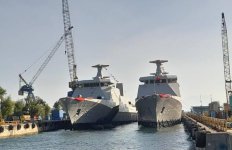
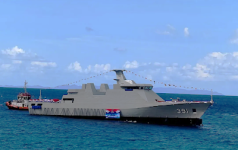
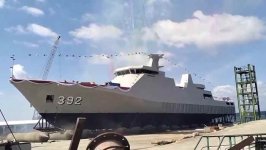
Two new OPV ships for the Navy (photo: DRU)
PRESTASI is proud to be presented by PT Daya Radar Utama (DRU). The Lampung-based company successfully launched two Offshore Patrol Vessel (OPV) and OPV ships within two days, namely on Wednesday (18/09/2024) and Friday (20/09/2024). The achievement shows the industrial capacity of the private shipyard of the country is not much different from PT PAL, because it can be trusted to cultivate a warship project that is considered to be a light frig class.
The ship-naming procession or naming of the ship is carried out simultaneously, led directly by the Chief of Staff of the Navy (KSAL) Admiral of the TNI Muhammad Ali, on Friday (20/9), at the shipyard of PT DRU, in Lampung. The names given are KRI Raja Haji Fisabilillah (RHF)-391 and KRI Lukas Rumkorem (LRK)-392. The two figures who are named are national heroes from Malay and Papua.
The plan, the two OPV ships whose construction began in August 2021 will be played as combat ships as well as high-speed patrol boats capable of operating throughout the waters of Indonesia's jurisdiction. The construction of this monohull-in-forming ship is designed to have good performance at high speeds, which is about 28 knots, and at a cruising speed of about 20 knots.
The ship is also equipped with two ramp loadings for the launch of the RHIB (rigid hull inflatable boat) which is placed in the fumber and one helipad. Projected ship with a design based on the frigate of RE Martadina class (Sigma 10514) to meet the needs of the TNI AL Eskorta Ship Unit (Satkor).
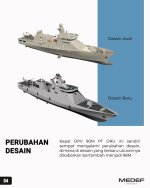
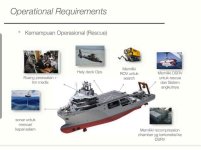
Change design of the OPV ship (image: Medef)
As a fangs, the ship will be equipped with a 76 mm and 40 mm Leonardo cannon, the 20 mm Escribano cannon, decoy or therma, and the surface to surface missile 2x4 Roketsan system with the missile to be embedded, Atamca.To complete the weaponry and combat management system (CMS), the procurement will be done separately or modelfitted for but not with (FFBNW).
Theoretically, as Bayu Pamus wrote in Indomilitary.com edition 18/09/2024, OPV was made to bridge the gap between fleet ships in the Patrol Ship Unit (Satrol) and corvette-class warships and frigates. The same segment is also being built by Malaysia, Thailand, Singapore and Australia. But if viewed from the specifications of the weapon system that is fairly fierce, this OPV TNI AL deserves to be called light frigates.
Muhammad Ali explained, the construction of the OPV ship is a strategic step of the Navy to increase its operational capabilities in order to deal with the dynamics of increasingly complex maritime threats. According to him, this program of modernization of equipment is in line with the Long-Tertary Strategic Plan which aims to realize the modern Navy, treacherable in the region, and global projecting.
“In addition, the construction of the OPV ship is a manifestation of the contribution of the Navy in supporting the independence of the domestic defense industry,” he said. The construction of the 90M OPV ship is a manifestation of the contribution of the Ministry of Defense (Kemhan) in supporting the independence of the domestic defense industry, which ultimately aims to improve the national economy and the welfare of the people.
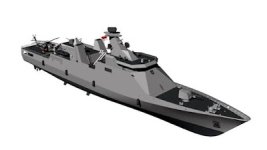
The design of the last OPV ship used (image: DRU)
In the speech of the Ministry of Defense Department read by the Expert Staff of the Minister of Defense in the field of Expert Staff of the Minister of Defense for Security Major General TNI Kosasih, revealed that the construction of the OPV 90M ship is an integral part of the construction of the state defense system, especially the strength of the Navy. This program is in accordance with existing strategic planning, which aims to meet the minimum number of ships that can be operated to support the fulfillment of the tasks of the Indonesian Navy.
The Ministry of Defense's News on behalf of Defense Minister Prabowo Subianto appreciated the cooperation and hard work of PT DRU and the Dignity Task Force in the country of the OPV 90M Ship, and his ability to build ships according to the contract. The Ministry of Defense also hopes that the domestic defense industry, in this case the national shipyard, can increase the ability to be able to compete in the global market through increasing production capacity, management, and modern technology so as to be able to compete with overseas competitors.
Director of PT DRU John Wijanarko in his speech stated that PT DRU was the first shipyard given the trust of the Ministry of Defense (Kemhan) to build an OPV ship. With the weaponry of anti-aircraft warfare, sea level, and underwater embedded, the OPV ship has not only function as a patrol force, but also can be operated into a striking force to increase the strength of the Navy's TNI equipment.
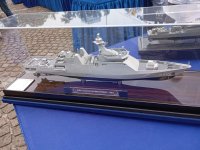
Miniature OPV 90 DRU (photo: special)
Private Role Equ State Equ State Inhan
The trust given to PT DRU to build an OPV-class warship can be considered as a milestone in the national private defense industry. This reality shows they are no longer a tier 2 company that is only trusted to work on patrol boat contracts or landing ship tanks (LST), but also larger warships, which have only been enjoyed by PT PAL.
How can private shipyards have the same rights as BUMN Inhan? Not Law No. 16 of 2012 on the Defense Industry only provides a mandate of lead integrator to SOEs inhan alone, including making the main tool to produce the main tools of weapons systems and / or integrate all major components, components, and raw materials into the main tool. While private companies are only given a portion as a major component industry and / or support, component industry and / or support (support), as well as the raw material industry.
However, the monopoly of SOEs inhan ended along with the exit of Law No. 11 of 2020 on Work Creation. The law commonly called the Omnibus Law allows private companies to be the lead integrator of the defense industry. In addition to giving equal roles to private companies, Omnibus Law also provides opportunities for foreign investors to enter the defense industry sector.
The publication of
www.neliti.com entitled “Change of the Landing of Defense Indudtry Law, Defense Industry Law VS Omnibus’ explained, the Omnibus Law also gave a role to the Ministry of Defense (Kemhan) to determine private parties who will produce tier 1 equipment, allowing other parties to invest, as well as licensing other activities described in the Omnibus Law.
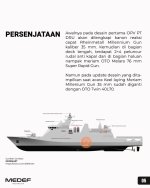
Armament OPV-90 (image: Medef)
As a consequence of giving more role to the Ministry of Defense, based on article 74 paragraph 2 of the Omnibus Law, there is an abolction of the duties and functions of the Defense Industrial Policy Committee (KKIP) in determining the fulfillment of equipment to support the defense of the country, as well as the security and order of the community or alpahankam. Previously, KKIP had the authority to set government policies for the needs of the equipment and gave consideration to its marketing.
Thus, the change in regulation that occurs with the exit of the Omnibus Law is the granting of very strong authority to the Ministry of Defense to determine the direction of national defense industry independence development. The campaign plays a crucial role in controlling the defense industry from upstream to downstream, and grants defense industry approvals and permits.
The issuance of the Omnibus Law is indeed a lot of pro-counter-public. But in the positive side, its presence is expected to open up the opportunities of the defense industry to develop defense systems independently, meet the quality and quantity of equipment in accordance with the characteristics of the region and potential threats, and build deterrence effect against other countries.
The political dynamics that occurred forced the Omnibus Law to be revoked. In exchange, the government established the Government Regulation Replacement Law (Perppu) No. 2 of 2022 on Job Creation on December 30, 2022. Is there an impact on the private defense industry?
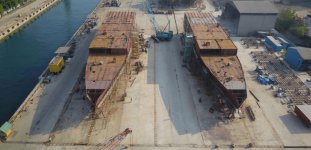
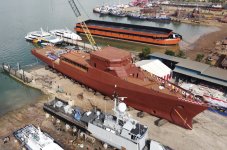
The beginning of the construction of 2 OPV ships in the DRU shipyard (photo: Keris)
In the article “The Importance of Perppu No. 2 of 2022 on Work Creation on December 30, 2022 in the Development of Indonesian Defense Industry’” released
www.kemhan.go.id, explained that in the defense industry sector, Perppu Cipta Kerja provides equal opportunities for SOEs and private companies to participate in the main tool production activities in the defense industry, where previously the main tool production activities were only carried out by SOEs inhan.
It is said that providing equal opportunities is expected to spur healthy and competitive competition, building good cooperation between defense industries in supporting the development of defense forces aspects of the main tools of weapons systems or equipment. In addition, Perppu also provides an opportunity for the transfer of technology (ToT) in the form of investment from abroad.
This step is expected to bring a dynamic and progressive positive impact on the capabilities of the national defense industry in meeting the needs of domestic users and building competition capabilities in the international market. Indonesia’s inter-defense cooperation with international companies is expected to bring the national defense industry into the international supply and chain network.
The role given by the Work Creation Law or Perppu Cipta Kerja is in line with the vision of President Joko Widodo (Jokowi) and Defense Minister Prabowo Subianto. As noted in the release of ‘Mend Prabowo Encouraged the Domestic Defense Industry to Run Good Management’ released by
www.kemhan.go.id, on February 2, 2022, it was reported that Prabowo claimed to have received President Jokowi’s instructions to raise Indonesia’s defense industry as a whole.
The President-elect in the 2024 Presidential Election confirms that the domestic defense industry is the pride of the Indonesian people. For this reason, the government continues to encourage the improvement of the capacity and capability of the defense industry, in terms of marketing and technology.
One form of support is maximizing ToT and offsets in the acquisition of equipment from other countries. On the other hand, Prabowo asked the domestic defense industry also needs to always realize that they are the pride of the Indonesian nation, and the public expects their best performance.
Waiting for a bigger challenge
The success of PT DRU worked on two OPV ships for the Indonesian Navy proved that the national private shipyard could not be underestimateed. If previously they were only given the opportunity to build a landing ship tank (LST) or a fast missile (KCR), the capacity shown by PT DRU confirmed that private shipyards were ready to accept new challenges working on larger warships.
-------------------
To Be Continued

 www.thejakartapost.com

/data/photo/2024/10/16/670f0232960f4.jpg)