AJK govt bans Joint Awami Action Committee, notification issued

To view this content we will need your consent to set third party cookies.
For more detailed information, see our cookies page.


Pakistan did not pay anything to the AJK government as water usage charges/royalty for Mangla Dam for 36 years.
In 2003, they started paying 15 paisa per unit when they were paying 1 rupee 15 paisa per unit to other provinces of Pakistan.
The government of Azad Kashmir received 1/7th of what what other provinces were receiving for hydropower.

But the most egregious part is that while AJK government receives pittance for exporting hydro electricity to Pakistan, Pakistan re-exports the same electricity back to AJK at exorbitant costs!


80% of AJK budget comes from Islamabad. Stop posting BS of dam royality which only amount of Rs20bn per year while Islamabad give them Rs240bn.
 
80% of AJK budget comes from Islamabad. Stop posting BS of dam royality which only amount of Rs20bn per year while Islamabad give them Rs240bn.

Our taxation system is broken

It centers around Punjab and Karachi's,

Everyone else tends to underpay and demand everything z not giving a crap about other poor people in the country
 
Brother what are we gonna discuss in a political problem if not politics ?
Brother this is a thread on Internal security. People are flining excrement at eachothers political affiliations. It's unnecessary and unhelpful to the debate.

Kindly contribute to healthy debates as personal attacks don't help.
 
We Pakistanis of every kind love to catasrophise, every incident like this, no matter how large or small, implies the imminent collapse of the state, all orchestrated by the evil masterminds of india. Most of the time we're at each others necks anyway so the Indians don't really have to do much.
 
  • Like
Reactions: Waz
“According to the Constitution of Azad Jammu and Kashmir, the President, Prime Minister, and Members of the Assembly are bound by this oath, which clearly states:

"That I will remain loyal to the country and the cause of accession of the State of Jammu and Kashmir to Pakistan."

Similarly, the Election Act of Azad Kashmir states it with further elaboration:
"I solemnly declare that I believe in the ideology of Pakistan, the ideology of state's accession to Pakistan and the integrity and sovereignty of Pakistan."

In contrast, the alternative oath proposed by the Jammu Kashmir Joint Awami Action Committee states:
"Mandatory oath of loyalty by candidates and elected members of the Legislative Assembly to the geographical unity and integrity of the State of Jammu and Kashmir."

So Rana Sanaullah was right. Indian action committe have put forward this demand. And you want state to negotiate with separatists? Inna di bund sui kardo
 
You acknowledge that the overwhelming majority of AJK's population descends from tribes that migrated from Punjab and that many speak languages such as Pahari, Potohari, Hindko, or Punjabi rather than Kashmiri. Yet you reject any Punjabi connection while simultaneously claiming a Kashmiri identity.

The Afghanistan comparison does not work because "Afghan" evolved into a national identity encompassing multiple ethnic groups. "Kashmiri," however, has traditionally referred to an ethnic and linguistic group originating from the Kashmir Valley. If ethnicity matters, then ancestry, language, and historical origin cannot simply be ignored.

You also portray the Sikh Empire as a Punjabi force opposed by AJK. But Sikhs themselves are Punjabis. Ranjit Singh's empire was fundamentally a Punjabi-led state, and many of the groups that later became part of Pakistan's Punjab, Jammu, and AJK were incorporated into it. Fighting the Sikh Empire does not somehow make a population non-Punjabi.

Nobody denies that people living along the LoC have suffered from Indian shelling and cross-border conflict. However, suffering does not determine ethnicity. The question of who is ethnically Kashmiri is separate from the question of who has suffered because of the Kashmir dispute.

If the basis for being Kashmiri is political affiliation rather than ethnicity, language, ancestry, or geography, then the term loses any clear meaning. By that logic, millions of non-Kashmiris who support the Kashmir cause could also claim to be Kashmiris.

That's the origin not what it became. And no, I don't claim a 'Kashmiri' identity, you can ask them why they do. The people of AJK are a mix.

No, Afghan historically and culturally has meant Pashtun that's a fact, even acknowledged by the other ethnic groups. The 16th-century work Baburnama distinguishes Afghans (Pashtuns) from other ethnic groups. The 17th-century Pashtun chronicle Makhzan-i-Afghani treats "Afghan" and "Pashtun" as essentially synonymous. In the Mughal period, Afghan rulers such as Sher Shah Suri were described as Afghans because they were Pashtuns.However to have a cohesive state they took on the term to bring in non-Pashtun groups. How can it not apply to Pashtuns but it does for Kashmiris? But yes the true Kashmiri ethnicity is a dardic one centered around the valley, but hey haven't lived in isolation and relied on mountainous tribes for support.

Yes, the Sikh empire was opposed by AJK and countless battles were fought against it. It makes no difference whether they were Punjabis, as they were fought on the basis of them being a hostile force with a faith different to ours. There was no issue with the Mughals.
As for the word 'incorporation' that applies to the Punjab plains that make up Pakistan who willingly went along with the Sikh empire. We didn't. Also war is the ultimate in defiance of not wanting to be part of a nation or people, that's more than enough to show that we wanted no part of this united Punjabi identity under them. This is something the British also later exploited as mentioned in my earlier posts.

I didn't state that our people suffered so hence we are the true Kashmiris. It was put up in response to a poster who stated that the people of IOK has suffered the most, which is true. My point was that there has been plenty of suffering inflicted on our people as well.
The millions of people who support the Kashmiri cause don't live in the region or are a direct party to the conflict, like the people of AJK are. It's more than just a political stand or a label they apply to themselves. As for culture and race I've responded to that earlier on in my post.
 
Someone from Bhimber/Mirpur have little in common with someone from Neelam valley. Both are AJK because these areas were gifted to Dogra for their services to British. Not taking in to account ethnicity or languages. And then ended up with Pakistan and thats how modern AJK came in to being. Its neither Kashmir nor Jammu.

Pakistan pushed this identity on to AJK to keep the dispute alive.

That's true, then we can also say someone from Punjab has little in common with a Pashtun in Pakistan. But there's a shared cause i.e. Pakistan. Yes that's how the state came into being, but the key point here is that the region is called as such because it lives free. Kashmir should have gone to Pakistan in it's entirety, so of course AJK will be the focal point to push this.
 
unfortunately pinning the blame on India will be our downfall.

Blaming India means we get to overlook introspect. We dont need to criticise ourselves and understand why the unrest, when we can just say its indian sponsored mischief.

Until we continue to blame india for all of our issues, and not actually look inside, they'll remain.
yes yes yes
99.9% of the current problems are our own made and preventable. they have reached to this point due to our incompetence, indifference and hubris. Azad Kashmir politics and social life is badly affected by xenophibia, morbid racism and family politics and the opposition to 12 seats of Kashmiri Mohajir seats in rest of Pakistan has an element of that selfishness as well.
Indians and Afghans for all their worth will definately take advantage of that as will any disgruntled poltical party in opposition. the PTI tried to benefit from this situation with mixed results since the movement is grass root and is leaderless.

the civil administration of Azad Kashmir and its politicians seek GHQ approval for their self preservation. the continued abuse of power, incompetence and curroption has taken its toll.
 
If it continues to escalate - you can kiss your pov on Kashmir goodbye and even open up ambiguity for an Indian intervention in Kashmir under the guise of preventing state atrocities ala 71 while showing how its occupied Kashmir has made much more progress compared to AJk.
I lived like 7 years in different parts of Azad Kashmir. its a shit show. the ever so welcoming and loving people can suddenly morph into Aholes without warning on some very trivial issues. these people dont like each other and are very driffernt to each other.
Muzafarabad, Bagh, Rawalkot people despite Mirpuris and Kotli people and they want to govern GB and GB people say they would rather join KP than allign with them.
the family politics xenophobia and racism is very high (to put it mildly) the objection to 12 seats of Mohajirs (its a curse word, used with disdain) that comes from Kasmiri migrants from Jammu and Kashmir that live in Punjab (mostly) is not just based on principled objections to GHQ manimulations but is also based on racism as well.

I think the Kashmiri leadership and its beurocracy is very much capable of destroying this sorry state even if India doesnt do much. but for sure its giving a lot of happy material to Gdi media and that Moed Haramzada in America to gloat and tell us how GHQ has looted Kashmir.
 
Look around you, PTI will even turn up when our forces or police are killed

Currently PTI is dangerous for the country

Fundamentally we have a problem, the problem is Pakistan isn't made up of one group, called the Pakistani

It's made up of 5-6 groups
And these groups are pushing in different directions with increasing hostility between them

Some groups are incredibly violent, will kill travellers and labourers

Their demands are not reasonable, they want special condition for their group that no-one else should get

Some want special rates or electricity or gas
Others want borders completely open or erased with foreign often hostile states
Others want to take Pakistani sovereign territory and become part of other states
Others want to create kingdoms in their areas only ruled by their own ethnicity
All of them are corrupt

We have two barely functional areas and that's Punjab and Karachi

We are being held together by the security forces

And everyone knows it, it's the only force keeping us together, with a eye on foreign enemies and the internal lannats

No democracy, create a autocratic system and start taking out these idiots one by one
I have spoken to someone from AJK, he says they chased away some PTI people who tried to take advantage and bring their party banners but in some other areas PTI also joined and together cursed the army. enemy of my enemy is my friend and just check that Moeed Thumzada Haramzada who has roots from Punch himself and he is posting in tune to what Godi media is posting.

that aside, the AJK goverment and the administration has 100% responsibility for this escalation. this couldve been handled better.
 

AJK reinstates 177 FIRs against JAAC members over breach of Oct '25 agreement​

Directs police, judiciary and administrative authorities to implement the decision and pursue further legal action


ISLAMABAD:
The Azad Jammu and Kashmir (AJK) government on Thursday withdrew earlier concessions related to protest and agitation cases and reinstated 177 First Information Reports (FIRs) against members of the Joint Awami Action Committee (JAAC), citing violation of the October 4, 2025 agreement between the two sides.

The move comes amid escalating tensions in AJK following recent deadly clashes that have generated competing narratives over casualties, governance grievances, and political legitimacy. Official sources have confirmed at least seven deaths.

Last week, the AJK government banned the JAAC, accusing the organisation of involvement in terrorism, promoting hatred, and creating anarchy in the state.

The ban followed the JAAC’s call for a protest on June 9. The organisation has previously led large-scale demonstrations demanding economic relief and political rights, with some protests ending in violence and fatalities during clashes with law enforcement in May 2024 and September 2025.

According to official statements, the government concluded that the JAAC had breached the October 2025 agreement by returning to street agitation rather than pursuing dispute resolution through the implementation committee established under the accord.

As a result, all protest-related cases that had previously been withdrawn under the agreement have now been restored.

untitled-design-581781170736-0.png


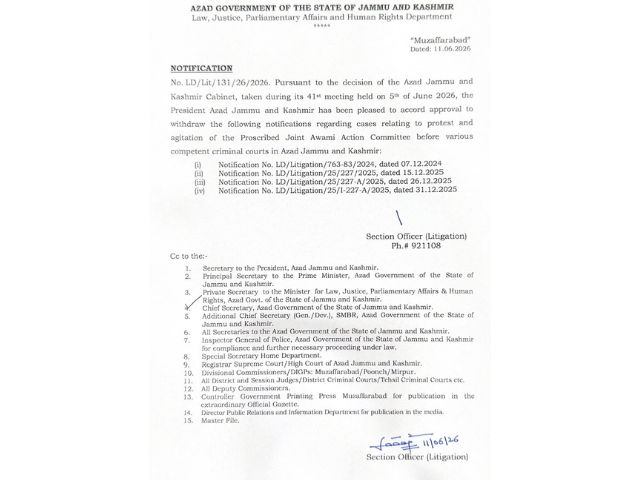
A notification issued by the Law, Justice, Parliamentary Affairs and Human Rights Department in Muzaffarabad confirmed the decision.

“Pursuant to the decision of the Azad Jammu and Kashmir Cabinet, taken during its 41st meeting held on June 5, 2026, the President of Azad Jammu and Kashmir has been pleased to accord approval to withdraw the following notifications regarding cases relating to protest and agitation of the proscribed Joint Awami Action Committee before various competent criminal courts in Azad Jammu and Kashmir,” the notification stated.

Also Read: Tariq Fazal rejects JAAC claims of inaction, says most agreement commitments fulfilled

The order revoked several earlier notifications issued between December 2024 and December 2025, including those dated December 7, 2024, December 15, 2025, December 26, 2025, and December 31, 2025.

It also directed relevant departments, including the police, judiciary, and administrative authorities, to implement the decision and proceed with further legal action. Officials said the move effectively reverses relief previously granted to individuals facing protest-related charges, maintaining that the agreement had been violated.

FIR's

The reinstated FIRs relate to protests held across AJK in September and October 2025, when the JAAC launched a campaign demanding governance and constitutional reforms.

The demonstrations escalated into violent confrontations with security forces, resulting in the deaths of at least nine people, including three police officers.

Among the JAAC’s key demands were the abolition of privileges for the political elite, the removal of 12 refugee-reserved seats in the AJK Legislative Assembly, and reforms to the quota system.


Following the unrest, the government and the JAAC reached an agreement in October 2025 on a broader reform framework. The accord included the formation of a high-level committee to review contentious issues, including refugee representation.

Subsequently, the government withdrew cases registered against protesters involved in the long march and related demonstrations. Officials said 177 FIRs were dropped through notifications issued in December 2025.

However, cases linked to deaths during the unrest were not withdrawn and remain under legal process. A proposal to establish a judicial commission to investigate the violence is also still under consideration.

Background

The recent unrest and deadly clashes in areas, including Rawalakot, where the newly proscribed JAAC had been holding a sit-in outside the Combined Military Hospital Rawalakot. AJK police allege that armed JAAC members opened fire on deployed law enforcement in a planned attack, leaving four personnel dead and around 20 injured. JAAC, however, disputes this account, claiming security forces used tear gas and fired shells toward the hospital.

According to the AJK police, three individuals linked to the JAAC and four law enforcement personnel were killed during the protests on Sunday. JAAC, however, said in a statement on X that seven individuals were killed and dozens were injured when street firing was carried out in the dark after electricity was allegedly cut off.

The clash on Sunday came as the AJK government and the JAAC witnessed a face-off, as the election date for AJK was announced for July 27.

Read More: Certain elements seeking to create instability in AJK despite repeated offers of dialogue: Rana Sanaullah

AJK's 53-member legislative assembly includes 12 seats reserved for Kashmiri refugees — people who fled Indian-controlled Kashmir in 1947 and 1965 and are now scattered across Pakistan. Six seats represent refugees from the Jammu division (~434,000 people) and six from the Kashmir Valley (~30,000 people) — an already lopsided arrangement that many see as unfair.

The region witnessed one of its most turbulent periods in October last year when protests led by the JAAC erupted over demands for constitutional and governance reforms. At least nine people, including three policemen, were killed during the unrest.

The JAAC, which organised the protests and strike, had presented a wide-ranging charter of demands, including an end to the privileges enjoyed by the ruling elite, the abolition of 12 assembly seats reserved for refugees, and the scrapping of the quota system.

Two days after the violence, the government and the JAAC reached an agreement covering 12 core and 13 additional points. Under the accord, both sides agreed to constitute a high-level committee to examine the issue of refugee seats in the AJK Legislative Assembly.

Read More: Four police personnel martyred, over 20 injured in Rawalakot firing: AJK police

The unrest also triggered political upheaval in the region. The PPP subsequently moved a no-confidence resolution against then Prime Minister Chaudhry Anwarul Haq, with the Pakistan Muslim League-Nawaz joining the effort. Haq, who had been elected in April 2023 with 48 votes, chose to face the vote rather than resign.

On Nov 17, Rathore secured 36 votes in the election and became the 16th prime minister of Azad Jammu and Kashmir.

With elections now approaching and the refugee seat issue still unresolved, the AJK government convened an All Parties Conference (APC) in Muzaffarabad to build consensus. Almost every major party attended — except PTI and the JAAC, who boycotted it.

The JAAC's position is that the government had already rejected its written proposals submitted on May 30, so attending would be futile. It had proposed either keeping symbolic refugee representation until the Kashmir dispute is permanently resolved, or replacing the 12 assembly seats with 4 seats in the AJK Council — a body chaired by the Prime Minister, which it argued would better preserve the political dimension of the Kashmir cause.

The APC rejected any changes outside the constitutional and legislative framework, saying only the elected assembly could alter refugee seat arrangements. The JAAC called the resolution "a page and a half of utterly trivial lines" and accused participants of gathering to serve their own interests rather than the public's.
 
To view this content we will need your consent to set third party cookies.
For more detailed information, see our cookies page.
 

Users who are viewing this thread

Country Watch Latest

Latest Posts

Back
Top