Navigation
Install the app
How to install the app on iOS
Follow along with the video below to see how to install our site as a web app on your home screen.
Note: This feature may not be available in some browsers.
More options
Style variation
You are using an out of date browser. It may not display this or other websites correctly.
You should upgrade or use an alternative browser.
You should upgrade or use an alternative browser.
Chinese SAC - FC-31/J-35 5th Gen Stealth Aircraft
- Thread starter SiliconBit (silicon0000)
- Start date
More options
Who Replied?



MNZGamerX
Registered Member

After its official reveal at the Zhuhai Airshow, what do we know about China’s new fifth-generation fighter?
By Rick Joe
November 20, 2024
The 2024 Zhuhai Airshow presented a deluge of aircraft, drones, munitions, and systems, including displays of hardware in service with China’s People’s Liberation Army (PLA) and PLA Air Force (PLAAF) or soon to enter service. The new J-35A – a stealthy fifth-generation fighter – was most widely covered.
The revelation of J-35A being intended for service in the PLAAF coincided with the Air Force’s 75th anniversary, and multiple different prototype airframes were flown over multiple days at Zhuhai. Subsequent coverage in official state media and on social networks followed, essentially “declassifying” the J-35A, as PLA norms go. At present, the J-35A has yet to enter frontline service.
The J-35A is an aircraft simultaneously both recent in entering the rumor cycle and long expected. This piece will review the background of the J-35A, and assess its characteristics and the rationale for its procurement.
From FC-31 to J-35A
In past articles, I’ve covered the aircraft types that preceded the J-35A. First, there was the original FC-31 developed by Shenyang Aircraft Corporation (SAC) as a technology demonstrator and potential export product, albeit without any PLA commitment at that time. Two flying prototypes and multiple static prototypes were developed, with the two differing prototypes flying in 2012 and 2016. During this time, the FC-31 was sometimes called the “J-31,” but the name was not official given the lack of PLA commitment.
In the mid-to-late 2010s, concrete rumors emerged that the FC-31 had been chosen by the PLA Navy (PLAN) to be developed into a carrierborne fifth generation fighter, with the possible name “J-35.” In October 2021, the first prototype of the J-35 flew, with pictures confirming traits of a carrierborne fighter such as an enlarged folding wing, reinforced landing gear, and a catapult launch bar, as well as other refinements such as an enlarged dorsal fuselage hump and a more complex sensor fitout.
Starting from 2021, rumors emerged that the PLAAF was also interested in pursuing a land-based, “de-navalized” version of the J-35. Over the last couple of years, such rumors began to spread with greater intensity. In 2023, photos emerged of one or more prototypes of an aircraft appearing similar to the J-35 but with a reduced wingspan, consistent with features expected of an air force variant. However the designation of the PLAAF’s variant was still not known.
With Zhuhai Airshow 2024 and the PLAAF’s 75th anniversary, the fighter’s name has now been confirmed as J-35A. (It is unknown what the official name of PLAN’s carrierborne variant will be, but I will continue to use “J-35” until new indicators emerge.)
The J-35A/J-35/FC-31 lineage had a developmental course that is both protracted and short – protracted if one measures from the FC-31 technology demonstrator first flying in 2012, without PLA interest, and short if one measures from the carrierborne J-35 first flying in late 2021.
This family of aircraft has been dogged by commentary emphasizing its resemblance to the United States’ F-35 family of aircraft, with both being fifth-generation, medium-sized fighters with similar wing and tail configurations and dual side air intakes. These similarities have been emphasized in the context of the Chinese cyberespionage operations that reportedly stole data on the F-35. However, the emergence of multiple other aircraft with similar configurations (the twin engine KF-21 and AMCA, in particular) may reflect a convergence of form due to pursuit of similar functions in context of desiring mature aerodynamic configurations.
While it is very much plausible that espionage relating to the F-35 may have benefited the J-35/A program, it is unlikely that gross aircraft planform and aerodynamic configurations would have benefited from such intelligence. More telling evidence might be if the development of certain avionics, weapons, or other mission systems may have benefited from intelligence garnered with the aim of countering the F-35. Alas, confirmation of this matter would require detailed forensics of both the J-35/A and the F-35 family, which is unlikely ever to occur.
Design and Features
The J-35A is a medium-sized fighter with a twin divertless supersonic intake, twin engine layout, and a single ventral internal weapons bay (IWB). It possesses a conventional wing and tail configuration, with the usual hallmarks of a stealthy fifth-generation aircraft such as edge alignment, chines, serrated paneling and doors, and a relatively smooth external finish. Radar absorption materials are virtually guaranteed, both structurally “baked in” and surface applied once it enters production.
There has been past industry documentation relating to the external dimensions of the FC-31, describing its length (17.3 meters), wingspan (11.5 meters), maximum takeoff weight (28 tons), combat radius (1,200 kilometers). However, it is not known whether those figures remain true for the J-35A, particularly the weight and combat radius specs. The J-35A likely possesses an increased internal fuel capacity thanks to the larger J-35-style dorsal fuselage hump. The J-35A is also likely to benefit from advances in airframe materials and structural design, as well as utilizing more refined engines than the original FC-31.
The original FC-31 was thought to have utilized Russian RD-33 engines, later replaced by the improved reverse engineered powerplant WS-13E, with some of the prototype airframes thought to be utilizing a further improved WS-21 engine. However, the target powerplant for the J-35A will be the WS-19, an engine in a similar thrust and size class to the F414 or EJ200. It is not presently known if WS-19 has flown yet on a J-35A or a J-35; there has been some careful imagery inspection of the airframes over Zhuhai that identified differences in engine nozzles, but without credible Chinese language grapevine confirmation, at present it is prudent to assume that the engines flown on existing J-35As are WS-13Es and/or WS-21s. At present it is expected that the J-35A (and likely the J-35) will be capable of supercruise when powered by WS-19s.
J-35/A fighters are likely to utilize avionics of a similar pedigree and sophistication to the upcoming improved J-20A fighter, encompassing modern and up-to-date iterations of a primary AESA radar, sensor processing, networking, and electronic support measure sensors. There is confirmation of a chin mounted electro optic/infrared sensor and optical apertures situated around the aircraft to provide full spherical coverage as well. A wide-angle holographic heads-up display is visible in the cockpit; however, it is likely to also offer a helmet-mounted display similar to the J-20. A modern glass cockpit with a wide-screen display is likely to be present as well.
One feature of the J-35/A to observe in coming years is the specific dimensions of its ventral IWB. There have been some rumors that the IWB of the J-35/A may possess the same dimensions as the J-20/A. This is not outside of the realm of possibility as the J-20/A does not possess a weapons bay as deep as the central stations of the F-35A/C variants, and a common weapons bay geometry would enable more efficient weapons development, fitting, and separations testing. New air-to-air and air-to-ground/strike weapons are known to be in development for use by both the J-20/A and J-35/A.
One “new” air-to-air weapon seen at Zhuhai in 2024 was a folding tail version of the PL-15E, the export version of the PL-15 beyond visual range air-to-air missile. The new missile configuration will likely enable the J-20/A and J-35/A to carry six PL-15s internally versus the existing four with fixed tails. A folding tail PL-15 had been rumored for some time, but it remains unknown whether it will supplement or replace fixed tail PL-15 production. Presently, it is believed that a new generation beyond visual range missile is also in development as well (sometimes dubbed the PL-16 or PL-20).
The J-35A is likely to possess external weapons carriage capability for additional weapons and outsize munitions.
Rationale and Role
The place of the J-35A in the PLAAF is not quite obvious at first glance. While a medium weight, possibly cheaper complement to the heavier weight J-20/A seems intuitive, there are certain drawbacks to introducing a new fighter type, such as requiring its own supply chain for key parts and a new engine type. This remains all the more complicated when one considers that J-20 annual production at Chengdu Aerospace Corporation (CAC) in recent years has grown to approach or achieve the three-digit mark, which is likely to be sustained for a number of years.
Therefore, in the plausible event that J-20/A procurement for the rest of this decade occurs at 100 or more airframes per year (with a potential ceiling rate of 150), the idea of producing additional fifth-generation fighters on top of this seems rather ambitious. Procurement of the J-35A by the PLAAF therefore can be explained by a few mutually supporting factors, with the above assumptions in place.
The J-35A may reflect a desire by the PLAAF to further expand the pace of fifth-generation fighter procurement beyond CAC’s already expanded J-20/A production rates. This may be particularly important, because CAC is expected to be the prime contractor for the PLA’s next generation/sixth-generation fighter (which I previously dubbed the “J-XD”). That means some J-20/A factory space may gradually transitioned to J-XD production in the late 2020s. SAC therefore can help to augment China’s fifth-generation production, accelerating modernization of the PLAAF in a manner where technology and industry are not as much of a bottleneck as in the past.
Additionally, it is likely that the J-35A will share significant common subsystems with the navy’s carrierborne J-35, offering benefits in both cost and availability. It is also possible that the PLAAF was able to accelerate development of the J-35A by leveraging work that the PLAN had already committed for the J-35, as well as technology demonstrator work done by SAC with the FC-31 airframes.
There is also a valid argument that the J-35A may offer lower procurement and operating costs than the J-20 as a slightly lighter weight fighter. It may also benefit from more modern manufacturing techniques (though it is possible the J-20A may also incorporate these aspects). But even if the J-35A is slightly lower in cost, the final procurement ratio of J-20/A aircraft and J-35As may be akin to the Flanker to J-10 procurement ratio, which is weighted in favor of the heavier and longer-range Flanker, by virtue of PLA range requirements.
Another factor to consider is the the ability to develop an export-grade J-35A variant for international customers, where potential buyers have the assurance of knowing the PLAAF will remain a committed customer to the type, thus guaranteeing future upgrade and sustainment packages. There may also be industry benefits by providing SAC with increased workshare for the manned fighter segment, compared to if the PLAN’s J-35 was procured alone.
As it stands, the Chinese military has described the J-35A as primarily an air superiority fighter with multirole strike capabilities, compared to the J-20/A, which is more oriented to the air superiority role. This may reflect the greater range and persistence of the J-20/A compared to the J-35A. Both should possess competitive kinematic performance, similar avionics, and similar weapons bay dimensions and thus similar weapons suite options.
The J-35A and the Future
With the J-35/A, China will have two entirely separate fifth-generation fighter families in active production. In the PLAAF, the J-35A will be complemented by the larger fifth-generation J-20/A, and both will be augmented by substantial numbers of 4.5th generation fighters (J-16s, J-10Cs, and J-11BGs). The J-35A may enable faster retirement of early fourth-generation aircraft (Su-27/J-11A/Su-30, J-10A) and the few remaining third- generation aircraft.
The exact balance of the PLAAF tactical air fleet will also depend on how China’s air force integrates unmanned combat aerial vehicles and collaborative combat aircraft (UCAVs/CCAs), which is a global trend and an open secret for PLA aerial developments as well. Finally, the next generation J-XD will also start to influence the fleet makeup of PLAAF, perhaps as soon as the early 2030s.
As a concluding remark regarding next generation developments, an openly fictional, anime-esque mockup (the “White Emperor”) shown for public engagement at Zhuhai Airshow this year has unfortunately resulted in multiple articles written by authors under the impression it is a legitimate next-generation aircraft project. While the PLA is actively pursuing the J-XD as a next-generation/sixth-generation manned fighter (and some developments may be visible on this front in the near future) this ludicrous, anime-inspired fighter mockup certainly is not it.
By Rick Joe
November 20, 2024
The 2024 Zhuhai Airshow presented a deluge of aircraft, drones, munitions, and systems, including displays of hardware in service with China’s People’s Liberation Army (PLA) and PLA Air Force (PLAAF) or soon to enter service. The new J-35A – a stealthy fifth-generation fighter – was most widely covered.
The revelation of J-35A being intended for service in the PLAAF coincided with the Air Force’s 75th anniversary, and multiple different prototype airframes were flown over multiple days at Zhuhai. Subsequent coverage in official state media and on social networks followed, essentially “declassifying” the J-35A, as PLA norms go. At present, the J-35A has yet to enter frontline service.
The J-35A is an aircraft simultaneously both recent in entering the rumor cycle and long expected. This piece will review the background of the J-35A, and assess its characteristics and the rationale for its procurement.
From FC-31 to J-35A
In past articles, I’ve covered the aircraft types that preceded the J-35A. First, there was the original FC-31 developed by Shenyang Aircraft Corporation (SAC) as a technology demonstrator and potential export product, albeit without any PLA commitment at that time. Two flying prototypes and multiple static prototypes were developed, with the two differing prototypes flying in 2012 and 2016. During this time, the FC-31 was sometimes called the “J-31,” but the name was not official given the lack of PLA commitment.
In the mid-to-late 2010s, concrete rumors emerged that the FC-31 had been chosen by the PLA Navy (PLAN) to be developed into a carrierborne fifth generation fighter, with the possible name “J-35.” In October 2021, the first prototype of the J-35 flew, with pictures confirming traits of a carrierborne fighter such as an enlarged folding wing, reinforced landing gear, and a catapult launch bar, as well as other refinements such as an enlarged dorsal fuselage hump and a more complex sensor fitout.
Starting from 2021, rumors emerged that the PLAAF was also interested in pursuing a land-based, “de-navalized” version of the J-35. Over the last couple of years, such rumors began to spread with greater intensity. In 2023, photos emerged of one or more prototypes of an aircraft appearing similar to the J-35 but with a reduced wingspan, consistent with features expected of an air force variant. However the designation of the PLAAF’s variant was still not known.
With Zhuhai Airshow 2024 and the PLAAF’s 75th anniversary, the fighter’s name has now been confirmed as J-35A. (It is unknown what the official name of PLAN’s carrierborne variant will be, but I will continue to use “J-35” until new indicators emerge.)
The J-35A/J-35/FC-31 lineage had a developmental course that is both protracted and short – protracted if one measures from the FC-31 technology demonstrator first flying in 2012, without PLA interest, and short if one measures from the carrierborne J-35 first flying in late 2021.
This family of aircraft has been dogged by commentary emphasizing its resemblance to the United States’ F-35 family of aircraft, with both being fifth-generation, medium-sized fighters with similar wing and tail configurations and dual side air intakes. These similarities have been emphasized in the context of the Chinese cyberespionage operations that reportedly stole data on the F-35. However, the emergence of multiple other aircraft with similar configurations (the twin engine KF-21 and AMCA, in particular) may reflect a convergence of form due to pursuit of similar functions in context of desiring mature aerodynamic configurations.
While it is very much plausible that espionage relating to the F-35 may have benefited the J-35/A program, it is unlikely that gross aircraft planform and aerodynamic configurations would have benefited from such intelligence. More telling evidence might be if the development of certain avionics, weapons, or other mission systems may have benefited from intelligence garnered with the aim of countering the F-35. Alas, confirmation of this matter would require detailed forensics of both the J-35/A and the F-35 family, which is unlikely ever to occur.
Design and Features
The J-35A is a medium-sized fighter with a twin divertless supersonic intake, twin engine layout, and a single ventral internal weapons bay (IWB). It possesses a conventional wing and tail configuration, with the usual hallmarks of a stealthy fifth-generation aircraft such as edge alignment, chines, serrated paneling and doors, and a relatively smooth external finish. Radar absorption materials are virtually guaranteed, both structurally “baked in” and surface applied once it enters production.
There has been past industry documentation relating to the external dimensions of the FC-31, describing its length (17.3 meters), wingspan (11.5 meters), maximum takeoff weight (28 tons), combat radius (1,200 kilometers). However, it is not known whether those figures remain true for the J-35A, particularly the weight and combat radius specs. The J-35A likely possesses an increased internal fuel capacity thanks to the larger J-35-style dorsal fuselage hump. The J-35A is also likely to benefit from advances in airframe materials and structural design, as well as utilizing more refined engines than the original FC-31.
The original FC-31 was thought to have utilized Russian RD-33 engines, later replaced by the improved reverse engineered powerplant WS-13E, with some of the prototype airframes thought to be utilizing a further improved WS-21 engine. However, the target powerplant for the J-35A will be the WS-19, an engine in a similar thrust and size class to the F414 or EJ200. It is not presently known if WS-19 has flown yet on a J-35A or a J-35; there has been some careful imagery inspection of the airframes over Zhuhai that identified differences in engine nozzles, but without credible Chinese language grapevine confirmation, at present it is prudent to assume that the engines flown on existing J-35As are WS-13Es and/or WS-21s. At present it is expected that the J-35A (and likely the J-35) will be capable of supercruise when powered by WS-19s.
J-35/A fighters are likely to utilize avionics of a similar pedigree and sophistication to the upcoming improved J-20A fighter, encompassing modern and up-to-date iterations of a primary AESA radar, sensor processing, networking, and electronic support measure sensors. There is confirmation of a chin mounted electro optic/infrared sensor and optical apertures situated around the aircraft to provide full spherical coverage as well. A wide-angle holographic heads-up display is visible in the cockpit; however, it is likely to also offer a helmet-mounted display similar to the J-20. A modern glass cockpit with a wide-screen display is likely to be present as well.
One feature of the J-35/A to observe in coming years is the specific dimensions of its ventral IWB. There have been some rumors that the IWB of the J-35/A may possess the same dimensions as the J-20/A. This is not outside of the realm of possibility as the J-20/A does not possess a weapons bay as deep as the central stations of the F-35A/C variants, and a common weapons bay geometry would enable more efficient weapons development, fitting, and separations testing. New air-to-air and air-to-ground/strike weapons are known to be in development for use by both the J-20/A and J-35/A.
One “new” air-to-air weapon seen at Zhuhai in 2024 was a folding tail version of the PL-15E, the export version of the PL-15 beyond visual range air-to-air missile. The new missile configuration will likely enable the J-20/A and J-35/A to carry six PL-15s internally versus the existing four with fixed tails. A folding tail PL-15 had been rumored for some time, but it remains unknown whether it will supplement or replace fixed tail PL-15 production. Presently, it is believed that a new generation beyond visual range missile is also in development as well (sometimes dubbed the PL-16 or PL-20).
The J-35A is likely to possess external weapons carriage capability for additional weapons and outsize munitions.
Rationale and Role
The place of the J-35A in the PLAAF is not quite obvious at first glance. While a medium weight, possibly cheaper complement to the heavier weight J-20/A seems intuitive, there are certain drawbacks to introducing a new fighter type, such as requiring its own supply chain for key parts and a new engine type. This remains all the more complicated when one considers that J-20 annual production at Chengdu Aerospace Corporation (CAC) in recent years has grown to approach or achieve the three-digit mark, which is likely to be sustained for a number of years.
Therefore, in the plausible event that J-20/A procurement for the rest of this decade occurs at 100 or more airframes per year (with a potential ceiling rate of 150), the idea of producing additional fifth-generation fighters on top of this seems rather ambitious. Procurement of the J-35A by the PLAAF therefore can be explained by a few mutually supporting factors, with the above assumptions in place.
The J-35A may reflect a desire by the PLAAF to further expand the pace of fifth-generation fighter procurement beyond CAC’s already expanded J-20/A production rates. This may be particularly important, because CAC is expected to be the prime contractor for the PLA’s next generation/sixth-generation fighter (which I previously dubbed the “J-XD”). That means some J-20/A factory space may gradually transitioned to J-XD production in the late 2020s. SAC therefore can help to augment China’s fifth-generation production, accelerating modernization of the PLAAF in a manner where technology and industry are not as much of a bottleneck as in the past.
Additionally, it is likely that the J-35A will share significant common subsystems with the navy’s carrierborne J-35, offering benefits in both cost and availability. It is also possible that the PLAAF was able to accelerate development of the J-35A by leveraging work that the PLAN had already committed for the J-35, as well as technology demonstrator work done by SAC with the FC-31 airframes.
There is also a valid argument that the J-35A may offer lower procurement and operating costs than the J-20 as a slightly lighter weight fighter. It may also benefit from more modern manufacturing techniques (though it is possible the J-20A may also incorporate these aspects). But even if the J-35A is slightly lower in cost, the final procurement ratio of J-20/A aircraft and J-35As may be akin to the Flanker to J-10 procurement ratio, which is weighted in favor of the heavier and longer-range Flanker, by virtue of PLA range requirements.
Another factor to consider is the the ability to develop an export-grade J-35A variant for international customers, where potential buyers have the assurance of knowing the PLAAF will remain a committed customer to the type, thus guaranteeing future upgrade and sustainment packages. There may also be industry benefits by providing SAC with increased workshare for the manned fighter segment, compared to if the PLAN’s J-35 was procured alone.
As it stands, the Chinese military has described the J-35A as primarily an air superiority fighter with multirole strike capabilities, compared to the J-20/A, which is more oriented to the air superiority role. This may reflect the greater range and persistence of the J-20/A compared to the J-35A. Both should possess competitive kinematic performance, similar avionics, and similar weapons bay dimensions and thus similar weapons suite options.
The J-35A and the Future
With the J-35/A, China will have two entirely separate fifth-generation fighter families in active production. In the PLAAF, the J-35A will be complemented by the larger fifth-generation J-20/A, and both will be augmented by substantial numbers of 4.5th generation fighters (J-16s, J-10Cs, and J-11BGs). The J-35A may enable faster retirement of early fourth-generation aircraft (Su-27/J-11A/Su-30, J-10A) and the few remaining third- generation aircraft.
The exact balance of the PLAAF tactical air fleet will also depend on how China’s air force integrates unmanned combat aerial vehicles and collaborative combat aircraft (UCAVs/CCAs), which is a global trend and an open secret for PLA aerial developments as well. Finally, the next generation J-XD will also start to influence the fleet makeup of PLAAF, perhaps as soon as the early 2030s.
As a concluding remark regarding next generation developments, an openly fictional, anime-esque mockup (the “White Emperor”) shown for public engagement at Zhuhai Airshow this year has unfortunately resulted in multiple articles written by authors under the impression it is a legitimate next-generation aircraft project. While the PLA is actively pursuing the J-XD as a next-generation/sixth-generation manned fighter (and some developments may be visible on this front in the near future) this ludicrous, anime-inspired fighter mockup certainly is not it.

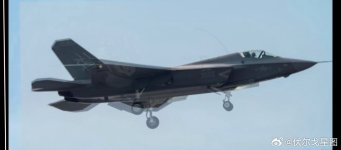
100%_Guest
Registered Member

The F119 has a 0.30:1 bypass ratioI'm not an aero engine expert to analyze some of the specialized knowledge.
I understand from some available knowledge that turbofan engine design is not a matter of more thrust is better. It is a matter of design tradeoffs and parameter balancing. For example, the F135 does have a lot of thrust, but it is traded off with the ability to give up some other parameters.
Design is an art of compromise and balance.
The F135 has a 0.57:1, bypass ratio
The WS-15 has a 0.25. bypass ratio
(Available Info from google.)
Now you see why Fatso 35 it call a L:emon
that cant run and turn...
It aint a superfly that can supercruise

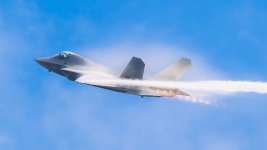

Fatman17
THINK TANK: CONSULTANT

FEATURES
Assessing the J-35A: The Chinese Air Force’s New Stealth Fighter
After its official reveal at the Zhuhai Airshow, what do we know about China’s new fifth-generation fighter?By Rick Joe
November 20, 2024
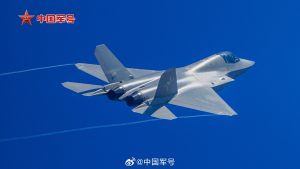
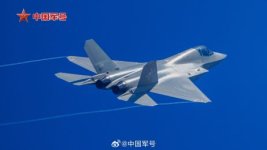
This image, released by the official Weibo account of a People’s Liberation Army media wing, shows the J-35A in action.
Credit: Weibo/中国军号
Subscribe for ads-free reading
The 2024 Zhuhai Airshow presented a deluge of aircraft, drones, munitions, and systems, including displays of hardware in service with China’s People’s Liberation Army (PLA) and PLA Air Force (PLAAF) or soon to enter service. The new J-35A – a stealthy fifth-generation fighter – was most widely covered.
The revelation of J-35A being intended for service in the PLAAF coincided with the Air Force’s 75th anniversary, and multiple different prototype airframes were flown over multiple days at Zhuhai. Subsequent coverage in official state media and on social networks followed, essentially “declassifying” the J-35A, as PLA norms go. At present, the J-35A has yet to enter frontline service.
The J-35A is an aircraft simultaneously both recent in entering the rumor cycle and long expected. This piece will review the background of the J-35A, and assess its characteristics and the rationale for its procurement.
From FC-31 to J-35A
In past articles, I’ve covered the aircraft types that preceded the J-35A. First, there was the original FC-31 developed by Shenyang Aircraft Corporation (SAC) as a technology demonstrator and potential export product, albeit without any PLA commitment at that time. Two flying prototypes and multiple static prototypes were developed, with the two differing prototypes flying in 2012 and 2016. During this time, the FC-31 was sometimes called the “J-31,” but the name was not official given the lack of PLA commitment.
In the mid-to-late 2010s, concrete rumors emerged that the FC-31 had been chosen by the PLA Navy (PLAN) to be developed into a carrierborne fifth generation fighter, with the possible name “J-35.” In October 2021, the first prototype of the J-35 flew, with pictures confirming traits of a carrierborne fighter such as an enlarged folding wing, reinforced landing gear, and a catapult launch bar, as well as other refinements such as an enlarged dorsal fuselage hump and a more complex sensor fitout.
Starting from 2021, rumors emerged that the PLAAF was also interested in pursuing a land-based, “de-navalized” version of the J-35. Over the last couple of years, such rumors began to spread with greater intensity. In 2023, photos emerged of one or more prototypes of an aircraft appearing similar to the J-35 but with a reduced wingspan, consistent with features expected of an air force variant. However the designation of the PLAAF’s variant was still not known.
With Zhuhai Airshow 2024 and the PLAAF’s 75th anniversary, the fighter’s name has now been confirmed as J-35A. (It is unknown what the official name of PLAN’s carrierborne variant will be, but I will continue to use “J-35” until new indicators emerge.)
The J-35A/J-35/FC-31 lineage had a developmental course that is both protracted and short – protracted if one measures from the FC-31 technology demonstrator first flying in 2012, without PLA interest, and short if one measures from the carrierborne J-35 first flying in late 2021.
This family of aircraft has been dogged by commentary emphasizing its resemblance to the United States’ F-35 family of aircraft, with both being fifth-generation, medium-sized fighters with similar wing and tail configurations and dual side air intakes. These similarities have been emphasized in the context of the Chinese cyberespionage operations that reportedly stole data on the F-35. However, the emergence of multiple other aircraft with similar configurations (the twin engine KF-21 and AMCA, in particular) may reflect a convergence of form due to pursuit of similar functions in context of desiring mature aerodynamic configurations.
While it is very much plausible that espionage relating to the F-35 may have benefited the J-35/A program, it is unlikely that gross aircraft planform and aerodynamic configurations would have benefited from such intelligence. More telling evidence might be if the development of certain avionics, weapons, or other mission systems may have benefited from intelligence garnered with the aim of countering the F-35. Alas, confirmation of this matter would require detailed forensics of both the J-35/A and the F-35 family, which is unlikely ever to occur.
https://www.actirise.com/?utm_source=thediplomat.com&utm_campaign=intext
Design and Features
The J-35A is a medium-sized fighter with a twin divertless supersonic intake, twin engine layout, and a single ventral internal weapons bay (IWB). It possesses a conventional wing and tail configuration, with the usual hallmarks of a stealthy fifth-generation aircraft such as edge alignment, chines, serrated paneling and doors, and a relatively smooth external finish. Radar absorption materials are virtually guaranteed, both structurally “baked in” and surface applied once it enters production.
There has been past industry documentation relating to the external dimensions of the FC-31, describing its length (17.3 meters), wingspan (11.5 meters), maximum takeoff weight (28 tons), combat radius (1,200 kilometers). However, it is not known whether those figures remain true for the J-35A, particularly the weight and combat radius specs. The J-35A likely possesses an increased internal fuel capacity thanks to the larger J-35-style dorsal fuselage hump. The J-35A is also likely to benefit from advances in airframe materials and structural design, as well as utilizing more refined engines than the original FC-31.
The original FC-31 was thought to have utilized Russian RD-33 engines, later replaced by the improved reverse engineered powerplant WS-13E, with some of the prototype airframes thought to be utilizing a further improved WS-21 engine. However, the target powerplant for the J-35A will be the WS-19, an engine in a similar thrust and size class to the F414 or EJ200. It is not presently known if WS-19 has flown yet on a J-35A or a J-35; there has been some careful imagery inspection of the airframes over Zhuhai that identified differences in engine nozzles, but without credible Chinese language grapevine confirmation, at present it is prudent to assume that the engines flown on existing J-35As are WS-13Es and/or WS-21s. At present it is expected that the J-35A (and likely the J-35) will be capable of supercruise when powered by WS-19s.
https://www.actirise.com/?utm_source=thediplomat.com&utm_campaign=intext
J-35/A fighters are likely to utilize avionics of a similar pedigree and sophistication to the upcoming improved J-20A fighter, encompassing modern and up-to-date iterations of a primary AESA radar, sensor processing, networking, and electronic support measure sensors. There is confirmation of a chin mounted electro optic/infrared sensor and optical apertures situated around the aircraft to provide full spherical coverage as well. A wide-angle holographic heads-up display is visible in the cockpit; however, it is likely to also offer a helmet-mounted display similar to the J-20. A modern glass cockpit with a wide-screen display is likely to be present as well.
One feature of the J-35/A to observe in coming years is the specific dimensions of its ventral IWB. There have been some rumors that the IWB of the J-35/A may possess the same dimensions as the J-20/A. This is not outside of the realm of possibility as the J-20/A does not possess a weapons bay as deep as the central stations of the F-35A/C variants, and a common weapons bay geometry would enable more efficient weapons development, fitting, and separations testing. New air-to-air and air-to-ground/strike weapons are known to be in development for use by both the J-20/A and J-35/A.
One “new” air-to-air weapon seen at Zhuhai in 2024 was a folding tail version of the PL-15E, the export version of the PL-15 beyond visual range air-to-air missile. The new missile configuration will likely enable the J-20/A and J-35/A to carry six PL-15s internally versus the existing four with fixed tails. A folding tail PL-15 had been rumored for some time, but it remains unknown whether it will supplement or replace fixed tail PL-15 production. Presently, it is believed that a new generation beyond visual range missile is also in development as well (sometimes dubbed the PL-16 or PL-20).
The J-35A is likely to possess external weapons carriage capability for additional weapons and outsize munitions.
Rationale and Role
The place of the J-35A in the PLAAF is not quite obvious at first glance. While a medium weight, possibly cheaper complement to the heavier weight J-20/A seems intuitive, there are certain drawbacks to introducing a new fighter type, such as requiring its own supply chain for key parts and a new engine type. This remains all the more complicated when one considers that J-20 annual production at Chengdu Aerospace Corporation (CAC) in recent years has grown to approach or achieve the three-digit mark, which is likely to be sustained for a number of years.
Therefore, in the plausible event that J-20/A procurement for the rest of this decade occurs at 100 or more airframes per year (with a potential ceiling rate of 150), the idea of producing additional fifth-generation fighters on top of this seems rather ambitious. Procurement of the J-35A by the PLAAF therefore can be explained by a few mutually supporting factors, with the above assumptions in place.
The J-35A may reflect a desire by the PLAAF to further expand the pace of fifth-generation fighter procurement beyond CAC’s already expanded J-20/A production rates. This may be particularly important, because CAC is expected to be the prime contractor for the PLA’s next generation/sixth-generation fighter (which I previously dubbed the “J-XD”). That means some J-20/A factory space may gradually transitioned to J-XD production in the late 2020s. SAC therefore can help to augment China’s fifth-generation production, accelerating modernization of the PLAAF in a manner where technology and industry are not as much of a bottleneck as in the past.
Additionally, it is likely that the J-35A will share significant common subsystems with the navy’s carrierborne J-35, offering benefits in both cost and availability. It is also possible that the PLAAF was able to accelerate development of the J-35A by leveraging work that the PLAN had already committed for the J-35, as well as technology demonstrator work done by SAC with the FC-31 airframes.
There is also a valid argument that the J-35A may offer lower procurement and operating costs than the J-20 as a slightly lighter weight fighter. It may also benefit from more modern manufacturing techniques (though it is possible the J-20A may also incorporate these aspects). But even if the J-35A is slightly lower in cost, the final procurement ratio of J-20/A aircraft and J-35As may be akin to the Flanker to J-10 procurement ratio, which is weighted in favor of the heavier and longer-range Flanker, by virtue of PLA range requirements.
Another factor to consider is the the ability to develop an export-grade J-35A variant for international customers, where potential buyers have the assurance of knowing the PLAAF will remain a committed customer to the type, thus guaranteeing future upgrade and sustainment packages. There may also be industry benefits by providing SAC with increased workshare for the manned fighter segment, compared to if the PLAN’s J-35 was procured alone.
As it stands, the Chinese military has described the J-35A as primarily an air superiority fighter with multirole strike capabilities, compared to the J-20/A, which is more oriented to the air superiority role. This may reflect the greater range and persistence of the J-20/A compared to the J-35A. Both should possess competitive kinematic performance, similar avionics, and similar weapons bay dimensions and thus similar weapons suite options.
The J-35A and the Future
With the J-35/A, China will have two entirely separate fifth-generation fighter families in active production. In the PLAAF, the J-35A will be complemented by the larger fifth-generation J-20/A, and both will be augmented by substantial numbers of 4.5th generation fighters (J-16s, J-10Cs, and J-11BGs). The J-35A may enable faster retirement of early fourth-generation aircraft (Su-27/J-11A/Su-30, J-10A) and the few remaining third- generation aircraft.
The exact balance of the PLAAF tactical air fleet will also depend on how China’s air force integrates unmanned combat aerial vehicles and collaborative combat aircraft (UCAVs/CCAs), which is a global trend and an open secret for PLA aerial developments as well. Finally, the next generation J-XD will also start to influence the fleet makeup of PLAAF, perhaps as soon as the early 2030s.
As a concluding remark regarding next generation developments, an openly fictional, anime-esque mockup (the “White Emperor”) shown for public engagement at Zhuhai Airshow this year has unfortunately resulted in multiple articles written by authors under the impression it is a legitimate next-generation aircraft project. While the PLA is actively pursuing the J-XD as a next-generation/sixth-generation manned fighter (and some developments may be visible on this front in the near future) this ludicrous, anime-inspired fighter mockup certainly is not it.
GUEST AUTHOR
Rick Joe
Rick Joe is a longtime follower of Chinese military developments, with a focus on air and naval platforms.

SiliconBit (silicon0000)
Trusted Member
- Thread starter
- #639
FEATURES
Assessing the J-35A: The Chinese Air Force’s New Stealth Fighter
After its official reveal at the Zhuhai Airshow, what do we know about China’s new fifth-generation fighter?
By Rick Joe
November 20, 2024
This image, released by the official Weibo account of a People’s Liberation Army media wing, shows the J-35A in action.
Credit: Weibo/中国军号
Subscribe for ads-free reading
The 2024 Zhuhai Airshow presented a deluge of aircraft, drones, munitions, and systems, including displays of hardware in service with China’s People’s Liberation Army (PLA) and PLA Air Force (PLAAF) or soon to enter service. The new J-35A – a stealthy fifth-generation fighter – was most widely covered.
The revelation of J-35A being intended for service in the PLAAF coincided with the Air Force’s 75th anniversary, and multiple different prototype airframes were flown over multiple days at Zhuhai. Subsequent coverage in official state media and on social networks followed, essentially “declassifying” the J-35A, as PLA norms go. At present, the J-35A has yet to enter frontline service.
The J-35A is an aircraft simultaneously both recent in entering the rumor cycle and long expected. This piece will review the background of the J-35A, and assess its characteristics and the rationale for its procurement.
From FC-31 to J-35A
In past articles, I’ve covered the aircraft types that preceded the J-35A. First, there was the original FC-31 developed by Shenyang Aircraft Corporation (SAC) as a technology demonstrator and potential export product, albeit without any PLA commitment at that time. Two flying prototypes and multiple static prototypes were developed, with the two differing prototypes flying in 2012 and 2016. During this time, the FC-31 was sometimes called the “J-31,” but the name was not official given the lack of PLA commitment.
In the mid-to-late 2010s, concrete rumors emerged that the FC-31 had been chosen by the PLA Navy (PLAN) to be developed into a carrierborne fifth generation fighter, with the possible name “J-35.” In October 2021, the first prototype of the J-35 flew, with pictures confirming traits of a carrierborne fighter such as an enlarged folding wing, reinforced landing gear, and a catapult launch bar, as well as other refinements such as an enlarged dorsal fuselage hump and a more complex sensor fitout.
Starting from 2021, rumors emerged that the PLAAF was also interested in pursuing a land-based, “de-navalized” version of the J-35. Over the last couple of years, such rumors began to spread with greater intensity. In 2023, photos emerged of one or more prototypes of an aircraft appearing similar to the J-35 but with a reduced wingspan, consistent with features expected of an air force variant. However the designation of the PLAAF’s variant was still not known.
With Zhuhai Airshow 2024 and the PLAAF’s 75th anniversary, the fighter’s name has now been confirmed as J-35A. (It is unknown what the official name of PLAN’s carrierborne variant will be, but I will continue to use “J-35” until new indicators emerge.)
The J-35A/J-35/FC-31 lineage had a developmental course that is both protracted and short – protracted if one measures from the FC-31 technology demonstrator first flying in 2012, without PLA interest, and short if one measures from the carrierborne J-35 first flying in late 2021.
This family of aircraft has been dogged by commentary emphasizing its resemblance to the United States’ F-35 family of aircraft, with both being fifth-generation, medium-sized fighters with similar wing and tail configurations and dual side air intakes. These similarities have been emphasized in the context of the Chinese cyberespionage operations that reportedly stole data on the F-35. However, the emergence of multiple other aircraft with similar configurations (the twin engine KF-21 and AMCA, in particular) may reflect a convergence of form due to pursuit of similar functions in context of desiring mature aerodynamic configurations.
While it is very much plausible that espionage relating to the F-35 may have benefited the J-35/A program, it is unlikely that gross aircraft planform and aerodynamic configurations would have benefited from such intelligence. More telling evidence might be if the development of certain avionics, weapons, or other mission systems may have benefited from intelligence garnered with the aim of countering the F-35. Alas, confirmation of this matter would require detailed forensics of both the J-35/A and the F-35 family, which is unlikely ever to occur.
https://www.actirise.com/?utm_source=thediplomat.com&utm_campaign=intext
Design and Features
The J-35A is a medium-sized fighter with a twin divertless supersonic intake, twin engine layout, and a single ventral internal weapons bay (IWB). It possesses a conventional wing and tail configuration, with the usual hallmarks of a stealthy fifth-generation aircraft such as edge alignment, chines, serrated paneling and doors, and a relatively smooth external finish. Radar absorption materials are virtually guaranteed, both structurally “baked in” and surface applied once it enters production.
There has been past industry documentation relating to the external dimensions of the FC-31, describing its length (17.3 meters), wingspan (11.5 meters), maximum takeoff weight (28 tons), combat radius (1,200 kilometers). However, it is not known whether those figures remain true for the J-35A, particularly the weight and combat radius specs. The J-35A likely possesses an increased internal fuel capacity thanks to the larger J-35-style dorsal fuselage hump. The J-35A is also likely to benefit from advances in airframe materials and structural design, as well as utilizing more refined engines than the original FC-31.
The original FC-31 was thought to have utilized Russian RD-33 engines, later replaced by the improved reverse engineered powerplant WS-13E, with some of the prototype airframes thought to be utilizing a further improved WS-21 engine. However, the target powerplant for the J-35A will be the WS-19, an engine in a similar thrust and size class to the F414 or EJ200. It is not presently known if WS-19 has flown yet on a J-35A or a J-35; there has been some careful imagery inspection of the airframes over Zhuhai that identified differences in engine nozzles, but without credible Chinese language grapevine confirmation, at present it is prudent to assume that the engines flown on existing J-35As are WS-13Es and/or WS-21s. At present it is expected that the J-35A (and likely the J-35) will be capable of supercruise when powered by WS-19s.
https://www.actirise.com/?utm_source=thediplomat.com&utm_campaign=intext
J-35/A fighters are likely to utilize avionics of a similar pedigree and sophistication to the upcoming improved J-20A fighter, encompassing modern and up-to-date iterations of a primary AESA radar, sensor processing, networking, and electronic support measure sensors. There is confirmation of a chin mounted electro optic/infrared sensor and optical apertures situated around the aircraft to provide full spherical coverage as well. A wide-angle holographic heads-up display is visible in the cockpit; however, it is likely to also offer a helmet-mounted display similar to the J-20. A modern glass cockpit with a wide-screen display is likely to be present as well.
One feature of the J-35/A to observe in coming years is the specific dimensions of its ventral IWB. There have been some rumors that the IWB of the J-35/A may possess the same dimensions as the J-20/A. This is not outside of the realm of possibility as the J-20/A does not possess a weapons bay as deep as the central stations of the F-35A/C variants, and a common weapons bay geometry would enable more efficient weapons development, fitting, and separations testing. New air-to-air and air-to-ground/strike weapons are known to be in development for use by both the J-20/A and J-35/A.
One “new” air-to-air weapon seen at Zhuhai in 2024 was a folding tail version of the PL-15E, the export version of the PL-15 beyond visual range air-to-air missile. The new missile configuration will likely enable the J-20/A and J-35/A to carry six PL-15s internally versus the existing four with fixed tails. A folding tail PL-15 had been rumored for some time, but it remains unknown whether it will supplement or replace fixed tail PL-15 production. Presently, it is believed that a new generation beyond visual range missile is also in development as well (sometimes dubbed the PL-16 or PL-20).
The J-35A is likely to possess external weapons carriage capability for additional weapons and outsize munitions.
Rationale and Role
The place of the J-35A in the PLAAF is not quite obvious at first glance. While a medium weight, possibly cheaper complement to the heavier weight J-20/A seems intuitive, there are certain drawbacks to introducing a new fighter type, such as requiring its own supply chain for key parts and a new engine type. This remains all the more complicated when one considers that J-20 annual production at Chengdu Aerospace Corporation (CAC) in recent years has grown to approach or achieve the three-digit mark, which is likely to be sustained for a number of years.
Therefore, in the plausible event that J-20/A procurement for the rest of this decade occurs at 100 or more airframes per year (with a potential ceiling rate of 150), the idea of producing additional fifth-generation fighters on top of this seems rather ambitious. Procurement of the J-35A by the PLAAF therefore can be explained by a few mutually supporting factors, with the above assumptions in place.
The J-35A may reflect a desire by the PLAAF to further expand the pace of fifth-generation fighter procurement beyond CAC’s already expanded J-20/A production rates. This may be particularly important, because CAC is expected to be the prime contractor for the PLA’s next generation/sixth-generation fighter (which I previously dubbed the “J-XD”). That means some J-20/A factory space may gradually transitioned to J-XD production in the late 2020s. SAC therefore can help to augment China’s fifth-generation production, accelerating modernization of the PLAAF in a manner where technology and industry are not as much of a bottleneck as in the past.
Additionally, it is likely that the J-35A will share significant common subsystems with the navy’s carrierborne J-35, offering benefits in both cost and availability. It is also possible that the PLAAF was able to accelerate development of the J-35A by leveraging work that the PLAN had already committed for the J-35, as well as technology demonstrator work done by SAC with the FC-31 airframes.
There is also a valid argument that the J-35A may offer lower procurement and operating costs than the J-20 as a slightly lighter weight fighter. It may also benefit from more modern manufacturing techniques (though it is possible the J-20A may also incorporate these aspects). But even if the J-35A is slightly lower in cost, the final procurement ratio of J-20/A aircraft and J-35As may be akin to the Flanker to J-10 procurement ratio, which is weighted in favor of the heavier and longer-range Flanker, by virtue of PLA range requirements.
Another factor to consider is the the ability to develop an export-grade J-35A variant for international customers, where potential buyers have the assurance of knowing the PLAAF will remain a committed customer to the type, thus guaranteeing future upgrade and sustainment packages. There may also be industry benefits by providing SAC with increased workshare for the manned fighter segment, compared to if the PLAN’s J-35 was procured alone.
As it stands, the Chinese military has described the J-35A as primarily an air superiority fighter with multirole strike capabilities, compared to the J-20/A, which is more oriented to the air superiority role. This may reflect the greater range and persistence of the J-20/A compared to the J-35A. Both should possess competitive kinematic performance, similar avionics, and similar weapons bay dimensions and thus similar weapons suite options.
The J-35A and the Future
With the J-35/A, China will have two entirely separate fifth-generation fighter families in active production. In the PLAAF, the J-35A will be complemented by the larger fifth-generation J-20/A, and both will be augmented by substantial numbers of 4.5th generation fighters (J-16s, J-10Cs, and J-11BGs). The J-35A may enable faster retirement of early fourth-generation aircraft (Su-27/J-11A/Su-30, J-10A) and the few remaining third- generation aircraft.
The exact balance of the PLAAF tactical air fleet will also depend on how China’s air force integrates unmanned combat aerial vehicles and collaborative combat aircraft (UCAVs/CCAs), which is a global trend and an open secret for PLA aerial developments as well. Finally, the next generation J-XD will also start to influence the fleet makeup of PLAAF, perhaps as soon as the early 2030s.
As a concluding remark regarding next generation developments, an openly fictional, anime-esque mockup (the “White Emperor”) shown for public engagement at Zhuhai Airshow this year has unfortunately resulted in multiple articles written by authors under the impression it is a legitimate next-generation aircraft project. While the PLA is actively pursuing the J-XD as a next-generation/sixth-generation manned fighter (and some developments may be visible on this front in the near future) this ludicrous, anime-inspired fighter mockup certainly is not it.
GUEST AUTHOR
Rick Joe
Rick Joe is a longtime follower of Chinese military developments, with a focus on air and naval platforms.
Dear you always share nice information, Thanks for it. Just one suggestion, if possible please remove irrelevant links and hyperlinks like advertisement links etc before you post. These links could be harmful.



Beijingwalker
VIP Member
NEWS
by Tyler Evans

The J-35, a product of China’s leading aircraft manufacturer, is nothing short of awe-inspiring. It sports cutting-edge stealth technology that drastically reduces its radar footprint, enabling it to penetrate enemy defenses undetected. Not only that, but it also boasts advanced electronic warfare capabilities as well as exceptional performance capabilities.
Critics and analysts alike share the opinion: China’s J-35 is in a league of its own. Equipped with high-performance engines and a combination of both long and short-range air-to-air missiles, the J-35 represents a major leap for Chinese aviation technology and a clear challenge to foreign military powers.
Besides the aircraft’s remarkable performance characteristics, the J-35 is also an integral part of China’s grand strategy to assert itself as a global superpower. With the launch of this innovative aircraft, China has firmly stamped its mark on the global stage, and the world has taken notice.
Indeed, the J-35 is more than just a typical fighter jet. With its outstanding capabilities, it is rewriting the rules of air warfare and asserting China’s growing presence in the global arena. It truly is a hidden gem in China’s high-tech arsenal, set to shape the future of aerial warfare.
The J-35, a brainchild of China’s premier aircraft manufacturer, embodies sheer innovation and impressiveness. It prominently features ultra-modern stealth technology, dramatically reducing its radar visibility, allowing infiltrations into enemy lines undetected. Moreover, it possesses superior electronic warfare skills along with extraordinary performance capabilities.
According to critics and analysts, China’s J-35 is a class apart. Armed with powerful engines and a blend of both long and short-range air-to-air missiles, the J-35 signifies a significant step forward for Chinese aviation technology while posing a challenge to international military powers.
Besides its impressive performance attributes, the J-35 forms a critical part of China’s overarching strategy to establish itself as a global powerhouse. With the deployment of this innovative fighter jet, China has emphatically stamped its authority on the international stage, garnering worldwide attention.
Indeed, the J-35 exceeds the realm of a standard fighter jet. With its exceptional capabilities, it is revolutionizing the rules of air warfare and accentuating China’s expanding influence in the global sphere. The J-35 truly shines as a hidden gem in China’s cutting-edge weaponry arsenal, poised to architect the future trajectory of aerial warfare.
The Chinese J-35‘s stealth technology significantly minimizes its radar signature, making it nearly invisible to enemy defense systems. This technological edge enhances its ability to stealthily enter enemy lines without detection.
Furthermore, the J-35 boasts superior electronic warfare capabilities, designed to disrupt, confuse, or disable enemy electronic systems. These features strengthen the jet’s potential to dominate in modern air combat situations.
One of the most exceptional aspects of the J-35 is its propulsion system. Equipped with high-performance engines, the J-35 possesses remarkable speed, agility, and range. This grants it an advantage in various combat situations, whether it’s to chase down an enemy aircraft or retreat rapidly from a precarious situation.
The J-35 also comes equipped with a combination of both long and short-range air-to-air missiles. This varied arsenal ensures the jet can effectively engage in combat at multiple ranges, providing it with a flexible and comprehensive battle strategy.
This new addition to its arsenal can have implications for geopolitical relations, potentially shifting the balance of power. As China continues to rise as a global superpower, other nations will need to reassess their strategies and defenses to balance this new challenge posed by the J-35.
In conclusion, the J-35 represents a transformative evolution in aerial warfare. Beyond its innovative features, it stands as a symbol of China’s burgeoning global influence, reaffirming the nation’s status as a formidable force in aviation technology.
https://lanoticiadigital.com.ar/news-en/chinas-hidden-gem-rewriting-air-combat-history/51912/
China’s Hidden Gem: Rewriting Air Combat History
7 January 2025by Tyler Evans
The J-35 Stealth Fighter: A Game-Changer on Global Stage
China’s continued advancements in aviation technology have taken the world by storm, especially with the unveiling of their latest stealth fighter aircraft, the J-35. Labelled as a “hidden gem”, the J-35 is rapidly reshaping the landscape of air combat and threatening to redraw geopolitical lines.The J-35, a product of China’s leading aircraft manufacturer, is nothing short of awe-inspiring. It sports cutting-edge stealth technology that drastically reduces its radar footprint, enabling it to penetrate enemy defenses undetected. Not only that, but it also boasts advanced electronic warfare capabilities as well as exceptional performance capabilities.
Critics and analysts alike share the opinion: China’s J-35 is in a league of its own. Equipped with high-performance engines and a combination of both long and short-range air-to-air missiles, the J-35 represents a major leap for Chinese aviation technology and a clear challenge to foreign military powers.
Besides the aircraft’s remarkable performance characteristics, the J-35 is also an integral part of China’s grand strategy to assert itself as a global superpower. With the launch of this innovative aircraft, China has firmly stamped its mark on the global stage, and the world has taken notice.
Indeed, the J-35 is more than just a typical fighter jet. With its outstanding capabilities, it is rewriting the rules of air warfare and asserting China’s growing presence in the global arena. It truly is a hidden gem in China’s high-tech arsenal, set to shape the future of aerial warfare.
Unveiling the Future of Aerial Warfare: The Chinese J-35 Stealth Fighter
China’s prowess in aviation technology continues to gain global attention, particularly with the introduction of the state-of-the-art stealth fighter jet, the J-35. Highly regarded as an “undiscovered jewel,” the J-35 is rapidly transforming the dynamics of aerial warfare and could potentially redefine geopolitical boundaries.The J-35, a brainchild of China’s premier aircraft manufacturer, embodies sheer innovation and impressiveness. It prominently features ultra-modern stealth technology, dramatically reducing its radar visibility, allowing infiltrations into enemy lines undetected. Moreover, it possesses superior electronic warfare skills along with extraordinary performance capabilities.
According to critics and analysts, China’s J-35 is a class apart. Armed with powerful engines and a blend of both long and short-range air-to-air missiles, the J-35 signifies a significant step forward for Chinese aviation technology while posing a challenge to international military powers.
Besides its impressive performance attributes, the J-35 forms a critical part of China’s overarching strategy to establish itself as a global powerhouse. With the deployment of this innovative fighter jet, China has emphatically stamped its authority on the international stage, garnering worldwide attention.
Indeed, the J-35 exceeds the realm of a standard fighter jet. With its exceptional capabilities, it is revolutionizing the rules of air warfare and accentuating China’s expanding influence in the global sphere. The J-35 truly shines as a hidden gem in China’s cutting-edge weaponry arsenal, poised to architect the future trajectory of aerial warfare.
The Chinese J-35‘s stealth technology significantly minimizes its radar signature, making it nearly invisible to enemy defense systems. This technological edge enhances its ability to stealthily enter enemy lines without detection.
Furthermore, the J-35 boasts superior electronic warfare capabilities, designed to disrupt, confuse, or disable enemy electronic systems. These features strengthen the jet’s potential to dominate in modern air combat situations.
One of the most exceptional aspects of the J-35 is its propulsion system. Equipped with high-performance engines, the J-35 possesses remarkable speed, agility, and range. This grants it an advantage in various combat situations, whether it’s to chase down an enemy aircraft or retreat rapidly from a precarious situation.
The J-35 also comes equipped with a combination of both long and short-range air-to-air missiles. This varied arsenal ensures the jet can effectively engage in combat at multiple ranges, providing it with a flexible and comprehensive battle strategy.
The Global Implications of the J-35
The introduction of the J-35 isn’t just an advancement in China’s technological capabilities. It’s a statement of intent, a bold move by China to demonstrate its increasing influence and assertiveness on the global stage.This new addition to its arsenal can have implications for geopolitical relations, potentially shifting the balance of power. As China continues to rise as a global superpower, other nations will need to reassess their strategies and defenses to balance this new challenge posed by the J-35.
In conclusion, the J-35 represents a transformative evolution in aerial warfare. Beyond its innovative features, it stands as a symbol of China’s burgeoning global influence, reaffirming the nation’s status as a formidable force in aviation technology.
https://lanoticiadigital.com.ar/news-en/chinas-hidden-gem-rewriting-air-combat-history/51912/


Michael
VIP Member
via Weibo@央视军事 (Original link)
第三届“航空航天医学高峰论坛”,多位院士参会展开交流。《战斗机发展的思考》是中国工程院院士孙聪在论坛上演讲的题目。他说:“我们的研制周期现在都太长了,这就是给我们飞机研发领域提出一个新挑战,能不能像造手机一样造飞机,是我们未来的一个梦想!”
Sun Cong, Academician of the Chinese Academy of Engineering: “Our development cycle is now all too long, this is to put forward a new challenge to our aircraft research and development field, can we build aircraft like building cell phones, is a dream for our future!”
=========================================
The J-35 series will be produced on a very large scale. The current production system is being planned and built to a very large capacity. It is expected that it will have a total capacity of over 1000+.
About the J-35 foreign trade version:
The foreign trade version of the J-35 is confirmed to use the WS-21 engine. In the future, the engine will be used exclusively for export, and it will not only be used in the foreign trade version of the J-35, but also in other export fighters. At the same time, the engine may be exported both technically and as a separate engine.
Since the vast majority of countries around the globe do not have independent modern military information systems. And, these countries do not have sufficient funds to procure and maintain these systems. This will pose a huge problem for the export of the J-35.
China currently has no intention of military hegemony. It is impossible for China to build military alliances with these countries. Therefore, China will not open its modern military information network to other countries. So how about a solution for the information support that the 5th Gen fighter must rely on? I think there are these solutions:
1, J-35 castrated version. This is the easiest way. Certain countries don't need advanced information network support platforms either.
2, Lease China's well-developed civilian systems.
China's civilian remote sensing satellites, imaging satellites, communication satellites, etc. are more advanced than the military satellite systems of many countries around the world. They are fully available for use by other countries' militaries. The only problem is that China's huge civilian satellite system belongs to different governmental organizations, scientific research institutions, enterprises, schools and so on. They need a unified organization to coordinate and manage them. Separate frequency bands and channels are divided among these satellite systems, which are transmitted and managed with military-grade encryption, and then leased to foreign militaries for their use.
第三届“航空航天医学高峰论坛”,多位院士参会展开交流。《战斗机发展的思考》是中国工程院院士孙聪在论坛上演讲的题目。他说:“我们的研制周期现在都太长了,这就是给我们飞机研发领域提出一个新挑战,能不能像造手机一样造飞机,是我们未来的一个梦想!”
Sun Cong, Academician of the Chinese Academy of Engineering: “Our development cycle is now all too long, this is to put forward a new challenge to our aircraft research and development field, can we build aircraft like building cell phones, is a dream for our future!”
=========================================
The J-35 series will be produced on a very large scale. The current production system is being planned and built to a very large capacity. It is expected that it will have a total capacity of over 1000+.
About the J-35 foreign trade version:
The foreign trade version of the J-35 is confirmed to use the WS-21 engine. In the future, the engine will be used exclusively for export, and it will not only be used in the foreign trade version of the J-35, but also in other export fighters. At the same time, the engine may be exported both technically and as a separate engine.
Since the vast majority of countries around the globe do not have independent modern military information systems. And, these countries do not have sufficient funds to procure and maintain these systems. This will pose a huge problem for the export of the J-35.
China currently has no intention of military hegemony. It is impossible for China to build military alliances with these countries. Therefore, China will not open its modern military information network to other countries. So how about a solution for the information support that the 5th Gen fighter must rely on? I think there are these solutions:
1, J-35 castrated version. This is the easiest way. Certain countries don't need advanced information network support platforms either.
2, Lease China's well-developed civilian systems.
China's civilian remote sensing satellites, imaging satellites, communication satellites, etc. are more advanced than the military satellite systems of many countries around the world. They are fully available for use by other countries' militaries. The only problem is that China's huge civilian satellite system belongs to different governmental organizations, scientific research institutions, enterprises, schools and so on. They need a unified organization to coordinate and manage them. Separate frequency bands and channels are divided among these satellite systems, which are transmitted and managed with military-grade encryption, and then leased to foreign militaries for their use.
Last edited:
Users who are viewing this thread
Total: 2 (members: 0, guests: 2)
Pakistan Defence Latest


Country Watch Latest


Latest Posts
-

-

-
 FlyDubai Incident: Pilot was stabbed on flight to Israel - diverted to Saudi Arabia (24 Viewers)
- Latest: Feroze
-
 My mummy's grave third time vandalized by wahabi / deobandi movleez because my mummy name is margarte (12 Viewers)
- Latest: Maarkhoor
-