Chinese SAC - FC-31/J-35 5th Gen Stealth Aircraft

So it needs J20 matching.
You do need second stealth jet J-31 will be the answer for all USAF/USN/JSDF F-35/F-22, South Korean KF21 jets J-20 is not enough and China is not able to produce J-20 in numbers because it's expensive and complex machine China needs cheaper stealth jet to be complementary with j20
 
Than why F-22 and F-35 don't have canard if they're not bad for stealth please educate me sir
The Canard is definitively designed for optimizing supersonic performance.

As aircraft break the sound barrier, the wing generates lift in a completely different way - instead of generated by air velocity and thus pressure differential, the lift is generated by shockwave pressure differential. As to not make my typically long response even longer, the TL;DR version of a week long aerodynamics lecture is that when breaking into supersonic speed, the center of lift moves backward. For a traditional layout aircraft, this means the center of lift moves closer and closer toward the control surface (stabiliator), which means less arm to generate control authority, thus making the aircraft more and more clumsy. Canard is the exact opposite, as center of lift moves backward and away from the canard, the aircraft instead becomes more agile.

J-20 is envisioned as a true full-stage supersonic fighter, as in it would remain in supersonic speeds when hot toward the enemy, cranking, defending, and committing for an attack, something that YF-23 envisioned and F-22 don't quite manage (this is why we joked that the Fagin is the spiritual successor of the YF-23 lmao). This means the lethality of the missile launched by J-20 is far greater (as the missile don't need to spend its own fuel to break the sound barrier), the jet have a much longer Minimum Abort Range against incoming missiles, that even without the benefit of stealth, J-20 can still dominate fourth gen fighters in sheer flight performance, and dominate other fifth gen fighters in a peer to peer matchup.

However, airfoils with all moving canards (not immovable canard like Mirage or canard with aileron like Saab 37 Viggen) is very difficult to design, because canard is both a vortex generator and a control surface, which means as you maneuver, the canard's AOA change would lead to change in the vortex generated over the wing, and that change is non-linear. The amount of design workload input required multiplies several times fold, and is nigh impossible before the advent of super-computers and high performance supersonic wind tunnels, hence why the canard delta designs like Typhoon, Rafale, and Gripen only emerged after 2000s. F-22 and F-35 are both still optimized for Transonic or Subsonic ranges, and Canard is unnecessary for them.
 
Last edited:
The Canard is definitively designed for optimizing supersonic performance.

As aircraft break the sound barrier, the wing generates lift in a completely different way - instead of generated by air velocity and thus pressure differential, the lift is generated by shockwave pressure differential. As to not make my typically long response even longer, the TL;DR version of a week long aerodynamics lecture is that when breaking into supersonic speed, the center of lift moves backward. For a traditional layout aircraft, this means the center of lift moves closer and closer toward the control surface (stabiliator), which means less arm to generate control authority, thus making the aircraft more and more clumsy. Canard is the exact opposite, as center of lift moves backward and away from the canard, the aircraft instead becomes more agile.

J-20 is envisioned as a true full-stage supersonic fighter, as in it would remain in supersonic speeds when hot toward the enemy, cranking, defending, and committing for an attack, something that YF-23 envisioned and F-22 don't quite manage (this is why we joked that the Fagin is the spiritual successor of the YF-23 lmao). This means the lethality of the missile launched by J-20 is far greater (as the missile don't need to spend its own fuel to break the sound barrier), the jet have a much longer Minimum Abort Range against incoming missiles, that even without the benefit of stealth, J-20 can still dominate fourth gen fighters in sheer flight performance, and dominate other fifth gen fighters in a peer to peer matchup.

However, airfoils with all moving canards (not immovable canard like Mirage or canard with aileron like Saab 37 Viggen) is very difficult to design, because canard is both a vortex generator and a control surface, which means as you maneuver, the canard's AOA change would lead to change in the vortex generated over the wing, and that change is non-linear. The amount of input required multiplies several times fold, and is nigh impossible before the advent of super-computers and high performance supersonic intake, hence why the canard delta designs like Typhoon, Rafale, and Gripen only emerged after 2000s. F-22 and F-35 are both still optimized for Transonic or Subsonic ranges, and Canard is unnecessary for them.
But upcoming NGAD will also has no canards sir and as far as I remember sir early in JSF designs one mockup built by either Lockheed Martin or Boeing had a canards with delta wings but it was rejected by USAF/USN
 
But upcoming NGAD will also has no canards sir and as far as I remember sir early in JSF designs one mockup built by either Lockheed Martin or Boeing had a canards with delta wings but it was rejected by USAF/USN
That is because NGAD have completely given up on traditional BFM maneuverability. NGAD have opted entirely for wide-band stealth, which includes lower frequency radar like L-band, which, ugh, another lecture... okay, TL;DR, you should have less geometric details. Doesn't matter canard, doesn't matter traditional tail (vertical and stabiliator), get rid of them all. The entire airframe, except for the wing and fuselage, should have nothing else poking out of it, everything should be as smooth as a baby's bottom. All of the NGAD designs for air force are tailless lambda wing designs, that survives thanks to a even higher degree of stealth, advanced sensors, and collaboration with unmanned loyal wingman drones.

The Navy F/A-XX program which is also a part of the NGAD does have canard, but that is more to give the aircraft the bare minimum high AOA low speed performance to be able to carry out carrier landing.

The Canard design that predated the X-35 was actually for when the JSF program was still the JAST program, in which the jet was only meant to serve in the air force and the Navy. When the JAST program was merged with ASTOVL program and had to incorporate designed for STOVL for USMC, while there were attempts in modifying the canard design with lift fans, the canard delta layout is just not enough to meet both the payload and range requirement as the Canard Delta layout is not as efficient in subsonic high AOA missions carrying a heavy payload.
 
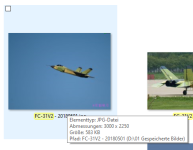
J-31 for Pakistan? (No Hump behind the cockpit as on the PLANAF J-35) EOTS deleted? Supposedly the EOTS is still there but I don’t see it.
View attachment 13216

Credit to @LouisCheung_HK on twitter
@Deino ????
Too many assumptions I think?


To tell it politely: @LouisCheung_HK is an idiot, a most stupid spreader of rumours!

No, this is clearly no. 31003 and I have this image since 1st May 2018!

1705938861266.png
 
To view this content we will need your consent to set third party cookies.
For more detailed information, see our cookies page.
 
To view this content we will need your consent to set third party cookies.
For more detailed information, see our cookies page.

That's a very significant development.

I speculate the PLAN, especially on their STOBAR carriers, would primarily use J-35 as high-survivability ISR platforms, due to limitations imposed on operational range and payload due to the inherent disadvantages of the STOBAR layout, with secondary roles in aerial intercept and denial.
But still, this brings very significant leaps in capability for Liaoning and Shandong carrier group, both in defense against sea-skimming warheads and in offense, engaging distant enemy threat beyond the horizon using a variety of missiles.

Still, they are no substitute for full-fledged carrier borne AEW in terms of availbility and performance, we shall see if KJ-600 can make it onto Liaoning and Shandong as well.

While this still wouldn't make them 1 for 1 comparable with supercarriers like Nimitz and Ford, this does bridge the generation gap in terms of air fleet capability compared to Japanese and South Korean projects centered around F-35Bs.
 

Experts spot ‘dummy’ J-35 fighter on China’s Liaoning carrier​

By TOC On Feb 14, 2024

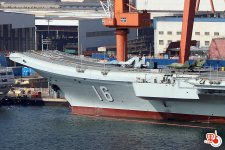
Amid February 2024, chatter began stirring on social media about notable advances in China’s J-35 carrier-capable fighter program. Images were shared, depicting what appeared to be a J-35 mockup performing tests on the Liaoning aircraft carrier during a routine refurbishment session.

To view this content we will need your consent to set third party cookies.
For more detailed information, see our cookies page.


The presence of the J-35 mockup on China’s pioneering aircraft carrier, the Liaoning, speaks volumes about the progress made in integrating the J-35 into China’s naval fleet.

This leads to speculation about whether the fighter could be deployed on China’s current carriers which, interestingly, are not equipped with catapult launch systems, but instead utilize ‘ski jump’ ramps.

New direction

Initially, we expected to see the J-35 operating from China’s soon-to-be operational Type 003 Fujian aircraft carrier, using China’s own Electromagnetic Aircraft Launch System. However, these recent developments suggest a new direction for the fighter initiative.

Both of China’s aircraft carriers, the Liaoning and its sister ship, the Shandong, operate under the Short Take-off but Arrested Recovery [STOBAR] principle, which relies on ski-jump ramps for take-off and arrester wires for landings. The Liaoning, originally sourced from Ukraine, forms the cornerstone of China’s ambition for carrier aviation, and the Shandong was designed to closely mimic it.

Experts spot 'dummy' J-35 fighter on China's Liaoning carrier


Photo credit: Twitter

Up until now, both carriers, the Liaoning and the Shandong, have been using only J-15s for their fighter operations. These are Chinese adaptations of the Russian Su-33 Flanker carrier fighter, refined incrementally with local modifications in engines, avionics, and armaments.

The anticipated arrival of Fujian

However, things are set to change with the anticipated arrival of China’s Type 003 Fujian [CV-18] aircraft carrier. This carrier innovates by utilizing Catapult-assisted Takeoff but Arrested Recovery [CATOBAR] operations, with a sophisticated Electromagnetic Aircraft Launch System [EMALS].

Although the authenticity of the shared images cannot be definitively confirmed, they do provide sufficient detail to identify the mockup as a life-size representation of the J-35. This is a practice typical for carrying out carrier compatibility assessments.

The sharing of these photos caught the attention of Naval Defense Analyst Alex Luck, who commented on Twitter: “J-35 mockup on Liaoning. Not conclusive, but it’s a logical inference considering it’s unlikely that both Kuznetsov carriers would be retired before a considerable number of CATOBAR CVs have been put into service.”

Furthermore, Luck believes that in the end, the J-35 stands a good chance of becoming the primary manned fighter for carrier operations, as he sees the lifespan of the J-15 series as being limited. Luck emphasizes that having more decks available for take-off will not only streamline operations but also alleviate the pressure on associated crew training pipelines. This would be particularly beneficial in preparing for the introduction of the Fujian aircraft carrier.

J-35 Stealth Fighter

The J-35, commonly known as the naval modification for the FC-31 or J-31 Gyrfalcon, is China’s very own fifth-generation aircraft. This impressive machine was developed by the Shenyang Aircraft Corporation, a government enterprise, specifically for the People’s Liberation Army.

According to the Pentagon’s final report on the PLA in 2023, the inaugural flight of the J-35 occurred in 2021. This aircraft, designed specifically for naval operations, boasts improvements such as a significantly restructured F-35B-style canopy and cockpit layout with limited rear visibility, reinforced landing gear, and a catapult launch bar.

What’s more, it has incorporated retractable outer-wing panels that are designed to reduce space usage while the aircraft is parked or moving on the carrier deck.

J-35 cutting-edge avionics

Equipped with a cutting-edge active electronically scanned array [AESA] radar, the J-35 is finely tuned to deploy a series of Chinese-made air-to-air and air-to-ground munitions.

In December of 2023, a probable mockup of the J-35 was seen on the deck of the Fujian – the latest aircraft carrier in the Chinese Navy. This fighter jet employs stealth technology, putting it on par with Lockheed Martin’s advanced fifth-generation fighter, the F-35.

The jet was recently featured at the World Defense Show in Saudi Arabia. The manufacturers envision this aircraft as potential competition to the widely popular fifth-generation US jets, which are highly esteemed by many nations in the region.

J-35 data

Although the F-35 has a slower maximum speed than the FC-31—1.6 Mach compared to 1.8 Mach—it is lauded for its extended combat range. The F-35 covers 1,240km [770 miles], surpassing the Chinese jet, which only achieves 1,207km [750 miles].

Moving to future applications, Pakistan’s Air Chief Marshal Zaheer Ahmed Baber Sidhu announced in January 2024 that Pakistan has plans to acquire the FC-31 to modernize its air force. Unfortunately, no additional specifics regarding the procurement process were revealed.

However, considering the J-35 mockup was presented on the Liaoning, it strongly implies that the People’s Liberation Army Navy [PLAN] is considering the possibilities of deploying this stealth jet not only on the Type 003 carrier and its future successors but also on the current fleet of aircraft carriers.
 
To view this content we will need your consent to set third party cookies.
For more detailed information, see our cookies page.


J-35 Fighter Appears Unexpectedly on China's Liaoning Carrier​

 
To view this content we will need your consent to set third party cookies.
For more detailed information, see our cookies page.


J-35 Fighter Appears Unexpectedly on China's Liaoning Carrier​


Best image so far ... and second, thsi video was already posted above and even more check, if there is already a thread available. We do not need to start a new thread just for a YouTube video.

PLN CV-16 Liaoning - 20240218 + J-35 mockup - 點新聞dotdotnews - 1 smaller.jpg
 
I am extremely looking forward to J31/J35. In 2014, I saw J31 at the Zhuhai Aviation Exhibition. After so many years of development, it has finally come close to maturity. Due to the special relationship between China and the Western world, China's military propaganda cannot be as transparent as foreign countries such as India, such as AMCA promoting on a drawing board. Our cutting-edge weapon promotion is almost equivalent to absolute confidentiality. I like this plane and I look forward to the J-35 appearing at the Zhuhai Aviation Exhibition. I will go and watch it again
 
I am extremely looking forward to J31/J35. In 2014, I saw J31 at the Zhuhai Aviation Exhibition. After so many years of development, it has finally come close to maturity. Due to the special relationship between China and the Western world, China's military propaganda cannot be as transparent as foreign countries such as India, such as AMCA promoting on a drawing board. Our cutting-edge weapon promotion is almost equivalent to absolute confidentiality. I like this plane and I look forward to the J-35 appearing at the Zhuhai Aviation Exhibition. I will go and watch it again


I totally agree, but how likely is it, that the real J-35 will be on show this November?
 
I totally agree, but how likely is it, that the real J-35 will be on show this November?
The possibility is not high this year. I am looking forward to the Zhuhai Aviation Exhibition in 2026 or 2028, and China is now fully committed to developing J35.
 
But upcoming NGAD will also has no canards sir and as far as I remember sir early in JSF designs one mockup built by either Lockheed Martin or Boeing had a canards with delta wings but it was rejected by USAF/USN
That is because NGAD have completely given up on traditional BFM maneuverability. NGAD have opted entirely for wide-band stealth, which includes lower frequency radar like L-band, which, ugh, another lecture... okay, TL;DR, you should have less geometric details. Doesn't matter canard, doesn't matter traditional tail (vertical and stabiliator), get rid of them all. The entire airframe, except for the wing and fuselage, should have nothing else poking out of it, everything should be as smooth as a baby's bottom. All of the NGAD designs for air force are tailless lambda wing designs, that survives thanks to a even higher degree of stealth, advanced sensors, and collaboration with unmanned loyal wingman drones.

The Navy F/A-XX program which is also a part of the NGAD does have canard, but that is more to give the aircraft the bare minimum high AOA low speed performance to be able to carry out carrier landing.
There are three rules in designing a low radar observable, aka 'stealth', platform:

1. Control of QUANTITY of radiators
2. Control of ARRAY of radiators
3. Control of MODES of radiation

Geometric details, from flight control surfaces to comm antennas to rivets, are radiators. The 3 rules are not so much rules to break but to obey in degrees. The sphere is the most obedient to the rules.

Of the current limited 'stealth' platforms, the B-2/21 are the most obedient to the rules. How obedient will the NGAD platform be? We can be certain that the NGAD platform is the inevitable evolution of the B-2/21.


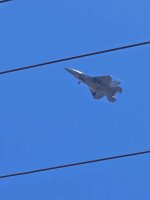
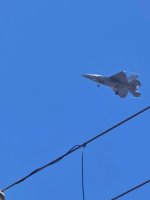
So, provided the clip is genuine, what’s that shape? Impossible to say. For sure, the fact that it was being moved, in plain daylight (although many RCS need to be carried out under the sunlight!), in front of someone filming with a smartphone, without being covered, seems to suggest it was nothing too secret.​

From the F-117 days, I would caution from making assumptions about the final shape of the NGAD fighter. Whatever we see on the internet, assume that the testing shape is just one of many variations the manufacturer is studying. The shapes themselves are no longer 'Top Secret' but more like 'Confidential'. What is secret are what goes on BETWEEN shape tests.

Though I may hope that we will get this straight forever: The canard is 'bad for stealth' the same way that the vertical stab is 'bad for stealth'. If you have something that sticks out from the main body and into the radar stream, no matter how little, that something is 'bad for stealth'.

So what does this mean for future air warfare? That in any contested airspace where one side is either unable or unwilling to deploy its own 'stealth' fighter, a two-ship flight of NGAD fighter will lopside the contest to whoever field them. Most countries import their defense meaning they have to buy their air forces from someone else. You can send 100 4th-gen fighters but if you lose even just one fighter per week from meeting the NGAD fighters, you will not be able to sustain your forces, let alone gaining air superiority over that contested airspace. In any conflict in any environment, if you cannot retaliate, you will lose the war, and the NGAD fighter will cost you more than just one fighter per week.
 

Users who are viewing this thread

Back
Top