Federal Constitutional Court/ Supreme Court / High Courts of Pakistan, News

Yasir Khan
@SKjourneybegins


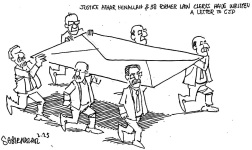
With due respect can you please elaborate what loss has occurred to democracy, to nation to country, to provinces, to federation?However the judges monopoly is being broken which is essential. Check out the performance of the judiciary since Independence.
 
The president and the prime minister will play key roles in judicial appointments, while some powers of the Supreme Court will be transferred to the new court.

Similarly, the Judicial Commission will decide on the transfer of high court judges, and any objections to such transfers will be reviewed by the Supreme Judicial Council.

The eligibility period for high court judges for appointment to the Federal Constitutional Court has been reduced from seven to five years.

The seniority of sitting Supreme Court judges appointed to the new court will remain intact, while seniority among new appointees from the bar or high courts will be determined by age.

The Judicial Commission of Pakistan (JCP) has been expanded to include, in addition to a woman or non-Muslim member, a technocrat nominated by the Speaker of the National Assembly, qualified to become a member of Parliament, ensuring broader merit-based representation.

The suo motu powers will now be exercised by the Federal Constitutional Court upon written application and after the court's satisfaction that constitutional grounds exist for intervention, ensuring transparency and judicial restraint.
 
On the transfer of judges, the bill authorizes the Judicial Commission of Pakistan to process inter-court transfers. If a judge decline transfer without valid reason, the matter will be referred to the Supreme Judicial Council for a hearing before any decision is made.
 

The court that replaced the Constitution​


Syed Jalal Hussain
November 14, 2025


The writer is a lawyer and development consultant. Email: [email protected]

Constitutions in Pakistan rarely die in flames. They survive the heat, only to be quietly rewritten by those who once swore to protect them. The 27th constitutional amendment keeps the book unburned, yet edits the chapters that shaped the Republic's balance of power. It builds a Federal Constitutional Court, a polished institution born of reform's promise. Beneath that veneer lies a redesign of power itself. The Supreme Court, once the last refuge of dissent, is reduced to an appellate archive, while the new court decides what is constitutional, what is lawful, and what may no longer be questioned.

It is the most sophisticated capture of the Constitution in our history, a coup written in calligraphy.

The harder question though is what the judiciary has done to the state as much as what the state has done to the judiciary. For many, this moment stirs resentment more than sympathy. The citizen asks, almost bitterly: what claim do these judges have on our defence? What light were they shining before it was snuffed out, that we should now grieve its absence? They brought down elected leaders, sanctified unconstitutional power, and hesitated when history demanded resolve. In their conviction lay a moral absolutism that mistook authority for virtue. It is difficult to summon outrage for their loss when the echo of their own overreach still lingers.
 
To view this content we will need your consent to set third party cookies.
For more detailed information, see our cookies page.
 

Justice Aminuddin Khan sworn in as first chief justice of Federal Constitutional Court


News Desk | Umer Mehtab | Malik Asad
November 14, 2025

1763121640138.png

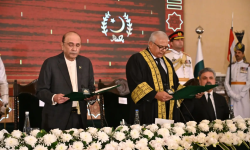
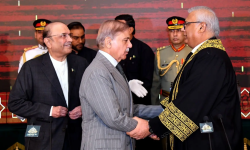
President Asif Ali Zardari administers oath to Justice Aminuddin Khan. — DawnNewsTV

1763121660044.png

President Asif Ali Zardari administers oath to Justice Aminuddin Khan.

Justice Aminuddin Khan on Friday was sworn in as the first chief justice of the newly established Federal Constitutional Court (FCC) after the 27th Amendment was enacted into law a day earlier.

Chief of Army Staff (COAS) Field Marshal Asim Munir and Chairman Joint Chiefs of Staff Committee (CJCSC) General Sahir Shamshad Mirza were also present for the ceremony held at the Aiwan-i-Sadr in Islamabad. Meanwhile, Supreme Court Chief Justice Yahya Afridi, President Asif Ali Zardari and Prime Minister Shehbaz Sharif sat alongside Justice Aminuddin on the stage.
 
Justice Aminuddin vowed to discharge his duties in accordance with the Constitution and the law, while also abiding by the code of conduct issued by the Supreme Judicial Council.

“That I will not allow my personal interest to influence my official conduct or my official decisions. That I will preserve, protect and defend the Constitution of the Islamic Republic of Pakistan and that in all circumstances, I will do right to all manner of people according to law, without fear or favour, affection or ill will,” he said in his oath, after which he shook hands with the president.

His appointment was made by President Asif Ali Zardari a day earlier under Clause 3 of Article 175A, read with Article 175C, of the Constitution, adding that it would come into effect from the date of Justice Aminuddin’s oath-taking.

The proposal to establish the FCC has been revived as part of the judicial reforms incorporated in the 27th Constitutional Amendment. According to government officials, the FCC’s creation aims to reduce the SC’s workload, ensure timely adjudication of constitutional cases and strengthen judicial independence and credibility.
 

6 judges appointed to FCC​

President Zardari also appointed the remaining six judges to the FCC. A notification issued by the law ministry, a copy of which is available with Dawn, said that the president made the appointments under Clause 3 of Article 175-A read with Article 175-C of the Constitution.

Justice Syed Hasan Azhar Rizvi, Justice Aamer Farooq and Justice Ali Baqar Najafi of the Supreme Court, Justice KK Agha of the Sindh High Court and Balochistan High Court Chief Justice Rozi Khan Barrech were appointed to the FCC.

Justice (retd) Arshad Hussain Shah has also been appointed. He was appointed as Justice Musarrat Hilali was not willing to join the FCC, a source told Dawn.

The initial strength of the FCC was determined through a presidential order, while any future increase in the number of judges will require parliamentary approval through an act of Parliament.

Of the judges appointed to the FCC, Justices Rizvi, Farooq and Najafi were administered the oath by Justice Aminuddin at the Islamabad High Court (IHC) today.

Interestingly, that ceremony was also not held in the FSC as originally planned. The FCC was intended to be established in the FSC building in Islamabad, while the FSC was to be shifted to the IHC premises. However, sources within the FSC revealed that its judges expressed dissatisfaction over their abrupt relocation and raised the matter with CJP Afridi.
 
It was earlier reported that the oath-taking ceremony for the FCC judges would be held at the IHC, as judges of the Federal Shariat Court (FSC) had resisted an immediate relocation to the third floor of the IHC building.

Initially, the oath-taking of Justice Aminuddin was scheduled for Thursday at 10am. However, following a minor revision to the 27th Constitutional Amendment Bill, the legislation had to be returned to the Senate for approval. After the Senate cleared the bill on Thursday, the ceremony was first rescheduled for 6pm and was later moved to Friday morning.
 

Who is the first chief justice of the Federal Constitutional Court?

Justice Aminuddin — a second-generation lawyer — was born on December 1, 1960 in Multan.

News Desk
November 14, 2025

1763122538340.png

The enactment of the 27th Constitutional Amendment into law paved the way for the formation of the Federal Constitutional Court (FCC), with the Supreme Court’s Justice Aminuddin Khan being appointed its first chief justice.

Today, Justice Aminuddin was sworn in by President Zardari at a ceremony held at the Aiwan-i-Sadr, with Chief Justice of Pakistan Yahya Afridi sat beside him.

With the FCC set to adjudicate on constitutional cases, here is a summary of Justice Aminuddin’s life and career thus far.

According to the Supreme Court’s website, Justice Aminuddin — a second-generation lawyer — was born on December 1, 1960 in Multan. He was awarded a bachelor’s degree in Philosophy in 1981 and completed his LLB from University Law College in Multan in 1984.​


He then started practicing with his father, late Khan Sadiq Muhammad Ahsan. Justice Aminuddin became an advocate of the Lahore High Court (LHC) in 1987 and of the Supreme Court in 2001. That same year, he joined Zafar Law Chambers in Multan and worked with the legal firm until he was elevated to the position of a judge of the LHC bench in 2011.

In 2019, Justice Aminuddin was elevated to the Supreme Court, taking his oath of office from then-chief justice Asif Saeed Khosa.

In September last year, he was chosen by then-chief justice of Pakistan Qazi Faez Isa to replace Supreme Court’s Justice Munib Akhtar on the three-judge Practice and Procedure Committee.

The development had come moments after the federal government promulgated an ordinance to amend the Supreme Court (Practice and Procedure) Act 2023, empowering the chief justice to pick any judge of the Supreme Court to be the third member of the body.
 
Justice Aminuddin was also appointed to head the Supreme Court’s Constitutional Bench in November 2024 following the passage of the 26th Constitutional Amendment while ranking fourth in seniority among Supreme Court judges.

During his career, Justice Aminuddin also assisted renowned lawyers like Mian Nisar Ahmed and Umar Ata Bandial. According to the SC’s website, Justice Aminuddin also worked as an examiner and lecturer at University Law College in Multan, his alma mater.
 

Notable judgements and cases​

Article 63-A case: Justice Aminuddin was part of a five-member bench, headed by then-chief justice Isa, that unanimously accepted in October last year a review petition against the Supreme Court’s 2022 verdict related to the defection clause under Article 63-A of the Constitution.

Through its May 17, 2022 verdict, the court had declared that votes cast contrary to the parliamentary party lines in four instances outlined in Article 63-A should not be counted.

However, the October ruling by the five-member bench meant that in any future legislation, the ballots of lawmakers who vote against party policy would be counted in four instances, namely the election of the prime minister and the chief minister; a vote of confidence or no-confidence; a Constitution amendment bill; and a money bill.

Military trials of civilians case:
In May, the Supreme Court’s Constitutional Bench, headed by Justice Aminuddin, restored key provisions of the Pakistan Army Act (PAA), allowing for the trial of civilians in military courts and overturning the Supreme Court’s earlier decision. Justice Aminuddin had announced the 10-page short order of the majority ruling.

The majority judgment explained that Sections 2(1d)(i) and (ii) — which pertain to trying individuals not subject to the Army Act — could not be declared ultra vires on the anvil or bedrock of Article 8(5) of the Constitution, which states that the fundamental rights will not be suspended except as expressly provided by the Constitution.

“Thus, it does not control the rigors of Article 8(3),” the majority judgement explained, adding that no question with regard to the suspension of any fundamental rights was involved within the sphere of influence or realm of Article 233 of the Constitution.
 
Reserved seats case:
In June, the Constitutional Bench, again headed by Justice Aminuddin, overturned an earlier judgement in the reserved seats case, which stripped the embattled PTI of its reserved seats and handed them over to rival parties in the national and provincial legislatures.

In its detailed verdict, the Constitutional Bench had ruled that the earlier judgment in the case was not justified in granting relief to the PTI by invoking Article 187 of the Constitution, which empowers the court to do ‘complete justice’, when no issue regarding the grant of reserved seats to the party was pending before it.
 

Users who are viewing this thread

Pakistan Defence Latest

Back
Top