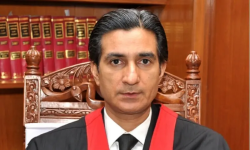
Federal Constitutional Court/ Supreme Court / High Courts of Pakistan, News

26 Amendment case:
Prior to the 27th Amendment, the Constitutional Bench headed by Justice Aminuddin had also taken up pleas filed against the 26th Constitutional Amendment — the very legislation that led to the establishment of the bench.

The Amendment, which was approved by both houses of Parliament in October last year, altered judicial authority and tenure, and was a lightning rod for debate with both opposition parties and legal experts questioning its impact on the judiciary’s autonomy, as has been the case with the 27th Amendment.

The last hearing of the case was held on October 23. It was scheduled to be taken up on November 10 but was later delisted for hearing. It is not yet clear where the case will now land up, considering the establishment of the FCC.
 
Defence Minister Khawaja Asif on Friday criticised two Supreme Court judges for tendering resignations following the passage of the 27th constitutional amendment a day earlier, saying their “consciences only awakened after their monopoly was curtailed.”

Justices Mansoor Ali Shah and Athar Minallah handed in their resignations, hours after the contentious 27th Constitutional Amendment was signed into law by President Asif Ali Zardari on Thursday.

Speaking on the floor of the National Assembly today, Asif accused the judges of having “selective amnesia”, saying that they had “forgotten their past” and were now becoming “guardians of democracy”.

“Four to five years ago — in fact, eight to 10 years ago — when the process to remove Nawaz Sharif from his post started, I want to tell you about the history of our SC judges at that time. The conspiracy created against Nawaz before that and the role our judiciary played in turning that conspiracy into reality,” Asif said, amid chants of ‘kon bachayega Pakistan; Imran Khan, Imran Khan’ [who will save Pakistan; Imran Khan, Imran Khan] by the opposition.

“The entire process started with the Panama case when Chief Justice Saqib Nisar formed two benches that deemed Nawaz ineligible to hold office,” Asif said, adding that the bench included Justices Asif Saeed Khan Khosa, Ejaz Afzal, Gulzar Ahmed, and Ijazul Ahsan.

“After Nawaz was declared ineligible, another bench was created to decide the duration of the ineligibility,” the defence minister said.
 
All this because the current military and political regime wants to stick to the power until 20135.
Most likely that will happen. All arrangements are there now.
Happy days.
 
Resignation letters
In his letter to the president yesterday, Justice Shah had assailed the 27th Amendment as “a grave assault on the Constitution of Pakistan”, which “dismantles the Supreme Court of Pakistan, subjugates the judiciary to executive control, and strikes at the very heart of our constitutional democracy”.

“By fracturing the unity of the nation’s apex court, it has crippled judicial independence and integrity, pushing the country back by decades,” he wrote.

“As history bears witness, such a disfigurement of the constitutional order is unsustainable and will, in time, be reversed — but not before leaving deep institutional scars.”

The judge had stated that he had a choice between serving as an SC justice, which he said “undermines the very foundation of the institution one has sworn to protect”, or hand in his resignation.

On the other hand, Justice Minallah had stated in his letter that when he took the oath of office 11 years ago, he swore to uphold not “a constitution” but “the Constitution”.

He wrote: “Prior to the passage of the 27th Amendment, I wrote to the Chief Justice of Pakistan, expressing concern over what its proposed features meant for our constitutional order.

“I need not reproduce the detailed contents of that letter, but suffice it to say that, against a canvas of selective silence and inaction, those fears have now come to be,” he added.

Justice Minallah regretted that the Constitution he swore to uphold was “no more”, adding that he “can think of no greater assault on its memory than to pretend that, as new foundations are now laid, they rest upon anything other than its grave”.

“What is left of it is a mere shadow; one that breathes neither its spirit, nor speaks the words of the people to whom it belongs,” the judge wrote.
 

Justices Shah and Minallah — Guardians of the Constitution

Eighteen years after the lawyers’ movement, when three friends and colleagues, bound by a shared belief in the Constitution, were tested once more, only two remained true to that promise.

Umer A. Ranjha
November 14, 2025

One of the most striking moments in A Man for All Seasons comes when Thomas More debates his hot-headed son-in-law, Roper, who insists that the law should be swept aside to catch the “devil”, meaning anyone dangerous or politically threatening. More responds with a powerful image: England is planted thick with laws, “like a forest”, and those laws protect everyone, even the people we despise.

Then More asks a piercing question: if you cut down every law to hunt your enemies, what will protect you when power turns and comes for you? Without the law, More warns, you will be standing in an open field with the winds blowing from every direction, completely defenceless.

This scene captures the core of the play: the rule of law is not a tool for the powerful but a shield for everyone, and once it is weakened for expedience, no one can control what comes next.

Yesterday, Pakistan lost two of its most brilliant jurists — Justices Syed Mansoor Ali Shah and Athar Minallah. Why that happened remains for history to answer. But their story did not begin yesterday. It began decades ago, in 1997, when three friends, united by a shared belief in the Constitution, established one of the most progressive law firms of the time: Afridi, Shah & Minallah. They had little more than their intellect, their conviction, and an unshakable refusal to compromise principle for power.

A decade later, that promise was tested. They stood by their principles, boycotting the Dogar court and taking to the streets as part of the nationwide lawyers’ movement to reinstate Chief Justice Iftikhar Chaudhry. Their courage was quiet, steadfast, and unwavering. The Dogar court fell. The Chaudhry court resumed. What happened within those walls is a discussion for another day.
 

Justice Shah: a bench of reform​

Justice Shah was elevated to the Lahore High Court in 2009, following a distinguished legal career spanning tax, corporate, and numerous public interest cases, particularly in environmental protection and sustainable development. Elevation had never been on his radar, but a few persuaded him that the bench would give him a platform to interpret the law, expand rights, transform social order, and uphold the rule of law.

And he did all that, and more.

At the Lahore High Court, Justice Shah authored some of the most progressive judgments across elections, democracy, disability, gender, climate, technology, court delays, local government, and more. Known as the “green judge”, he led the Green Bench to hear climate and environmental disputes.

A judicial reformist, he established Alternate Dispute Resolution Centres in Punjab to reduce chronic case backlogs, set up Criminal and Civil Model Courts to improve coordination and expedite justice, and introduced the Case Management and Court Automation Systems.

With the Punjab Information Technology Board, he implemented the first Enterprise IT System to make the judicial system open, transparent, and fully connected for the decade ahead.
 

Justice Minallah: courage in the capital​

In 2014, Shah was joined by his friend and former law firm partner, Athar Minallah, who rose to the bench at the Islamabad High Court, where a clear strand of judicial courage emerged.

Justice Minallah confronted enforced disappearances, extra-judicial killings, illegal land acquisitions, animal rights violations, and defended society’s most vulnerable. When the Prevention of Electronic Crimes Act 2016 was weaponised to stifle dissent, he declared it unconstitutional.

He also made exemplary judicial appointments, including several judges who repeatedly stood firm to principle despite intense executive pressure.

The purpose of this piece is not to catalogue every judicial achievement. Even their critics must acknowledge the creativity, constitutional insight, and hundreds of judgments they authored, which enriched Pakistan’s jurisprudence domestically and internationally. They carried this par excellence with grace and grit at the Supreme Court, and their impact continues to resonate.

One may disagree with many of their lordships’ judgments, but like everyone else, they are human.

As Justice Minallah recently reminded in a letter, “Barring a few exceptions, all of us, myself included, have erred or fallen short of the ideals we are sworn to uphold. We are, after all, fallible human beings.”
 

The loyal court and the path to the 27th Amendment​

The Qazi court had already undermined the very foundation of the Constitution. Its successor, with a handpicked chief justice, completed that destruction. Military courts were legalised, verdicts restoring the will of the people were overturned, and challenges to the 26th Amendment were ignored.

In the reserved seats verdict, Justice Shah reminded us, “We must remember that Constitutions are not ephemeral enactments, designed to meet passing situations but are designed to approach immortality as nearly as human institutions can approach it.”

Today, Parliament has bulldozed through a constitutional amendment that fundamentally alters the balance of power between the judiciary and the executive. The amendment establishes a Federal Constitutional Court, effectively a Federally Controlled Court (FCC), a parallel judicial structure that strips the Supreme Court of Pakistan of its defining role: interpreting the Constitution.

Under this amendment, the president and prime minister appoint the FCC’s chief justice and initial judges, bypassing the Judicial Commission of Pakistan and embedding executive influence from the outset. Until legislation determines its composition, the executive alone decides the number of judges. Their preferred nominee has already been identified: the same judge who instructed the election commission to disregard a binding Supreme Court decision.

Almost every civil or criminal case involves a constitutional question, yet litigants must now navigate a maze between the FCC and the Supreme Court. Cases will ricochet; justice will become slower, costlier, and less certain; ordinary citizens seeking refuge from power will have no clear path.
 
History is rarely kind to regimes that attempt permanence through constitutional engineering. Their projects always collapse, but only after inflicting deep wounds on institutions meant to protect citizens. Pakistan has seen this cycle before.

In his additional note in the Zulfiqar Ali Bhutto Reference, Justice Yahya Afridi warned that “the extraordinary political climate of the time and the pressures inherent in such an environment appear to have influenced the course of justice in a manner inconsistent with the ideals of judicial independence”. He paid tribute to Justices Dorab Patel, Muhammad Haleem, and G. Safdar Shah, judges who stood firm in moments of darkness, even when their dissents could not change the outcome.

But when history presented him with the same test, the chief justice appears to have chosen accommodation over conviction. The 27th Amendment was bulldozed through, and he did not resist the dismantling of the judiciary. What he diagnosed in words, he failed to defend in practice. In the end, others saw him as more concerned with retaining his title than safeguarding the institution — serving as chief justice of a broken, toothless Supreme Court stripped of its constitutional soul.
 
In the future, a Special Parliamentary Committee will select the chief justices of the Supreme Court and the FCC from amongst the judges of the respective courts. There is no stated criterion for a judge being selected to either position. Previously, the senior-most judge of the Supreme Court was automatically selected as the chief justice of Pakistan without any selection by the government.

The Judicial Commission of Pakistan (JCP), which selects judges for elevation to the Supreme Court, the FCC and the high courts by voting, will be dominated by political, executive-branch members. Only five out of 13 members of the JCP will be judicial appointments (two executive-appointed FCC judges and two senior-most judges of the SC, and one more judge of either court).

Before the 26th Amendment, the judges of the superior courts were selected by a JCP which had a majority of judicial members; this means that the judiciary was selecting judges from within itself without being outvoted by the executive’s representatives on the JCP.

The executive-dominated JCP will also have the power to recommend the transfer of judges from one high court to another through the President. If a judge does not accept the transfer, they will undergo disciplinary proceedings (which are not public) before the Supreme Judicial Council (consisting of executive-appointed judges) and may be removed for misconduct. There is no stated criterion on the basis of which judges may be transferred from one court to another, and therefore no way of assessing whether there are any legitimate grounds for transfer.
 
Amendments have also been made to grant lifetime immunity from arrest, and all criminal and civil proceedings to the President and anyone holding the ranks of Field Marshal, Admiral of the Fleet, and Marshal of the Air Force. The position of the Chairman of the Joint Chiefs of Staff Committee has been abolished. The National Strategic Command has been transferred to the military. The army chief will be the Chief of Defence Forces, making him the head of all military services, including the army, navy and air force. The Field Marshal has been empowered to retain his rank, privileges and uniform for life.

And finally, there is another person-specific amendment which allows Justice Yahya Afridi to retain his title of the CJP. After him, the title may no longer reside at the Supreme Court.
 

Did the judiciary need this overhaul?​

According to the regime, its unelected parliamentarians and pro-regime opinion makers, these amendments are necessary to control a superior judiciary that had become all-powerful and was stepping outside its constitutional role.

Some judges, they say, are too “independent”, guilty of judicial overreach, and that is not desirable. The Saqib Nisar, Khosa and Bandial terms are particularly lamented.

Let’s divide “judicial overreach” into two categories. The first category is where courts have interfered in politics or persecuted politicians, and the second category is where courts have made populist decisions that interfered with policy.

When courts have interfered with politics, endorsed martial laws or removed prime ministers, it was not because they were “independently” exercising their own preferences. It was because they were too susceptible to pressure from certain quarters that used them as tools for political engineering. Decisions in Maulvi Tamizuddin, Dosso, Nusrat Bhutto, and Zulfiqar Ali Bhutto are a testament to the courts being used to achieve state objectives and not judicial preferences.

More recently, the judges of the Islamabad High Court, in a display of historic courage and national spirit, through their letter to the then-CJP Qazi Faez Isa and more recently through petitions before the Supreme Court, have documented the kind of coercion and pressure judges in this country are subject to when they act “independently”.

Mere days ago, Justice Athar Minallah, in a letter to Chief Justice Afridi, detailed the pressure judges were under before passing an “undesirable” judgment in favour of the PTI in the reserved seats matter.
 
Why should the average Pakistani care?

The 26th and 27th Amendments to the Constitution are the latest assault on fundamental rights and democratic freedoms in Pakistan. But they are part of the same coercive project that seeks to crush the will of the people, keep their elected representatives out of office, and entrench an unelected elite at the top.

No ordinary Pakistani, irrespective of political affiliation or ideological gymnastics, will remain unaffected or benefit from the collapse of the judiciary and the empowerment of military elites. This will not stop here.

We already know the damage an executive-controlled court can do, not just in our history, but in the conduct and decisions of the Supreme Court’s Constitutional Bench following the 26th Amendment. It reversed the SC’s reserved seats decision and gave an unrepresentative majority to an unelected government by denying reality. It allowed the secret court martials of ordinary civilians. It allowed the transfer of judges as an instrument of control. It argued in riddles and tautologies to justify the 26th Amendment.


In exchange, Justice Aminuddin, who led this bench, has been rewarded with the chief justiceship of the new FCC. As this piece is being written, he takes the oath for the new position.

Whenever there is a violation of fundamental rights or unlawful acts by the state, the matter will go before the FCC. When the state is being tried by a court that it has hand-picked, the citizens will lose every time.

The chaos created by artificially splitting constitutional and appellate jurisdictions in the context of the Pakistani legal system, with no precedent to guide it, will bring the entire system into deadlock.

The state’s ability to transfer or deselect a judge anytime they show defiance or “independence” will eliminate every judge’s ability to stand up for citizens and prevent rare public victories. The fight against the 26th and 27th Amendments is a fight for every Pakistani’s right to justice. It is not a fight to protect the judiciary for its own sake.
 

Justice Shams Mehmood Mirza resigns from LHC following 27th Amendment

Wajih Ahmed Sheikh
November 15, 2025

1763206559369.png

This photo shows Lahore High Court’s Justice Shams Mehmood Mirza. — LHC/website

Justice Shams Mehmood Mirza on Saturday tendered his resignation as a judge of the Lahore High Court (LHC), becoming the first judge to resign from any high court after the contentious 27th Constitutional Amendment was enacted into law.

According to family sources, his resignation letter stated that in light of the latest amendment to the Constitution, he could not continue in good conscience.

Justice Mirza was appointed as an additional judge of the LHC in March 2014, and his superannuation was due on March 6, 2028.

He is the son of late Justice Zia Mehmood Mirza, a former Supreme Court judge who delivered the famous and only dissenting opinion among seven judges in the case pertaining to the dismissal of Benazir Bhutto’s government by then-president Farooq Ahmad Khan Laghari in 1996.

The judge had held that Laghari’s move was unjustified and there was no evidence suggesting there was a breakdown of constitutional order to justify exercising his powers under Article 58(2)(b), which allowed the president to dismiss the elected government and which was ultimately removed in the 18th Amendment.


Justice Mirza’s resignation comes two days after the passage of the contentious 27th Amendment, which has been assailed as a “flagrant attack” on judicial independence by the International Commission of Jurists (ICJ).

The move also follows the resignations of the Supreme Court’s senior puisne judge, Justice Mansoor Ali Shah, and Justice Athar Minallah, both of whom wrote strongly worded resignation letters censuring the 27th Amendment.

Amid speculation about possible transfers of high court judges, Justices Mohsin Akhtar Kayani and Saman Rafat Imtiaz of the Islamabad High Court (IHC) have hinted they might not be available to hear cases in the federal capital from next month.
 

Users who are viewing this thread

Pakistan Defence Latest

Back
Top