Federal Constitutional Court/ Supreme Court / High Courts of Pakistan, News

The judge noted that to the extent of those 41 candidates, the ROs “correctly prepared [a] list of contesting candidates while drawing Form-33, showing them as independents” and those 41 individuals then joined the Sunni Ittehad Council (SIC) by exercising their right provided under Article 51 (6d) of the Constitution.


Justice Mandokhail pointed out that the 41 candidates had declared themselves as independents in their nomination papers submitted by Dec 24, 2023, which was before the January 2024 SC verdict that revoked the PTI’s bat symbol — the same judgment that PTI argued led to “peculiar circumstances” and therefore the independent declarations.

PTI’s Salman Akram Raja said that the party “administration had decided that the candidates should submit their nomination papers independently to avoid any unwarranted situation”, the note recalled.

“They did not claim to be affiliated with PTI nor showed their intention to leave SIC and join any other party. Under such circumstances, how could it be presumed that their declaration as independent candidates was on account of that judgment?” Justice Mandokhail said.

He added that if Raja’s contention about peculiar circumstances was “believed to be correct, a question arises as to how those 39 returned candidates and the number of others who lost elections, submitted their nomination papers declaring themselves as PTI’s candidates?”

However, about the 39 PTI-backed people who had submitted their party nomination papers, Justice Mandokhail maintained that the ROs and the Election Commission of Pakistan (ECP) had “mis-exercised their jurisdiction by declaring the PTI’s 39 affiliated candidates as independents [and] by refusing to allot reserved seats to PTI on the strength of its affiliated returned candidates”.

Headed by Justice Aminuddin Khan then, the CB, through a short order on June 27, had overturned the July 12, 2024 majority judgment that declared the PTI eligible for reserved seats for women and non-Muslims in the national and provincial assemblies.
 

Majority of CB refused ‘best solution’ on way to include original bench judges​

In his additional note, Justice Mandokhail also touched upon the matter of not being able to include judges from the SC bench that gave the original July 2024 verdict.

He noted that after the 26th Amendment, the CB was specifically authorised to hear constitutional matters and hence, a 13-member CB was formed out of the 15 judges nominated by the Judicial Commission of Pakistan (JCP). The bench excluded Justices Shakeel Ahmad and Ishtiaq Ibrahim as they were part of the Peshawar High Court bench whose order had been challenged.

While the judge stated it was “not practicable” to fix the petitions before the same bench that had delivered the judgment under review, he noted that the purpose of fixing the review pleas before the same judges was “to ensure judicial continuity and consistency”.

“There is no bar upon the JCP to nominate all judges of the Supreme Court,” Justice Mandokhail maintained.

“In order to make it practicable to fix these CRPs (civil review petitions) before the same bench, I proposed that the matter be referred to the JCP to nominate the rest of the members of the original bench,” he wrote, as that would allow the constitutional committee to reconstitute the CB and include the original bench’s judges.

“Had the matter been referred to the JCP, the [Supreme Court Rules] of 1980 could have been implemented within the parameters of the Constitution. It was the best solution to resolve the problem, which would have fostered public trust and confidence in the judiciary.

“However, the majority members of the CB did not agree and decided to proceed with the matter through the available members nominated by the JCP,” Justice Mandokhail revealed.
 

‘Presumption that 41 were PTI candidates not supported by any evidence’​


In its detailed judgment released last month, the CB ruled that the original SC verdict was not justified in granting relief to PTI by invoking Article 187 of the Constitution — which empowers the court to do complete justice — when no issue regarding the grant of reserved seats to the party was pending before it.

In the detailed verdict, 10 judges of the 12-judge CB held that there was no justification in giving relief to the PTI under Article 187, especially when appeals were filed and pursued by the SIC under Article 185(3) (appeal against high court order) of the Constitution.

Now, in his additional note, Justice Mandokhail explained that the majority members of the original bench declared 41 MNAs as independents and gave them an option to join any political party within 15 days, “despite the fact that the matter of 41 candidates was never pending before the Supreme Court as well as before any of the fora below”.

“The decision of the majority members proves the fact that those 41 candidates were actually independents,” the judge observed.

“By now, it is well settled that a candidate who is elected with an affiliation of a particular political party or after being elected independently, joins any political party, cannot leave that particular party nor can join another,” Justice Mandokhail observed, adding if the candidate does so, he will face the consequences of losing his seat, as provided by Article 63A(1) of the Constitution.

“We have already held that no authority including the Supreme Court has the power to declare a candidate independent or change his status contrary to his declaration,” Justice Mandokhail emphasised.

He added that while there was no doubt on the SC’s jurisdiction under Article 187 to do complete justice in a matter pending before it, such power was not unlimited and hence, “cannot be expanded in any circumstance”.

Noting that pendency of a matter was a condition precedent under Article 187, the judge pointed out that “there was no matter pending before the Supreme Court with regard to declaring 41 candidates as independents nor did they claim such relief”.
 

27th Constitutional Amendment: Full court rejected proposal that judges resign en masse​

Some judges also suggested writing letter to govt on behalf of Full Court​


By Abdul Qayyum Siddiqui
November 20, 2025


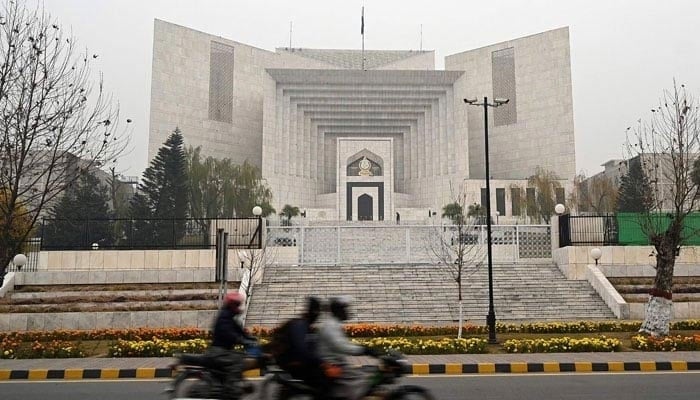
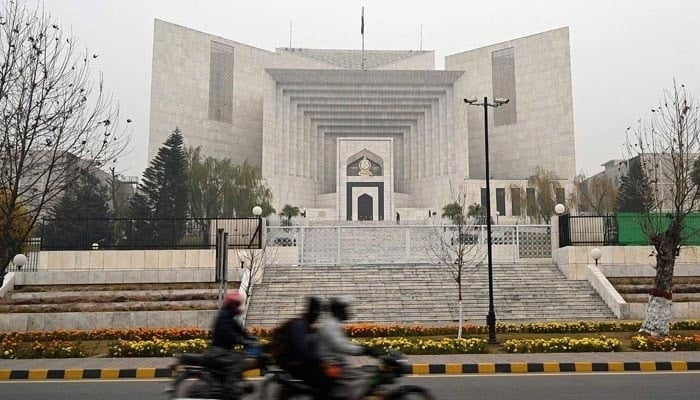
The Supreme Court (SC) building in Islamabad can be seen in this image. — AFP/File
ISLAMABAD: A senior judge’s proposal for en masse resignation was discussed in the Full Court Meeting but the majority of judges disagreed with it.

Later, the meeting unanimously approved the Supreme Court Amendment Rules 2025, said sources.

Discover more
Pakistani youth talent
Economic forecasting services
International affairs analysis
Business analysis tools
Technology gadgets electronics
Celebrity biography books
Health and wellness products
Video streaming platforms
Newspaper archives
Daily newspaper delivery
Sponsored Content

Where Do The Richest Americans Live?Where Do The Richest Americans Live?Mansion Global

Learn More


AI Protein Design Tools Pose Biosecurity Risks for DNA MakersAI Protein Design Tools Pose Biosecurity Risks for DNA MakersGenomeWeb


Woman Lavished All Her Savings On This Old Shed, Take A Look Inside!Woman Lavished All Her Savings On This Old Shed, Take A Look Inside!Tips and Tricks

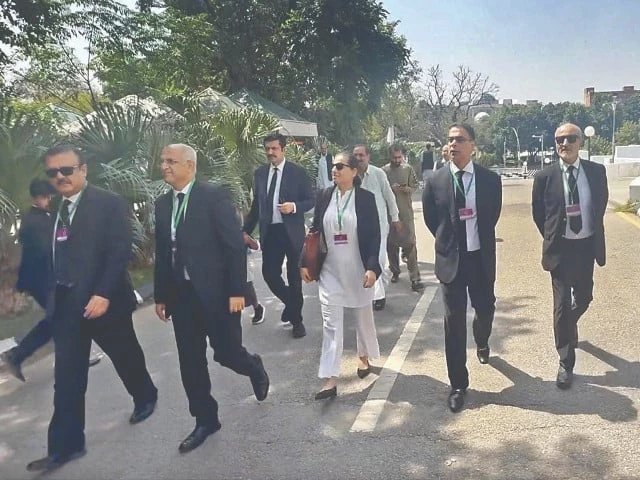
According to the Supreme Court (SC) sources, around 13 judges attended the Full Court Meeting called in connection to discuss the resignation by two judges. Two of the 23 SC judges, former judges Mansoor Ali Shah and Athar Minallah, have already resigned.

Justice Aminuddin Khan, Justice Hassan Azhar Rizvi, Justice Aamir Farooq and Justice Baqir Najafi did not attend, as they had been nominated as judges of the Federal Constitutional Court. Also, Justice Muneeb Akhtar, Justice Ayesha Malik and Justice Musarrat Hilali could not attend due to personal engagements.

The meeting convened in the chamber of CJP Yahya Afridi. At the outset, some judges said it is a sad day that some of our brother judges have resigned and the meeting must discuss the judiciary’s response to the 27th Constitutional Amendment, sources said.


Discover more
Online newspaper subscription
World travel packages
Technology gadgets electronics
Travel insurance plans
Newspaper archives
Epaper access
Epaper subscriptions
Media literacy workshops
International affairs analysis
Public speaking training
One of the judges asked what kind of response that might be. He went on to ask what constitutional and legal authority the Supreme Court has to stop parliament from exercising its legislative powers.

At this point, some judges suggested writing a letter to the government on behalf of the Full Court, sources said. The chief justice said the judges should have discussed the issue with him instead of writing letters. “My doors are always open for everyone. I don’t think it’s the right thing to write a letter to the government,” he said.

The apex court has the power of judicial review, which the court can use to determine what is ultra vires, he said; asking, otherwise, what powers judges have to stop the parliament from legislation. How can the parliament be prevented from passing a law, he asked.

Despite chief justice’s response, several participants of the meeting kept insisting on institutional response. A senior judge said there is only one way of giving “institutional response”, and that is resignation by all judges, including the chief justice, from the Supreme Court. However, majority of judges disagreed with the proposal. Later, the meeting took up the Supreme Court Amendment Rules 2025 and approved them.


Four IHC judges prepare to challenge 27th Constitutional Amendment​


According to sources, draft petition has been prepared and forwarded to the apex court for filing

Fiaz Mehmood
November 20, 2025


photo sabah file


Four judges of the Islamabad High Court have prepared a draft petition to challenge the 27th Constitutional Amendment, it is learnt on Thursday.

According to the sources, a draft petition has been prepared and forwarded to the apex court for filing, with the formal submission expected later.

Justices Mohsin Akhtar Kiani and Babar Sattar are among the applicants, while Justices Saman Rafat Imtiaz and Sardar Ejaz Ishaq Khan are also part of the group contesting the legislation.

However, sources within the Supreme Court said, no petition from the Islamabad High Court judges had been received so far. Officials of the newly established Federal Constitutional Court similarly stated that they also had not yet received any application challenging the amendment.

The 27th Constitutional Amendment, which became law after receiving the president’s assent, has triggered widespread criticism from opposition parties, lawyers, judges and legal commentators, who have described it as an assault on the constitutional and fiduciary principles.

In protest over the amendment’s approval, the senior-most judges of the Supreme Court — Justices Mansoor Ali Shah and Justice Athar Minallah — resigned, calling the move 'a grave assault on the Constitution of Pakistan'.

The fallout has continued to deepen, fuelling speculation that more resignations may follow. Under the new constitutional framework, the Supreme Court now stands subordinate to the Federal Constitutional Court.

The amendment introduces sweeping institutional changes. Under revised Articles 199 and 200, the president is empowered to transfer high court judges between provinces on the recommendation of the Judicial Commission, with any judge declining transfer, deemed retired.

Article 248 has been amended to grant the president lifetime legal immunity, which is waived only if the individual assumes public office again.

Changes to Article 243 abolish the office of the Chairman Joint Chiefs of Staff Committee from November 27, 2025, concentrating strategic military authority under the Chief of the Defence Forces.
 

FCC chief justice hopes court will stand as ‘guardian of constitutionalism, enduring symbol of justice’

News Desk
November 21, 2025 l

Federal Constitutional Court (FCC) Chief Justice Aminuddin Khan said on Friday that he hoped the institution would “stand as a guardian of constitutionalism and an enduring symbol of justice for generations to come”.

The FCC was established under the recently enacted 27th Constitutional Amendment amid much opposition from the opposition and within the judiciary. According to government officials, the creation of the FCC is intended to reduce the Supreme Court’s workload, ensure timely adjudication of constitutional cases, and strengthen the independence and credibility of the judicial system.

“The creation of this court represents an important moment in the nation’s ongoing constitutional journey,” Justice Aminuddin said in a message posted on the newly launched website for the FCC.

“One that reinforces our collective commitment to the rule of law and to the enduring promise of the Constitution of the Islamic Republic of Pakistan,” he stressed.


He said that the FCC “has been entrusted with a mandate of great significance: to interpret the Constitution with clarity, independence and fidelity; to safeguard the fundamental rights guaranteed to the people; and to ensure that the constitutional order remains a source of stability, justice and balance for all institutions of the state.”

“The work of this court is not only judicial — it is also a solemn trust that carries profound implications for the lives, liberties and aspirations of Pakistan’s citizens,” he said.

“As we begin our institutional life, our focus remains firmly on building a judicial forum that embodies integrity, impartiality and intellectual rigour,” he said.

Justice Aminuddin added that each matter brought before the court would be approached with an “unwavering commitment to fairness and restraint, guided solely by the Constitution and the principles of justice that lie at its heart”.

“We aspire to nurture a tradition of reasoned adjudication, institutional dignity and public confidence — qualities that are indispensable to any constitutional court,” he said.

He further said that as the first FCC chief justice, he considered it a “privilege to contribute to the foundations of an institution whose purpose transcends individuals and moments in time”.

On Thursday, Justice Aminuddin Khan had visited the designated site for the establishment of a new record room within the premises of the Islamabad High Court.
 

SC ‘turns away’ judges’ petition against 27th Amendment

Malik Asa
November 21, 2025

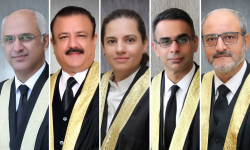
Collage shows IHC Justices Mohsin Akhtar Kayani, Sardar Ejaz Ishaq Khan, Saman Rifat Imtiaz, and Babar Sattar. — DawnNewsTV

• Justices Mohsin Akhtar Kayani, Babar Sattar, Sardar Ejaz Ishaq Khan and Saman Rifat Imtiaz wanted to file petition under Article 184(3)
• Registry refuses to entertain plea, says SC original jurisdiction doesn’t exist anymore
• Judges asked to approach new Federal Constitutional Court, the very institution assailed in their draft petition


ISLAMABAD: Four judges of the Islamabad High Court (IHC) — who wanted to challenge the recently introduced 27th Amendment — were turned away by the Supreme Court and told to approach the newly-formed Federal Constitutional Court (FCC), it emerged on Thursday.

The four judges — Justices Mohsin Akhtar Kayani, Babar Sattar, Sardar Ejaz Ishaq Khan and Saman Rifat Imtiaz — had drafted a petition invoking the original jurisdiction of the top court under Article 184(3), and sent a representation to the apex court’s registry branch.

However, sources said the petition was not entertained on the grounds that Article 184(3), which used to be an inherent power of the Supreme Court to enforce fundamental rights, has been omitted from the Constitution.

The petitioner judges did not personally visit the Supreme Court to either file the petition or undergo biometric verification, the sources added.

Insiders told Dawn that the four judges had decided to move the Supreme Court after months of raising concerns over what they described as an “incremental but systematic dismantling” of judicial independence, beginning with the 26th Amendment and culminating in the latest constitutional changes.
 

Judges’ transfer case: 5 IHC judges file plea challenging fixing of intra-court appeal before FCC

Malik Asad Published November 22, 2025

1763812395563.png

This photo combo shows (from left to right) Justices Mohsin Akhtar Kayani, Tariq Mehmood Jahangiri, Justice Saman Rafat Imtiaz, Babar Sattar and Sardar Ejaz Ishaq Khan of the Islamabad High Court. — Photo courtesy: IHC website/File

Significant progress was reported on Saturday in the ongoing litigation over the transfer of judges, as five judges of the Islamabad High Court (IHC) filed a miscellaneous petition before the Federal Constitutional Court (FCC) challenging the transfer of their intra-court appeal from the Supreme Court to the former.

The application was filed by IHC’s Justice Mohsin Akhtar Kayani, Justice Babar Sattar, Justice Sardar Ejaz Ishaq Khan, Justice Saman Rafat Imtiaz and Justice Tariq Mehmood Jahangiri.

The case pertains to the transfer of three judges from other high courts to the federal capital. In June, the SC’s Constitutional Bench had declared that their transfers were not unconstitutional. Subsequently, the five IHC judges had challenged the decision and filed an intra-court appeal.

However, the intra-court appeal in the case has now been fixed before the FCC, which was established under the 27th Amendment, on November 24.

In the miscellaneous petition, the IHC judges asked the FCC to return the intra-court appeal to the SC, arguing that the matter constitutionally falls within the jurisdiction of the apex court.

The petition stated that the appeal was shifted to the FCC under the 27th Constitutional Amendment, but contended that the amendment itself contradicted the Constitution.

In their application, the petitioners argued that the Constitution clearly outlined the legislature, executive, and judiciary as the three essential pillars of the state and delineated limits and powers for each.

The judges maintained that while Parliament holds the authority to amend the Constitution, such powers could not be exercised to abolish, restructure, or fundamentally weaken the judiciary, which forms an integral component of the constitutional framework.

They further asserted that several apex court judgments affirm the separation of powers and the protection of judicial independence, insisting that the appellate jurisdiction in such matters remained with the SC unless expressly provided otherwise without affecting the judiciary’s constitutional existence.

The petition stressed that transferring the appeal to the FCC on the basis of the 27th Amendment was legally flawed since the amendment itself was under challenge for being inconsistent with the Constitution’s basic structure.
 
With the new miscellaneous petition filed, the FCC is now expected to determine whether it can proceed with the appeal or whether the matter must be returned to the Supreme Court for adjudication.

Four of the same five IHC judges, excluding Justice Jahangiri, who wanted to challenge the recently introduced 27th Amendment, were turned away by the SC earlier this week and told to approach the FCC. The judges had drafted a petition invoking the original jurisdiction of the top court under Article 184(3), and sent a representation to the apex court’s registry branch.

According to the draft petition, the judges had also challenged the amendments to Article 200, which allowed the transfer of high court judges without their consent. They had argued that such provisions exposed judges to pressure, fear of retaliation, and manipulation of court composition.
 

Judicial Commission of Pakistan to pick superior court judges on Dec 2

Nasir Iqbal
November 21, 2025

ISLAMABAD: The Judicial Commission of Pakistan (JCP) will hold its first meeting after the passage of the Constitution 27th Amendment and the establishment of the Federal Constitutional Court (FCC) on Dec 2, with a packed agenda.

The forum is expected to elevate a judge to the Supreme Court from the Islamabad High Court (IHC) as well as nominate the chief justices of the Sindh High Court (SHC) and the Balochistan High Court (BHC).

The meeting of the JCP will be convened at 2:30pm in the conference room of Islamabad’s SC building.

One of the agendas of the meeting is to consider appointment of a judge to the SC from the senior judges of the IHC. However, the names of the judges and their seniority position will be disclosed at a later stage.

SC strength

With the establishment of the FCC, where four judges from the Supreme Court — Justices Aminuddin Khan, Syed Hasan Azhar Rizvi, Aamer Farooq and Ali Baqar Najafi — have been appointed as well as the resignation of Justices Syed Mansoor Ali Shah and Athar Minallah, the total strength of the SC has been reduced to 18 judges from the earlier 24.

Presided over by Chief Justice of Pakistan (CJP) Yahya Afridi, the JCP meeting will also be attended by FCC CJ Aminuddin Khan; Justices Munib Akhtar, Syed Hasan Azhar Rizvi and Aamer Farooq; Attorney General for Pakistan Mansoor Usman Awan; Law Minister Azam Nazeer Tarar; Pakistan Bar Council representative Ahsan Bhoon; Senators Farooq Hamid Naek and Syed Ali Zafar as well as MNAs Sheikh Aftab Ahmad and Gohar Ali Khan.

Likewise, the JCP during its meeting will also consider the appointment of SHC CJ from among the three senior-most judges of the high court.

Those who will be considered for the office are acting SHC Chief Justice Zafar Ahmed Rajput and Justices Muhammad Iqbal Kalohoro and Justice Mahmood A. Khan.

Similarly, the JCP will also consider for the appointment of the BHC chief justice from among the three senior-most judges of the high court.

They include acting BHC Chief Justice Muhammad Kamran Khan Mulakhai and Justices Iqbal Ahmed Kasi and Shaukat Ali Rakhshani. After the passage of the 27th Constitutional Amendment, changes were made to key constitutional and statutory judicial bodies.

Following these changes, SC’s Justice Jamal Khan Mandokhail was included in the Supreme Judicial Council (SJC) and the Practice and Procedure Committee while FCC’s Justice Farooq was made a member of the JCP.

Among the three statutory bodies, the SJC is the top forum for judicial accountability that probes allegations of misconduct against judges, the Practice and Procedure Committee forms benches and fixes cases, and the JCP is responsible for appointing judges to the superior judiciary.
 
On Monday, the FCC formally commenced proceedings after notifying three benches. The first bench, headed by FCC Chief Justice Amin-ud-Din Khan, included Justice Ali Baqar Najafi and Justice Syed Arshad Hussain Shah.

The second bench comprised Justice Hassan Azhar Rizvi and Justice K K Agha while the third bench included Justice Aamer Farooq and Justice Rozi Khan Barrech.

Proceedings in the courtroom of Justice Amin-ud-Din Khan began with the recitation of the Holy Quran. During roughly half an hour of proceedings, the bench heard all five cases, though lawyers did not appear in two of them.

The bench took up the Karachi Metropolitan Corporation’s (KMC) appeal against the Sindh High Court decision regarding the use of public parks in Karachi for commercial sports activities.

KMC’s counsel argued that the matter related to KMC’s powers and that the corporation had approved the use of public parks for sports activities through a resolution. The SHC had held that KMC lacked such authority, prompting the appeal.

The bench remarked that the matter involved public interest and issued a stay order against the SHC judgment. It also issued notices to all parties and adjourned the hearing until 27 November 27.

The petitioner’s lawyer stated that contempt petitions had also been filed against them. The bench directed the SHC not to proceed with contempt proceedings.

The bench also heard a case related to the availability of life-saving medicines.

During the hearing, Additional Attorney General Aamir Rehman appeared before the bench on the court’s call. The chief justice remarked that this was a public-interest case and the government must review the availability of medicines.

The bench sought a report from DRAP regarding the availability of medicines and adjourned the hearing for an indefinite period.
Not a lawyer but how is this case any different to what the SC hears?
 

Federal Constitutional Court finds support in apex lawyer bodies


Nasir Iqbal
November 23, 2025
https://whatsapp.com/channel/0029VaMc238IiRov8okfYy3n
ISLAMABAD: Two premier lawyer bodies on Saturday extended support to the establishment of the Federal Constitutional Court (FCC) through the recently passed 27th Amendment.

In a joint statement, the Pakistan Bar Council (PBC) and the Supreme Court Bar Association (SCBA) affirmed that it was their two-decade-old demand that the FCC should be established with equal representation of the provinces for hearing constitutional and political matters, so that general public cases could be decided by the Supreme Court of Pakistan in a timely manner.

The statement was jointly issued by PBC Vice Chairman Chaudhry Tahir Nasrullah Warriach and SCBA President Haroonur Rashid.

According to the statement, the FCC will strengthen the federation. It said the premier bodies were watching carefully the entire process, including the appointment of judges, and would express their concerns and grievances, when needed, through decisions and resolutions of the general houses of both bodies. The statement said that the PBC and the SCBA always stood for upholding the rule of law, the independence of the judiciary, the supremacy of institutions, and adherence to the Constitution.

The statement also expressed regret over certain political factions within the legal community aimed at creating chaos and division among lawyers, just to achieve their ulterior political motives and promote their political agenda. They often issue statements aimed at sabotaging the democratic system of the country, it claimed.

“We strongly reject and condemn such statements issued by the non-elected people and assure that their futile exercise will soon be rendered ineffective,” the statement said.
 

Federal Constitutional Court sets up special desk, receives two fresh cases

Nasir Iqbal

ISLAMABAD: The Federal Constitutional Court of Pakistan (FCCP) on Friday received the first-ever appeal against a Sindh High Court (SHC) decision after a dedicated Filing and Information Desk was formally opened.

FCCP Registrar Muhammad Hafeezullah Khan inaugurated the desk on the premises of the Islamabad High Court (IHC). “The establishment of this desk marks a significant step toward enhancing public facilitation and improving access to judicial services,” says a handout issued by FCCP.

At the inauguration, the desk received two fresh cases, marking the commencement of its operational functions.

The desk has been established to serve multiple purposes, including filing of new cases for FCCP, providing information and assistance to litigants, lawyers and the general public and receiving applications for attested copies of judicial records.

Before the setting up of the information desk, the lawyers were facing difficulty since they had no idea where to file petitions or appeals.

Justice Ali Baqar Najafi, who graced the inauguration, acknowledged the initiative as a historical milestone in strengthening judicial outreach and administrative efficiency.

The FCCP also issued an official notification regarding the court’s working hours, ensuring clarity and accessibility for all stakeholders. It stated the federal court was committed to improving service delivery, transparency and ease of access for litigants across the country.

The appeal against the SHC in a family property dispute was filed by Ghulam Shah Abbasi in person, seeking prevention of harassment and protection of fundamental rights guaranteed under the Constitution.
 

Users who are viewing this thread

Back
Top