Federal Constitutional Court/ Supreme Court / High Courts of Pakistan, News

Judges transfer case: FCC rejects intra-court appeal filed by IHC judges


Nasir Iqbal
November 24, 2025
1763987301329.png

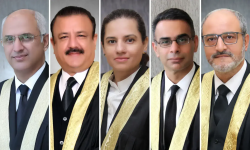
This photo combo shows (from left to right) Justices Mohsin Akhtar Kayani, Tariq Mehmood Jahangiri, Justice Saman Rafat Imtiaz, Babar Sattar and Sardar Ejaz Ishaq Khan of the Islamabad High Court. — Photo courtesy: IHC website/File

The Federal Constitutional Court (FCC) on Monday rejected on Monday a set of intra-court appeals, including one filed by five Islamabad High Court (IHC) judges in a judges transfer case, for non-prosecution.

The case pertains to the transfer of three judges from other high courts to the federal capital, and the IHC judges have challenged a decision by the now-defunct Constitutional Bench (CB) of the Supreme Court to uphold the transfers.

However, the appeal was fixed before the FCC following its established under the 27th Amendment.

A six-member FCC bench, headed by Chief Justice Aminuddin Khan and comprising Justices Syed Hasan Azhar Rizvi, Ali Baqar Najafi, Muhammad Karim Khan Agha, Rozi Khan Barrech and Arshad Hussain Shah took up a set of pleas pertaining to the case today.

As the proceedings began, the court associate called out the names of each of the lawyers representing different clients, and when they did not appear, the FCC dismissed the appeals one at a time, dictating separate orders for each plea.

The rejected appeals included the one filed by IHC Justices Mohsin Akhtar Kayani, Babar Sattar, Sardar Ejaz Ishaq Khan, Saman Rafat Imtiaz and Tariq Mehmood Jahangiri. These judges were also not present at the hearing.

Apart from the appeal moved by the five judges through senior counsel Muneer A Malik, the FCC also took up pleas filed by Tahir Faraz Abbasi through counsel Abid Shahid Zuberi, Raja Muqsit Nawaz Khan and PTI founder Imran Khan through counsel Idrees Ashraf, the Lahore High Court Bar Association (LHCBA) and Lahore Bar Association (LBA) through counsel Hamid Khan and the Karachi Bar Association, Muhammad Shoaib Shaheen and Riasat Ali Azad through counsel Faisal Siddiqi.
 
From these nine appeals, the FCC adjourned the hearing on three pleas for an indefinite period.

Among them was also Imran’s plea, whose counsel Ashraf sought directives for meeting the incarcerated former prime minister. He argued that he needed instructions from Imran after the enactment of the 27th Amendment.

The counsel pled that he had to file additional grounds since he had moved the appeal against the SC’s short order. Therefore,he argued that a meeting with the client was necessary.

However, Justice Aminuddin rejected the request, observing that the counsel should approach the forum that sentenced his client. Justice Aminuddin said the matter did not fall in the FCC’s domain.

But, the counsel argued that a directive by the FCC would “fulfil the requirement of complete justice” under Article 187 of the Constitution.

At the hearing, Advocate Ajmal Toor appeared before the court on behalf of senior counsel Hamid Khan, who is representing the LHCBA and LBA.

Advocate Toor sought more time from the court as the senior counsel was unavailable.

The court then adjourned the hearing on the pleas of the two lawyers’ bodies for an indefinite period.
 

Pleas on judges transfer​

On June 19, the now-defunct CB issued a 3-2 majority judgement, declaring that the transfer of three judges to the IHC from three other courts was within the framework of the Constitution.

The judgement was issued on petitions challenging the transfers of Justice Sardar Mohammad Sarfraz Dogar from the LHC, Justice Khadim Hussain Soomro from the Sindh High Court and Justice Muhammad Asif from the Balochistan High Court to the IHC.

The controversy centred around the alteration of the judges’ seniority list after these transfers as Justice Dogar was made the senior puisne judge, which paved the way for his appointment as the acting IHC chief justice after Justice Aamer Farooq’s elevation to the SC. Justice Dogar is now the IHC chief justice.

The five IHC judges had challenged the June 19 decision and filed an intra-court appeal.

The judges contended in the appeal that the June 19 order impermissibly read in “permanent” in Article 200(1) and (2) of the Constitution when no such language was contained in the provision.

The appeal pled that the constitutional bench had misunderstood the provisions of Article 200 by reading sub-article (1) in isolation from other provisions of the article by not holding that transfers envisioned in Article 200(1) were only for a temporary and time-specified period.

The order also failed to interpret articles 200 and 175A, without scuttling and undermining the powers of the Judicial Commission of Pakistan under Article 175A of the Constitution, the appeal argued, adding that independence of the judiciary did not allow bestowing onto the executive a much more expansive power than what the text of Article 200 and the foundational principles of constitutional law can bear.
 

Two courts jostle for space in ‘joint-family home’


Malik Asad
November 24, 2025

1763987699308.png

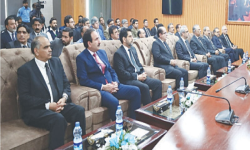
A VIEW of the congested conference room where new Federal Constitutional Court judges were sworn in.—Dawn

AFTER receiving a warm and cordial welcome during its inauguration at the Islamabad High Court (IHC) building, calls are now growing to shift the newly-formed Federal Constitutional Court (FCC) to its originally-designated premises, in the Federal Shariat Court (FSC) building.

The ongoing tug-of-war over who gets control of the Constitution Avenue premises is increasingly starting to resemble a joint family squeezed into an old ancestral home, where every member complains about inadequate space and competing needs.

Last week, the Islamabad High Court Bar Association (IHCBA) demanded that the FCC be moved out of its temporary location within the IHC building, asserting that the new court must eventually operate from the FSC premises.

The bar leadership also warned that any attempt to relocate the IHC itself would be met with determined legal and democratic resistance.

Islamabad judiciary wary as newly formed Federal Constitutional Court could potentially usurp its coveted Constitution Avenue location

The establishment of the FCC has exposed what many observers describe as a lack of planning on the part of policymakers. The FCC — initially part of the 26th Constitutional Amendment package, but removed shortly before its passage — was reintroduced in the 27th Amendment.
 
The decision to convert the FSC building into the FCC’s permanent home was taken unilaterally, without consulting Shariat Court judges. Under the plan, four FSC judges and a backlog of only 56 pending petitions were to be shifted to the IHC’s third floor, where the Capital Development Authority (CDA) was instructed to urgently prepare four new courtrooms.

Simultaneously, the CDA was tasked with renovating FSC courtrooms for FCC judges. But when CDA teams arrived to take possession of the Shariat Court premises, the administration strongly resisted, even preventing their entry.

FSC Chief Justice Iqbal Hameedur Rehman, along with other judges, subsequently met Chief Justice of Pakistan Yahya Afridi and conveyed their reservations over what they termed a unilateral and abrupt order, requiring them to vacate their purpose-built premises within a week.

A senior lawyer remarked that the situation was ironic: “A tenant is normally granted at least a month to vacate a rented property, yet the FSC judges were expected to leave within a week from a building acquired specifically for the Shariat Court”.

Cramped space


After the 27th Amendment was passed and received presidential assent, the oath-taking ceremony of the FCC Chief Justice was held at the Presidency, attended by the top civil, military and legal leadership.

But with the FSC building still not handed over to the FCC, the oath-taking for the judges had to be held at the Islamabad High Court.
 

Constitutional bench denies stay against e-challan system in Karachi​


‘Every place has its own dynamics’ bench replies to argument that penalties are higher in the metropolis

Our Correspondent
November 25, 2025

tribune


The constitutional bench of the Sindh High Court has refused to grant an immediate stay against the e-challan system, issuing notices to the DIG Traffic Police and other respondents to submit their replies on a slew of petitions against the new mechanism in Karachi.

A two-member bench – headed by Justice Adnan Iqbal Chaudhry – took up the petitions on Tuesday, filed by Jamaat-e-Islami, Markazi Muslim League, Bus Owners Associations, and several citizens, challenging the legality and enforcement of traffic fines issued through the e-challan system.

The petitioners’ counsels argued that traffic fines in Karachi were much higher than those imposed in Lahore, terming the disparity discriminatory. The bench, however, observed that Karachi could not simply be compared with other cities, observing that ‘every place has its own dynamics’.

During the hearing, the counsel for the bus owners, Munisf Jan Advocate, complained that buses were not being allowed to pick up passengers. The court remarked, “All buses are required to stop only at designated stops.”

He argued that proper bus stops were largely nonexistent in the metropolis. Justice Chaudhry responded: “We live in this city ourselves; we know the situation.”

The court ordered that all replies be consolidated and heard together, and adjourned proceedings until December 11. The petitions have named the Sindh chief secretary, provincial government, IG police, DIG Traffic, NADRA, Excise Department and other relevant institutions as respondents.
 

Federal Constitutional Court okays high-pay posts amid questions about rules


Malik Asad
November 30, 2025
https://whatsapp.com/channel/0029VaMc238IiRov8okfYy3n
• Officials say SC Rules do not permit them
• Policy meant for technical experts, not routine judicial administrators

ISLAMABAD: The Federal Constitutional Court (FCC), the country’s newly-established apex forum for constitutional interpretation, apparently acting under the proviso of Article 208 of the Constitution made certain appointments in which some employees have been placed in the federal government’s Special Professional Pay Scale (SPPS) policy.

A notification issued by FCC earlier this week, and approved by Chief Justice Aminuddin Khan, created eight senior posts — including one in BS-22 and seven in BS-21 — all placed in SPPS. Under SPPS-I, the pay package ranges from Rs1.5 million to Rs2m, almost equivalent to the salary of a high court judge.

However, senior federal officials familiar with service laws say the FCC administration has thus far not framed any rules under Article 208 and therefore, under the proviso to the said article, can only follow the Supreme Court Rules relating to the appointment of officers and servants of the SC.

Assigning the pay scales of SPPS to certain officers, without there being a similar provision in the related Supreme Court Rules, may raise issues as to the legality of the settled terms and conditions of officers and servants of FCC.

At present there are four types of pay packages for those being paid from the exchequer.

It includes the Basic Pay Scale, which applies to all the government sector; the Project Pay Scale, which covers the salaries of those working on specific projects of the government; the Management Pay Scale, also called the MP Scale for highly trained professionals; and SPPS, which was introduced to attract the highly paid experts of the private sector.

According to the FCC notification — issued under Article 208 of the Constitution — the court has created administrative posts, including: registrar (SPPS-I/BS-22) – one post, secretary to the chief justice (SPPS/BS-21) — one post, additional registrar (SPPS/BS-21) — six posts, deputy registrars (BS-20) — six posts, assistant registrars (BS-19) — 10 posts, senior private secretaries (BS-20) — five posts , research and reference officers (BS-19–20) — six posts, and a range of other positions from BS-16 to BS-2, including senior assistants, clerks, drivers, daftaris, qasids and sweepers.

The notification states that the expenditure will be met from FCC’s allocated budget for FY 2025-26.
 

Victims’ families pardon IHC judge’s son in hit-and-run case

Malik Asad
December 6, 2025

A judicial magistrate on Saturday ordered the release on bail of the son of Islamabad High Court (IHC) Justice Mohammed Asif, after the victims’ families forgave him in the fatal accident case that claimed the lives of two young women.

The tragic incident occurred late at night on Monday near the Pakistan National Council of Arts in Islamabad when a black speeding sports utility vehicle (SUV) allegedly driven by Abuzar struck two girls who worked part-time for an event management company. The victims were travelling on a scooter when the speeding vehicle hit them, killing both on the spot due to severe injuries.

The accused, Abuzar, was remanded into police custody on Tuesday in the case.

He was produced before Judicial Magistrate Shaista Kundi upon completion of his four-day physical remand today. During the proceedings, the court recorded statements of the victims’ families.

The brother of one victim appeared in person, while her mother submitted her statement online. The father of the other girl also confirmed before the court that he had pardoned the accused.
 

Karachi University declares Justice Tariq Jahangiri’s degree forged

  • HEC says since Karachi University does not recognise degree, HEC also cannot recognise it
BR Web Desk
December 9, 2025

1765286828375.png

The Karachi University (KU) has declared the degree of Justice Tariq Mehmood Jahangiri to be forged, Aaj News reported on Tuesday.

The Controller of Examinations for the university stated that not only were the enrollment numbers fabricated on the degree and mark-sheet, but other documents were also tampered.

In a report submitted to the Islamabad High Court (IHC) by the Karachi University, it was stated that enrollment number 5968/87 was originally allotted to a student named Imtiaz Ahmed. Jahangiri allegedly used the LLB Part II number 7184/87 through forgery. During this process, names and enrollment numbers were repeatedly changed to obtain mark-sheets and the degree.

The report further stated that following a petition by citizen Irfan Mazhar, the university initiated a new investigation.

The Controller of Examinations ruled the degree and mark-sheets invalid, stating that dual enrollment numbers are impossible. The principal of Government Islamia College also confirmed that Jahangiri was not a student of the college from 1984 to 1991.

The Higher Education Commission (HEC) also presented its stance to the Islamabad High Court, stating that issuing a degree is the prerogative of the university and that the HEC has no role in the matter.

The HEC clarified that since Karachi University does not recognise the degree, the HEC also cannot recognise it.

The development comes days after the IHC sought the record of Justice Jahangiri’s law degree from the Karachi University through the HEC.
 
To view this content we will need your consent to set third party cookies.
For more detailed information, see our cookies page.
 

Justice Jahangiri likely to appear as defendant in his own court

Malik Asad
December 14, 2025

1765719711521.png

Justice Tariq Mehmood Jahangiri of the Islamabad High Court. — Picture via IHC website

ISLAMABAD: Justice Tariq Mehmood Jahangiri is likely to appear as a defendant before the Islamabad High Court (IHC) to face accusations that surfaced in a petition that challenged his appointment over a controversy related to his law degree.

A division bench comprising Islamabad High Court Chief Justice Sardar Muhammad Sarfraz Dogar and Justice Muhammad Azam Khan will take up the matter for further proceedings on Monday (tomorrow).

In a detailed written order issued on Dec 9, the IHC held that the question regarding the validity of Justice Jahangiri’s law degree fell squarely within the scope of a writ of quo warranto — his right to hold public office.

The two-member bench ruled that the petition was maintainable and set aside the office objection earlier raised by the registrar.

The bench had also granted Justice Jahangiri three days to respond to the facts unearthed till date.

The registrar’s office served the notice at the judge’s chamber due to time constraints. Sources said court staff of Justice Jahangiri received the notice and submitted it to his chamber. They added that Justice Jahangiri decided to appear before the bench at the next hearing.

While Justice Jahangiri along with four other IHC judges — Justices Mohsin Akhtar Kayani, Babar Sattar, Sardar Ejaz Ishaq Khan, and Saman Rafat Imtiaz — had earlier appeared before the Supreme Court as well on the same matter, it is not yet clear whether his fellow judges will accompany him in the IHC on Monday.

However, lawyers are expected to attend the proceedings to express solidarity with him. According to former president of the Islamabad High Court Bar Association Riasat Ali Azad, he, along with scores of lawyers, will be present in the courtroom during the hearing.
 
Fake degree controversy

The petition, filed by Advocate Mian Dawood under Article 199 of the Constitution, seeks a judicial determination on whether Justice Jahangiri lawfully holds the office of a high court judge in view of allegations concerning his LLB degree obtained from the University of Karachi (KU).

According to the order, the bench observed that the petitioner had challenged the judge’s eligibility to hold office rather than alleging misconduct.

As such, the matter did not fall within the exclusive jurisdiction of Article 209 of the Constitution, which governs proceedings before the Supreme Judicial Council.

During the hearings, IHC Chief Justice Dogar consistently observed that the petition raised a direct question of qualification, whether the respondent fulfilled the statutory requirements to hold judicial office, which could be examined through a writ of quo warranto. The bench also noted that the SC had already directed the IHC to proceed with the matter in accordance with law.

The court order referred to a report submitted by KU through the Higher Education Commission (HEC), which highlighted several discrepancies in the academic record of the degree in question.

According to the report, a candidate named “Tariq Mehmood” obtained an LLB degree in 1991 under enrolment number 5968. However, university records showed that the same enrolment number had already been issued to another student, Imtiaz Ahmed, in 1987.

The report further stated that the transcript for LLB Part-I was issued in the name “Tariq Jahangiri”, while the inquiry revealed that the judge had also been assigned a separate enrolment number (7124) for the same degree programme. The committee observed that this violated university rules, which allow only one enrolment number for the entire duration of a degree.

According to the inquiry findings, the existence of multiple identities, duplicate enrolment numbers, and conflicting transcripts rendered the academic credentials “invalid”, although the committee stopped short of declaring the degree “bogus”.

The report also noted that the candidate had been debarred for three years in 1988 on grounds of using unfair means but later appeared in examinations under a different name.

The university alleged collusion with staff and impersonation of other enrolled students, following which the results were cancelled and a three-year ban was imposed, effective until 1992.

In its order, the IHC bench reproduced and relied upon several SC judgements — including Abrar Hassan vs Government of Pakistan, Malik Asad Ali vs Federation, and Sindh High Court Bar Association vs Federation — to conclude that a writ of quo warranto could be issued against a judge in matters relating to eligibility.

The bench also referenced the SC’s direction in Justice Tariq Mehmood Jahangiri vs Mian Dawood.

It noted that the apex court had explicitly ordered the IHC to proceed with Mr Dawood’s petition. “Keeping in view the stance of the petitioner that Respondent No. 1 [Justice Jahangiri] possesses an invalid/fake LLB degree, as well as a careful perusal of the report submitted by the University of Karachi through [the] HEC, we deem it appropriate to issue notice to Respondent No. 1 to submit his reply within three days,” the order stated.
 

IHC CJ Dogar-led bench orders Justice Jahangiri’s removal as judge ‘for having invalid degree at time of appointment’


Malik Asad
December 18, 2025

1766057824831.png

Justice Tariq Mehmood Jahangiri of the Islamabad High Court. — Picture via IHC website

The Islamabad High Court (IHC) ordered the removal of Justice Tariq Mehmood Jahangiri as a judge on Thursday, ruling that his degree for “invalid” at the time of his appointment.

A division bench led by Chief Justice Sardar Muhammad Sarfraz Dogar and Justice Muhammad Azam Khan announced the judgement, which was reserved earlier today, on a plea that challenged the legitimacy of Justice Jahangiri’s law degree and appointment as a judge.

The bench directed Justice Jahangiri to cease his office forthwith for “having an invalid law degree at the time of his appointment and confirmation as a judge”.

It also directed the law ministry to denotify him as a judge.

Prior to the issuance of the judgement, University of Karachi (KU) Registrar submitted a record of Justice Jahangiri’s law degree to the court.

He said the KU syndicate had cancelled the judge’s degree for having been “secured through unfair means”.

“Justice Jahangiri was found cheating and creating disturbance in an examination hall in 1988,” following which he was debarred from sitting an exam until 1992, he said.

However, instead of complying with the decision, the judge appeared in an exam in 1989 under a changed name, the registrar alleged.
 
However, instead of complying with the decision, the judge appeared in an exam in 1989 under a changed name, the registrar alleged.

He also submitted a log pertaining to marksheets and results to justify the KU syndicate’s decision.

During his arguments, Advocate Muhammad Akram Sheikh, who was representing Justice Jahangiri, objected to the bench hearing the case.

He contended that a judge who faced legal proceedings could not hear the petition involving a fellow judge, who had challenged his posting.

In July, Justice Jahagiri, along with four other IHC judges, had filed an intra-court appeal against the Supreme Court’s constitutional bench decision of upholding the seniority of the IHC that raised Justice Dogar to the top.

The five judges requested the SC not to consider Justices Sardar Mohammad Sarfraz Dogar, Khadim Hussain Soomro and Mohammad Asif as judges of IHC until they took fresh oaths in accordance with Article 194.

The intra-court appeal was fixed before the FCC following its establishment under the 27th Constitutional Amendment and eventually dismissed for non-prosecution.

Sheikh’s argument today seemed to be referring to this matter.

He also highlighted that the Sindh High Court (SHC) had issued a stay order in connection with the matter, arguing that the IHC bench should not hear the case.

This, seemingly, was a reference ot the SHC order suspending the cancellation of Justice Jahangiri’s law degree by the KU syndicate.

Barrister Salahuddin Ahmad, who was also representing Justice Jahangiri, requested more time from the court to submit a reply.

For his part, the petitioner in the case, lawyer Mian Dawood, alleged that Justice Jahangiri had “misused” the SHC stay order. “Instead of clearing his name […] the judge has been filing petitions and scandalising his chief justice,” he commented.

Following these arguments, the court reserved its judgement in the case and later ordered the removal of Justice Jahangiri.
 

Users who are viewing this thread

Back
Top