
Navigation
Install the app
How to install the app on iOS
Follow along with the video below to see how to install our site as a web app on your home screen.
Note: This feature may not be available in some browsers.
More options
Style variation
You are using an out of date browser. It may not display this or other websites correctly.
You should upgrade or use an alternative browser.
You should upgrade or use an alternative browser.
General Economic Updates
- Thread starter Sainthood 2.0
- Start date
More options
Who Replied?

Pakistanithinktank
Registered Member

Pakistan must empower its citizens to invest directly in stocks and funds without relying on brokers to unlock financial inclusion, boost market liquidity, and fuel fintech innovation. Direct access means:
• More people can build wealth
• Markets become stronger and more transparent
• Fintechs can create modern, user
friendly tools
• Citizens gain financial literacy and control
It’s not just modernization, it’s economic empowerment.
• More people can build wealth
• Markets become stronger and more transparent
• Fintechs can create modern, user
friendly tools
• Citizens gain financial literacy and control
It’s not just modernization, it’s economic empowerment.
hydrabadi_arab
Trusted Member
Rs659.6 billion guaranteed for power sector debt settlement, remittance subsidy to be phased out by FY27
Government moves to settle power sector debt of Rs1.225 trillion, phase out Home Remittance Incentive Scheme, ensure fertiliser gas supply, and address tariff adjustments and financial settlements
Federal Minister for Finance and Revenue, Senator Muhammad Aurangzeb chairing a meeting of the Economic Coordination Committee (ECC) of the Cabinet at the Finance Division, Islamabad on November 7, 2025.
The Economic Coordination Committee (ECC) of the federal cabinet approved the issuance of a Rs659.6 billion guarantee for the settlement of Power Holding Company’s debt, alongside a series of measures to address fiscal and energy sector challenges.
In a key decision, the ECC approved a Rs659.6 billion government guarantee for circular debt financing of Rs1.225 trillion, intended to clear outstanding dues owed to independent power producers (IPPs) and to settle Power Holding Limited’s (PHL) debt.
This step comes after the government and commercial banks recently signed financing and security agreements to secure the loan, which will be repaid by electricity consumers through a surcharge of Rs3.23 per unit.
To meet the financing condition, the Ministry of Finance will issue a Letter of Comfort (LoC), taking responsibility in case the power sector fails to repay its debt. This letter will be accepted by Habib Bank Limited for the first drawdown of circular debt financing.
In addition to the circular debt settlement, the ECC deliberated on the phase-out of the Home Remittance Incentive Scheme (HRIS). The Ministry of Finance proposed the gradual removal of the scheme, with a complete phase-out expected by FY27.
The central bank has recommended a gradual rationalization of the HRIS incentives to avoid significant disruption in remittance inflows. The government aims to evaluate the outcomes of HRIS revisions in FY26 before finalising the phase-out timeline.
The committee also approved the allocation of gas from Mari Fields to fertilizer plants to ensure adequate and affordable fertilizer supply. Under this decision, major fertilizer plants, including Fatima Fertilizer, Agritech, and Fauji Fertilizer Bin Qasim, will receive a steady supply of 170 mmcfd of gas over the next two years.
This move is part of a $200 million investment in Mari Energies to secure long-term gas supply for these plants. The raw gas will be delivered from the Ghazij-Shawal facility, with fertilizer plants installing gas processing and compression facilities.
Further financial decisions included waiving Rs119.5 billion in late payment interest for the Pakistan Atomic Energy Commission (PAEC) and passing on Rs22 billion of financial obligations to gas consumers. The ECC also authorized CPPA-G to pay Rs89.5 billion to OGDCL in a lump sum, replacing the original 18-month installment plan.
The ECC endorsed a proposal from the Ministry of National Food Security for the reallocation of funds to support ongoing agricultural research. This reallocation will help fund critical agricultural initiatives as part of a technical supplementary grant.
Moreover, the committee addressed tariff rationalization for nuclear and government-owned power plants. The approved framework for tariff adjustments and outstanding dues settlement aims to support fiscal balance and stabilize the power sector’s finances.
In discussions related to the power sector, the ECC also approved the issuance of a Memorandum of Understanding (MoU) with PAEC, and authorized CPPA-G to execute negotiated settlement agreements (NSAs) for restructuring power purchase agreements. PAEC was further authorized to file tariff petitions with Nepra for new tariffs for five nuclear power plants, based on debt adjustments among the parties.
Despite these measures, some ECC members raised concerns that the agreements would not lead to significant tariff reductions, with prices expected to rise due to quarterly tariff adjustments and monthly fuel cost adjustments.
hydrabadi_arab
Trusted Member
Fertilizer plants to get local gas instead of expensive imported fuel
ECC approves shift from costly RLNG to indigenous Mari gas to cut subsidies, stabilize fertilizer prices, and support Pakistan’s agriculture sector
By
Ahmad Ahmadani
ISLAMABAD:The Economic Coordination Committee (ECC) of the Cabinet has approved a major policy decision to supply locally produced gas from the Mari Field to fertilizer plants, replacing expensive imported RLNG.
The move aims to reduce production costs, stabilize fertilizer prices, and ensure a steady supply of urea and DAP for the agriculture sector.
According to industry sources, the Petroleum Division’s proposal, approved by the ECC, focuses on diverting gas from Mari Energies Limited’s newly developed Ghazij and Shawal reservoirs in Ghotki, Sindh, to fertilizer producers. These reservoirs, which are currently producing 48 million cubic feet of gas per day, will serve as a long-term indigenous source for fertilizer production as output increases in the coming years.
The decision marks a structural shift in fertilizer policy. For years, the government had been supplying subsidized re-gasified liquefied natural gas (RLNG) to plants such as Fatimafert Limited and Agritech Limited to keep urea prices stable. Between fiscal years 2022 and 2024, these subsidies cost the national exchequer more than Rs 70 billion. With the ECC’s approval, this subsidy-driven model will now be replaced with local gas supplies, reducing financial pressure on the government while ensuring affordable fertilizer for farmers.
Under the new plan, fertilizer plants including Fauji Fertilizer Company’s Port Qasim unit, Fatimafert, and Agritech will receive indigenous gas directly from the Mari Field. Each company will build its own gas processing and compression facilities within the field to make the gas suitable for industrial use. The investment for this infrastructure, estimated at over 200 million dollars, will be borne by the fertilizer producers.
The ECC also decided to reallocate 110 million cubic feet of gas per day from GENCO-II, a state-owned power producer with largely outdated units, to Engro Fertilizer’s base plant in Mari. The Power Division confirmed that GENCO-II’s 747-megawatt Guddu plant can continue operations on Kandhkot field gas, freeing up Mari gas for more productive industrial use.
Initially, Fatimafert and Agritech will share the 48 mmcfd currently produced from Ghazij and Shawal reservoirs until full production capacity is achieved within two years. The shortfall will be met through backfill from Mari’s older HRL reservoir. No subsidized RLNG will be supplied to fertilizer plants after October 30, 2025, except in limited cases to maintain network stability.
The Petroleum Division emphasized that the shift to local gas will save foreign exchange, promote energy self-sufficiency, and help prevent further build-up of circular debt in the gas sector. The plan also ensures that the fertilizer sector will continue to pay prices at or above the wellhead cost determined by the Oil and Gas Regulatory Authority (OGRA), preventing negative gas development surcharges.
The proposal was reviewed by a high-level committee headed by the Deputy Prime Minister Senator Ishaq Dar, who oversees fertilizer price stability, and received unanimous support from the Ministries of Industries, National Food Security, Power, Climate Change, Planning, and Privatization. Following this endorsement, the ECC gave its formal approval.
Industry sources said the decision is a major step toward energy reform and agricultural stability. By switching fertilizer plants to local gas, the government expects to ensure continuous production, shield farmers from sudden price spikes, and reduce the burden of imported fuel on Pakistan’s fragile external account.

hydrabadi_arab
Trusted Member
NIP 2025-30 unveiled
Abdul Rasheed Azad Published November 13, 2025https://www.facebook.com/sharer/sha...er.com/news/40392121&display=popup&ref=plugin
Follow us
ISLAMABAD: Special Adviser to the Prime Minister on Industries and Production, Haroon Akhtar Khan, on Wednesday, unveiled the National Industrial Policy (NIP) 2025–30 saying the government is committed to a decisive shift from decades of protectionism to an export-oriented, innovation-driven industrial economy.
Speaking at the Pakistan Prosperity Forum 2025, hosted by the Policy Research Institute of Market Economy (PRIME), the SAPM reaffirmed the government’s commitment to comprehensive economic reform and industrial revival while addressing.
The NIP’s broader macroeconomic targets include raising exports to $60 billion by 2030, achieving 6 percent GDP growth with 8 percent annual industrial growth, and lifting total investment to 15 percent of GDP. It explicitly aligns with Pakistan’s current IMF programme, emphasising reforms that are “fiscally neutral but structurally powerful”. Lowering tariffs, simplifying taxation, and improving regulatory efficiency are going to be the hallmarks rather than introducing new subsidies.
Akhtar described the new framework as a “blueprint for national revival,” saying Pakistan stood “at an inflection point in its economic journey.” He said the new policy would “replace protectionism with competitiveness” and reorient incentives away from rent-seeking toward performance-based growth. “Our goal is to make tariffs an engine of export-led growth, not a barrier to trade,” he added.
The policy proposes a comprehensive tariff reform under which customs-duty slabs will be reduced to just four 0, 5, 10, and 15 percent over the next five years, while Additional and Regulatory Duties will be phased out altogether. According to the government’s estimates, these changes will deliver Rs175 billion in cost savings to industry during the current year alone. Officials described the reform as a structural break from the long-standing protectionist model that favoured domestic markets over exports, a shift consistent with the Prime Minister’s Economic Transformation Agenda, which aims to embed Pakistan within global and regional value chains.
The event, titled “Charting a New Path Toward Limited Government and Lower Taxes,” brought together leading policymakers, economists, and thought leaders to deliberate on the role of liberty, economic freedom, and private sector dynamism in shaping Pakistan’s economic future.
Khan emphasized that Pakistan stands today at a critical inflection point in its economic journey, where the government is determined to replace short-term fixes with long-term, systemic reforms. “Economic stability is not achieved by chance; it is built through consistency, credibility, and competence,” he stated, echoing the vision of the government.
Highlighting industrial diversification, Khan said the policy encourages value addition and technology-intensive sectors, including artificial intelligence, electric vehicles, chemicals, and green technologies. “While some nations weaponize tariffs, Pakistan is rationalizing them, lowering costs, building resilience, and integrating into global value chains,” he remarked.
Khan also elaborated on the government’s second major initiative — the Regulatory Guillotine and Reform Initiative, being implemented through the Board of Investment. He stated that 465 regulatory simplifications have already been delivered under three reform packages, saving businesses more than Rs250 billion annually in compliance costs. “The AsaanKarobar Act 2025 will legally anchor these reforms,” he added.
He announced the launch of the Revival and Debt Resolution Framework for Sick Industrial Units, developed in partnership with the SECP, State Bank, and Pakistan Banking Association. This framework will enable the restructuring of non-performing industrial assets and promote strategic partnerships through the newly established National Industrial Revival Commission (NIRC).
Reiterating the government’s resolve to ensure a business-friendly environment, Mr. Khan stated that harassment-free regulation, grievance redressal mechanisms, and investor facilitation are being strengthened to encourage compliance through cooperation, not fear.
The SAPM further highlighted energy and tax reforms, including preferential electricity tariffs for high-tech Greenfield industries such as EVs, batteries, and data centers, as well as plans to phase out the super tax and move toward a balanced, growth-oriented tax regime.
“We are shifting the paradigm from protectionism to productivity, from ad-hoc incentives to performance-based rewards, and from import dependence to value addition,” Mr. Khan asserted. “In doing so, we are not just reviving factories — we are rebuilding the very spirit of enterprise that once made Pakistan a rising industrial power in South Asia.”
He emphasized that 21st-century competitiveness rests on innovation, regulatory efficiency, green technology, and digital integration, calling upon government, private sector, and academia to work together for a future defined by shared prosperity and sustainable growth.”
The path to prosperity is neither easy nor instant,” he concluded, “but as the saying goes, ‘The best time to plant a tree was twenty years ago; the second best time is now.’”
The policy also aims to eliminate regulatory distortions that have constrained manufacturing competitiveness. Through the Regulatory Guillotine Initiative, 465 outdated or overlapping regulations have been simplified or removed, producing an estimated annual saving of Rs250 billion in business compliance costs.
Akhtar said the reforms were part of a wider effort to replace “harassment with facilitation,” noting that the forthcoming Asaan Karobar Act 2025 would permanently anchor these simplifications in law. The Companies Act 2017 has also been amended to ease incorporation and operations for unlisted firms, while security-clearance requirements for foreign investors are being streamlined.
The centrepiece of the policy is a new Debt Resolution and Industrial Revival Framework, developed jointly by the State Bank of Pakistan, the Securities and Exchange Commission, and the Pakistan Banking Association. It seeks to rehabilitate non-performing but potentially viable industrial units burdened by debt and outdated technology. A new National Industrial Revival Commission will oversee the restructuring of distressed assets, encourage mergers and acquisitions, and bring idle plants back into production and employment.
In energy and credit markets, the policy introduces several targeted reforms aimed at lowering costs and improving access. Special electricity tariffs will be offered to high-tech greenfield industries such as electric vehicles, data centres, and battery manufacturing, while a revised wheeling policy will reduce power rates for exporters. The government also plans to encourage banks to lower capital adequacy risk weightings for medium enterprises, thereby expanding credit access for small and medium-sized manufacturers.
Copyright Business Recorder, 2025
ejaz007
Registered Member

Lotte Chemical sells 75% stake in Pakistani subsidiary for $69m
By ReutersNovember 14, 2025
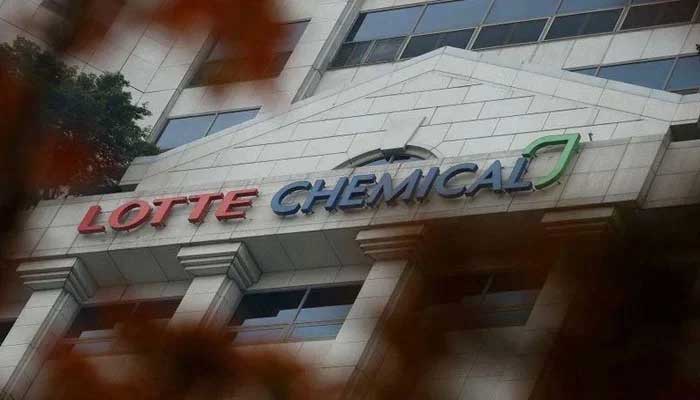
NEW DELHI: South Korea’s Lotte Chemical said on Thursday it has sold about 75 per cent stake in its Pakistani subsidiary to Dubai-based PTA Global Holding for 98 billion won ($68.94 million).
The South Korean company is trying to restructure its portfolio under a government-led programme aimed at aiding loss-making petrochemicals in the country due to poor demand and abundant supply.
Advertisement
Lotte Chemical Pakistan produces 500,000 tonnes of high-purity terephthalic acid (PTA), used in polyester fibres, industrial yarns and PET bottles, annually at its plant in Karachi.
Adnan Afridi has been appointed the firm’s chief executive officer following the stake sale, Lotte Chemical Pakistan said in a statement late on Wednesday.Afridi said the company plans aggressive growth “through mergers and acquisitions to enable diversification and scale”.
Lotte Chemical sells 75% stake in Pakistani subsidiary for $69m
NEW DELHI: South Korea’s Lotte Chemical said on Thursday it has sold about 75 per cent stake in its Pakistani subsidiary to Dubai-based PTA Global Holding for 98 billion won .The South Korean...
 www.thenews.com.pk
hydrabadi_arab
Trusted Member
Q1FY26: Pakistan’s central government debt falls sharply by over Rs 1.2 trillion
- Analysts say early decline in central government debt is a positive sign and should help ease the burden of interest payments
KARACHI: In a major development on the economic front, Pakistan’s central government debt fell sharply by over Rs 1.2 trillion during the first quarter of this fiscal year (FY26), supported by strong profit transfers from the central bank.
According to the State Bank of Pakistan (SBP), the country’s total public debt, including domestic and external obligations, dropped by Rs 1.283 trillion during July to September of FY26. The overall stock stood at Rs 76.605 trillion at the end of September 2025, down from Rs 77.888 trillion at the close of June 2025.
The SBP statistics showed that, during the first quarter of this fiscal year, the bulk of the decline came from domestic debt, which contracted by Rs 1.048 trillion to Rs 53.424 trillion in September 2025.
FD projects decline in public debt
Analysts said the early decline in central government debt is a positive sign and should help ease the burden of interest payments. They noted that the government and the State Bank of Pakistan have managed debt obligations more effectively this year, supported by strong profit transfers from the central bank to the federal government.
In addition, contained net budgetary borrowing with support of ongoing fiscal consolidation, will create space for private sector credit for a steady growth, they added.
Within domestic debt, long-term debt also witnessed a significant decline. Long-term debt reduced by Rs 692 billion, slipping from Rs 45.653 trillion in June 2025 to Rs 44.961 trillion in Sept 2025. Similarly, short-term debt also declined by Rs 356 billion, falling to Rs 8.4 trillion from Rs 8.756 trillion in the corresponding period of last fiscal year.
However, debt under Naya Pakistan Certificate increased from Rs 62 billion to Rs 63 billion in the first quarter of this fiscal year.
Pakistan’s external debt, measured in rupee terms, registered a decline of Rs 236 billion. The stock of external debt stood at Rs 23.181 trillion at the end of September 2025 compared with Rs 23.417 trillion in June 2025.
The SBP earned a strong profit of Rs 2.5 trillion in the last fiscal year, out of which Rs 2.4 trillion was transferred to the federal government. This inflow has helped ease the overall debt burden on the economy.
Copyright Business Recorder, 2025
hydrabadi_arab
Trusted Member
Pakistan’s current account posts $112mn deficit in October 2025
- Deficit follows a surplus of $83 million in September 2025 and a surplus of $296 million in October 2024
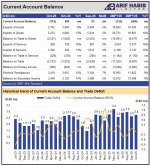
Pakistan’s current account posted a deficit of $112 million in October 2025, data released by the State Bank of Pakistan (SBP) showed on Monday.
The deficit follows a surplus of $83 million recorded in September 2025 and a surplus of $296 million in October 2024.
The deficit came the back of a significantly higher import bill and lower exports during the month.
In October 2025, the country’s total export of goods and services amounted to $3.57 billion, down nearly 4% as compared to $3.71 billion in the same month of the previous year.
Meanwhile, total imports clocked in at $6.32 billion during October 2025, an increase of over 13% on a yearly basis, as compared to $5.58 billion in the same month last year, according to SBP data.
During October 2025, Pakistan’s workers’ remittance inflows clocked in at $3.42 billion, as compared to $3.05 billion in the same month last year, reflecting an increase of 12% on a yearly basis.
“Pakistan’s external account showed mixed signals in October, with the country posting a $112mn current account deficit after a brief surplus in September. The deterioration was driven primarily by a 4% MoM widening in the trade deficit, as imports rose faster than exports amid recovering domestic demand,” Waqas Ghani, Head of Research at JS Global, told Business Recorder.
The analyst noted that remittances have played a pivotal role in stabilising Pakistan’s external account, consistently offsetting the trade deficit. “Their role has become even more important as external pressures resurface,” he said.
During the 4MFY26, the current account recorded a cumulative deficit of $733 million, up from $206 million in the same period last year, an increase of 256%.
Pakistan’s foreign exchange reserves (excluding CRR/SCRR) rose to $14.50 billion, reflecting a substantial 29% rise year-on-year, indicating stronger external buffers despite ongoing structural pressures on the current account.
hydrabadi_arab
Trusted Member
Pakistan’s current account posts $112mn deficit in October 2025
- Deficit follows a surplus of $83 million in September 2025 and a surplus of $296 million in October 2024
Pakistan’s current account posted a deficit of $112 million in October 2025, data released by the State Bank of Pakistan (SBP) showed on Monday.
The deficit follows a surplus of $83 million recorded in September 2025 and a surplus of $296 million in October 2024.
The deficit came the back of a significantly higher import bill and lower exports during the month.
In October 2025, the country’s total export of goods and services amounted to $3.57 billion, down nearly 4% as compared to $3.71 billion in the same month of the previous year.
Meanwhile, total imports clocked in at $6.32 billion during October 2025, an increase of over 13% on a yearly basis, as compared to $5.58 billion in the same month last year, according to SBP data.
During October 2025, Pakistan’s workers’ remittance inflows clocked in at $3.42 billion, as compared to $3.05 billion in the same month last year, reflecting an increase of 12% on a yearly basis.
“Pakistan’s external account showed mixed signals in October, with the country posting a $112mn current account deficit after a brief surplus in September. The deterioration was driven primarily by a 4% MoM widening in the trade deficit, as imports rose faster than exports amid recovering domestic demand,” Waqas Ghani, Head of Research at JS Global, told Business Recorder.
The analyst noted that remittances have played a pivotal role in stabilising Pakistan’s external account, consistently offsetting the trade deficit. “Their role has become even more important as external pressures resurface,” he said.
During the 4MFY26, the current account recorded a cumulative deficit of $733 million, up from $206 million in the same period last year, an increase of 256%.
Pakistan’s foreign exchange reserves (excluding CRR/SCRR) rose to $14.50 billion, reflecting a substantial 29% rise year-on-year, indicating stronger external buffers despite ongoing structural pressures on the current account.
Growth in IT exports+remittances keeping CA under control. Will be in surplus if not for decline in exports of goods.
hydrabadi_arab
Trusted Member
"Pakistan's power generation decreased by 4% YoY and 21% MoM to 9,885 GWh in Oct 2025.
This takes 4MFY26 power generation at 50,818GWh flattish YoY.Power generation cost (fuel cost) down by 6% YoY while up 20% MoM in Oct 2025 to Rs.8.5/units. This takes 4MFY26 cost down 8% YoY to Rs7.7/units"
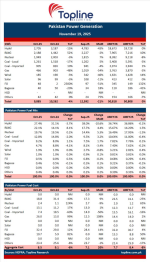
Bad news for electric grid continues.
This takes 4MFY26 power generation at 50,818GWh flattish YoY.Power generation cost (fuel cost) down by 6% YoY while up 20% MoM in Oct 2025 to Rs.8.5/units. This takes 4MFY26 cost down 8% YoY to Rs7.7/units"
Bad news for electric grid continues.
ejaz007
Registered Member
Maersk reaffirms $2bn port investment in Pakistan
By Israr KhanNovember 20, 2025
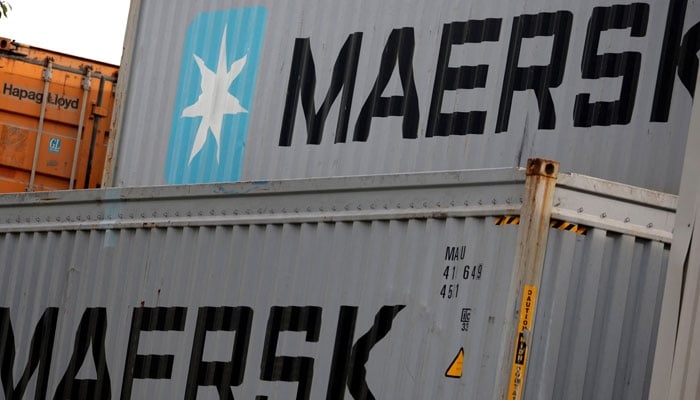
ISLAMABAD: Global shipping giant Maersk has reaffirmed its $2 billion investment plan for Pakistan, signaling one of the country’s most significant prospective boosts to port and logistics infrastructure in recent years.
The investment centers on developing a new port at Gadani, Balochistan, alongside a modern shipping terminal and expanded warehousing and supply chain facilities. The initiative is designed to strengthen Pakistan’s maritime capacity and enhance regional trade connectivity.
Sponsored Content
Makarem Ajyad Makkah Hotel
Book now
Booking.com
 Woman Lavished All Her Savings On This Old Shed, Take A Look Inside!Tips and Tricks
 Baking Soda Tricks Everyone Should Know AboutDailySportX
The plan builds on a Memorandum of Understanding signed in October 2024 between Pakistan and Denmark, under which Maersk committed to explore major investments in port modernization, integrated logistics hubs, maritime workforce development, sustainable ship recycling and greenshipping practices. Officials say these areas align with Pakistan’s broader goals of improving trade efficiency and meeting global environmental standards.
The reaffirmation came during a high-level meeting between a visiting delegation from APM Terminals, a Maersk subsidiary, and Federal Minister for the Board of Investment Qaiser Ahmed Sheikh. The delegation briefed the minister on the project’s progress and future expansion components.
Sheikh said the government was committed to fully facilitating international investors, noting that Prime Minister Shehbaz Sharif and Finance Ministry remain aligned on efforts to draw long-term foreign investment. He added that the Board of Investment is working to streamline procedures and reinforce policy support to accelerate major projects.
Describing the potential investment as “transformative” for Pakistan’s maritime sector, Sheikh said Gadani’s strategic location offers the most efficient route for transit trade with Central Asia, positioning Pakistan to become a more competitive regional logistics hub.

Maersk reaffirms $2bn port investment in Pakistan
ISLAMABAD: Global shipping giant Maersk has reaffirmed its $2 billion investment plan for Pakistan, signaling one of the country’s most significant prospective boosts to port and logistics...
www.thenews.com.pk

Ali_Baba
VIP Member

Interesting to see that context, Pakistan's problem is its inability to generate Foreign exchange for its import needs and payment of external debts( complicated topic with many variables like inflation, interest rates etc so I will stop here !) .
Users who are viewing this thread
Total: 2 (members: 0, guests: 2)
Pakistan Defence Latest
-
 Federal cabinet gives nod to imposition of emergency in KP; summary sent to president (25 Viewers)
- Latest: ziaulislam
-

-
-

-

Country Watch Latest
-

-
-
Trump orders military base mass shooter to be executed by firing squad (4 Viewers)
- Latest: AZ_HighCountry
-
-

Latest Posts
-
Federal cabinet gives nod to imposition of emergency in KP; summary sent to president (25 Viewers)
- Latest: ziaulislam
-
-
-
-
