History of Pashtuns

On 12th February 1842, a further demand that the town be given up arrived from Kabul, but by this time the senior officers had recovered their composure. The demand was rejected and the officers resolved to hold Jellalabad to the end. They were reinforced in their resolve by the arrival of a message from General Pollock, the new commander of the relieving army in India, announcing that he would advance at the first opportunity.

During the period of correspondence with Shah Shujah, Broadfoot and his sappers worked untiringly to strengthen the fortifications.
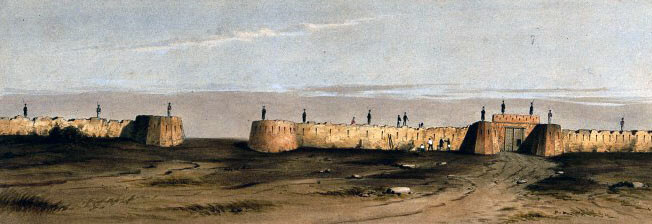
Jellalabad gate and defences after the earthquake: Siege of Jellalabad from 12th November 1841 to 13th April 1842 during the First Afghan War
On 19th February 1842, an earthquake destroyed much of their efforts, but Broadfoot’s leadership was inspirational, and the garrison quickly restored the broken works.

The Afghans, now commanded by Akbar Khan, invested the town closely.

On 11th March 1842, Colonel Dennie led out a further sortie and captured some 500 Afghan sheep left to graze under the town walls, a welcome addition to the commissariat stores.
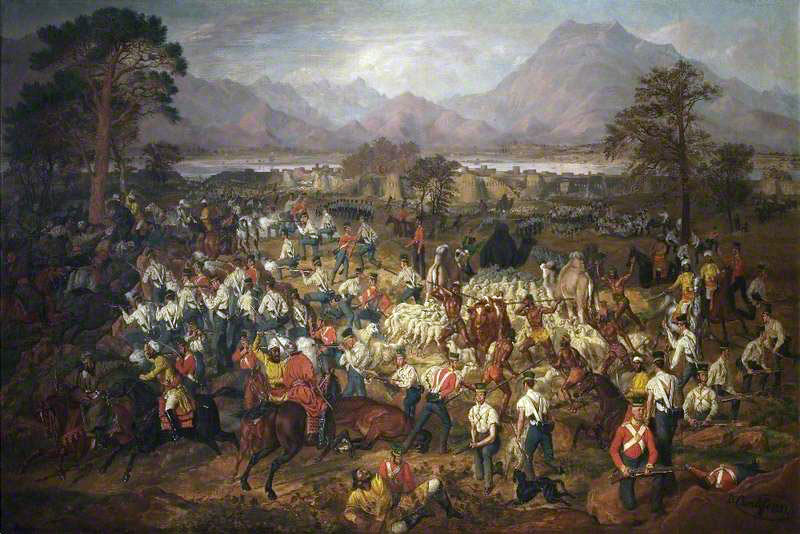
HM 13th Regiment and Skinner's Horse capturing the flock of sheep: Siege of Jellalabad from 12th November 1841 to 13th April 1842 during the First Afghan War: picture by Daniel Cunliffe
HM 13th Regiment and Skinner’s Horse capturing the flock of sheep: Siege of Jellalabad from 12th November 1841 to 13th April 1842 during the First Afghan War: picture by Daniel Cunliffe
On 9th April 1842, the Afghans fired a series of salutes. Coupled with disturbing messages from the east, the salutes led the commanders of the garrison to believe that General Pollock had been driven back.

Brigadier Sale resolved on a major sortie by the entire garrison, in an attempt to drive the Afghan besiegers away. The odds were not in the garrison’s favour. Akbar had some 5,000 to 6,000 men. The garrison numbered around 1,500 men.

At dawn on 7th April 1842 three columns issued from the Kabul Gate into the open country outside Jellalabad. The columns advanced in line towards Akbar’s camp, some 3 miles away, its right flank resting on the river.

Half way to the camp lay a ruined fort, held by Afghans. Colonel Dennie allowed his column to be diverted into the fort, where a vicious hand to hand fight accounted for several British and Indian casualties including Dennie himself.
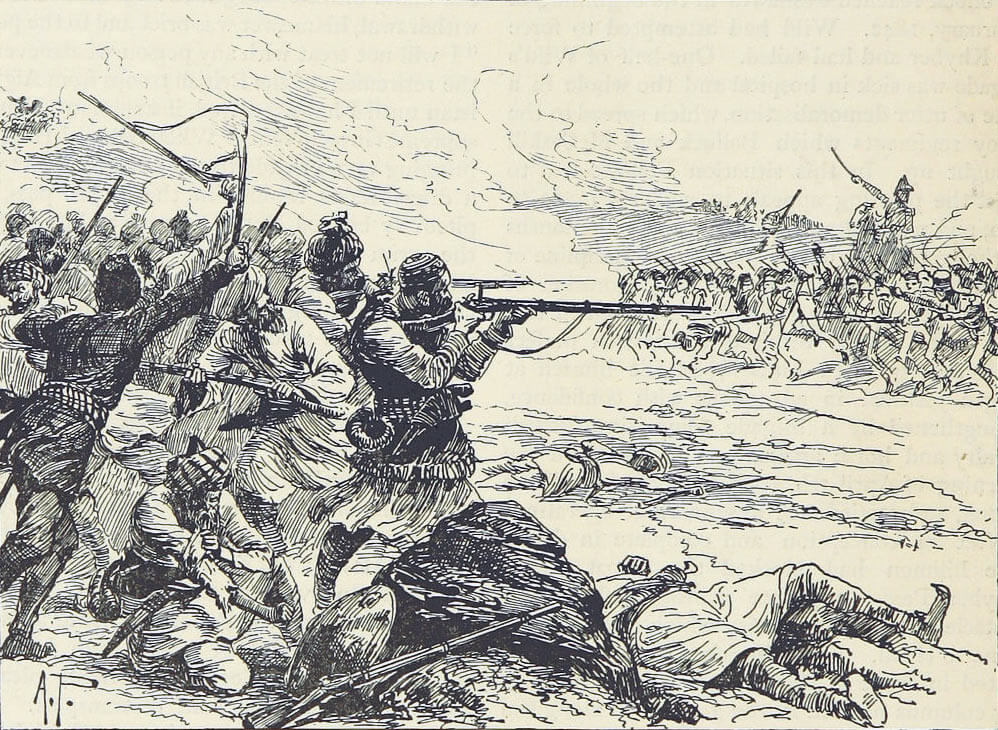
Sortie from Jellalabad: Siege of Jellalabad from 12th November 1841 to 13th April 1842 during the First Afghan War
Dennie’s troops finally conformed to the other two columns, commanded by Havelock and Monteath of the 13th, and the advance continued. The artillery came up in support and a heavy fire was opened on the Afghans, as the three columns advanced into Akbar’s camp capturing his artillery and driving his soldiers away in rout.
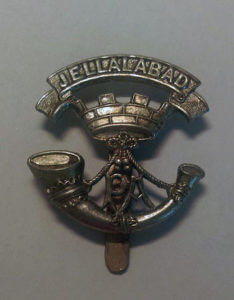
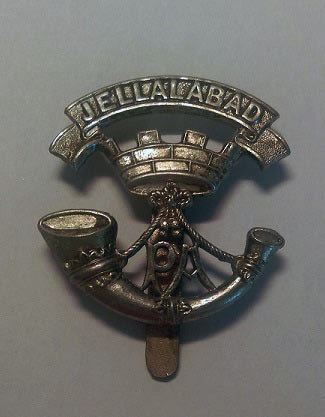
Jellalabad Badge of the 13th Prince Albert's Own Light Infantry: Siege of Jellalabad from 12th November 1841 to 13th April 1842 during the First Afghan War
Jellalabad Badge of the 13th Prince Albert’s Own Light Infantry: Siege of Jellalabad from 12th November 1841 to 13th April 1842 during the First Afghan War
By 7am on 8th April 1842 the Afghan besieging force had fled and the 35th BNI, 13th Foot and the artillery were enabled to march back into Jellalabad in triumph. The garrison had raised the siege without assistance.

On 13th April 1842 Pollock’s Army of Retribution arrived, to be played into Jellalabad by the band of the 13th with the Scottish song “Oh but you’ve been a lang time acoming.”

Casualties at the Siege of Jellalabad:
The British and Indian garrison suffered casualties of 20 men killed and wounded during the siege, and 42 men killed and wounded during the final sortie, including Colonel Dennie. Afghan casualties are unknown.

Follow-up to the Siege of Jellalabad:
The holding of Jellalabad was an enormous boost to the British in India, and to Britain, after the disasters of Kabul and Gandamak. Pollock left Jellalabad for Kabul, to punish the Afghans for having the temerity to defend their country.
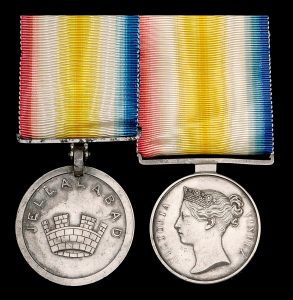
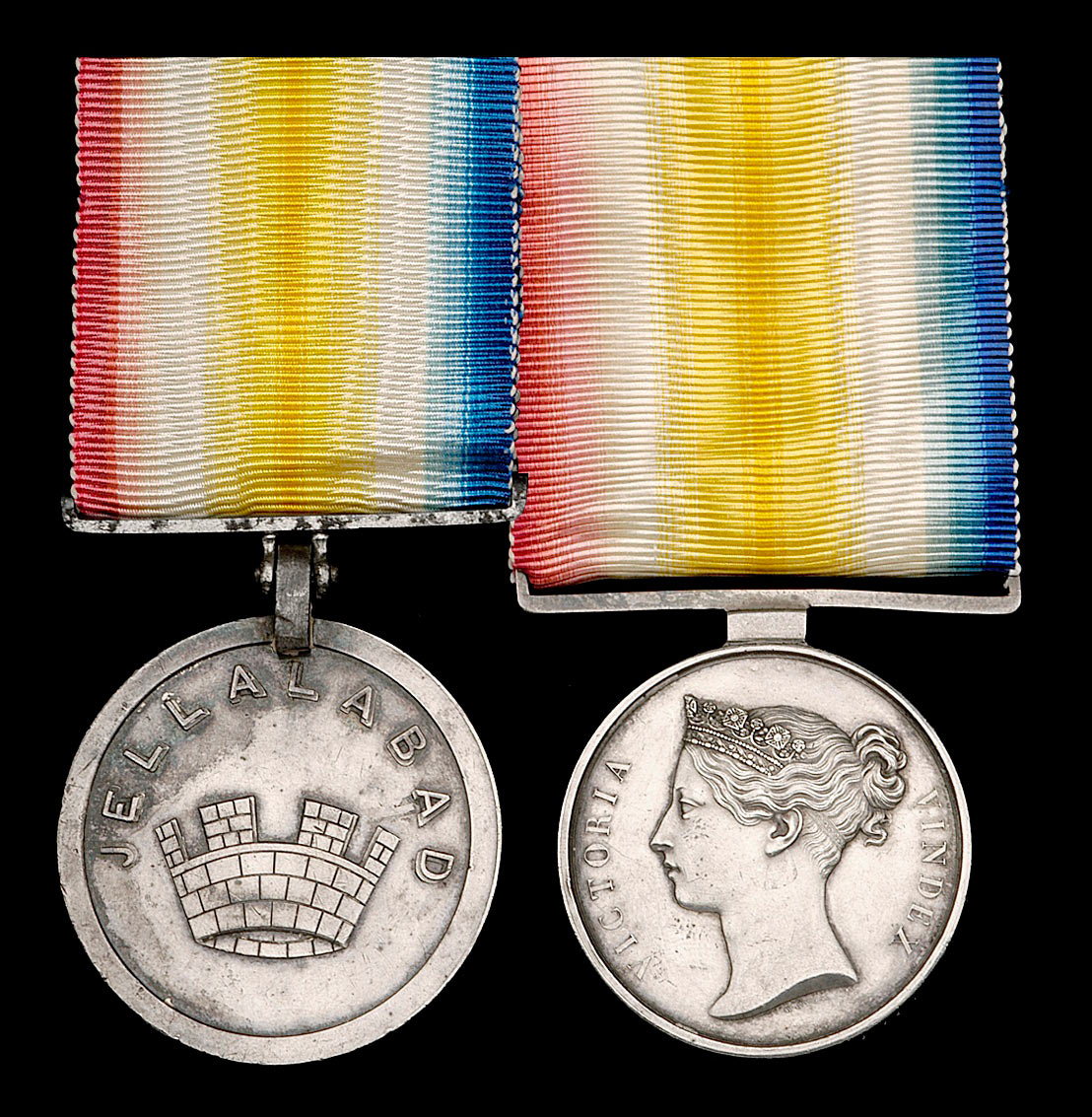
Jellalbad medal issued by the East India Company for the Siege of Jellalabad from 12th November 1841 to 13th April 1842 during the First Afghan War
Anecdotes and traditions from the Siege of Jellalabad:

  • The defence of Jellalabad made heroes of the 13th It is reported that as the regiment marched back through India, to return to Britain, every garrison fired a ten-gun salute in its honour. Queen Victoria directed that the regiment be made Light Infantry, carry the additional title of ‘Prince Albert’s Own’ and wear a badge depicting the walls of the town with the word ‘Jellalabad’ inscribed.
  • The East Indian Company issued a medal to commemorate the siege and issued it to every member of the Jellalabad garrison present in Jellalabad during the period 12 November 1841 to 16 April 1842.
  • Captain Henry Havelock of the 13th Regiment greatly distinguished himself in the Indian Mutiny, relieving the British Residency in Lucknow and dying there of dysentery in 1857. Havelock studied military history and theory in great depth. He was a driven Christian and established Bible reading classes for all ranks in his regiment. The crisis generated by the inadequate elderly British generals needed officers of the ability and driven determination of Havelock and Broadfoot to ensure the survival of the Anglo-Indian garrison in Jellalabad.
References for the Siege of Jellalabad: Jalalabad

Afghanistan From Darius to Amanullah by Lieutenant General Sir George McMunn.

The Afghan Wars by Archibald Forbes.

History of the British Army by Fortescue.


Much love to the Pashtun brothers..

My favorite song which I don’t understand.. lol

To view this content we will need your consent to set third party cookies.
For more detailed information, see our cookies page.


I hope a Pashtun brother can translate.. subtitles are not enough

@Mirzali Khan
 
Sikh mashwani conflict and creation of abbottabad


Screenshot_20240203_145507_Gallery.jpg
 
By Ismail Khan https://pakistanipatriots.blogspot.com/search?q=Pakhtuns+history

The Pakhtuns (also Pushtun , Pakhtun , ethnic Afghan , or Pathan) are an ethno-linguistic group of people, living primarily in eastern and southern Afghanistan, the Pakhtunkhwa Province of Pakistan, and small communities in India. The Pakhtuns are characterized by their indigenous code ("religion") of honor and culture, Pashtunwali (pakhtunwali). The Pakhtuns are the world's largest segmental lineage (patriarchal) tribal group in existence. The total population of the group is estimated at ca. 40 million.

Pakhtun culture is ancient and much of it is yet to be recorded in contemporary times. There are many conflicting theories, some contemporary, some ancient, about the origins of the Pakhtun people, both among historians and the Pakhtun themselves.


"The word Afghan… first appears in history in the Hudud-al-Alam, a work by an unknown Arab geographer who wrote in 982 AD." Until the advent of the modern Afghan state in the 18th century, the word Afghan had been synonymous with Pakhtun.


From the 1st century BC to the 5th century AD the regions where the Pakhtuns lived saw immense migrations of peoples from Central Asia and the Middle East: the arrival of the Sakas, Kushans, Huns, Gujjars Hebrews,and Greeks.


According to most anthropologists, the Pakhtuns appear to be primarily of Iranic descent similar to the Persians, Ossetians, Kurds, Balochis and Tajiks. The Pakhtuns have eastern Iranic origins as the Pashto language is classified as an eastern Iranic tongue closely related to Avestan among other Iranic languages.


There are more mythological and romanticized origins for the Pakhtuns. For example, according to the Encyclopedia of Islam, the Theory of Pakhtun descent from Israelites is traced to Maghzan-e-Afghani who compiled a history for Khan-e-Jehan Lodhi in the reign of Mughal Emperor Jehangir in the 16th century AD. This reference is in line with the commonly held view by Pakhtuns that when the twelve tribes of Israel were dispersed (Israel and Judah, Lost Ten Tribes), the tribe of Joseph among other Hebrew tribes settled in the region.

Hence the term "Yusef Zai" in Pashto (pukhto) translates to the ' sons of Joseph'; the Yusefzai are the 8th largest tribe of the Pakhtuns. Other Pakhtuns claim descent from Arabs and some groups such as the Afridis claim to be descended from Alexander the Great's Greeks as well. What may be the case is that the Pakhtuns have been modified by various invaders, while maintaining their eastern Iranic base both linguistically and genetically overall.

The Pakhtuns are intimately tied to the history of modern-era Afghanistan. The country's founder, Ahmad Shah Durrani, was a Pakhtun. He founded the state, as we know it today, in 1747 and the Pakhtuns would rule it for the next 200 years. The Pakhtuns fought both the British and Russians to a standstill during the Great Game.
 
Today marks the 29th anniversary of the passing of the esteemed Pashto poet, writer, novelist, translator, and pioneer of Pashto ghazal, Amir Hamza Khan Shinwari.

Shinwari, born in Landi Kotal, demonstrated an early passion for literature after completing his matriculation. Notably, in 1935, he authored the inaugural Pashto drama, "Zamindar," for All India Radio Peshawar, and later contributed to the scripting and lyrical composition of the first Pashto film, "Laila Majnoon," released from Bombay in 1941. In addition to his writing endeavors, he ventured into directing and performed as a playback singer.

Post the formation of Pakistan, Hamza Shinwari made significant contributions to Radio Pakistan Peshawar by producing numerous dramas, features, and speeches. As a translator, he translated 204 ghazals of Rahman Baba into Urdu, and converted Allama Iqbal's works, "Javid Nama" and "Armughan-e-Hijaz," into Pashto. Additionally, he translated "Nahjul Balagha" into Pashto.

Amir Hamza Shinwari's literary legacy spans across various genres including mysticism, poetry, psychology, and cultural discourse, evident through his extensive body of prose and poetic works. His masterpiece, "Tajalliyat-e-Mohammadiya," stands as a cornerstone in Pashto Sufi literature.

He is fondly remembered as 'Hamza Baba' or the 'Father of Pashto Ghazal,' credited with introducing the ghazal form into Pashto poetry.

Furthermore, Shinwari served as the editor of the Pashto section in the English newspaper 'Khyber Mail,' contributing daily columns titled 'Zhor Fikrona' (Deep Thoughts) on various social and literary subjects.

In acknowledgment of his literary contributions, the Government of Pakistan bestowed upon him the 'President's Award for Pride of Performance' and the 'Sitara-i-Imtiaz.'

Amir Hamza Shinwari passed away on February 18, 1994, and was laid to rest in his ancestral homeland. Even today, thousands gather annually at his shrine to pay homage to this revered Sufi poet.


1708377269646.png
 
The Sikh "Dal Khalsa" or Sikh army of Sikh empire fought many wars with Durrani empire of Afghanistan between 1751 to 1837 and conquered the areas today in Pakistani FATA and KPK.

Durranis even lost Peshawar to the Sikh onslaught. The local tribes could only do some insurgency against sikhs but never had total control or a government of their own.

Sikh Ruler Ranjit singh died in 1839 and the demise of Sikh empire started. in 1848 the British conquered the Sikh empire and took over the areas ruled by the Sikh.

However in 1839 British also conquered Kabul in Afghanistan and were repelled by Afghans. But Afghans could never conquer back the areas they lost to Sikhs and later inherited by the British.

The Afghan rulers constantly provoke the today's FATA tribes to rise against the British and join Afghanistan which cause two more Anglo-Afghan wars in 1878 and 1919.

Both times the English had large numbers of Sikh soldiers and went all the way to Kabul and both times Afghan king had to make peace treaty with the British.

So that's about 170 years of wars between Afghan Pushtoons and Punjabi sikhs.

Some ignorant Pakistani Pushtoons and Afghani as a whole still keep that grudge on ethnic grounds and let it out on "Muslim Punjabis" of Pakistan despite the fact that they fought Sikh Punjabi not Muslim Punjabi. The hateful term "Daal Khor" is remnant of Pushtoon Afghan wars when most sikhs used to be vegetarians.

Muslim Punjabis were killed and plundered in their millions by Sikhs during 1947 partition and had to migrate.
 
Ghurid Sultanate

iu


They were a powerful Sultanate that ruled from Iran to Bangladesh at their peak, building many magnificent structures such as the Minaret of Jam. Their major cities were Lahore, Firozkoh, Herat and Ghazni. One of their Sultan's (Muhammad Ghur) is buried in Pakistan in a magnificent tomb:

https://www.britannica.com/place/Ghurid-sultanate

Khiliji Sultanate

iu


They were Turks who had assimilated into the Pashtun fold, and are the ancestors of the Ghiliji Pashtuns (hence the almost identical names). They ruled over most of Pakistan, Nepal and Bangladesh, as well as large portions of northern Hindustan and small portions of Afghanistan. Their major cities were Delhi and Lahore. The most notable achievement of this empire is that they defeated the Mongols.

https://www.britannica.com/topic/Khalji-dynasty
 
Sketch Map Of Kohat District Excluding Ilaqa Teri (Present Day District Karak) Showing Principal Villages, Tehsils, Tuppas & Circles By R. Undy Deputy Commissioner, 26-08-1885.

1625521933177.png


The Durrani State (Afghanistan) Was Not The First State Formation Among Afghans (Pashtuns). In The 16th Century, Two Feudal Principalities (Akora Present Day Akora Khattak District Nowshera & Teri Present Day District Karak) Had Emerged In The Territory Populated By An East Afghan Tribe - The Khattak's. Teri Khanete Was The First Oldest Principality Of The Pashtuns, By The Pashtuns In The Land Of Pashtuns. Founded In 1540 By The Cheif Of Khattak's Malik Akor Khan (Great Grandfather Of Pashto Poet Khuhsal Khan Khattak).

The Khanete Of Teri (1550 - 1956), Present Day District Karak (Banda Daudshah, Karak, And Takht-e-Nasrati Tehsils) Half Of Present Day District Kohat (Lachi Tehsil And Gumbat Area).

Scale 1 Inch= 4 Miles Lithographed At The Survey Of India Offices, Calcutta, February 1886
 
Operations against the Mahsuds, July 1917.

1625685444455.png


Sick convoy at Manzal South Waziristan Field Force, Owing to salts in the water of the River Shahur the Field Force suffered severely from stomach trouble scarcely a man escaping.
 
Sir Frederick Roberts and the Sirdars of Kabul, 1879 (c).

1626557136450.png


This photograph of Sir Frederick Roberts (1832–1914) and Afghan sirdars (noblemen) is from an album of rare historical photographs depicting people and places associated with the Second Anglo-Afghan War. Roberts was a British Army officer who in a long career fought in Ethiopia, Afghanistan, and South Africa. In October 1879 he led the Kabul Field Force, consisting of a combination of British and Indian troops, over the Shotur Gardan Pass, defeated an Afghan army at the Battle of Charasia, and occupied Kabul. Roberts is seated among Afghan men and boys, who are all wearing turbans and warmly dressed in chapan (overcoats) or tunics.

The Second Anglo-Afghan War began in November 1878 when Great Britain, fearful of what it saw as growing Russian influence in Afghanistan, invaded the country from British India. The first phase of the war ended in May 1879 with the Treaty of Gandamak, which permitted the Afghans to maintain internal sovereignty but forced them to cede control over their foreign policy to the British.

Fighting resumed in September 1879, after an anti-British uprising in Kabul, and finally concluded in September 1880 with the decisive Battle of Kandahar.

The album includes portraits of British and Afghan leaders and military personnel, portraits of ordinary Afghan people, and depictions of British military camps and activities, structures, landscapes, and cities and towns. The sites shown are all located within the borders of present-day Afghanistan or Pakistan (a part of British India at the time).

About a third of the photographs were taken by John Burke (circa 1843–1900), another third by Sir Benjamin Simpson (1831–1923), and the remainder by several other photographers. Some of the photographs are unattributed.

The album possibly was compiled by a member of the British Indian government, but this has not been confirmed. How it came to the Library of Congress is not known.
© World Digital Library
 
Fort Gulistan, Tirah Valley, North-West Frontier, 1897-98 (c).

1627784711058.png


The Battle of Saragarhi was fought before the Tirah Campaign on 12 September 1897 between Sikh soldiers of the British Indian Army and Pashtun Orakzai tribesmen. It occurred in the North-West Frontier Province (now Khyber Pakhtunkhwa, Pakistan).

The British Indian contingent comprised 21 Sikhs of the 36th Sikhs (now the 4th Battalion of the Sikh Regiment), who were stationed at an army post attacked by tribesmen. The Sikhs, led by Havildar Ishar Singh, chose to fight to the death, in what is considered by some military historians as one of history's greatest last-stands. The post was recaptured two days later by another British Indian contingent.

Sikh military personnel commemorate the battle every year on 12 September, as Saragarhi Day.

Note - The Tirah Campaign proved the most difficult and protracted military operation during the rising costing the Army in India 287 dead and 853 wounded, despite initial expectations in many quarters that British and Indian troops would only be opposed by lashkars still reliant on hand-to-hand combat supported by limited jezail or occasional rifle fire.

3 In his final report dated 24th February 1898 Major-General Sir William Lockhart summed up the difficulties encountered by imperial troops, "No campaign on the frontiers of India has been conducted under more trying and arduous circumstances than those encountered by the Tirah Expeditionary Force".
 
Here is some info on Old Peshawar and some of its "15" gates:

Old Peshawar Map:

a4fd4ac575ce74133b966c5c2ef737be.jpg


Taxila Gate 1879:
115d1820d3a4bd7b0f3f6f958ffcca1d.jpg


Kabuli Gate 1891:

37582526f25e12c963c71afae0841416.jpg


Kabuli Gate 1903:

ea7f714e2143b0176019cf83fdbd3a0a.jpg


Kabuli Gate and Qissa Khwani Bazaar (a caravan line):

9570fe4df3317f1e4eefac24607e8c20.jpg


Qissa Khwani Bazaar 1903:

bc49983589d20c8633177e0ab35c284d.jpg
 

Users who are viewing this thread

Pakistan Defence Latest

Country Watch Latest

Back
Top