Indonesia Leads EM Rally as Carry Appeal, Growth Lure Investors

Indonesia’s Special Economic Zones Attract Rp 90 Trillion Investment in 2024​


Arnoldus Kristianus, Heru Andriyanto


January 22, 2025 | 11:46 pm

1737863371610.webp
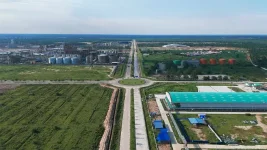
The Sei Mangkei Special Economic Zone in North Sumatra. (Handout photo)


Jakarta. Indonesia’s special economic zones (SEZs) attracted Rp 90.1 trillion ($5.5 billion) in new investment and created 47,747 jobs last year, an official announced on Wednesday.


The government has established 24 SEZs across the country since 2012 and plans to add five more this year. These zones offer significant benefits, including generous tax incentives, expedited licensing procedures, and land concessions for up to 80 years.


The five new zones will focus on sectors like renewable energy, logistics, and digital technology.


Since their inception nearly 13 years ago, SEZs have secured Rp 263.4 trillion ($16.2 billion) in domestic and foreign investments and generated 160,874 jobs, involving over 400 businesses, according to Susiwijono Moegiarso, Chair of the National Council for SEZs.


He said the SEZ program has become a cornerstone of the country’s economic agenda for its ability to spur regional growth, attract investment, and create employment opportunities.


“To achieve the economic growth target of 8 percent, we need Rp 13,032 trillion in investment over the next five years. SEZs play a pivotal role in our efforts to meet this goal,” Susiwijono said in a statement.


SEZs differ from standard industrial areas due to the special treatments they receive, such as exemptions from value-added tax on specific goods, duty-free facilities, and customs and excise benefits. These advantages are designed to attract both domestic and international investors, boosting regional development and job creation.


Sei Mangkei in North Sumatra, established in 2012, was the first SEZ and initially focused on the palm oil and rubber industries.


Several SEZs also prioritize the hospitality sector, including Mandalika in West Nusa Tenggara, which features the country’s largest and most modern motor racing circuit, a regular host of the MotoGP race.


Prominent SEZs in Indonesia

  • Mandalika SEZ (West Nusa Tenggara): Focused on tourism, this SEZ boasts premium resorts, beaches, and the Mandalika International Street Circuit, which hosts international events like MotoGP.
  • Sei Mangkei SEZ (North Sumatra): Specializes in palm oil and rubber processing, as well as downstream industries to add value to raw materials.
  • Batam Aero Technic SEZ (Riau Islands): Serves as a hub for aircraft maintenance, repair, and overhaul (MRO), attracting investments in aviation
  • Gresik SEZ (East Java): Focused on industries such as petrochemicals and steel, catering to Indonesia's industrial growth.
  • Bitung SEZ (North Sulawesi): Positioned as a logistics hub for Eastern Indonesia, emphasizing fisheries and exports.


Indonesia Attracts $105 Billion Investment in 2024​


Jayanty Nada Shofa


January 31, 2025 | 11:57 am

1738463165740.webp
Investment Minister Rosan Roeslani gives a press statement at the Presidential Palace in Jakarta on Jan. 2, 2025. (Photo Courtesy of Presidential Press Bureau)


Jakarta. Indonesia announced Friday that it had attracted Rp 1,714.2 trillion or approximately $105 billion throughout 2024 with a significant portion of the money coming from international investors.


Former President Joko “Jokowi” Widodo had set a goal for Indonesia to register Rp 1,650 trillion in combined investments in his final year in office. This means that Indonesia managed to achieve 103.9 percent of the target despite a shift in presidency to the incumbent President Prabowo Subianto in the fourth quarter. The overall investment flowing into Indonesia witnessed a 20.8 percent year-on-year (yoy) growth, according to Investment Minister Rosan Roeslani. These investments also created jobs for almost 2.5 million people.


Foreign direct investments (FDI) made up 52.5 percent of what Indonesia had recorded throughout last year, amounting to Rp 900.2 trillion.


The basic metal industry was the most sought-after among foreign investors who had put their money in resource-rich Indonesia that year. FDI in this subsector hit $13.6 billion, seconded by the mining subsector which registered $5.2 billion from international investors.


“For the past 10 years, Singapore has always been our top foreign investor. Last year, we recorded $20.1 billion in FDI from Singapore in January-December 2024. Hong Kong was our second-largest FDI source with $8.2 billion, and then we have China at $8.1 billion,” Rosan told a press briefing in Jakarta.


FDI inflows from close neighbor Malaysia reached $4.2 billion. The US, which had recently witnessed President Donald Trump’s return to the White House, invested $3.7 billion in Indonesia last year.


Southeast Asia’s largest economy is currently trying to move its commodities up the value chain as part of a massive downstream industry development plan. Indonesia is nudging international manufacturers into setting up their production plants in the country, regardless of the sector: be it mineral mining, agriculture, or even forestry. This way, the country can add value to its commodity exports.


According to Rosan, investors appear to be on board with the plan as data shows downstream industries recorded Rp 407.8 trillion in investments for the entirety of 2024. This is equivalent to 23.8 percent of the total investments that Indonesia saw that year.


About Rp 245.2 trillion of the investments went to mineral smelting industries. The nickel-abundant Indonesia booked Rp 153.2 trillion in the smelting industry of the silvery-white lustrous metal over the same period. Indonesia’s downstream industry development masterplan began with nickel, starting with an export ban on its unprocessed ores in 2020. Data also shows the Indonesian electric vehicle battery ecosystem registered Rp 8.4 trillion in investments in 2024.


“We believe that investments in the downstream industry development will continue to rise. It is one of President Prabowo Subianto’s priority programs. … We are working on developing the industrialization in other commodities [beyond the existing ones like minerals],” Rosan said.


Indonesia's FDI at $55.3 bln in 2024​


By Reuters
January 31, 20259:21 AM GMT+7


To view this content we will need your consent to set third party cookies.
For more detailed information, see our cookies page.


Updated 3 days ago


JAKARTA, Jan 31 (Reuters) - Indonesia's foreign direct investment last year was 900.2 trillion rupiah ($55.33 billion), up 21% on a yearly basis, the investment ministry said on Friday.

FDI in the fourth quarter was 245.8 trillion rupiah, a 33.3% increase from the same period a year earlier, versus the third quarter's growth of 18.6%. The data excludes investment in the financial and oil and gas sectors.

Southeast Asia's largest economy has seen its FDI rising, especially in the mining and metal refining sectors, after Jakarta banned the exports of nickel ore back in 2020 with a goal to develop its nickel processing industry.

In the October-December quarter, the base metal sector received $3.4 billion of investment, the paper industry received $2.1 billion and mining recorded $1.3 billion of investment.

Singapore, China and Hong Kong were the biggest sources of FDI in the fourth quarter of 2024.

Total direct investment in 2024, including from domestic sources, reached 1,714.2 trillion rupiah ($105.13 billion), up 20.8% on an annual basis, the data showed.


Indonesia nominal GDP is projected by IMF to exceed 2 trillion USD marks in 2029.

Indonesia population is also projected by IMF to be nearly 300 million in 2029. Indonesia latest fertility rate is 2.1, which is enough to replace the current population with slightly increase.

To view this content we will need your consent to set third party cookies.
For more detailed information, see our cookies page.
 

Indonesia Must Embrace AI to Accelerate Digital Transformation: Meutya​


Zhulfakar, Heru Andriyanto

January 30, 2025 | 10:54 pm

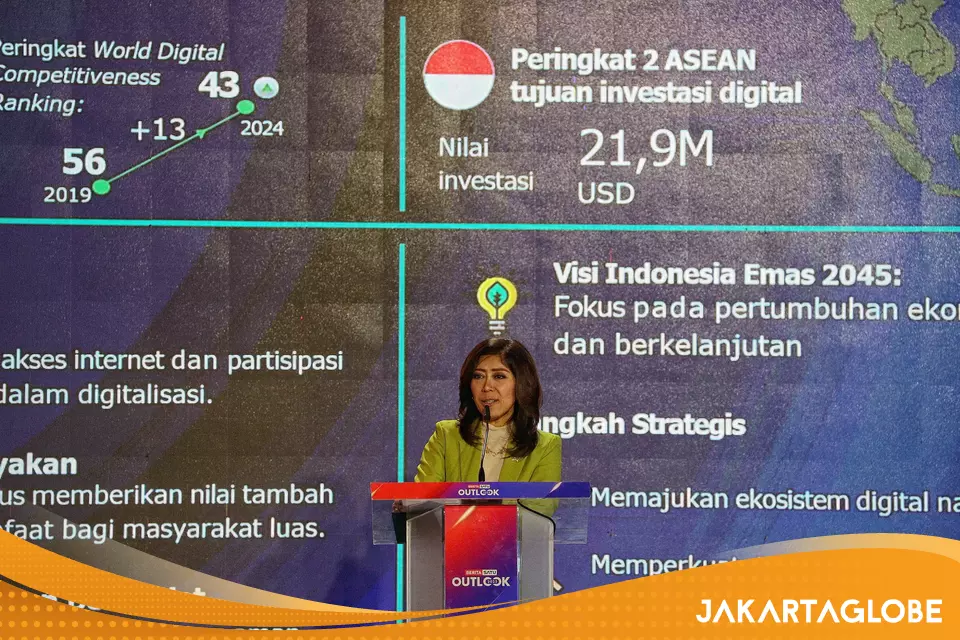
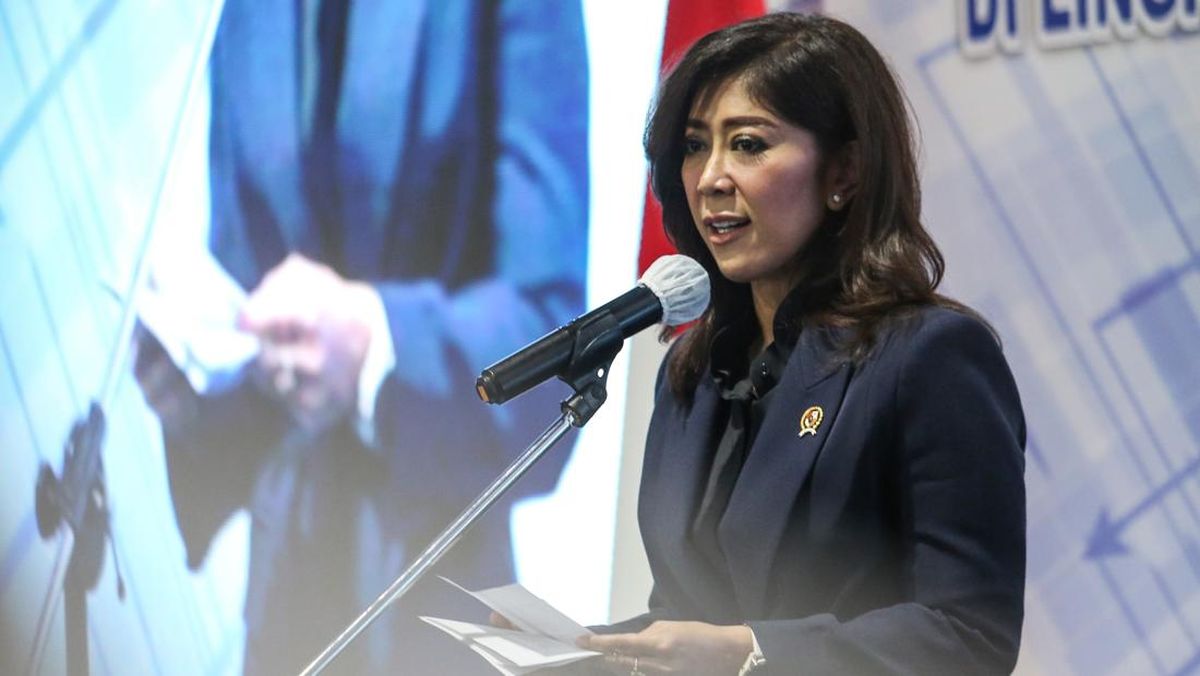
1738588974750.webpCommunication and Digital Affairs Minister Meutya Hafid speaks at the Outlook 2025 seminar hosted by Beritasatu at the Westin Hotel in Jakarta, Thursday, Jan. 30, 2025. (JG Photo/Joanito De Saojoao)


AI as a Key Driver of Economic Growth
Meutya stressed that AI will play a crucial role in supporting Indonesia’s digital economy and driving national economic growth.


"The current global competition is not only about military capabilities but also digital technology. Developing AI and embracing the digital economy is now an urgent priority for every nation, including Indonesia," she said.


She added that Indonesia’s digital transformation must be inclusive, empowering, and reliable, ensuring that technological advancements deliver tangible benefits to the people.


"Technology adoption must add value to society and bring real, measurable outcomes," she added.


Indonesia’s Digital Economy on the Rise
According to data from the Ministry of Communication and Digital Affairs, Indonesia attracted $21.9 billion in digital investment in 2024, making it the second-largest recipient of digital investment in ASEAN.


The country’s digital economy and online retail sector are expanding rapidly, with gross merchandise value (GMV) reaching $90 billion last year.


Additionally, Indonesia’s ranking in the World Digital Competitiveness Index has seen significant improvement, climbing from 56th place in 2019 to 43rd in 2024, reflecting the country’s growing digital capabilities and global competitiveness.


Investment in manufacturing exceed 44 billion USD in 2024, which is around 42% of total investment in Indonesia last year (105 billion USD).

It is an increase of 20.9 % from previous year.


BPS records Indonesia's economic growth reached 5.03 percent in 2024​


Wednesday, February 5, 2025 11:34 WIB

1738732064040.webp
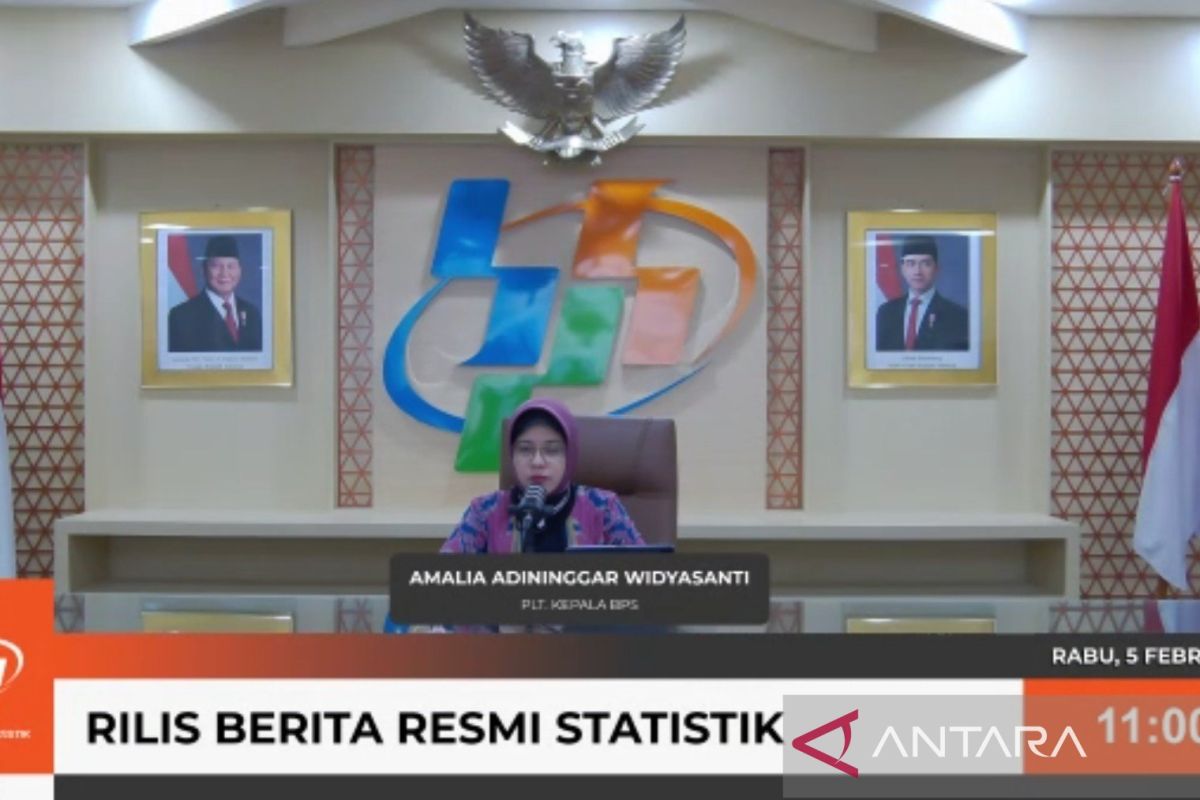
Plt. Head of BPS Amalia Adingar Widyasanti attended the 2024 cumulative economic growth press conference in Jakarta, Wednesday (5/2/2025). BETING/Uyu Septiyati Liman.


Jakarta (ANTARA) - Plt. Head of the Central Statistics Agency (BPS) Amalia Adininggar Widyasanti said that the Indonesian economy grew 5.03 percent cumulatively throughout 2024.

“Indonesia’s economy in 2024 grew by 5.03 percent. The entire business field grew positively in 2024," said Amalia Adininggar Widyasanti in Jakarta on Wednesday.

The value of Gross Domestic Product (GDP) cumulatively in 2024 on the basis of prevailing price (ADHB) reached Rp22.138.96 trillion.


Indonesia Q4 GDP growth at 5.02% y/y, full-year at 5.03%​

Feb 5, 2025
11:08 GMT+7


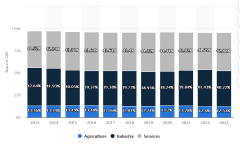
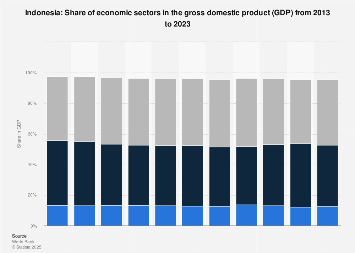
Indonesia: Share of economic sectors in the gross domestic product (GDP) from 2013 to 2023​


1738735648482.png

Share of economic sectors in the GDP in Indonesia 2013-2023​

Published by
Aaron O'Neill,
Jan 22, 2025


This statistic shows the share of economic sectors in the gross domestic product (GDP) in Indonesia from 2013 to 2023. In 2023, the share of agriculture in Indonesia's gross domestic product was around 12.53 percent, industry contributed approximately 40.22 percent and the services sector contributed about 42.88 percent.


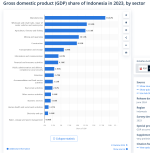
Gross domestic product (GDP) share of Indonesia in 2023, by sector​


1738735989121.png

Breakdown of GDP share Indonesia 2023, by sector​

Published by Mona Siahaan, Oct 24, 2024


In 2023, preliminary figures indicated that the manufacturing sector contributed approximately 18.67 percent of Indonesia's GDP, making it the largest contributor to the nation's economy. It was followed by the wholesale and retail trade and agricultural sectors. With its abundant resources, Indonesia ranks among the largest economies in the world.

Economic development in Indonesia​

Indonesia’s GDP is expected to rise steadily until 2029, suggesting consistent economic growth. Resonating with this pattern, foreign direct investment in Indonesia has steadily increased over the past few years. However, the government still grapples with inflation rates and a budget deficit, with government revenue consistently lower than expenditure. Despite these challenges, Indonesia aims to become one of the top five largest economies globally by 2045.

The manufacturing sector’s growth and investment​

Over the years, Indonesia has become an increasingly attractive destination for investments due to its economic expansion and large labor force. As of 2023, the GDP growth rate for Indonesia’s manufacturing sector was projected to be nearly five percent. Across the various segments of the sector, the highest investment value came from basic metals manufacturing, demonstrating its important role in driving industrial growth.


OpenAI CEO Sam Altman Becomes First Person to Get Indonesian ‘Golden Visa’​


1738828290668.webp

OpenAI Chief Executive Officer Sam Altman is the first person to get an Indonesian golden visa as Southeast Asia’s largest economy seeks to draw foreign investors.

Read More: OpenAI CEO Sam Altman Is Pushing Past Doubts on Artificial Intelligence


The country’s immigration authority issued a 10-year visa for Altman as he “has an international reputation and may bring benefits to Indonesia,” said Immigration Director General Silmy Karim in a statement. The co-founder of the ChatGPT creator would enjoy priority security screening at airports, longer stay periods and easier entry and exit processes, among other perks.

Introduced last week to boost economic development, the new visa allows foreigners who make substantial investments in the country to remain for between five and 10 years. For example, an individual who invests $350,000 into shares of local public companies, savings accounts or government bonds is eligible for a five-year stay.

 
Indonesia Can Finally Enjoy Wi-Fi 6E and Wi-Fi 7
CNN Indonesia
Friday, 07 Feb 2025
20:50 WIB

1739158197216.jpeg
Illustration. Meutya Hafid inaugurated the allocation of the 6 GHz lower band, which paves the way for the implementation of Wi-Fi 6E and Wi-Fi 7. (PHOTO: BETWEEN PHOTOS/ASPRILLA DWI ADHA)

Jakarta, CNN Indonesia --

The Indonesia Technological Alliance (ITA) announced the allocation of the 6 GHz lower band, which paves the way for the implementation of Wi-Fi 6E and Wi-Fi 7.

This new policy was inaugurated directly by the Minister of Communication and Digital (Menkodigi) Meutya Hafid.

"We mark another important milestone in the journey of Indonesia's digital transformation, namely the launch of Wi-Fi 7, the next integration of connectivity. At the Ministry of Communication and Digital, our mission is clear, we must build a digital infrastructure that is safe and ready for the future, which allows unlimited communication for all Indonesians," Meutya said at the launch event in Jakarta on Friday (7/2).

Secretary General Komdigi Ismail said Wi-Fi 6E and Wi-Fi 7 that can be implemented after the allocation of 6 GHz frequency bands can produce a speed of 4 times the current Wi-Fi.

"What we launch is Wi-Fi 6E and Wi-Fi 7, so we will get into the new technology that is at the forefront. Because the speed can be more than 4 times the Wi-Fi that now exists, "said Ismail.

Ismail said this high-speed Wi-Fi technology could be used by the public in homes for free.

Higher internet speeds also have implications for the use of the public, for example for the use of artificial intelligence (AI) applications.

"With the presence of Wi-Fi 6 and Wi-Fi 7, various applications that have been implemented in the global, now Indonesia has entered in that era," he said.

In addition to speed, Ismail said, the presence of Wi-Fi 6E and Wi-Fi 7 also presents greater capacity, so that connections to large networks can be handled better.

Komdigi and ITA itself collaborate to draft technical specifications to be able to implement this newly released technology.

Furthermore, Meutya invites private parties to collaborate in encouraging investment and innovation of telecommunications technology.

“To our partners in the private sector, I convey an open invitation to collaborate in driving investment, innovation, and research in the next generation of wireless technology. The deployment of Wi-Fi 7 will require state-of-the-art hardware, optimized software, and also a new wave of digital talent, areas where collaboration will be very important.


To view this content we will need your consent to set third party cookies.
For more detailed information, see our cookies page.


AI Adoption in Indonesia, specifically for Canva (Design AI tool)
 

Bank Mandiri Issues Global Bond US$800 Million, Oversubscribe 3.5 Times​


mkh, CNBC Indonesia

20 March 2025 18:10

To view this content we will need your consent to set third party cookies.
For more detailed information, see our cookies page.


Jakarta, CNBC Indonesia — PT Bank Mandiri Tbk (Persero) managed to raise funding of US$800 million from the issuance of Global Bond. This debt letter is part of Bank Mandiri’s Euro Medium Term Note Program worth US$4 billion and is issued in the Regulation S format. This transaction marks the return of Bank Mandiri to the international debt securities market since 2023.


This issuance of Global Bond received 3.5 times the oversubscription at the time of the book building process of the published amount. This debt letter has a tenor of 3 years and is issued with a coupon of 4.90% and is recorded on the Singapore Exchange. The funds resulting from the issuance of the debt will be used for the development of the company's business.

Director of Treasury and International Banking Bank Mandiri Eka Fitria said that the transaction issuance of debt securities in the US dollar with the largest amount ever carried out by banks in Indonesia. In addition, this debt letter is issued with the thinnest spread in the history of the issuance of Global Bond Bank Mandiri, namely the US Treasury (UST) 3 Years + 113 bps.

This success is an achievement and proof that investors have high confidence in the performance of Bank Mandiri, as well as confidence in the stability and growth potential of Bank Mandiri in the future even amid the uncertainty of the global and domestic markets.

Positive investor confidence is also reflected in the rating given for this debt letter with Moody's setting the Baa2 rating and S&P giving the BBB rating. Investors who buy this debt are dominated by fund managers and asset managers by 79% of the total issuance allocation, banks and financial institutions 13%, insurance companies 4%, sovereign wealth fund/public sector 3%, and private banks and corporations 1%.

Investors from Asia dominate as much as 75%, and investors from Europe, the Middle East & Africa (EMEA) by as much as 25%. HSBC, J.P. Morgan, Mandiri Securities, and MUFG act as Joint Bookrunners and Joint Lead Managers for this transaction.


https://www.cnbcindonesia.com/marke...global-bond-us-800-juta-oversubscribe-35-kali
 

Fitch Affirms Indonesia at 'BBB'; Outlook Stable​

Tue 11 Mar, 2025 - 04.47 ET


Fitch Ratings - Hong Kong - 11 Mar 2025: Fitch Ratings has affirmed Indonesia's Long-Term Foreign-Currency Issuer Default Rating (IDR) at 'BBB' with a Stable Outlook.


A full list of rating actions is below.


Key Rating Drivers​


Credit Strengths and Weaknesses: Indonesia's 'BBB' rating reflects the country's favourable medium-term growth outlook and low government debt/GDP ratio. The rating is primarily constrained by a weak government revenue intake and lagging structural features, such as GDP per capita and governance indicators compared with 'BBB' category peers.

Resilient Growth Outlook: Fitch forecasts Indonesia's real GDP to grow by 5.0% in 2025, maintaining momentum from 2024 and outperforming many 'BBB' category peers (median: 3.3%). Strong domestic demand, supported by public spending on social assistance and infrastructure projects, will be the main growth driver. Private investment should remain robust, driven by modest monetary policy easing, reduced policy uncertainty post-elections and continued downstreaming activities.

Potential External Headwinds: We forecast growth to ease slightly to 4.9% in 2026 as higher US tariffs and weaker demand from China exert more pressure on Indonesia's exports, although resilient domestic demand should mitigate some of the pressures.

Challenging Growth Targets: The government aims for 8% growth by 2029 while maintaining economic stability, including through continued prudent fiscal policies. This target looks challenging without significant structural reforms. The key policy agenda thus far includes a free meals programme and initiatives for food and energy self-sufficiency. It also includes investment via the newly launched Danantara sovereign wealth fund (SWF), commodity downstreaming and expanded electric-vehicle and battery manufacturing.

Modest Inflationary Pressure: The headline CPI fell for the first time in over two decades by 0.1% yoy in February 2025, on temporary discounts on household electricity tariff, while core inflation held steady at 2.5% yoy. We project headline CPI to rise to 2.7% by end-2025 as discounts diminish and food prices increase, staying within the current official inflation target band at 2.5% +/- 1pp. We expect the Bank Indonesia to further cut the policy rate by 50bp to 5.25% by end-2025, following a 25bp cut in January.


Fiscal Uncertainty: We project the fiscal deficit to rise to 2.5% of GDP in 2025, up from 2.3% in 2024. However, the fiscal outlook is highly uncertain, particularly over the medium term. Reversing the planned 1pp VAT rate increase would result in a Fitch-estimated revenue loss of 0.3% of GDP. The government's efforts to enhance spending efficiency, including 1.3% of GDP in spending cuts reallocated to the free meals programme, may face challenges in fully using the budget savings, potentially leading to underspending.

Government Debt Ratio to Decline: Fitch forecasts a moderate decline in general government debt to 39.1% of GDP in 2028 from 40.4% in 2025 (BBB median: 58.0%). We expect a mild increase in the budget deficit over the coming years to accommodate the government's additional public social spending and infrastructure investment. This reflects our baseline assumption that the government, supported by a broad parliamentary coalition, will continue to adhere to the deficit ceiling of 3% of GDP in the medium term.

New SWF: The recent passage of Indonesia's new SOE law paved the way for the establishment of Danantara SWF on 24 February 2025. The government plans to consolidate its state-owned enterprise (SOE) portfolio under this new investment vehicle. The initial plan involves channelling funds from budget savings and SOE dividend payments to finance prioritised national projects, such as downstream industries, renewable energy, food production, affordable housing and AI.

Danantara's investment strategy is still unclear. Even so, borrowing through Danantara or SOEs under it may increase contingent liability risks to the sovereign balance sheet. Public nonfinancial corporation gross debt accounted for roughly 5% of GDP in 2024, according to the official source.

Low Revenue Intake: We project the general government revenue/GDP ratio to average 14.3% during 2025 and 2026, well below the 'BBB' category peer median of 21.2%. This reflects our expectation of falling commodity prices and challenges in meaningfully raising revenue in the coming years, especially after reversing the planned VAT rate hike. Persistently low revenue intake also contributes to Indonesia's high interest/revenue ratio, which we project at 15.6% in 2026, against the 'BBB' peer median of 8.4%.

CAD to Widen Further: We forecast the current account deficit to widen to 1.3% of GDP in 2025, up from an estimated 0.6% in 2024. We expect weaker global demand, rising trade protectionism and declining commodity prices to reduce Indonesia's goods trade surplus. We expect the basic balance, including current account and net FDI, to revert to a deficit in 2025, moderately increasing dependence on volatile portfolio flows. Non-resident holdings of local-currency government debt are likely to remain well below pre-Covid-19 levels.

Rise in FX Reserves: Indonesia's foreign exchange (FX) reserves increased by 7.3% yoy to USD154.5 billion in February 2025, equivalent to about 5.6 months of current-account payments. This was broadly in line with the 'BBB' median level.

The government recently issued a regulation on FX retention that requires natural resource exporters to deposit 100% of FX earnings into a special account at national banks for 12 months, in a bid to support currency stability and contain market volatility. However, Indonesia's external liquidity - measured by the ratio of liquid external assets to liquid external liabilities - remains weaker than many 'BBB' peers.


ESG - Governance: Indonesia has an ESG Relevance Score (RS) of '5' and '5[+]' respectively for both Political Stability and Rights and for the Rule of Law, Institutional and Regulatory Quality and Control of Corruption. These scores reflect the high weight that the World Bank Governance Indicators (WBGI) have in our proprietary Sovereign Rating Model.

Indonesia has a medium WBGI ranking at 49th percentile, reflecting a recent record of peaceful political transitions, a moderate level of rights for participation in the political process, moderate institutional capacity, established rule of law and a high level of corruption.


RATING SENSITIVITIES​

Factors that Could, Individually or Collectively, Lead to Negative Rating Action/Downgrade​


- Public Finances: A material increase in the overall public debt burden closer to the level of 'BBB' category peers, resulting, for example, from a substantial rise in fiscal deficits, or materialisation of contingent liabilities.

- External Finances: A sustained decline in FX reserve buffers, resulting, for example, from outflows stemming from deterioration in investor confidence or large FX interventions.


Factors that Could, Individually or Collectively, Lead to Positive Rating Action/Upgrade​


- Public Finances: A marked improvement in the government revenue ratio closer to the level of 'BBB' category peers, including from better tax compliance or a broader tax base, which would strengthen public finance flexibility.

- External Finances: A material reduction in external vulnerabilities, for instance, through a sustained increase in FX reserves or lower exposure to commodity price volatility.

- Structural: Significant improvement in structural indicators, such as governance standards, closer to those of 'BBB' category peers.


Moodys


Users who are viewing this thread

Pakistan Defence Latest

Back
Top