Indonesian Energy sector

PGN Allocates USD 353 Million CAPEX in 2026 to Strengthen Integrated Infrastructure Development​


Muhdi Qorib
March 9, 2026
To view this content we will need your consent to set third party cookies.
For more detailed information, see our cookies page.


Jakarta, ruangenergi.comPT Perusahaan Gas Negara (Persero) Tbk (PGN), the Gas Subholding of Pertamina, has allocated capital expenditure (CAPEX) of USD 353 million for 2026, an increase of around 14% compared to 2025.

The allocation is aimed at strengthening the development of integrated natural gas infrastructure, supporting national energy security, and optimizing the role of natural gas as a transition energy source.

PGN President Director Arief Kurnia Risdianto stated that the company’s strategy in 2026 will focus on integrated, credible, and sustainable growth.

“PGN’s strategic direction in 2026 focuses on strengthening operations, consolidating the business portfolio, and selectively expanding value-added businesses. All of this is balanced with disciplined financial strategies and a full commitment to implementing Health, Safety, Security, and Environment (HSSE) standards across all operations,” Arief said on March 9, 2026.

Gas Infrastructure Development​

As part of efforts to deliver more accessible and reliable energy to communities and industrial customers, PGN has allocated USD 219 million of CAPEX for the development of transmission and distribution infrastructure, including both pipeline and beyond-pipeline solutions, such as:

  • Compressed Natural Gas (CNG)
  • Liquefied Natural Gas (LNG)
Priority projects include:

  • Customer attachment programs
  • Expansion of the household gas network (jargas) in Sumatra and Java
  • Construction of the Tegal–Cilacap pipeline
  • Extension of the Sei Mangkei pipeline
  • Development of a regasification terminal in East Java
At the same time, PGN continues to develop low-carbon business initiatives as a long-term growth driver, including biomethane projects.


Upstream Investments​

On the upstream side, PGN has allocated USD 134 million in CAPEX to optimize exploration performance and increase oil and gas lifting.

Key programs include:

  • Drilling activities in the Pangkah, Ketapang, and Fasken working areas
  • Extension of the production sharing contract (PSC) in the Pangkah Block
  • Implementation of 3D seismic surveys and processing
“To ensure operational performance targets are achieved, we are strengthening HSSE practices with a target of zero accidents. Meanwhile, for sustainability commitments, we aim to reduce emissions by 35,000 tons of CO₂ equivalent,” Arief emphasized.

Strengthening Stakeholder Collaboration​

Collaboration with stakeholders is considered key to navigating the dynamics and fluctuations of the energy market.

PGN continues to strengthen synergy with key stakeholders to maintain:

  • Transparency
  • Alignment of market expectations
  • Long-term business prospects
With this strong foundation of collaboration, PGN remains optimistic about its ability to stay adaptive and competitive amid increasingly dynamic challenges in the energy industry.


Eni Discovers 100 MMscfd Gas Reserves in West Ganal, Ready to Supply Bontang LNG​

Afiffah Rahmah Nurdifa, Denis Riantiza Meilanova
9 March 2026

1773234403940.png
West Ganal Block


Bisnis.com, JAKARTA — The Special Task Force for Upstream Oil and Gas Business Activities (SKK Migas) announced the results of exploration activities carried out by Eni West Ganal, a production sharing contract contractor, through the drilling of the Maha-3 exploration well in the waters of East Kalimantan.

Head of SKK Migas, Djoko Siswanto, stated that the drilling successfully discovered a new gas reserve with a potential production capacity of around 100 million standard cubic feet per day (MMscfd).

“Exploration drilling of the Maha-3 well successfully discovered gas with a production potential of around 100 MMscfd in the waters of East Kalimantan,” Djoko said in a written statement on Monday (March 9, 2026).
Djoko explained that drilling of the Maha-3 well began on December 30, 2025, and was completed on January 15, 2026.

The well was drilled to a depth of 2,952 meters measured depth (MD) or 2,603 meters true vertical depth (TVD), targeting the T91 formation layer.

The discovered reservoir layer has a thickness of around 8.7 meters with reservoir pressure reaching 3,654 psi. In addition, the reservoir rock has an average permeability of 230 milliDarcy, indicating a good ability to flow hydrocarbon fluids.

“The target formation was the T91 layer with a reservoir thickness of about 8.7 meters,” he said.

Gas Testing Technology​

During the gas production testing process, SKK Migas and Eni used XDT-DTT technology.

This technology allows gas testing without flaring gas on offshore platforms.

The use of this method is considered safer and avoids wasting gas during production testing.

“Gas production testing used XDT-DTT technology, so gas flaring on the platform was not required,” he explained.
Currently, the Maha-3 well is entering the completion stage, which involves installing production equipment before it can operate fully.


Production Outlook​

Production from this well will replace part of the output from other wells that are experiencing natural decline, allowing production levels at the Maha Field to remain stable.

“Production from the Maha-3 well will substitute production from other wells that are experiencing decline,” he said.
He added that production from the field is expected to increase once Maha-3 begins operating, with a target onstream date in October 2026.

The additional gas production is planned to supply the Bontang LNG plant, potentially adding around three LNG cargoes for domestic energy needs.

“There will be an additional around three LNG cargoes from Bontang for domestic energy demand,” he concluded.


Production Cut, Indonesia Secures 150 Million Tons of Coal for Domestic Use​


Verda Nano Setiawan
10 March 2026 09:55


1773234907491.png

Jakarta, CNBC Indonesia — The Ministry of Energy and Mineral Resources (ESDM) has ensured that coal supply for domestic needs will remain a priority, even as the government evaluates coal production under the 2026 Work Plan and Budget (RKAB) at around 600 million tons.

The Director General of Minerals and Coal (Minerba) at the Ministry of Energy and Mineral Resources, Tri Winarno, stated that the government has secured around 150 million tons of coal for domestic consumption through the Domestic Market Obligation (DMO) scheme.

This figure refers to the policy requiring 30% of total coal production to be allocated for domestic supply.

“That means we have secured 150 million tons first. Later, coal for smelters is not counted as part of the DMO. Hopefully if there is a shortage later, we can increase it,” Tri said at the Ministry of Energy and Mineral Resources, as quoted Tuesday (March 10, 2026).
Tri further explained that the DMO allocation is mainly intended for strategic sectors, particularly:

  • Electricity generation
  • Fertilizer industry
These sectors are highly dependent on domestic coal supply.


Coal Supply to Power Plants​

Previously, the Indonesian Private Power Producers Association (APLSI) commented on the current condition of coal supply for coal-fired power plants (PLTU).

In essence, this year there has been a reduction in coal supply from mining companies.

Ferry Dwi Nugraha, Vice Chairman of the Primary Energy Value Chain Committee at APLSI, said there had been a temporary decline in coal supply from suppliers, partly due to uncertainty regarding production quotas in the 2026 RKAB.

“Two months ago there was some disruption, but it is starting to normalize after assignments were given to several coal producers,” Ferry said during the CNBC Indonesia Mining Forum, titled “What’s the Outlook for Indonesia’s Mining Industry?”, on Friday (March 6, 2026).

Risk of Power Plant Shutdown​

If coal supply disruptions continue, Ferry warned that coal-fired power plants may be forced to reduce operations, potentially shutting down half of their generation capacity.

In a worst-case scenario, this could even lead to power outages.

“It’s still far from that point. PLN will first evaluate before any blackouts occur. PLN could activate oil-fueled power plants temporarily. But that wouldn’t last long, because the cost of coal-fired electricity is about Rp1,200 per kWh, while electricity from fuel oil costs around Rp5,000 per kWh,” Ferry explained.


To view this content we will need your consent to set third party cookies.
For more detailed information, see our cookies page.


Two vessels of PT Pertamina International Shipping (PIS), namely PIS Rinjani and PIS Paragon, have successfully passed through the Strait of Hormuz and the conflict zone in the Middle East.

In addition to the two, two other vessels, namely VLCC Pertamina Pride and Gamsunoro, are still in the Arabian Gulf and are currently attempting to exit from there.
 

Oil Prices Surge, Government Reviews B50 Implementation​

Lisa Monica, Dhika Priambodo
11 Maret 2026
1773297370894.png


Indonesia’s mandatory biodiesel policy often influences global palm oil prices.

JAKARTADeputy Minister of Energy Yuliot Tanjung said Indonesia may review its plan to implement B50, a fuel blend consisting of 50% palm oil–based biodiesel and 50% conventional diesel, in the middle of this year following the surge in global oil prices due to the Middle East conflict.

As quoted by Reuters, the government has not yet made a final decision. Indonesia is the world’s largest producer of palm oil.

Previously, in January, the plan to launch B50 was canceled due to technical and funding considerations, so the government continued implementing the B40 policy.

However, the geopolitical situation caused by the war involving the United States and Israel against Iran has prompted the government to consider two possible energy policy scenarios.

According to Yuliot, B50 implementation could take place in the second half of this year or even sooner, although the steering committee has currently decided to maintain B40 until the end of 2026. The government is also monitoring energy prices in real time.

The biodiesel steering committee, which determines biodiesel policy, consists of several ministries and is chaired by Coordinating Minister for Economic Affairs Airlangga Hartarto.

Indonesia’s mandatory biodiesel policy often affects global palm oil prices, because increased domestic consumption reduces the volume available for export.

On Monday (March 9), crude oil prices surged above US$100 per barrel, while palm oil prices also increased due to expectations of rising biodiesel demand.

Meanwhile, Finance Minister Purbaya Yudhi Sadewa said the government is prepared to increase fuel subsidy allocations to mitigate the impact of rising global oil prices.


Indonesia to Phase Out Diesel Power Plants as Solar Projects Begin​


Calvin Moniaga Sipahutar
March 12, 2026 | 11:03 pm


The floating solar power plant in Cirata Dam in Purwakarta, West Java, pictured on Dec. 22, 2020. (Photo courtesy of PLN Nusantara Power)

The floating solar power plant in Cirata Dam in Purwakarta, West Java, pictured on Dec. 22, 2020. (Photo courtesy of PLN Nusantara Power)


Jakarta. Indonesia plans to gradually shut down diesel-powered electricity generators across the country when new solar power plants come online, Energy and Mineral Resources Minister Bahlil Lahadalia said on Thursday.

The government has launched an ambitious program to develop solar power plants with a total capacity of up to 100 gigawatts, primarily aimed at supplying electricity to rural areas that still lack access to reliable power.

Around 5,700 villages across Indonesia currently remain without electricity.

“Solar power plants must be built first, and once they reach commercial operation date, the diesel generators will be turned off,” Bahlil said at the Presidential Palace in Jakarta.


Read More:​

Indonesia Secures $1.4 Billion Investment for Solar Power Expansion

The initiative forms part of Indonesia’s broader energy transition strategy to reduce reliance on fossil fuels and expand renewable energy. In addition to solar projects, the government is also accelerating the development of geothermal power plants.

The combined strategy is intended to strengthen Indonesia’s energy security, particularly amid rising geopolitical tensions such as the war in Iran, which has pushed global oil prices higher.

“In the current geopolitical situation and with ongoing war, we cannot guarantee the long-term continuity of energy supply. Therefore, we must optimize all domestic energy resources,” Bahlil said.

Construction of new solar and geothermal power facilities is scheduled to begin after the Eid al-Fitr holiday later this month.

Read More:​

Rp 200 Trillion and the Rural Solar Revolution: Indonesia’s Moment for Green Industrial Policy

The large-scale rollout of solar power plants and geothermal facilities will start shortly after the holiday period, Bahlil said.

“The first power plants that will be phased out are diesel-based generators, which will be replaced by solar and geothermal power plants,” he added.

Last week, Investment Minister Rosan Roeslani said foreign investors have already committed about $1.4 billion to build factories producing components for solar power plants with a total capacity of up to 50 gigawatts.

The initial phase will focus on manufacturing components for solar plants with a combined capacity of 13 gigawatts, targeting regions that already have electricity transmission and distribution networks, Rosan said.

Read More:​

Indonesia Records 1.4 Billion-Liter Surplus in Diesel Supply


Iran Assures Safe Passage for Indonesian Ships in Strait of Hormuz​


Ichsan Ali
March 15, 2026 | 4:39 am

To view this content we will need your consent to set third party cookies.
For more detailed information, see our cookies page.


Jakarta. Iran will continue allowing Indonesian tanker ships to pass through the strategic Strait of Hormuz, a key global oil transit route, despite ongoing hostilities with Israel and the United States, Iran’s ambassador to Indonesia said on Saturday.


Mohammad Boroujerdi said the waterway remains open to countries that are not considered hostile to Iran.


Iran has been engaged in armed conflict with Israel and the United States, which Boroujerdi said have carried out continuous attacks over the past three weeks.


“The Strait of Hormuz is not closed,” Boroujerdi told reporters at his official residence in Jakarta. “It remains open to countries that do not allow enemy forces to use their territory to attack Iran.”

He said vessels that comply with traffic protocols in the strait, including ships from Indonesia, can still pass through the strategic shipping lane.

“Ships that follow the traffic protocols in the Strait of Hormuz during wartime are allowed to pass. Just yesterday, two Indonesian ships were permitted to transit the strait,” Boroujerdi said.


The strait, which connects the Persian Gulf to the Gulf of Oman, is one of the world’s most critical oil shipping corridors.


Boroujerdi said Iran remains responsible for maintaining security in the area.


“This is a place where we are the organizers of security. If it is not safe for us, then it will not be safe for anyone,” he said.


During the same briefing, Boroujerdi accused the United States and Israel of targeting residential areas, civilian facilities, and public infrastructure.


“Our agenda is to continue resisting and to continue fighting back. We will not compromise with our enemies. They must be taught a lesson once in history,” he said.


PGN Strengthens Natural Gas Infrastructure, Adds 230 km of Pipelines in 2025​


March 12, 2026

1773542342958.png

Jakarta — PT Perusahaan Gas Negara (Persero) Tbk (PGN), the gas subholding of Pertamina, has reaffirmed its commitment to expanding access to cleaner energy by strengthening Indonesia’s national natural gas infrastructure.

In 2025 alone, PGN added more than 230 kilometers of new gas distribution pipelines. The company currently manages more than 95% of Indonesia’s natural gas infrastructure.

The network expansion forms part of PGN’s strategy to strengthen integration between pipeline and non-pipeline infrastructure. Through this integration, PGN aims to deliver broader and more reliable natural gas services across various regions and customer segments in Indonesia.

Strengthening gas infrastructure is also intended to respond to rising domestic energy demand while supporting the country’s transition toward cleaner and more efficient energy sources.

Throughout 2025, PGN distributed 836 BBTUD of natural gas to various customer segments. At the same time, the company’s customer base continued to grow, reaching more than 830,300 customers.

The integration of pipeline and non-pipeline infrastructure is considered a key foundation for strengthening national energy security while expanding natural gas services to more regions and market segments.

PGN Corporate Secretary Fajriyah Usman stated that 2026 will be a strategic phase for the company to optimize the utilization of its integrated natural gas infrastructure. The move aligns with the steady expansion of PGN’s distribution pipeline network over the past three years.

According to her, PGN enters 2026 with a stronger position, after reinforcing multiple business foundations in 2025. These include improvements in health, safety, security, and environmental standards (HSSE), operational reliability, financial health, prudent risk management, and disciplined corporate governance.

Fundamentally, PGN’s core businesses in the midstream and downstream sectors continue to demonstrate solid performance. This is reflected in stable operational and financial results, with continued growth in revenue and positive operating cash flow.

“The integration of pipeline and non-pipeline networks will continue as PGN expands services to new areas while improving the reliability of natural gas distribution to customers. Strengthening infrastructure will also serve as the foundation for expanding access to cleaner energy and enhancing national competitiveness,” Fajriyah said on Thursday (March 12, 2026).
To strengthen its infrastructure development, PGN also collaborates with several subsidiaries, including Pertagas, PGN LNG Indonesia, Gagas Energi Indonesia, and Nusantara Regas. This collaboration enables optimization of natural gas services across multiple sectors, ranging from households and SMEs to industry, transportation, and public services such as hospitals and social facilities.

Fajriyah added that managing natural gas infrastructure carries significant operational risks, making technological integration and strict safety standards a top priority for the company.

“With strong and integrated infrastructure, PGN remains optimistic about expanding public access to natural gas while supporting Indonesia’s national energy security,” she concluded.


Indonesia 2025 crude palm oil output up 7.3% to 51.7 million tons, association says


  • Palm oil stocks at the end of 2025 stood at 2.07 million metric tons

Reuters Published March 12, 2026

1773543058463.png

JAKARTA: Indonesia’s crude palm oil output reached 51.66 million metric tons in 2025, its palm oil association GAPKI said on Thursday, up 7.3% compared to the previous year.


The association’s Secretary General Hadi Sugeng said palm oil stocks at the end of 2025 stood at 2.07 million metric tons, down 25% from the previous month.


Hadi told a press conference that Indonesian palm oil producers were working to boost output in 2026, but weather challenges could hinder efforts.

“We are trying to increase (output)… but if it increases, it will be no more than 5%, maybe 1%-2%,” he said, citing dry weather as well as industry regulation issues. Supply constraints may hamper any move by Indonesia to revive a plan to launch its mandatory B50 grade of palm oil-based biofuel later this year.


“If B50 is implemented, export volumes will be reduced and I’m afraid there will be an increase in the (export) levy,” Hadi said.


CPO Prices Rise, Indonesia’s Biodiesel Policy Becomes Key Support​


Monday, March 16, 2026 | 15:08 WIB

By Alya Fathinah | Editor: Herlina Kartika Dewi
1773673120533.png

JAKARTA —
Crude palm oil (CPO) prices have strengthened as rising global energy prices encourage the use of CPO as a feedstock for biodiesel.

Citing Bloomberg data, as of 14:40 WIB on Monday (March 16, 2026), CPO prices for May 2026 delivery on the Malaysian Derivatives Exchange stood at MYR 4,678 per ton, up 2.32% compared to the end of last week. Over the past month, CPO prices have increased by around 11.22%.

Traderindo.com founder Wahyu Laksono said Indonesia’s biodiesel policy remains a major pillar supporting prices in the global market.

According to Wahyu, the implementation of the B40 biodiesel mandate currently absorbs a very significant volume of palm oil, amounting to around 14.2 million kiloliters per year.

“The transition plan toward B50, which was previously expected to begin early this year, is now projected to be implemented gradually in the second half of 2026,” Wahyu told Kontan on Monday (March 16, 2026).
Wahyu believes the delay or adjustment of the B50 timeline provides some breathing room for global export supply, preventing prices from rising too sharply.

However, the policy still locks a significant portion of Indonesia’s domestic production into the energy sector, which automatically limits the availability of CPO in international markets and helps prevent prices from falling too deeply.

Similarly, Doo Financial Futures Chief Analyst Lukman Leong stated that Indonesia’s biodiesel policy has a major influence on the balance of the global CPO market.

“Currently, the B35–B40 biodiesel program absorbs around 20%–25% of Indonesia’s total CPO production, reducing the volume available for export,” Lukman said.
He added that if the biodiesel blend increases to B50, domestic consumption could rise to around 35% of national production, potentially tightening global supply and supporting CPO prices.


Adhi Karya Appointed FEED Contractor for Abadi Masela LNG Project​


Selasa, 12 Agu 2025 13:21 WIB

To view this content we will need your consent to set third party cookies.
For more detailed information, see our cookies page.

Adhi Karya is also the constructor of 42 kilometer Greater Jakarta LRT


Jakarta — PT Adhi Karya (Persero) Tbk (ADHI) has been appointed as the Front-End Engineering Design (FEED) contractor for one of Indonesia’s National Strategic Projects (PSN) being developed by a subsidiary of Japanese energy giant INPEX.

ADHI received a Letter of Award (LOA) for the Indonesia INPEX Abadi Onshore LNG Project from INPEX Masela Ltd. on Monday (August 4).

According to a disclosure on the Indonesia Stock Exchange (IDX) website, ADHI Corporate Secretary Rozi Sparta stated that the contract award demonstrates the company’s ability to compete in the global LNG project market. In the project, ADHI will collaborate with KBR and Samsung A&E under a Joint Operation framework.

“This achievement demonstrates that ADHI is trusted as a preferred partner by international EPC companies thanks to its strong engineering capabilities and extensive experience in managing large-scale national energy projects,” Rozi said in the official disclosure on Tuesday (August 12, 2025).
The Abadi Masela Block is located in Tanimbar Islands Regency, Maluku Province. The project, developed by INPEX, will process natural gas from the Abadi Field to produce approximately 9.5 million tons of LNG per year and 35,000 barrels of condensate per day.

The project has been designated as a National Strategic LNG Project and will include Carbon Capture and Storage (CCS) facilities designed to capture carbon emissions from the production process and store them in offshore reservoirs.

This approach aims to ensure the project provides a stable supply of lower-carbon energy.

“The presence of a large-scale onshore LNG facility in Maluku is expected to become a catalyst for regional economic growth and improve the long-term welfare of local communities,” Rozi concluded.


Prabowo Orders All Coal Production Prioritized for Domestic Use​


17 March 2026 08:15


View attachment 186376


Jakarta — Indonesian President Prabowo Subianto has emphasized that all natural resource production, including coal, must be prioritized for domestic needs before being exported.

According to Prabowo, this policy applies not only to coal but also to other strategic commodities such as palm oil. The government will ensure that national demand is fully met before allowing exports.

“Let me make this clear: all coal production must be prioritized for our national needs. This also applies to other commodities, including palm oil. We must meet our domestic needs first before allowing exports,” Prabowo said during a plenary cabinet meeting at the State Palace, as quoted on Tuesday (March 17, 2026).
Prabowo also stressed that all natural resources in Indonesia fundamentally belong to the Indonesian people, not to individuals or private companies.

“All of this belongs to the Indonesian nation, not to business owners. Businesses may operate, but ownership belongs to the nation. All natural resources belong to our people—I emphasize this,” he stated.
Previously, Minister of Energy and Mineral Resources Bahlil Lahadalia had issued a warning to coal producers, urging them to prioritize domestic supply through the Domestic Market Obligation (DMO) scheme.

Bahlil explained that all coal companies that have received approval under the Work Plan and Budget (RKAB) are required to fulfill their DMO obligations before exporting.

He also stressed that if domestic coal demand is not met, the government will withhold export permits from companies that fail to comply with DMO requirements.

“All coal companies that have obtained RKAB approval are required to fulfill their DMO obligations. If domestic demand is not met, we will not issue export permits,” Bahlil said.
Meanwhile, Bahlil addressed reports suggesting that coal supplies for coal-fired power plants (PLTU) are running low, stating that such claims are inaccurate.


Eni Moves Ahead with Two Major Deepwater Gas Hubs in Indonesia, Output Could Reach 2 Bscfd​


March 18, 2026

1773846946930.png

San Donato Milanese, Italy — Italian energy company Eni S.p.A. has officially taken a Final Investment Decision (FID) on two major deepwater gas projects in Indonesia, marking an acceleration in the development of one of Southeast Asia’s largest gas portfolios.

In an official statement cited from Eni’s website on Wednesday (March 18, 2026), the company approved FID for the South Hub (Gendalo–Gandang) and North Hub (Geng North–Gehem) projects, located offshore East Kalimantan in the Kutai Basin, Makassar Strait.

Through this integrated development, Eni targets peak production of 2 billion standard cubic feet per day (Bscfd) of gas and around 90,000 barrels per day (bpd) of condensate.


Leveraging Existing Infrastructure​

Notably, the projects will not be built entirely from scratch. Eni plans to utilize existing facilities, including:

  • Jangkrik Floating Production Unit (FPU)
  • Bontang LNG plant
This strategy is expected to reduce costs and accelerate time-to-market, enabling faster monetization of gas for both domestic use and LNG exports.


Project Details​

South Hub​

  • Water depth: 1,000–1,800 meters
  • Planned wells: 7 production wells

North Hub​

  • More extensive development:
    • 16 production wells
    • Water depth up to 2,000 meters
    • New FPSO with capacity exceeding 1 Bscfd of gas
    • Condensate production up to 90,000 bpd
    • Storage capacity of 1.4 million barrels

Resource Potential​

Combined resources from both hubs are estimated at:

  • Nearly 10 trillion cubic feet (Tcf) of gas
  • Around 550 million barrels of condensate
Production is scheduled to begin in 2028, with peak output expected in 2029. Gas will be transported onshore via pipelines and processed at the Bontang LNG facility for both domestic consumption and global export.


Reviving Idle LNG Capacity​

The project is also expected to reactivate idle LNG capacity (Train F) at the Bontang plant, potentially extending the operational life of one of Indonesia’s most iconic LNG facilities.


Strategic Implications​

The dual FID signals:

  • Strong global investor confidence in Indonesia’s upstream oil and gas sector
  • Close coordination between Eni, partners, and the Indonesian government
  • Indonesia’s growing strategic role in global gas and LNG supply
In addition, the North Hub development is expected to enable future tie-ins for new discoveries, reinforcing the Kutai Basin as a major global gas hotspot.


Future Portfolio Integration​

The projects will form part of a broader portfolio under Eni’s planned business integration with Petronas, targeting combined production of more than 500,000 barrels of oil equivalent per day (boepd) by 2029.


Editorial Note​

Eni’s aggressive expansion underscores a growing trend that “gas is the new oil” in Indonesia. With strong infrastructure support and accelerated project execution, Indonesia has the potential to re-emerge as a key player in the global LNG market over the next decade.


Indonesia Awards Nine Oil, Gas Blocks​

Published Mar 18, 2026 10:57 am ET

1773848043758.png

Indonesia awarded nine oil and gas blocks to several companies, with an investment commitment valuing nearly $85 million, its Energy Ministry said on Wednesday, with the blocks expected to help the country to achieve its energy security goals.

Here are some key points from the ministry statement:

  • The ministry awarded Bintuni and Drawa blocks located in offshore West Papua to a consortium consisting of four companies: BP Exploration Indonesia Ltd, MI Berau B.V., CNOOC Southeast Asia Ltd, and Indonesia Natural Gas Resources Muturi Inc.
  • The Bintuni block has estimated resources of around 2.1 trillion cubic feet of gas while Drawa has estimated resources of around 360 billion cubic feet of gas.
  • Indonesia also awarded Southwest Andaman block in offshore Aceh to the UAE's Mubadala Petroleum Limited. The block is projected to have around 3 tcf of gas potential.
  • A consortium consisting of Japan's Inpex Corporation and BP Exploration Indonesia Limited was given Barong block, which is located off the coast of East Java and South Sulawesi and has gas potential of around 2.9 tcf.
  • The government awarded Nawasena block, which is located in East Java province, to a unit of Medco Energi Internasional, Medco Energy Linggau.
(Reuters)


Official! Rp 2.7 Trillion Pipeline Project Begins First Gas Flow​


To view this content we will need your consent to set third party cookies.
For more detailed information, see our cookies page.

Batang Industrial Park, Central Java, one of industrial parks in Java that will get the gas supply from the project


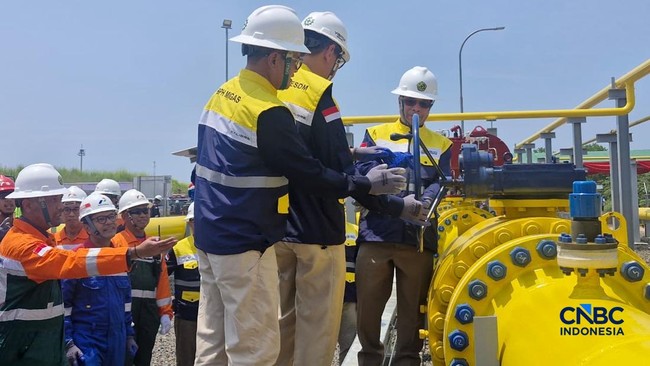
Batang — Indonesia’s Ministry of Energy and Mineral Resources (ESDM) has officially commenced first gas flow (gas-in) for the Cirebon–Semarang (Cisem) Phase II natural gas transmission pipeline project.

The project, valued at Rp 2.7 trillion, marks a significant step in strengthening national energy security while supporting industrial growth.

The inauguration was carried out by Deputy Minister of Energy and Mineral Resources Yuliot Tanjung on Wednesday (March 18, 2026), following the completion of all Engineering, Procurement, and Construction (EPC) works on March 5, 2026, as formalized through the signing of the project handover document (BAST-1).

Yuliot emphasized that the Cisem Phase II project is part of the government’s strategic agenda to achieve energy independence. He added that the infrastructure is expected to accelerate the development of industrial zones, commercial areas, and new economic growth centers across Java.

“The availability of energy will further accelerate growth in regions connected by this critical infrastructure,” Yuliot said during the event in Batang.

Lower Costs, Stronger Industrial Competitiveness​

Yuliot also highlighted that the project’s state budget (APBN)-based financing model plays a key role in maintaining industrial competitiveness. Direct government investment helps reduce gas transportation costs (toll fees), enabling more competitive gas prices for industrial users.


Operational Readiness Confirmed​

At the same event, Director General of Oil and Gas Laode Sulaiman confirmed that the pipeline is fully operational following a series of technical tests, including leak testing.

According to him, the results showed no leakage, indicating that the pipeline is ready to distribute gas to consumers, particularly in western Java.

“The tests confirmed there are no leaks, and the pipeline is ready to operate. We will soon begin supplying gas to consumers in western Java,” Laode stated.
He also noted that several users have already expressed initial commitments to utilize the pipeline, including:

  • Balongan Refinery
  • PT Cikarang Listrindo
  • Other industrial customers
“All technical aspects have been completed. The contractor and construction management teams have performed well,” he added.

Project Overview​

  • Length: ~242 kilometers
  • Status: National Strategic Project (PSN)
  • Construction period: August 6, 2024 – March 5, 2026
  • Total safe working hours: 4.65 million hours
  • Peak workforce: 1,981 workers
  • Local content (TKDN): 60.58%

To view this content we will need your consent to set third party cookies.
For more detailed information, see our cookies page.


Pertamina Jambaran Tiung Biru, East Java, the source of gas of the pipe lines

Future Operations​

The management of the Cisem Phase II pipeline has been assigned to LEMIGAS under Ministerial Decree No. 125.K/MG.01/MEM.M/2026. Going forward, LEMIGAS will collaborate with partners to optimize the utilization of the asset.

Gas supply for the pipeline will be sourced from the Jambaran Tiung Biru (JTB) gas field.


Users who are viewing this thread

Pakistan Defence Latest

Country Watch Latest

Latest Posts

Back
Top