Iranian Air Force (IRIAF/IRGC-ASF) | News and Discussions

Let's assume that article is correct and the FOV beam is only 10° at 350km or even 400km; that 10° beam is still scanning an entire 120° total FOV. That's why that article is a bit deceiving. The reason being is that the radar doesn't only scan in one method, but 2. From the embedded source:

The IRBIS-E was developed by the V V Tikhomirov Research Institute of Instrument Production as an X-waveband multi role radar with a passive phased antenna array (PAA) mounted on a two-step hydraulic drive unit. The two-step electro-hydraulic drive unit turns the antenna mechanically to 60° in azimuth and 120° in roll, while the antenna device scans using an electronically controlled beam in azimuth and angle of elevation in sectors exceeding 60°. By using the electronic control and mechanical additional turn of the antenna, the maximum deflection angle of the beam reaches to 120° - a capability few fighters can boast.

By combining both methods of scanning, the mechanical and electronic, it reaches a total beam angle of 120°.

It also neglects to mention anything about the AESA arrays that supplement the IRBIS-E nor the IRIST SAT which also assists in target detection.

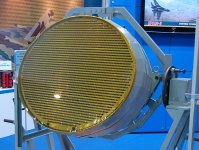
Here's another deceiving element to that article, this picture here where they claim the dial gauges are "metered analogue temperature & coolant gauges" for the IRBIS-E but notice where this is? It's in a testing facility where they're using those gauges to test the temperature and cooling aspects of the radar loool. This isn't the radar when it's in the aircraft? The dish barely fits in the aircraft's huge radome and look at that bracket holding the radar from top to the bottom where the gauges are. That's taller than the inside of the Su-35's radome. Those are only testing gauges as evidenced by where that radar is displayed.

View attachment 38385

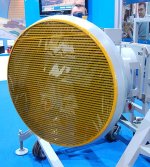
This is the radar mounted in the Su-35's radome. Notice the mechanical angle of the dish? But more important, the size in relation to the radome.

View attachment 38389

Not even close to the one in the testing pic. And see how tight it fits in there? No room for those guages and do you see any gauges? Of course not because why the hell would you need gauges there anyway when you can never see them only when the radom is open which is rarely LOL! Those were testing gauges only. That article is really biased wow!

It conveniently ignores the AESA arrays and touts the Viper's A/N-APG-83's AESA prowess & range while knocking the IRBIS-E's range by telling half-truths about the 10° beam angle FOV and here's another one:

In this picture it claims the following absolute shameful lie & deception:

According to HAL's upgrade package proposal to IAF's Su-30MKI, the IRBIS-E's flight test video where it allegedly detected a single target from 268km but wasn't able to get a track until 100km - all the while having just a single target to track.

View attachment 38387

Guess what, Hack Hook? India's Su-30MKI has the BARS radar, not the ERBIS-E! So why on earth would HAL be making a recommendation for improving the BARS radar using the IRBIS-E? Does that make any sense to you at all? Please be honest LOL!!! It's craaaaaaaaaazzzzyyyy how anti-Russian some of these outfits are. That's fine if the ones writing these sources have a certain bias (heck we all do to a certain point) and if they don't like Russia and want to pump up the US & the west that's also fine. But make an effort to bring honest information. Bring legitimate arguments but don't bring filthy lies, right? lol


I think we've proved that to be completely incorrect.


Well those MiG-29s in the IRIAF are relatively old, and so are their radars. The same could be said about any other older radars & systems. There has been tremendous improvements and developments since.


I think the major unit on the Su-35S that provides the ultimate EW and especially jamming are the Khibiny wingtip pods. Those are integral to the Su-35S as you well know. So if Iran would be getting these, they will have decided on how many of them will carry and operate the wingtip pods to have maximum jamming and EW capability within a flying group of aircraft. Even though they are most likely removable and the missile rails can be affixed instead (or vice-versa), it appears they keep dedicated aircraft supporting the khibiny pods at all times. Just like they do in Russia and just like they were ordered for Egypt 😭 and certainly for Iran.

Su-35S Electronic Warfare & Self Protection Systems

The Su-35S features a robust ECM suite designed to defeat and delay detection across the electromagnetic spectrum including the CKBA L150-35 Pastel RWR, KNIRTI L265M10R Khibiny-M ECM suite, NPK SSP ultraviolet missile approach warning system (MAWS), and six 14-round UV-50 decoy dispensers.[11] These systems complement one another to significantly enhance the Su-35S’ survivability against radar and IR guided AAMs.

If you click on the literature above, it'll take you to the article which has much more detail on the frequency bands the pods work in and against and all sorts of other details such as their effectiveness against the AIM-120's probability of kill. Also on specifics regarding the ERBIS-E. And it's totally unbiased & quite neutral as it also lists the Su-35S's shortcoming. It's not all hunky dory and strawberries & cream and all that mumbo jumbo jive. The article's from American Innovation which is part of a blogspot with references from Janes Defense, Sipri Arms data base which from everything I've read through them has been spot on. So hardly anything remotely close to biased or even Russian propaganda.
The Q is whether the ERBIS-E PESA radar of SU-35 is keeping up with other fighter radar, proliferating. Such as AESA kit for instance.

The same goes for its all-important ECM-suite. I would seriously doubt that Rafale really succeeded in jamming the IRBIS radar as reported during A-A mock combat between these two fighter's

The same goes for SU-35's ECM suite.

Would Russia really send a full-up SU-35 so that opposing countries could determine its strenghts and weakness.

Turning to Iran, while Russia (would) probably sell it such kit that are superior to the usual run of the mill Export equipment, I still have doubts whether aircraft destined for Iran will be Russian Air Force standard planes.

Piet
 
I think we've proved that to be completely incorrect.
no 10 degree scan 400km , 120 degree scan 200km, when the radar is in that 10 degree mode it wont mechanically rotate . when its rotate then the benefit of that 10 degree mode get nulified
 
It is possible Iran could ask for the SU-57 AESA to be incorporated into the SU-35S. I’m not sure the size difference

SU-57 400KM AESA X Band N036 Belka
1715011051896.jpeg

SU-35S IRBIS PESA

1715011112752.jpeg


Btw China added AESA to their own SU-35 domestic upgrade

So hypothetically if Iran can build an AESA radar for fighter jets it could upgrade the SU-35 on their own.
 
no 10 degree scan 400km , 120 degree scan 200km, when the radar is in that 10 degree mode it wont mechanically rotate . when its rotate then the benefit of that 10 degree mode get nulified

There's nothing in that write-up that proves anything about the beam scan reduced to a 10° narrow beam FOV. They're just throwing it out there to see if it sticks. Not even NIIP's release or Tikhomirov's either was there anything suggesting a narrowing beam, not to mention why it would do so in the first place when that radar is arguably the most powerful radar out there ATM with a 20kw output, which could even be argued that with such high power output, that could burn through most jamming signals, especially at long ranges.

And judging by all their other lies and fabrications in that write-up that I listed (which sounds like you agree with those since you didn't mention any of them) it's highly likely they're also blatantly lying about this 10° narrow beam scan.

And the fact that they used those screenshots to suggest India's HAL proposal for a new radar on the IAF's Su-30MKI were from the IRBIS-E, when all of the IAF's radars are the BARS radar shows you how dishonest they are and very likely to be fabricating all the rest of the statistics they claim, including the lie about the analogue gauges on the testing unit.
 
The Q is whether the ERBIS-E PESA radar of SU-35 is keeping up with other fighter radar, proliferating. Such as AESA kit for instance.

The same goes for its all-important ECM-suite. I would seriously doubt that Rafale really succeeded in jamming the IRBIS radar as reported during A-A mock combat between these two fighter's

The same goes for SU-35's ECM suite.

Would Russia really send a full-up SU-35 so that opposing countries could determine its strenghts and weakness.

Turning to Iran, while Russia (would) probably sell it such kit that are superior to the usual run of the mill Export equipment, I still have doubts whether aircraft destined for Iran will be Russian Air Force standard planes.

Piet

The beauty of AESA (and I don't mean to say something here that most fellas already know, but it's only to make my point) is that they generate a lot of scanning power and the greater the scanning power, the greater the detection range. Equally as important is because of the multiple modules acting as transmitters allows that powerful scanning to be done electronically only and in many directions without the need to mechanically steer the main antenna or the radar dish (in layman's terms). But arguably the best thing about AESA is that as a result of so many TR modules electronically transmitting, they're able to transmit in several different radio frequencies and not just one. They bounce from one frequency to the other which makes it extremely difficult to jam. And that's probably the best aspect of AESA.

But if you have a PESA (hybrid) radar which has to mechanically steering but with great output power and at great distances and also scan electronically with the addition of AESA arrays, you're almost at AESA capability. The only drawback is you're not capable of hoping frequencies on the main radar to prevent jamming and so how do you make up for that? You use the L-band frequency on the AESA arrays with the main radar in X band, and if your main radar puts out 20kw of power, your chances of burning through any jamming is great, and that's the ERBIS-E with the AESA wing arrays. Plus that is also all assisted by the powerful top forward IRST scanner.

FYI, breaking news on CNN: Hamas has agreed to Egypt's & Qatar's mediated ceasefire proposal with the zionist to end all hostilities in exchange for the release of all remaining hostages and full aid entry to Gaza. Great news!

I just thought I would share this important breaking news just minutes ago.
 
There's nothing in that write-up that proves anything about the beam scan reduced to a 10° narrow beam FOV. They're just throwing it out there to see if it sticks. Not even NIIP's release or Tikhomirov's either was there anything suggesting a narrowing beam, not to mention why it would do so in the first place when that radar is arguably the most powerful radar out there ATM with a 20kw output, which could even be argued that with such high power output, that could burn through most jamming signals, especially at long ranges.

And judging by all their other lies and fabrications in that write-up that I listed (which sounds like you agree with those since you didn't mention any of them) it's highly likely they're also blatantly lying about this 10° narrow beam scan.

And the fact that they used those screenshots to suggest India's HAL proposal for a new radar on the IAF's Su-30MKI were from the IRBIS-E, when all of the IAF's radars are the BARS radar shows you how dishonest they are and very likely to be fabricating all the rest of the statistics they claim, including the lie about the analogue gauges on the testing unit.
yes ibris-e seems use a different physic than other radars
 
lol, why?
its not an imaging sensor and it can only distinguish 4 hot node and it can't even show the pilot what those hot node are . compare it to what is inside euro-fighter and you get the picture
 
its not an imaging sensor and it can only distinguish 4 hot node and it can't even show the pilot what those hot node are . compare it to what is inside euro-fighter and you get the picture

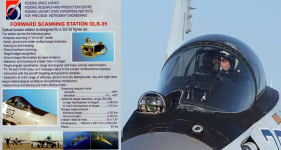
Not an imaging sensor? Are you sure about that? According to the specs, it has TV, IR & TV+IR video and message output to the cockpit's multi-functional display screens and it also has target imaging recognition. So how could it perform all those functions if it doesn't have an imaging sensor?

Click on the pic to enlarge and see the specs.
1715020996473.png

Infrared search and track

The infrared search and track fire control system, OLS-35 IRST, includes an infrared sensor, laser rangefinder, target designator and television camera. The accuracy of the laser rangefinder is 5m CEP (circular error probability), to a maximum range of 20km against airborne targets and 30km against ground targets. The OLS-35 is a high-performance system with ±90° azimuthal and +60°/-15° elevation coverage.


The 20km against airborne targets is different in other sources which goes up to 50km and in some cases listed as 80km for non-afterburning fighters. So there is a distinction to make there if that 20km is for fighters moving in afterburner or not? More likely in afterburner since it doesn't say otherwise. Just wanted to point that possible discrepancy in that pic's information.

I'm pretty sure I know what you're referring to about the Eurofighter, but pls show exactly so we can compare in detail and get down to the nitty gritty, Hacker lol. Bring it, bro!
 
Not an imaging sensor? Are you sure about that? According to the specs, it has TV, IR & TV+IR video and message output to the cockpit's multi-functional display screens and it also has target imaging recognition.

Come on ... Does anyone really believe the specifications of Russian systems?? They are not worth the paper they are written on - you only have look at the poor performance of Russian systems to know their paper specs are just that, paper specs ..
 
Come on ... Does anyone really believe the specifications of Russian systems?? They are not worth the paper they are written on - you only have look at the poor performance of Russian systems to know their paper specs are just that, paper specs ..

Are you suggesting that those general specs are false? If so, then list what isn't accurate and back it up with facts & sources.

"Paper specs not worth the paper they're written on" is all hearsay. It's what's been peddled about Russian equipment since the cold war by Russia's enemies, and they've succeeded at it. Hearsay is he said this, she said that and the truth is always somewhere in between.

Russian tech might not be on the same level as the US and some European, but that doesn't mean it can't hold its own. Russians have done a terrible job at marketing their weapons. Absolutely shameful when you compare it to the US and the way it's brilliant war-marketing strategy developed and evolved. No one here is denying the US' and the west's technological prowess with all the money it's able to spend. But what peer adversary has the US or any Euros really fought? Iraq? Even then the US was fighting it with a massive coalition.

As far as poor Russian performance, I assume you're referring to Ukraine? We talked about that a few pages ago, specifically their losses of the Su-35S. Much of that was due to assigning SEAD roles to that aircraft with single Russian pilots who hardly train on that specific mission tasks to be prepared to deal with a very dense SAM network. All their losses were to SAMs. On top of that, Russian pilots average 100-150 hours of training a year compared to US counterparts with an average of 250+ hours/year. Of course that will have a major impact on the success of the aircraft. And despite all that, Russians have lost a total of only 6 Su-35s since the SMO started up to last month. They've lost other aircraft, too, mostly to SAMs & technical malfunctions. But we're talking about the Su-35S. On the other hand, it's had tremendous air-air success.
 

Users who are viewing this thread

Pakistan Defence Latest

Back
Top