
PakFactor
Elite Member

Let's have a look at the map:
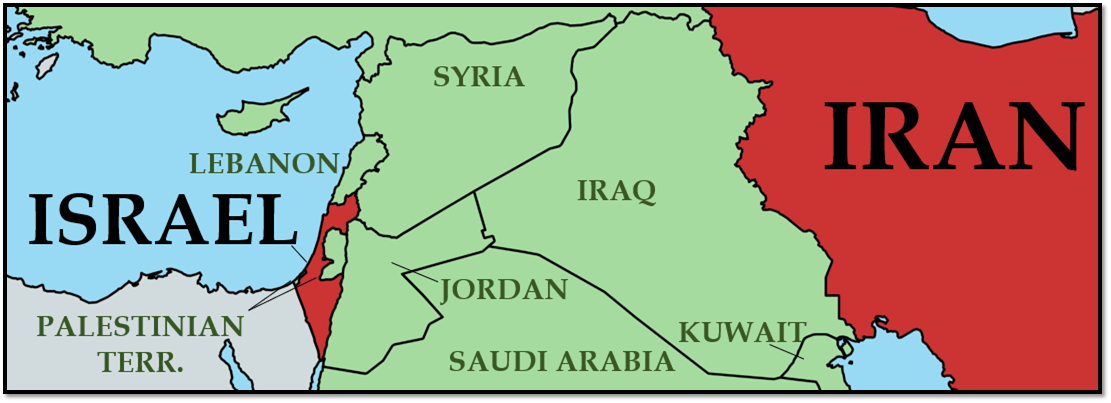
The US has crippled Iraqi defenses in war (Operation Iraqi Freedom), and Israel has crippled Syrian defenses in war (Operation Chess). Both Russia and Iran attempted to improve Syrian defenses and defeat Syrian rebels but failed.
Iran and Israel have long been engaged in the so-called “campaign between wars,” in which both have engaged in covert strikes and proxy warfare. After Hamas’s attack on Israel on October 7, 2023, the campaign between wars escalated. The subsequent months saw a series of high-profile assassinations by Israel targeting key figures in the so-called Resistance Axis, Iran’s network of non-state allies and proxies, as well as senior Islamic Revolutionary Guard Corps (IRGC) commanders. These actions brought the conflict between Iran and Israel out of the shadows and into open confrontation.
After Israel’s bombing of the Iranian consulate in Damascus last April, Iran’s response marked Iran’s first direct military strike against Israel from its own territory. This was intended to establish a new equation in the conflict—one in which Israeli actions against Iranian interests would be met with Iranian military retaliation. Yet, despite the scale of the operation, Israeli strikes continued in the following months, including strikes against Iranian interests in Syria and the assassination of Hamas leader Ismail Haniyeh in Tehran. The assassination of Hezbollah’s secretary general Hassan Nasrallah and IRGC brigadier general Abbas Nilforoushan on September 27 dealt a significant blow to Iran’s alliance network, demonstrating that the deterrence sought by Iran had not materialized as planned. - Link
The orange highlight = Israeli Operation Chess in Syria.
View attachment 98856
I have shed some light on these developments independently in relevant threads before (see this, this, this and this).
With limited warning, Tehran launched its second direct attack against Israel on October 1. This marked a stark departure from the April operation in both its execution and scale. Unlike the earlier strike, which employed a mix of ballistic missiles, drones, and cruise missiles, the October attack was conducted exclusively with ballistic missiles, which was likely intended to reduce advance detection and limit the effectiveness of Israel’s defenses.
In a video statement immediately following the attack, Israeli Prime Minister Benjamin Netanyahu vowed to exact reprisals, stating, “Iran made a big mistake tonight—and it will pay for it.” Although Israel initially considered a stronger response, targeting high-value sites such as nuclear or energy infrastructure, the plan was recalibrated due to U.S. pressure to avoid escalation. Additionally, the U.S. deployment of the Terminal High Altitude Area Defense (THAAD) was potentially an incentive for Israel to focus its retaliation primarily on military sites, while adding a layer of defense in anticipation of Iranian retaliation.
Prior to the Israeli attack, Iran’s Foreign Minister Abbas Araghchi launched a diplomatic mission to rally regional support against allowing Israel’s use of neighboring airspace. Araghchi’s outreach included Lebanon, Syria, Saudi Arabia, Qatar, Iraq, Oman, Jordan, Egypt, and Turkey, including states with traditionally tense relations with Iran, such as Jordan, Egypt, and Bahrain. Though Israel notably avoided Jordanian and Saudi airspace, Iran’s diplomatic outreach ultimately could not prevent an Israeli response.
In its strikes of October 26, Israel claimed to have used over 100 aircraft, including advanced F-15 and F-35 jets. Flying over 2,000 kilometers from Israel, these aircraft allegedly launched air launched ballistic missiles, which are much more challenging than surface-to-surface ballistic missiles for air defenses to intercept. - Link
Israeli Air Force could refuel its jet fighters mid-air above Syria or Iraq before reaching Iran. F-35 also have internal fuel tanks and its true range might be classified. Therefore, Lockheed Martin's disclosure is realistic and British intelligence has pointed out the same. Israel is unlikely to declassify this operation for public analysis anytime soon but GCC intelligence have also disclosed that Israel has probed Iranian defenses before these strikes.
View attachment 98858
Now I have a question for you: Does Iran have an Air Force that could intercept Israeli Air Force over Syria or Iraq?
Dear, I pointed out some technical aspects of the F-35 to you in following post. However, you have emotional claims in every thread and do not seem to learn. I have a realistic take on all themes and my analysis is usually spot on. Here are your facts:
1. Israeli army wiped out in Gaza.
2. Israeli army wiped out at the border of Lebanon.
3. Tel Aviv has fallen and Bibi is captured by Hezbollah.
4. Israel never attacked Iran.
5. Assad setup rules Syria.
6. Houthi sunk American Navy.
Lockheed Martin has often shed light on the performance of its products in military operations. Lockheed Martin has direct feedback from customers because it is crucial for improving its solutions. There is also information sharing among F-35 partners. The British were providing F-35 parts to Israel and British intelligence has pointed out the same.
That is perfectly well stated. Let me add one line item about the Israeli F-35s. They are different from their American counterparts because the Israelis have been allowed unfettered access to improve their features with in-home technology. As you have alluded, they may have an enhanced range with more internal tanks.
The key is your point on the Americans and Israelis pounding the regional countries, rendering them defenseless from the air.


 .
.


