JF-17 - In the Mirror of History

Production and Deliveries
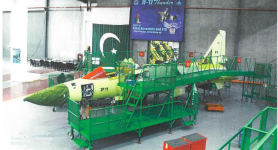
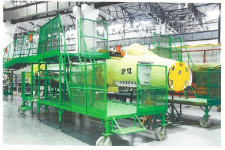
The initial order from the PAF was for eight aircraft. Delivery of the first two pre-production variant JF-17s to the PAF took place in March 2007. The remaining six examples had been delivered by 2008. A further order for 42 aircraft worth about US$800 million was signed in March 2009, and the production of these aircraft was completed in 2013.

Production of the improved Block-II variant JF-17 began in January 2014, with a further 50 examples expected to be produced for the PAF. PAC is also expecting to export the aircraft to a number of potential buyers including Sri Lanka, Kuwait and Qatar, with the first deal to be signed in 2014. CAIG is also currently developing a two-seater fighter-trainer variant of the FC-1/JF-17. However, the PLAAF has shown no interest in acquiring the aircraft.

Design
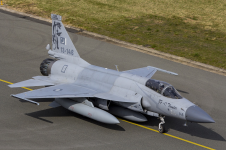
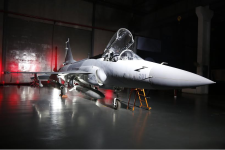
The FC-1/JF-17 adopts a rather conventional aerodynamic layout, with mid-mounted wings, lateral air intakes, single-frame bubble cockpit canopy, and two under-belly stabilising fins. The drag chute bay is located at the root of the rudder. An electronic equipment pod is mounted on the tip of the rudder. The production variant JF-17 features a diffuser supersonic inlet (DSI) similar to those of the U.S. F-35 fighter for better air-intake efficiency.

Radar
The JF-17s in service with the PAF are fitted with an Italian Grifo S-7 multi-track, multi-mode, pulse Doppler radar. The radar has 25 working modes and a non-break-down time of 200 hours, and is capable of “look-down, shoot-down”, as well as for ground strike abilities. Alternatively, the aircraft can be fitted with the Thales RC400, GEC Marconi Blue Hawk, Russian Phazotron Zemchug/Kopyo, and Chinese indigenous KLJ-7 developed by Nanjing Research Institute of Electronics Technology (NRIET).
Cockpit and Avionics
The aircraft’s avionics architecture is supported by two mission computers based on Multi-Bus System (MIL-STD-1553B). The heart of the system is a 32-bit Weapon and Mission management Computer (WMMC) which performs mission computations, flight management, reconfiguration / redundancy management and in-flight system self-test.
  • Navigation – Hybrid inertial navigation system (INS) and global positioning system (GPS);
  • Communications – Independent data link with two Independent wide-band radios with anti-jamming capabilities;
  • Electronic warfare (EW) – Self production jammer, missile approach warning system, radar warning receiver (RWR), chaff & flare dispenser;
  • Identification of Friend and foe (IFF) – IFF interrogator for target verification at the BVR range;
  • ‘Glass’ cockpit – Three large Multifunction Colour Displays (MFD) and smart Heads-Up Display (HUD) with built-in symbol generation capability; HOTAS;
  • Targeting — Laser Designator and Targeting Pod (LDTP) for target illumination and detection with day/ night capabilities;
 
Weapons

Fixed weapon includes a GSh-23 dual-barrel 23mm cannon. Alternatively the aircraft can be fitted with a GSh-30 dual-30mm cannon. There are 7 stores stations, including one under the fuselage, 4 under the wings, and 2 wingtip mounted, with up to 3,700kg weapon payload.

The aircraft is callable of ‘beyond-visual-range’ (BVR) attack capability with the PL-12/SD-10 active radar-homing medium-range air-to-air missile (MRAAM) developed by China Leihua Electronic Technology Research Institute (LETRI, also known as 607 Institute).

The aircraft also carries two short-range AAMs on its wingtip-mounted launch rails. The options include U.S. AIM-9P and Chinese PL-7, PL-8, and PL-9.
For air-to-ground mission the aircraft can carry a range of Chinese and foreign-made weapon systems, including LT-2/LT-3/GBU-16 laser-guided bombs, LS-6 satellite-guided bombs, Brazilian MAR-1 or Chinese LD-10 anti-radiation missiles, and C-802K anti-ship missiles.

The aircraft can carry a special pod allowing day/night delivery of laser-guided weapons. In addition, it can also carry unguided weapons such as low-drag general-purpose (LDGP) bombs and unguided rocket launchers.

Engine

The FC-1/JF-17 is powered by a Russian-made Klimov RD-93 turbofan jet engine rated 49.4kN dry or 84.4kN with afterburning. The RD-93 is a derivation of the RD-33 used by the MiG-29 fighter. In 2007, China signed a contract with Russia to supply 150 RD-93 engines for the JF-17 production.
Liyang Aero Engine Corporation in Guizhou is reportedly developing an indigenous turbofan engine designated WS-13 (or Tianshan-21) as an alterative powerplant option for the FC-1. The engine was said to have been based on the RD-93 design with some modifications.
 
Specifications
DIMENSIONS

Length 14 m
Wingspan 8.5 m (without wingtip missiles)
Height 5.10 m
Wing area 24.4 m2

WEIGHTS
Empty 6,411 kg
Loaded 9,100kg (without wingtip missiles)
Normal take-off 9,100 kg
Max take-off 12,700 kg
Fuel capacity 2,300 kg
Max payload 3,700 kg

PROPULSION
Powerplant 1X Russian Klimov RD-93 turbofan jet engine
Thrust (dry) 49.4kN
Thrust (afterburning) 84.4kN

PERFORMANCE
Max level speed Mach 1.8 (at altitude)
Max climb rate N/A
Service ceiling 16,700 m
Ferry range 3,000 km
Combat radius 1,350 km
In-flight refuelling (Block-I) No; (Block-II) Yes
G limit +8.5/-3

ARMAMENTS
Fixed weapon 23mm or 30mm dual-barrel cannon
External hardpoints 7 (1 under the fuselage centre-line; 4 under the wings; 2 on the wingtips)
Air-to-air missiles PL-8, PL-11, PL-12
Air-to-surface missiles MAR-1, LD-10, C-802K
Bomb LGB (LT-2/LT-3/GBU-16), Satellite -guided bomb (LS-6)
Other Unguided rocket launchers

AVIONICS
Fire-control radar options Grifo S-7 multi-track, multi-mode, pulse Doppler radar;
GEC Marconi Blue Hawk;
Russian Phazotron Zemchug/Kopyo;
Chinese indigenous KLJ-7;
Other
 
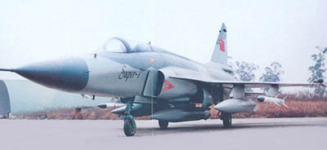
F-7P Sabre II "Super 7" (Chao Qi)

F-7P Sabre II "Super 7" (Chao Qi)

The Super-7 is a development of the F-7, Chengdu's version of the Mikoyan MiG-21 Fishbed.
The upgraded F-7M was to be offered for export by China as a lowcost, new-build replacement for the US-built Northrop F-5, the Soviet MiG-21, and the Chinese F-6 and F-7.

By the early 1980s the PAF was looking for a new fighter to replace the F-6 [Chinese J-6]. Pakistan initiated the Sabre II project which would upgrade the Chengdu F-7M Skybolt with a Western engine and avionics. The early 1980s was characterized by a pronounced improvement in US-Chinese relations.

It was therefore only natural that China became a major market for Western military hardware, in contrast to the years following China's 1949 Communist revolution, when an economic embargo imposed by the West forced China to seek assistance from the Soviet Union.

Grumman and China studied the feasibility of producing substantially improved F-7s using US engines and avionics. The extensively modified version of China's F-7 (MiG-21) fighter, called the Sabre II, would be re-engined and given a new forward fuselage with "solid" nose and side intakes.

The new plane was deep modernization of J-7 fighter. The Sabre II was an F-7 with a General Electric F404 or Pratt & Whitney PW1216 or PW1120 engine producing between 16,0001b and 20,0001b thrust.

The aircraft was equipped with the Westinghouse AN/APG-66 radar (the same as on the F-16 fighter. According to Chinese experts, the combat capabilities of the aircraft "Super 7" must have been closer to the American F-16 fighter.

The "SUPER-7" was the first fighter jet completely designed and manufactured by China. Super-7 (Chao Qi) fighter was a new generation fighter and the first of its kind of China's own intellectual property rights.

The third-generation fighter plane, which can carry 3.8 tons of missiles, also has improved systems for attacking ground targets. Its advanced radar positioning and operating systems give the plane greater flexibility and better close-range manoeuvrability.

The wing area would be enlarged by increasing span (from 23.5ft to 26ft) and chord. Leading-edge slats and combat flaps would be fitted. Two additional hardpoints would be incorporated for Sidewinder-class air-to-air missiles.

The higher thrust and lower wing loading would increase manuverability, while the longer fuselage (stretched from 45.8ft to 49.3ft) would give an 1,1001b increase in fuel capacity and single-point refuelling. The extra fuel and more-efficient turbofan would enhance range and endurance.

The main landing gear would be beefed up, and larger wheels fitted. The nose gear would also be redesigned, and would incorporate nosewheel steering. An arrester hook would be fitted, and the ventral strake would be reshaped.

The cockpit would be changed completely, with a Northrop F-20 Tigershark windscreen and canopy, F-16-type displays and instrumentation, and a new ejection seat. The gaseous oxygen system would be replaced by a higher-capacity liquid oxygen system.

The program was partially funded by Pakistan, which was considered as the main potential customer. The fighter was offered as a low-cost alternative to the F-16 to meet Pakistan's 150-aircraft requirement to replace Chinese-supplied F-6s (MiG-19s). The flyaway cost will be $8-9 million.

Grumman completed a five-month feasibility study in 1987. The American firm had performed preliminary studies and wind tunnel aircraft models.

Grumman, China's Chengdu aircraft factory, China Aero Technology Import-Export Company, the Pakistan Air Force and the Pakistan Aeronautical Complex (PAC) promoted the F-7 modification.

Chengdu would build the revised rear fuselage to a Grumman design, while the US company would build the new forward fuselage. PAC would assemble the aircraft. Several other Western companies were in competition to supply the engine and avionics.

In November 1988 Grumman and the China National Aero Technology Import-Export Corporation (Catic) started a nine month preliminary design study to upgrade Chinese-built Xian F-7M Airguard (MiG-21) fighter/ ground-attack aircraft. But by 1988 Grumman doubted that its proposal will be accepted, but believed that China could become interested in the modified F-7 for its own use.

The joint program to produce the Super 7 fighter was delayed in part because of resource constraints which prevented Beijing from meeting the project's initial R&D costs. Within a few years, project costs had escalated, and by 1989 the program was regarded as posing high financial risk by the PAF, given the 40% increase in the cost of the project. Chinese relations with the West broke down following the suppression of the Tiananmen Square protests in June 1989. Consequently, the "Sabre II" project was cancelled.

In the meantime the US lost interest in Pakistan following the Soviet withdrawal from Afghanistan. The US suddenly focused on Pakistan's nuclear weapons development program, and in 1990 the US imposed military and economic sanctions in the Pressler amendments.

Development of the "Super 7" upgrade was slowed with the end of American technical assistance following the Tienanmen repression of 1989. The PAF opted for a less ambitious option of acquiring the F-7P Skybolt, an upgraded version of the F-7M, to support the fleet of F-7P Skybolts with over a 100 F-16 Fighting Falcons.

By 1993 Saturn's AL-31F, which powers the Sukhoi Su-27 Flanker, had been selected to power the Chinese Chengdu Super-7, which was due to be flown in 1994. The Super-7 was to have been powered by the General Electric F404, but use of the engine was blocked by a US trade embargo.

The Russian powerplant was selected over the Turbo-Union marketed by Rolls-Royce. By 1995 Moscow was willing to assist with a number of Chinese programs, including the Super-7 fighter plane. But even with Russia's help, this aircraft ws not scheduled for delivery until the latter part of the 1990s. Pakistan and China later foreclosed the option of producing F-Super 7 aircraft due to non-availability of engines.

However, Chengdu continued it efforts to improve the F-7M airframe by re-designing air intakes on the sides of the fuselage, hence the name Super-7.

Both the "F-7P" and "Super 7" nomenclature are extremely ambiguous, and seem to refer as much to requirments as to actual specific pieces of hardware. The "F-7P" nomenclature seems to reference the full range of F-7 configurations for Pakistan, and antedates the development of the side inlet design.

Similarly, the "Super 7" nomenclature survived this F-7 derivative configuration, and for a while decended on the essentially unrelated FC-1 "Chao Qi" / JF-17 Thunder program, which Pakistan and China embarked on in the late 1990s.
 
Advanced China fighter aircraft makes test flight

www.chinaview.cn
2006-04-28 18:15:42


06ee5d8cc4ab158baf17f6e765dcdace.jpg


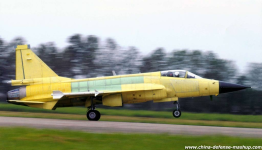
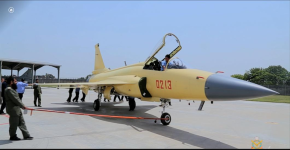
A Xiaolong 04 fighter plane is seen during its test flight at Wenjiang Airport in Chengdu, capital of southwest China's Sichuan Province, April 28, 2006. Xiaolong 04 is an improved home-built multi-purpose light fighter of a new generation. It succeeded in its first flight April 28. (Xinhua Photo)

4b957cd48c735136cedb728eeca3d89e.jpg


A Xiaolong 04 fighter plane is seen during its test flight at Wenjiang Airport in Chengdu, capital of southwest China's Sichuan Province, April 28, 2006. (Xinhua Photo)

150d6aef772038cc2c983d937d684f95.jpg


Photo taken on April 28, 2006 shows a Xiaolong 04 fighter plane at Wenjiang Airport in Chengdu, capital of southwest China's Sichuan Province. (Xinhua Photo)


CHENGDU, April 28 (Xinhua) -- An advanced version of the China-developed new-generation fighter plane, the Xiaolong/FC-4, succeeded in its first flight on Friday in southwest China's Sichuan Province.

Based on previous models, the Xiaolong/FC-1 and FC-3, the FC-4 is equipped with advanced electronics and weapons systems, which improve its combat capabilities, say experts.

The success of the 16-minute test flight marks a significant step in China's aviation industry, and makes mass production possible.

The Xiaolong series is a multipurpose light fighter aircraft developed by the China Aviation Industry Corporation I(CAIC-I), the Chengdu Aircraft Group Corp. and China Aero Technology Import and Export Corporation.

With advanced design and manufacturing technology, this export-oriented fighter plane is small, low in cost and suitable for modern warfare and the demands of military fighters, experts said.

The FC-1 made its successful maiden flight in August 2003, after about four years of development. The plane demonstrated outstanding mobility, and good interception and ground attack capabilities.

The development program for the new-generation fighter aircraftwas officially launched in 1999, led by the CAIC-I, the country's leading operator in the aerospace industry.

http://news.xinhuanet.com/english/2006-04/28/content_4487258.htm
 
Thursday May 11, 2006 (0152 PST)


55a13698f1586004d0bed25c79eb3cb6.jpg

KAMRA: Chief of the Air Staff, Air Chief Marshal Tanvir Mahmood Ahmed flashes victory signs sitting in the cockpit of Prototype-4 of JF-17 aircraft.


ISLAMABAD: The fourth Prototype (PT-4) of JF-17 ’Thunder’ aircraft, jointly produced by China and Pakistan, on Wednesday successfully completed its inaugural flight in Chengdu, China.

Chief of the Air Staff Air Chief Marshal Tanvir Mahmood Ahmed was the chief guest on the occasion.

Other members of the CAS high profile delegation included Air Marshal Rahat Hussain Khan CPD JF-17 and various high ranking officials of PAF and the MOD. The Chinese side was represented by Vice ministers of CONSTING, Presidents of Aviation Industries Corporation-1 (AVIC-1), CATIC, Chengdu Aircraft Design Institute (CADI), Chengdu Aircraft manufacturing Center (CAC) and other high ranking officials.

Speaking at the occasion, the Air Chief congratulated all members of Chengdu Aircraft Design Institute, Chengdu Aircraft Corporation and PAF contingent deployed at milestones achieved for the JF-17 programme so far. He termed that the success of the joint programme as one of the most successful programmes in the recent aviation history.

PT-4 of JF-17 is exclusively developed for avionics and weapons qualification flight testing phase. The advanced 4th generation avionics package of JF-17 aircraft integrates data from multiple sensors using weapons and mission computers and has the ability to evade and degrade the enemy’s sensors using onboard advanced electronic warfare suite.

It would greatly enhance the lethality and survivability of JF-17 aircraft. The advanced man-machine interface helps in presenting the sensors information in an integrated and effective manner, reducing the pilots work load and improving the combat efficiency.

The aircraft is powered by a reliable RD-93 engine, which is equipped with Digital Electronic Engine Control (DEEC) system. High trust to weight ratio and hybrid flight control provide enhance agility and maneuverability in all flight regimes.

JF-17 has a strong night and day surface attack capability including the delivery of PGMs. Its air to air capability includes all aspect Short Range as well as Beyond Visual Rang (BVR) missiles by utilizing Multimode Pulse Doppler Radar.

Addressing the gathering on the occasion, Chief of the Air Staff, Pakistan Air Force said, "the Avionics and weapon qualification flight testing phase on PT-4 would optimize its mission capability aspects in different flight regimes and condition. The finalization of this phase will herald a new era of serial production of aircraft in China and Pakistan." The first batch of operation JF-17 aircraft would arrive in Pakistan in early 2007 while serial production in Pakistan at PAC, Kamra would start in 2008.
 

Users who are viewing this thread

Latest Posts

Back
Top