ghazi52
THINK TANK: CONSULTANT


- Thread starter
- #46
Production and Deliveries
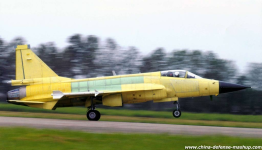
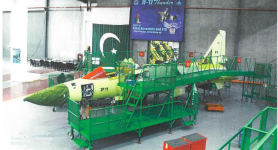
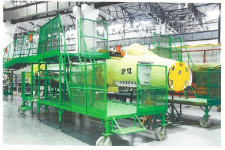
The initial order from the PAF was for eight aircraft. Delivery of the first two pre-production variant JF-17s to the PAF took place in March 2007. The remaining six examples had been delivered by 2008. A further order for 42 aircraft worth about US$800 million was signed in March 2009, and the production of these aircraft was completed in 2013.
Production of the improved Block-II variant JF-17 began in January 2014, with a further 50 examples expected to be produced for the PAF. PAC is also expecting to export the aircraft to a number of potential buyers including Sri Lanka, Kuwait and Qatar, with the first deal to be signed in 2014. CAIG is also currently developing a two-seater fighter-trainer variant of the FC-1/JF-17. However, the PLAAF has shown no interest in acquiring the aircraft.
Design
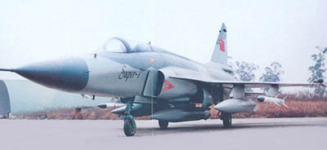
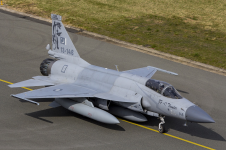
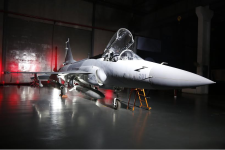
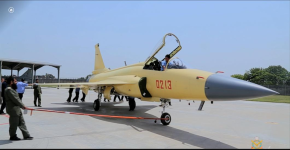
The FC-1/JF-17 adopts a rather conventional aerodynamic layout, with mid-mounted wings, lateral air intakes, single-frame bubble cockpit canopy, and two under-belly stabilising fins. The drag chute bay is located at the root of the rudder. An electronic equipment pod is mounted on the tip of the rudder. The production variant JF-17 features a diffuser supersonic inlet (DSI) similar to those of the U.S. F-35 fighter for better air-intake efficiency.
Radar
The JF-17s in service with the PAF are fitted with an Italian Grifo S-7 multi-track, multi-mode, pulse Doppler radar. The radar has 25 working modes and a non-break-down time of 200 hours, and is capable of “look-down, shoot-down”, as well as for ground strike abilities. Alternatively, the aircraft can be fitted with the Thales RC400, GEC Marconi Blue Hawk, Russian Phazotron Zemchug/Kopyo, and Chinese indigenous KLJ-7 developed by Nanjing Research Institute of Electronics Technology (NRIET).
Cockpit and Avionics
The aircraft’s avionics architecture is supported by two mission computers based on Multi-Bus System (MIL-STD-1553B). The heart of the system is a 32-bit Weapon and Mission management Computer (WMMC) which performs mission computations, flight management, reconfiguration / redundancy management and in-flight system self-test.
The initial order from the PAF was for eight aircraft. Delivery of the first two pre-production variant JF-17s to the PAF took place in March 2007. The remaining six examples had been delivered by 2008. A further order for 42 aircraft worth about US$800 million was signed in March 2009, and the production of these aircraft was completed in 2013.
Production of the improved Block-II variant JF-17 began in January 2014, with a further 50 examples expected to be produced for the PAF. PAC is also expecting to export the aircraft to a number of potential buyers including Sri Lanka, Kuwait and Qatar, with the first deal to be signed in 2014. CAIG is also currently developing a two-seater fighter-trainer variant of the FC-1/JF-17. However, the PLAAF has shown no interest in acquiring the aircraft.
Design
The FC-1/JF-17 adopts a rather conventional aerodynamic layout, with mid-mounted wings, lateral air intakes, single-frame bubble cockpit canopy, and two under-belly stabilising fins. The drag chute bay is located at the root of the rudder. An electronic equipment pod is mounted on the tip of the rudder. The production variant JF-17 features a diffuser supersonic inlet (DSI) similar to those of the U.S. F-35 fighter for better air-intake efficiency.
Radar
The JF-17s in service with the PAF are fitted with an Italian Grifo S-7 multi-track, multi-mode, pulse Doppler radar. The radar has 25 working modes and a non-break-down time of 200 hours, and is capable of “look-down, shoot-down”, as well as for ground strike abilities. Alternatively, the aircraft can be fitted with the Thales RC400, GEC Marconi Blue Hawk, Russian Phazotron Zemchug/Kopyo, and Chinese indigenous KLJ-7 developed by Nanjing Research Institute of Electronics Technology (NRIET).
Cockpit and Avionics
The aircraft’s avionics architecture is supported by two mission computers based on Multi-Bus System (MIL-STD-1553B). The heart of the system is a 32-bit Weapon and Mission management Computer (WMMC) which performs mission computations, flight management, reconfiguration / redundancy management and in-flight system self-test.
- Navigation – Hybrid inertial navigation system (INS) and global positioning system (GPS);
- Communications – Independent data link with two Independent wide-band radios with anti-jamming capabilities;
- Electronic warfare (EW) – Self production jammer, missile approach warning system, radar warning receiver (RWR), chaff & flare dispenser;
- Identification of Friend and foe (IFF) – IFF interrogator for target verification at the BVR range;
- ‘Glass’ cockpit – Three large Multifunction Colour Displays (MFD) and smart Heads-Up Display (HUD) with built-in symbol generation capability; HOTAS;
- Targeting — Laser Designator and Targeting Pod (LDTP) for target illumination and detection with day/ night capabilities;