Pakistan Afghanistan Relations

Strategically, the cost extends beyond lost revenue. Pakistan’s diminished presence in Afghanistan’s marketplace creates openings for other actors to expand their influence. Chinese goods, already prominent in Afghan bazaars, are likely to fill the vacuum left by Pakistan’s withdrawal. Central Asian republics, too, may reorient trade away from Pakistan toward Iran or alternative corridors supported by Russia or China.

In essence, a vacuum created by non-interdependence is rarely empty; it is occupied — often in ways that weaken Pakistan’s regional leverage, and its strategic “Vision Central Asia” policy framework.

Complicating matters is the nature of Afghanistan’s interim government. The Islamic Emirate, lacking democratic legitimacy and broad public consent, is ill-positioned to negotiate on core issues such as refugee repatriation and formalized trade agreements.

This political void has left Pakistani policymakers with a paradox: demanding cooperation from a regime that neither commands strong internal control nor faces accountability to its populace. This mismatch in expectations has produced strategic misalignments that weaken diplomatic responses rather than strengthen them.
 
The energy sector illustrates another dimension of interdependence. Pakistan relies on Afghan coal supplies for parts of its energy mix. Disrupted supply chains threaten to inflate energy costs domestically, adding pressure to an economy already grappling with inflation.

Higher energy costs ripple through the economy, increasing production costs for industry and transportation, and ultimately contributing to higher prices for consumers. This interconnectedness is not discretionary; it reflects an economic reality that isolation cannot erase.

The costs are equally severe for Afghanistan. As a landlocked country, Afghanistan depends heavily on Pakistani ports and transit routes to access goods from South Asia and the rest of the world. With formal crossings closed, Kabul has resorted to air cargo links for trade with partners like India.

While this workaround maintains a minimal level of commercial activity, it is neither cost-efficient nor scalable for an economy struggling with limited foreign exchange reserves and high logistics costs.

Access to the sea is far more than convenience; it is the lifeline of trade. Pakistan’s Gwadar and Karachi ports provide Afghanistan with its principal gateways to global supply chains.

The absence of reliable land transit inflates import costs for essential commodities including medicine worth of nearly $200 million, industrial inputs, and consumer goods — items that ordinary Afghans increasingly struggle to afford. Broken trade arteries also isolate Afghan producers who lack alternate viable routes to export their goods.
 
To be sure, security concerns remain real and pressing. No sovereign state should tolerate cross-border militancy. But treating non-interdependence as a solution is to confuse symptom management with cure. Isolation in a hyper-connected region is not solidity; it is brittle fragility.

The enduring lesson of history is blunt: borders can be closed for guns, but not for goods, people, or ideas. True stability will come not from walls or barriers, but from pragmatic cooperation rooted in mutual interest. Security mechanisms, joint patrols, intelligence sharing and economic dialogue are far more likely to defuse tensions than economic decoupling that deepens grievances.
 

Without supreme commander’s sanction, it’s chaos, not jihad: Afghan official​

Declares cross-border attacks without Taliban approval forbidden, funeral rites to be denied to violators

Shahabullah Yousafzai
January 30, 2026


afghan taliban patrol near the afghanistan pakistan border in spin boldak kandahar province on october 15 photo reuters


Afghan Taliban patrol near the Afghanistan-Pakistan border in Spin Boldak, Kandahar Province on October 15. Photo: Reuters

A district administrator in Afghanistan's Wardak province has warned armed individuals that they cannot carry out operations in Pakistan without official authorisation from the Islamic Emirate of Afghanistan.

Mufti Ali Marjan Majrokh, District Administrator and Police Chief of Daimirdad district, told religious scholars and local residents in Maidan Wardak that "without the command of Ameer ul Momineen Sheikh Haibatullah Akhund, jihad becomes chaos, and death is meaningless."

Majrokh said that traveling across the border to engage in fighting without permission from the leadership of the Islamic Emirate is both illegal and religiously forbidden. He added that such actions would render the jihad illegitimate and any resulting death "unlawful" under Islamic law.

Majrokh stated that under Islamic law, the bodies of anyone killed in unauthorised fighting brought back to Afghanistan would not receive funeral prayers, and no condolence gatherings or memorials would be permitted.

The announcement comes amid heightened tensions between Pakistan and Afghanistan over border security and Tehreek-e-Taliban Pakistan (TTP) activity. It reflects the Islamic Emirate's policy that Afghan territory should not be used for operations against neighbouring countries.
 

Afghanistan-Pakistan dialogue held in Türkiye amid efforts to ease tensions​


The Frontier Post

Afghanistan-Pakistan-810x486.jpg


(Ariana News): Representatives from Afghanistan and Pakistan met in Istanbul this week for the second round of the Afghanistan-Pakistan Track 1.5 Dialogue Process, as both sides seek to improve communication amid ongoing tensions between the neighboring countries.

The talks, held on June 8-9, were organized by the Turkish humanitarian organization IHH Humanitarian Relief Foundation and brought together participants in what organizers described as a constructive and cordial atmosphere.

According to IHH, the dialogue aims to promote mutual understanding, build trust and encourage cooperation between Afghanistan and Pakistan, with the broader goal of supporting regional stability and prosperity.

The organization said the process provides an informal platform for discussion and engagement between the two countries and could help strengthen communication on issues of shared concern.

Türkiye and Qatar also played facilitating roles in the dialogue.

IHH expressed hope that continued meetings would contribute to reducing tensions, expanding cooperation and fostering greater understanding between the two sides.
 

Pakistan allows 26 WFP aid containers to enter Afghanistan via Torkham​


The Frontier Post

containers.jpg


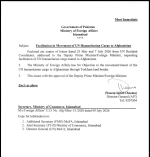
KABUL (Pajhwok): Pakistani customs authorities have cleared 26 containers carrying food and other humanitarian supplies for the World Food Programme (WFP) to enter Afghanistan through the Torkham crossing.

According to Pakistan’s Dawn newspaper, the containers were cleared on Monday evening (July 13) after completing customs formalities, including electronic scanning.

Representatives of customs clearance companies said the containers arrived at the Torkham import terminal on Monday morning but remained there until the end of the day pending a final decision by Pakistani authorities.

They added that, after receiving clearance, the drivers were informed they would be allowed to cross into Afghanistan on Tuesday.

The shipment consists of food and other essential relief supplies being delivered as part of the WFP’s humanitarian assistance for the Afghan people.

The Torkham crossing, one of the busiest trade and transit routes between Afghanistan and Pakistan, has remained closed to regular traffic since October 2025 due to tensions between the two countries.

The Islamic Emirate of Afghanistan has not yet commented on the development.
 

Transit trade with Kabul hits historic low

Mubarak Zeb Khan
July 19, 2026

1784469873348.png


Falls to 11,592 containers worth $367m in FY26
• Afghanistan increasingly relies on Iran, Central Asian trade routes
• Reverse transit collapses from $454m in FY25 to just $7m


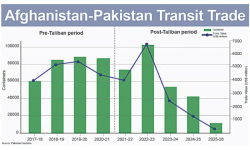
ISLAMABAD: Afghanistan-Pakistan transit trade has suffered one of its steepest declines, plunging to just 11,592 containers worth $367 million in the outgoing fiscal year from nearly 89,000 containers valued at $5 billion before the Taliban returned to power, as Kabul’s growing reliance on Iranian routes and Pakistan’s border curbs reshaped the decades-old trade corridor.

At first glance, the collapse appears to validate the widely held view that Pakistan’s decision to close its border with Afghanistan in October 2025 over security concerns brought bilateral transit trade to a standstill.

However, while the border closure undoubtedly accelerated the decline, data shows that transit trade had already begun losing momentum well before Islamabad adopted its most strict restrictions.

Trade analysts say the border closure did not initiate Kabul’s search for alternative trade routes. Rather, it marked the culmination of a strategy the Afghan Taliban had already begun to reduce Afghanistan’s dependence on Pakistani ports.

Kabul has pursued a deliberate policy of expanding trade through Iran and strengthening commercial links with Central Asian neighbours. Pakistan served for decades as Afghanistan’s cheapest and principal gateway to international markets.

The latest transit trade data show that Afghan transit through Pakistan expanded steadily during the period of the democratically elected government. Container traffic increased from about 60,500 containers in FY17 to nearly 89,000 containers in FY21, immediately before the Taliban returned to power.

This growth occurred despite often strained political relations between Pakistan and the government of former Afghanistan president Ashraf Ghani.
 
Although diplomatic ties remained tense, Kabul continued to rely on Pakistani ports as its primary gateway for international trade and did not discourage importers from using them. One reason may have been to help Afghan businesses import essential goods at lower transport costs and limit inflationary pressure in a highly import-dependent economy.

Following the Taliban’s return to power, transit cargo via Pakistan initially recovered, with container traffic reaching 102,886 and cargo valued at $6.7bn in FY23.

However, this marked the peak rather than the start of sustained growth. Transit volumes fell to 54,114 containers in FY24 and 42,959 containers worth $1.36bn in FY25, well before Pakistan closed the border in October 2025.

The decline suggests that the Taliban had already begun diverting part of Afghanistan’s trade to alternative routes before Islamabad’s decision to close the border on security grounds
 
Reverse transit

The collapse in reverse transit was even more dramatic. Reverse transit, which allows Afghan exports to reach third countries, particularly India, through the Wagah border and Karachi ports, fell from $454m in FY25 to just $7m in FY26, bringing a decades-old trade corridor almost to a halt.

However, while the Taliban managed to secure alternative import routes, especially through Iran, the shift came at a high economic cost.

According to the World Bank’s Afghanistan Economic Monitor 2026, Afghanistan’s imports rose 15pc to $13.2bn in FY25. Iran emerged as the largest source of imports with a 31.3pc share, while Iran’s direct and transit corridors accounted for 48.6pc of Afghanistan’s total imports, highlighting growing reliance on Iranian routes.

This diversion reduced Pakistan’s leverage but carried economic costs for Afghanistan. The country lost export opportunities, particularly for agricultural products and coal, while longer and more expensive supply routes increased import costs, adding to inflationary pressure on businesses and consumers.
 
The World Bank notes that prolonged closures of key Pakistan border crossings, coupled with conflict and geopolitical tensions in the Middle East, have weakened Afghanistan’s external trade by disrupting traditional transit routes and increasing transport and logistics costs. The diversion of trade away from Pakistan has also imposed high costs on Afghanistan’s economy through lower revenue collection and falling exports in FY25.

Traders report sharp increases in the prices of essential goods, including rice, vegetable ghee and pharmaceutical products, as imports are increasingly routed through longer and more expensive corridors.

The higher transport and logistics costs are ultimately passed on to consumers, adding to inflationary pressure. The burden falls disproportionately on eastern and southern Afghanistan, particularly Pakhtun communities that have traditionally relied on Pakistani goods and cross-border commerce.

The economic disruption extends beyond higher consumer prices. The near-collapse of transit trade has affected thousands of people whose livelihoods depend on cross-border commerce, including truck drivers, loaders, customs clearing agents, warehouse workers and other semi-skilled labourers.

Reduced commercial activity has also translated into fewer employment opportunities and lower household incomes on both sides of the border.
 

Users who are viewing this thread

Pakistan Defence Latest

Country Watch Latest

Back
Top