Pakistan External Debt

The problem is not “hybrid.” The problm is 75 years of weak institutions, zero reforms, political ego and constant instability. Pakistan will recover when reforms matter more than narratives, not when every crisis is conveniently blamed on whoever is in power at the moment.
The problem is 'hybrid', but the problem is from 1958. And includes all governments. PTI, PMNL, PPP and the non hybrid pure military governments.Here's my analysis:Sanctions, military coupé, war, war, war.But now, some good news.What is Pakistan achieving in 2025 under PM Shehbaz Sharif?
Date
Event

01/01/2025​
Pakistan Stock Exchange (PSX) breaks new record for the 72nd time, closing at 117,008.08.
If the PSK is breaking so many records, why is the only one IPO in the last six months of Image REIT for around 3 million USD. Your business leaders are not ready to put their money where your government's mouth is.
 
@Pakistan Space Agency

PSA sb,

This is how data was and still is manipulated (luckily much less now):

Fair point. And it might be useful to have a new thread with a comprehensive compendium of comparable numbers - pertaining to reserves, debt, CAD, Fisc deficit, growth etc- across the last 30 years or so.

Regards
 
You’re claiming the numbers are “incorrect” but you haven’t produced a single alternative figure from the State Bank, the Finance Ministry, or any credible dataset. Official data show a very large current account deficit in FY2017‑18, SBP reserves in the single‑digit billions by mid‑2018, and a fiscal deficit in the mid‑5%‑of‑GDP range, all of which are consistent with the figures quoted. Pointing out that politicians sometimes cherry‑pick between SBP vs total reserves, goods vs goods‑plus‑services, or total vs government external debt is fine, but that does not magically make these specific numbers false; it just shows you’re dodging the question instead of engaging with the actual data.
Fantastic. You're the first person who actually has asked me to provide figures from official datasets. Normally figures from official datasets are shot down straight away on this forum if they don't suite the narrative.

Also, I did not try to imply that you were mischievous when I pointed out one of the figures as incorrect. That's due to the AI program generating a number from some article..

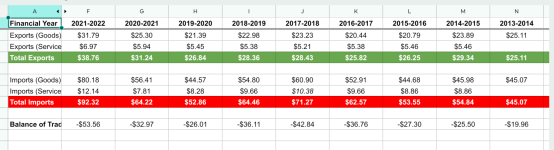
Imports and exports for financial years beginning 2013-2014 to 2021-2022.

Screenshot_20251205-094505.Sheets.png
The above screenshot is from my own spreadsheet. Monthly data collected over years. The data is mainly from Pakistan Bureau of Statistics.

You will need to click on "Monthly Summary" to get the data for the last 5 years, and you will find the historical figures under "Publications". (For the data for the missing months, I found the information from the Ministry of Commerce originally).

Both website have been updated very recently so I'm still trying to get used to navigating around it.

Foreign Reserves
Week Ending
Reserves with SBP
Reserves with Banks
Total liquid FX Reserves
01/06/2018$10.0416 billion$6.378 billion$16.4196 billion
08/04/2022$10.8496 billion$6.1785 billion$17.0281 billion

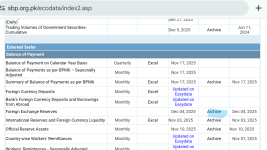
The above figures are from State Bank of Pakistan website. Select the Economic Date tab at the top. Scroll down to the Balance of Payment section. Select the Archive section against Foreign Exchange Reserves.

Screenshot_20251205-123954.Chrome.png

The spreadsheet that opens has 3 tabs - Year-End, Month-End and Week-end.

Pakistan's External Debt

Government
Quarter
Months
Year
Debt
Caretaker/PML-N​
Q4​
Apr-Jun​
2013​
$60.899 billion​
PML-N​
Q1​
Jul-Sept​
2013​
$61.854 billion​
PML-N​
Q2​
Oct-Dec​
2013​
$60.814 billion​
PML-N​
Q3​
Jan-Mar​
2014​
$61.691 billion​
PML-N​
Q4​
Apr-Jun​
2014​
$65.268 billion​
PML-N​
Q1​
Jul-Sept​
2014​
$63.960 billion​
PML-N​
Q2​
Oct-Dec​
2014​
$64.563 billion​
PML-N​
Q3​
Jan-Mar​
2015​
$62.715 billion​
PML-N​
Q4​
Apr-Jun​
2015​
$65.170 billion​
PML-N​
Q1​
Jul-Sept​
2015​
$66.456 billion​
PML-N​
Q2​
Oct-Dec​
2015​
$68.896 billion​
PML-N​
Q3​
Jan-Mar​
2016​
$70.358 billion​
PML-N​
Q4​
Apr-Jun​
2016​
$73.945 billion​
PML-N​
Q1​
Jul-Sept​
2016​
$75.762 billion​
PML-N​
Q2​
Oct-Dec​
2016​
$75.936 billion​
PML-N​
Q3​
Jan-Mar​
2017​
$77.908 billion​
PML-N​
Q4​
Apr-Jun​
2017​
$83.477 billion​
PML-N​
Q1​
Jul-Sept​
2017​
$85.623 billion​
PML-N​
Q2​
Oct-Dec​
2017​
$89.317 billion​
PML-N​
Q3​
Jan-Mar​
2018​
$92.293 billion​
PML-N/Caretaker​
Q4​
Apr-Jun​
2018​
$95.237 billion​
Caretaker/PTI​
Q1​
Jul-Sept​
2018​
$96.111 billion​
PTI​
Q2​
Oct-Dec​
2018​
$99.182 billion​
PTI​
Q3​
Jan-Mar​
2019​
$105.976 billion​
PTI​
Q4​
Apr-Jun​
2019​
$106.349 billion​
PTI​
Q1​
Jul-Sept​
2019​
$107.235 billion​
PTI​
Q2​
Oct-Dec​
2019​
$110.848 billion​
PTI​
Q3​
Jan-Mar​
2020​
$110.035 billion​
PTI​
Q4​
Apr-Jun​
2020​
$113.013 billion​
PTI​
Q1​
Jul-Sept​
2020​
$114.087 billion​
PTI​
Q2​
Oct-Dec​
2020​
$117.134 billion​
PTI​
Q3​
Jan-Mar​
2021​
$116.307 billion​
PTI​
Q4​
Apr-Jun​
2021​
$122.292 billion​
PTI​
Q1​
Jul-Sept​
2021​
$127.163 billion​
PTI​
Q2​
Oct-Dec​
2021​
$130.685 billion​
PTI​
Q3​
Jan-Mar​
2022​
$129.180 billion​

The above data is also from the State Bank of Pakistan website. Select the Economic Date tab at the top. Scroll down to the Pakistan's Debt Profile section. Select the Archive section against Pakistan's External Debt and Liabilities - Outstanding.

The spreadsheet has 4 tabs at the bottom (that's changed from the last time I checked). Two of the tabs where the above data is from are Old Archive and New Archive. (It's possible some of the figures may have been revised by a few thousand dollars - I've not had the chance to review them yet).
 
Usually, I found this user incapable of abstraction or of understanding epistemic truth, and any engagement with him beyond data and number crunching undermined his ability to develop scientific understanding.
We're going all philosophical now are we? Maybe you shouldn't go around claiming numbers and then trying to justify them with theories.
 
To view this content we will need your consent to set third party cookies.
For more detailed information, see our cookies page.


Dr. Kaiser Bengali Podcast
 
So this
The problem is 'hybrid', but the problem is from 1958. And includes all governments. PTI, PMNL, PPP and the non hybrid pure military governments.Here's my analysis:Sanctions, military coupé, war, war, war.But now, some good news.What is Pakistan achieving in 2025 under PM Shehbaz Sharif?

If the PSK is breaking so many records, why is the only one IPO in the last six months of Image REIT for around 3 million USD. Your business leaders are not ready to put their money where your government's mouth is.
So this whole Maryam propaganda thing Harold governance is what is driving people to support pmln is blown to dust
 
Fantastic. You're the first person who actually has asked me to provide figures from official datasets. Normally figures from official datasets are shot down straight away on this forum if they don't suite the narrative.

Also, I did not try to imply that you were mischievous when I pointed out one of the figures as incorrect. That's due to the AI program generating a number from some article..

Imports and exports for financial years beginning 2013-2014 to 2021-2022.

View attachment 163678
The above screenshot is from my own spreadsheet. Monthly data collected over years. The data is mainly from Pakistan Bureau of Statistics.

You will need to click on "Monthly Summary" to get the data for the last 5 years, and you will find the historical figures under "Publications". (For the data for the missing months, I found the information from the Ministry of Commerce originally).

Both website have been updated very recently so I'm still trying to get used to navigating around it.

Foreign Reserves
Week Ending
Reserves with SBP
Reserves with Banks
Total liquid FX Reserves
01/06/2018$10.0416 billion$6.378 billion$16.4196 billion
08/04/2022$10.8496 billion$6.1785 billion$17.0281 billion

The above figures are from State Bank of Pakistan website. Select the Economic Date tab at the top. Scroll down to the Balance of Payment section. Select the Archive section against Foreign Exchange Reserves.

View attachment 163704

The spreadsheet that opens has 3 tabs - Year-End, Month-End and Week-end.

Pakistan's External Debt

Government
Quarter
Months
Year
Debt
Caretaker/PML-N​
Q4​
Apr-Jun​
2013​
$60.899 billion​
PML-N​
Q1​
Jul-Sept​
2013​
$61.854 billion​
PML-N​
Q2​
Oct-Dec​
2013​
$60.814 billion​
PML-N​
Q3​
Jan-Mar​
2014​
$61.691 billion​
PML-N​
Q4​
Apr-Jun​
2014​
$65.268 billion​
PML-N​
Q1​
Jul-Sept​
2014​
$63.960 billion​
PML-N​
Q2​
Oct-Dec​
2014​
$64.563 billion​
PML-N​
Q3​
Jan-Mar​
2015​
$62.715 billion​
PML-N​
Q4​
Apr-Jun​
2015​
$65.170 billion​
PML-N​
Q1​
Jul-Sept​
2015​
$66.456 billion​
PML-N​
Q2​
Oct-Dec​
2015​
$68.896 billion​
PML-N​
Q3​
Jan-Mar​
2016​
$70.358 billion​
PML-N​
Q4​
Apr-Jun​
2016​
$73.945 billion​
PML-N​
Q1​
Jul-Sept​
2016​
$75.762 billion​
PML-N​
Q2​
Oct-Dec​
2016​
$75.936 billion​
PML-N​
Q3​
Jan-Mar​
2017​
$77.908 billion​
PML-N​
Q4​
Apr-Jun​
2017​
$83.477 billion​
PML-N​
Q1​
Jul-Sept​
2017​
$85.623 billion​
PML-N​
Q2​
Oct-Dec​
2017​
$89.317 billion​
PML-N​
Q3​
Jan-Mar​
2018​
$92.293 billion​
PML-N/Caretaker​
Q4​
Apr-Jun​
2018​
$95.237 billion​
Caretaker/PTI​
Q1​
Jul-Sept​
2018​
$96.111 billion​
PTI​
Q2​
Oct-Dec​
2018​
$99.182 billion​
PTI​
Q3​
Jan-Mar​
2019​
$105.976 billion​
PTI​
Q4​
Apr-Jun​
2019​
$106.349 billion​
PTI​
Q1​
Jul-Sept​
2019​
$107.235 billion​
PTI​
Q2​
Oct-Dec​
2019​
$110.848 billion​
PTI​
Q3​
Jan-Mar​
2020​
$110.035 billion​
PTI​
Q4​
Apr-Jun​
2020​
$113.013 billion​
PTI​
Q1​
Jul-Sept​
2020​
$114.087 billion​
PTI​
Q2​
Oct-Dec​
2020​
$117.134 billion​
PTI​
Q3​
Jan-Mar​
2021​
$116.307 billion​
PTI​
Q4​
Apr-Jun​
2021​
$122.292 billion​
PTI​
Q1​
Jul-Sept​
2021​
$127.163 billion​
PTI​
Q2​
Oct-Dec​
2021​
$130.685 billion​
PTI​
Q3​
Jan-Mar​
2022​
$129.180 billion​

The above data is also from the State Bank of Pakistan website. Select the Economic Date tab at the top. Scroll down to the Pakistan's Debt Profile section. Select the Archive section against Pakistan's External Debt and Liabilities - Outstanding.

The spreadsheet has 4 tabs at the bottom (that's changed from the last time I checked). Two of the tabs where the above data is from are Old Archive and New Archive. (It's possible some of the figures may have been revised by a few thousand dollars - I've not had the chance to review them yet).
Ok, so lets start from the top:
Saying official datasets are shot down on the forum is both without evidence and also is deflection. Pointing to supposed bias on the forum avoids engaging with whether these figures align with actual published data. It’s rhetorical misdirection that tries to frame disagreement as persecution, not verification.

Regarding the use of import export data as figures you are omitting an aspect. This is goods trade data ONLY. Trying to link it to account deficit, which also includes services, income, and transfers is trying to explain a bad car away with saying it has a great stereo.
Next, we know very well that PBS does not adjust for methodology revisions - what context is that data provided in?
Your “imports/exports” sheet? It only covers goods, not the current account. The original post referred to the current account deficit, which includes services, primary income, and secondary transfers. CEIC, Karandaaz, TradingEconomics, etc who have actually looked at SBP’s Balance of Payments Summary all talk to those extra items which swung the deficit well beyond the visible trade gap by FY2017‑18. Leaving them out doesn’t make the data “different”; it makes your extraction incomplete.

Your table lists total liquid reserves (SBP + bank holdings) - that is not the metric to asses macro vulnerability... only the SBP liquid reserves are. In mid‑2018, SBP reserves were around $9.8–10.1 billion and using the “total” figure ($16.4B) to contest this is misleading because commercial banks’ holdings are not available to the state for intervention in balance‑of‑payments crises. The whole reason macroeconomists focus on the SBP component is because commercial banks’ dollars aren’t deployable for external payments or exchange‑rate defense. The distinction is elementary macroeconomics for even the casual reader like me who happens to remember a few things from his MBA classes. Pretending otherwise is like counting your neighbor’s cash when balancing your own checkbook.

Even in the next table you mislead on context - sure the data is correct from SBP but gross external debt rose sharply between mid‑2013 and mid‑2018 by roughly $34B, or over 50% which is confirming, not refuting, the magnitude of the fiscal deterioration mentioned in the original. So you seem to be projecting when you say people are fudging figures when you are giving only half the story to do so yourself.
Even if we give the benefit of the doubt then whither the maturity structure, or the net debt impact after asset movements which are all all crucial to substantiate claims about “incorrect” numbers.

So if the goal here was to show the data from PTI or anyone other than PML(N) are “incorrect,” this does the opposite. What you’ve posted are supporting exhibits mislabeled as rebuttals. The only thing the screenshots prove is that official data still align with the original numbers and more so (it seems to this casual reader) that you didn’t check which variables correspond to which macro indicators before pasting them.

Even when cross‑checked against completely independent aggregators that scrape SBP’s own tables, the story doesn’t change from SBP reserves in mid‑2018 beingin the high‑single‑digit/low‑double‑digit billions, with banks holding another ~6–7B, and total liquid reserves sit in the mid‑teens. If someone wants to argue the numbers are ‘wrong,’ they now have to explain why SBP and every major data service built on SBP are all identically ‘wrong’ while their hand‑built spreadsheet is somehow uniquely correct.
 
Ok, so lets start from the top:
Saying official datasets are shot down on the forum is both without evidence and also is deflection. Pointing to supposed bias on the forum avoids engaging with whether these figures align with actual published data. It’s rhetorical misdirection that tries to frame disagreement as persecution, not verification.
Brother, this is the first time myself and yourself are having an engagement on economic data.

I've had the same discussions, arguments and debates with countless others on this forum over the years with many. So it's an honour for me.

I don't feel like I necessary foot me to provide evidence of my conversations with other members on this forum.

Regarding the use of import export data as figures you are omitting an aspect. This is goods trade data ONLY. Trying to link it to account deficit, which also includes services, income, and transfers is trying to explain a bad car away with saying it has a great stereo.
I wasn't trying to explain Current Account Deficit or Current Account Surplus but rather how the export and import figures are manipulated.

Next, we know very well that PBS does not adjust for methodology revisions - what context is that data provided in?
As above.

Your “imports/exports” sheet? It only covers goods, not the current account.
As above.

The original post referred to the current account deficit, which includes services, primary income, and secondary transfers. CEIC, Karandaaz, TradingEconomics, etc who have actually looked at SBP’s Balance of Payments Summary all talk to those extra items which swung the deficit well beyond the visible trade gap by FY2017‑18. Leaving them out doesn’t make the data “different”; it makes your extraction incomplete.
I only pointed out that the figure generated for the foreign exchange reserves was incorrect as it was not the total reserves amount.

Following this, I provided a sample of other comparable data showing how this has been/is manipulated for political/propaganda purposes in favour of PTI.

Your table lists total liquid reserves (SBP + bank holdings) - that is not the metric to asses macro vulnerability... only the SBP liquid reserves are. In mid‑2018, SBP reserves were around $9.8–10.1 billion and using the “total” figure ($16.4B) to contest this is misleading because commercial banks’ holdings are not available to the state for intervention in balance‑of‑payments crises.
As explained in my previous post that when it comes to PML-N, only the SBP reserves are shown but when it comes to glorifying PTI, total reserves are shown.

In other words, at the end of the PML-N tenure reserves are shown at $9 billion and for PTI, reserves are usually shown at $17 billion as at the end of its tenure. This is all that I was pointing out.

The whole reason macroeconomists focus on the SBP component is because commercial banks’ dollars aren’t deployable for external payments or exchange‑rate defense. The distinction is elementary macroeconomics for even the casual reader like me who happens to remember a few things from his MBA classes. Pretending otherwise is like counting your neighbor’s cash when balancing your own checkbook.
Okay.

Even in the next table you mislead on context - sure the data is correct from SBP but gross external debt rose sharply between mid‑2013 and mid‑2018 by roughly $34B, or over 50% which is confirming, not refuting, the magnitude of the fiscal deterioration mentioned in the original.
No misleading. I provided only raw data.

You are correct that during the 60 months of the PML-N tenure the external debt rose by around $34 billion.

You've not mentioned how much was increase during PTI's 45 month tenure.

So you seem to be projecting when you say people are fudging figures when you are giving only half the story to do so yourself.
As above, what was the overall increase during PTI's 45 month tenure compared to PML-Ns 60 month tenure?

Even if we give the benefit of the doubt then whither the maturity structure, or the net debt impact after asset movements which are all all crucial to substantiate claims about “incorrect” numbers.
Okay.

So if the goal here was to show the data from PTI or anyone other than PML(N) are “incorrect,” this does the opposite. What you’ve posted are supporting exhibits mislabeled as rebuttals. The only thing the screenshots prove is that official data still align with the original numbers and more so (it seems to this casual reader) that you didn’t check which variables correspond to which macro indicators before pasting them.
I had only pointed out one figure generated by the AI system and explained how that was incorrect. I did not comment on rest of your post. I thought your post was fair.

Even when cross‑checked against completely independent aggregators that scrape SBP’s own tables, the story doesn’t change from SBP reserves in mid‑2018 beingin the high‑single‑digit/low‑double‑digit billions, with banks holding another ~6–7B, and total liquid reserves sit in the mid‑teens. If someone wants to argue the numbers are ‘wrong,’ they now have to explain why SBP and every major data service built on SBP are all identically ‘wrong’ while their hand‑built spreadsheet is somehow uniquely correct.
Again, I provided raw numbers at the end of both the PML-N and PTI tenures. The only thing I highlighted was that for one party, only the SBP reserves are shown but for the other party the total reserves are usually shown rather than just the SBP reserves.

Week Ending​
Government
Reserves with SBP​
Reserves with Banks​
Total liquid FX Reserves​
01/06/2018PML-N$10.0416 billion$6.378 billion$16.4196 billion
08/04/2022PTI$10.8496 billion$6.1785 billion$17.0281 billion

It's the same with imports, exports, external debt and so on as pointed out in my previous post.

Now armed with raw data, would you call that misleading if you came across such claims?
 
Brother, this is the first time myself and yourself are having an engagement on economic data.

I've had the same discussions, arguments and debates with countless others on this forum over the years with many. So it's an honour for me.

I don't feel like I necessary foot me to provide evidence of my conversations with other members on this forum.


I wasn't trying to explain Current Account Deficit or Current Account Surplus but rather how the export and import figures are manipulated.


As above.


As above.


I only pointed out that the figure generated for the foreign exchange reserves was incorrect as it was not the total reserves amount.

Following this, I provided a sample of other comparable data showing how this has been/is manipulated for political/propaganda purposes in favour of PTI.


As explained in my previous post that when it comes to PML-N, only the SBP reserves are shown but when it comes to glorifying PTI, total reserves are shown.

In other words, at the end of the PML-N tenure reserves are shown at $9 billion and for PTI, reserves are usually shown at $17 billion as at the end of its tenure. This is all that I was pointing out.


Okay.


No misleading. I provided only raw data.

You are correct that during the 60 months of the PML-N tenure the external debt rose by around $34 billion.

You've not mentioned how much was increase during PTI's 45 month tenure.


As above, what was the overall increase during PTI's 45 month tenure compared to PML-Ns 60 month tenure?


Okay.


I had only pointed out one figure generated by the AI system and explained how that was incorrect. I did not comment on rest of your post. I thought your post was fair.


Again, I provided raw numbers at the end of both the PML-N and PTI tenures. The only thing I highlighted was that for one party, only the SBP reserves are shown but for the other party the total reserves are usually shown rather than just the SBP reserves.


Week Ending​
Government
Reserves with SBP​
Reserves with Banks​
Total liquid FX Reserves​
01/06/2018PML-N$10.0416 billion$6.378 billion$16.4196 billion
08/04/2022PTI$10.8496 billion$6.1785 billion$17.0281 billion

It's the same with imports, exports, external debt and so on as pointed out in my previous post.

Now armed with raw data, would you call that misleading if you came across such claims?

Lets just say that 2014-2022 was when both Nawaz/Imrandu borrowed billions to leave Pakistan near bankruptcy.

There is a reason Pakistan foreign debt is stuck at 2022 levels, because you no longer can afford it.
 
To view this content we will need your consent to set third party cookies.
For more detailed information, see our cookies page.
 
View attachment 138749

Foreign Loans Seen As Triumphs While Pakistan Sinks Deeper Into Debt Trap​

Pakistan faces a severe debt crisis with $250 billion owed, risking economic collapse, sovereignty loss, and burdening future generations without reforms​


How did you arrive at the $250 billion figure? Most of the numbers I have seen are $100-125 billion
 
@nahtanbob @Fatman17 sb

The number Fatman sb is referring to is the total Govt debt I suppose while USD 125 bn is the total external debt.

While in FY 25 and much of FY 26, the GOP's tax revenues were being eaten up by interest payments, in FY 27 the situation would ease as the impacts of the lower interest rates kick in fully.

Regards

@hydrabadi_arab @Pakistan Space Agency
 

Users who are viewing this thread

Back
Top