Pakistan Weather News / Updates

‘No longer rare disasters’, Experts urge shift from relief to adaptation as floods ravage Pakistan

Anadolu Agency
August 26, 2025
1756207274750.png

Farmers transport crops on a buffalo cart in the flood-affected area after heavy rainfall in Punjab’s Kasur district, August 24. — AFP

Northern areas are reeling from devastating climate-induced flash floods that killed hundreds earlier this month, destroying homes, infrastructure and livelihoods in scenes many compared to the catastrophic 2022 deluges.

Pakistan ranks among the world’s 10 most climate-vulnerable countries, despite contributing less than 1 per cent of global greenhouse gas emissions.

Experts warn that such floods and other calamities are no longer “rare disasters” and are becoming routine shocks in a country ill-prepared to withstand them.

The focus, according to these experts, must now be on adaptation, not emissions cuts.

“Floods are no longer rare disasters in Pakistan. They are becoming routine shocks that people brace for every monsoon. Calling them the ‘new normal’ is not an exaggeration,” said Karachi-based ecologist Rafi-ul-Haq.

Since mid-August, torrential rains, flash floods and cloudbursts have killed more than 460 people across the country, including in Azad Jammu and Kashmir and the Gilgit-Baltistan region.

Khyber Pakhtunkhwa has been the worst-hit, where swollen rivers, mudslides and collapsing homes have buried entire families. Nationwide, almost 800 people have died in rain-triggered floods and landslides since late June.

Haq said the intensity of rains and floods is accelerating due to climate change, global warming and melting glaciers. But human actions — unplanned urbanisation, deforestation, blocked waterways, lax governance and weak emergency responses — account for as much as 60pc of the destruction.

“Pakistan cannot stop the rain, but it can prevent much of the suffering by fixing manmade vulnerabilities,” he said. “Floods will happen, but disasters don’t have to.”

Ahmed Kamal, an Islamabad-based flood management expert, described the current flooding as a “new normal”. Shifting monsoon patterns, he said, have intensified rainfall and created new hotspots of devastation.

The Gilgit-Baltistan region, home to towering glaciers, has experienced alarming changes. Temperatures have risen steadily, accelerating glacier melt and causing glacial lake outburst floods. In May, Chilas district recorded an unprecedented 49°C (120F).

“We have our glaciers melting very fast, while winters are shrinking,” Kamal said. “Snowfall was almost 50pc below average last year.”

He also pointed out the dangers of intensifying cyclone threats in Pakistan, saying that rising sea surface temperatures in the Arabian Sea have shifted storm activity westward, with cyclones increasingly striking the coast since 2007.

At the same time, decades of deforestation — driven by demand for farmland and housing — have stripped the country of natural flood buffers. “This has multiplied the frequency and intensity of floods,” Kamal said.
 

Nearly 150,000 relocated across Punjab ahead of flood warnings: NDMA


Dawn.com
August 26, 2025

1756207470023.png

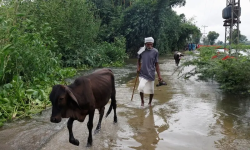
A resident walks with his cattle in a flooded street in Bhikhiwind village, Kasur, Punjab on Aug 24. — Reuters

1756207450211.png

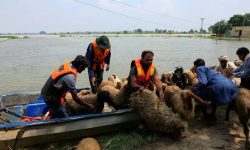
Rescue 1122 volunteers offload herd of sheep and goats, after they were rescued from the flooded area, in Bhikhiwind village, Kasur, Punjab on Aug 23. — Reuters

Nearly 150,000 people have been evacuated so far from flood-prone areas across Punjab as the province braces for heavy rains and floods, the National Disaster Management Authority (NDMA) said on Tuesday.

A devastating monsoon season marked by record rainfall, glacier melt, and widespread flooding has exposed Pakistan’s extreme vulnerability to climate change. The “high flood” warnings this week have put Punjab on high alert and prompted mass evacuations in various places.

“Nearly 150,000 people have so far been relocated to safer areas from flood-prone regions,” state-run APP reported, adding that it followed early warnings and alerts issued by NDMA regarding rising water levels and potential flooding.

The Punjab Provincial Disaster Management Authority (PDMA) initiated “large-scale evacuation operations” in vulnerable places following the swelling of the Sutlej River, the report said.

“Emergency response teams were deployed, and all concerned departments were placed on high alert to safeguard public life and property,” it added.

The data provided by the NDMA showed evacuations included 89,868 residents from Bahawalnagar, 14,140 from Kasur, 2,063 from Okara, 873 from Pakpattan, 361 from Bahawalpur, and 165 from Vehari, according to the APP.

It further said that around 40,000 people had moved to safer locations soon after the initial alerts.
 

‘Early monsoon, extreme heat behind widespread devastation’


Bakhtawar Mian
August 26, 2025

1756208195414.png

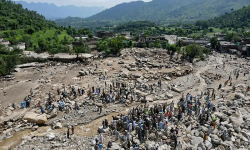
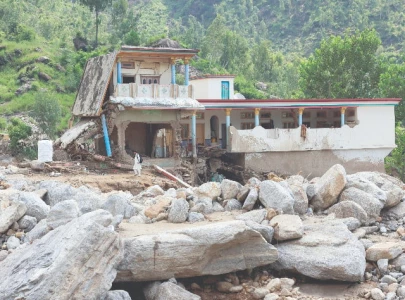
An aerial view shows flood survivors gathered near damaged houses along the banks of a river surrounded by heavy rocks in KP’s Buner district on August 17. — AFP

ISLAMABAD: A climate expert said on Monday that Pakistan’s monsoon set in around July 1 this year, two weeks earlier than usual and parts of the country experienced above-normal rainfall and searing heat that hastened glacial melt and unleashed glacial lake outburst floods (Glofs).

“This year, monsoon onset was early from July 1 instead of July 15,” said Dr Shehzada Adnan, a senior meteorologist, at a virtual roundtable hosted by the Sustainable Development Policy Institute (SDPI).

‘Depressions from the Bay of Bengal converged over both northern and southern regions, while westerly systems shifted unusually far north,’ he explained.

Rainfall was 13 per cent above the seasonal norm in north-eastern Punjab and Kashmir, he added, while temperatures rose by as much as 6-7°C, accelerating glacier melt and triggering Glofs.
 
The roundtable — Unprecedented Monsoon Impacts in Pakistan: Climate Extremes and Humanitarian Challenges — drew together researchers, humanitarians and policy specialists as the country faced what several participants called a climate-induced crisis.

A devastating monsoon season marked by record rainfall, glacier melt and widespread flooding has exposed Pakistan’s extreme vulnerability to climate change, they said, demanding urgent investment in climate-resilient plans to preempt future disasters.

“Pakistan contributes less than one percent of global emissions but remains among the world’s top 10 most climate-vulnerable countries,” said Dr Shafqat Munir, Deputy Executive Director at SDPI. “This is no longer just a natural hazard — it is a climate-induced humanitarian crisis.”

Mr Munir highlighted that the NDMA has presented 2025 contingency plans for four risk scenarios: heavy inflows merging into the Indus from mountain rains, flash floods in northern mountains, urban flooding in Karachi, and glacier melt; three have already occurred this season.

Experts stressed that a key failure is the public’s behavioural response.

“Pakistan’s greatest weakness was lack of preparedness and community drills,” said Dr Sofia Khalid, Chairperson of the Department of Environmental Sciences at Allama Iqbal Open University. “Despite repeated warnings from NDMA, people often ignore alerts. Our behavioural response remains reactive.”

“Communities in flood-prone areas must be trained on safe evacuation points, emergency contacts, and disaster drills. Preparedness can save lives,” she added.

The humanitarian fallout from these disasters disproportionately harms the most vulnerable, another speaker highlighted.

“Floods and climatic shocks disproportionately affect women, children, and minorities,” said Dr Andaleeb Koasar Jhatial, a lecturer at the International Islamic University Islamabad.

Published in Dawn, August 26th, 2025
 

Karachi’s monsoon woes linked more to bad governance than climate change

Faiza Ilyas
August 26, 2025

1756208873150.png

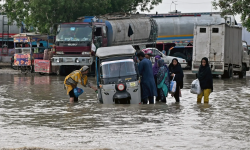
Passengers disembark from an auto rickshaw that got stranded on a flooded road after heavy monsoon rains in Karachi on August 20, 2025. — AFP

• KCF convener stresses need for strong political will to fix most basic problems
• City can’t handle even 10mm of rains with choked drains, says urban planner

KARACHI: Expressing serious concerns over the way the metropolis has been governed for the past several decades, civil society representatives said on Monday that the death, devastation and public chaos Karachi experiences with every monsoon have more to do with bad governance — corruption, inefficiency and absence of political will — rather than climate change.

The civil society held a press conference under the platform of the Karachi Citizens’ Forum (KCF) at the Pakistan Medical Association (PMA) House, where one of the speakers emphasised the need for what he called a supra provincial body to run Karachi.

Describing the situation as “depressing”, the speakers said that cost-efficient solutions to urban flooding were available and that there was no dearth of skilled and talented manpower in the city to implement them to help minimise rain damages.

“We need a strong political will to fix the city’s most basic problems. The continued official neglect towards the sewerage and drainage system has led to a situation where monsoons have become a source of fear and devastation,” said KCF convener Nargis Rehman.

She urged the civic authorities to learn from other countries and improve city’s fragile civic infrastructure.

The city, she pointed out, was run by 21 different agencies that took action only after damage, adding that the Met department’s warnings of heavier than usual rains were ignored this year, too, and timely steps, including cleaning of choked drains, were not taken.

Highlighting flaws, urban planner and researcher Muhammad Toheed stated that there was no question of flooding in Karachi, if its geology, natural slope and terrain had been considered in its growth and development.

“The city has 38 big drains and over 500 small drains. The operational maintenance of most of these drains is the responsibility of the Karachi Metropolitan Corporation (KMC). The problem started in 1996 when the [then] Karachi Water and Sewerage Board (KWSB) turned the big storm water drains, meant for discharge of rainwater, into sewer channels, instead of upgrading its network.
 

‘No longer rare’: Pakistan floods spark calls for adaptation over aid​


Experts call climate disasters Pakistan’s ‘new normal’; PM vows to end riverbed encroachment, boost resilience

Anadolu Agency
August 26, 2025


people wade through a flooded street as they carry a woman towards the hospital at latifabad hyderabad pakistan august 22 2025 photo reuters


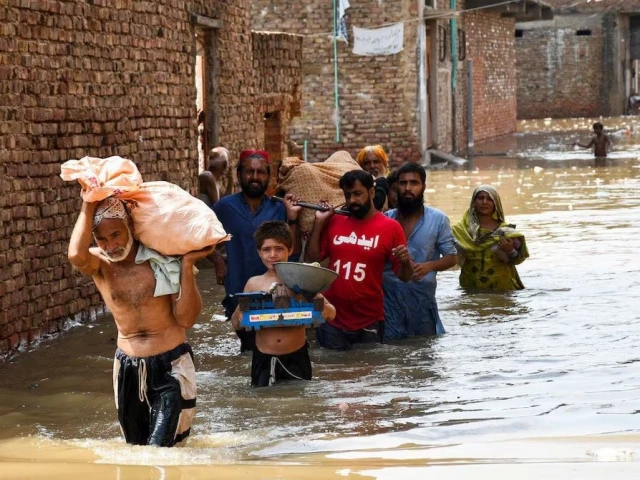
People wade through a flooded street as they carry a woman towards the hospital at Latifabad, Hyderabad, Pakistan, August 22, 2025.PHOTO: REUTERS

Recent flash floods have killed hundreds and uprooted thousands of lives in northern Pakistan, which ranks among the world’s 10 most climate-vulnerable countries

Northern Pakistan is reeling from devastating climate-induced flash floods that killed hundreds earlier this month, destroying homes, infrastructure and livelihoods in scenes many compared to the catastrophic 2022 deluges.

Pakistan ranks among the world’s 10 most climate-vulnerable countries, despite contributing less than 1% of global greenhouse gas emissions. Experts warn that such floods and other calamities are no longer “rare disasters” and are becoming routine shocks in a country ill-prepared to withstand them.

The focus, according to these experts, must now be on adaptation, not emissions cuts.

“Floods are no longer rare disasters in Pakistan. They are becoming routine shocks that people brace for every monsoon. Calling them the ‘new normal’ is not an exaggeration,” said Karachi-based ecologist Rafi-ul-Haq.

Since mid-August, torrential rains, flash floods and cloudbursts have killed more than 460 people across the country, including in Pakistan-administered Kashmir and the northern Gilgit-Baltistan region.
 
Northwestern Khyber Pakhtunkhwa has been the worst-hit, where swollen rivers, mudslides and collapsing homes have buried entire families. Nationwide, almost 800 people have died in rain-triggered floods and landslides since late June.

Haq said the intensity of rains and floods is accelerating due to climate change, global warming and melting glaciers. But human actions – unplanned urbanization, deforestation, blocked waterways, lax governance and weak emergency responses – account for as much as 60% of the destruction.

“Pakistan cannot stop the rain, but it can prevent much of the suffering by fixing manmade vulnerabilities,” he said. “Floods will happen, but disasters don’t have to.”

Ahmed Kamal, an Islamabad-based flood management expert, described the current flooding as a “new normal.” Shifting monsoon patterns, he said, have intensified rainfall and created new hotspots of devastation.

The Gilgit-Baltistan region, home to towering glaciers, has experienced alarming changes. Temperatures have risen steadily, accelerating glacier melt and causing glacial lake outburst floods. In May, Chilas district recorded an unprecedented 49C (120F).

“We have our glaciers melting very fast, while winters are shrinking,” Kamal said. “Snowfall was almost 50% below average last year.”

He also pointed out the dangers of intensifying cyclone threats in Pakistan, saying that rising sea surface temperatures in the Arabian Sea have shifted storm activity westward, with cyclones increasingly striking the coast since 2007.

At the same time, decades of deforestation – driven by demand for farmland and housing – have stripped the country of natural flood buffers. “This has multiplied the frequency and intensity of floods,” Kamal said.
 
Adaptation, resilience, and governance

Experts argue that Pakistan must focus on building resilience through a mix of natural and structural solutions.

“Given its economic limits, Pakistan’s priority must be adaptation and resilience rather than emissions cuts,” Haq said.

He called for restoring wetlands, mangroves and floodplains to absorb excess water, clearing illegal construction from drainage channels, and upgrading city drainage systems with green infrastructure.

He also emphasized the need for flood-resilient farming backed by insurance and social safety nets. “Low-cost steps like pre-monsoon drain cleaning, early warning systems, and community shelters can save lives immediately,” he said, while also stressing the need to address weak land-use planning and corruption.

Prime Minister Shehbaz Sharif has acknowledged that “criminal negligence” by successive governments had allowed construction on riverbeds and watersheds. At a Cabinet meeting last week, he vowed to clear these encroachments.

“Along with this, larger investments in watershed management and resilient housing can follow with international climate finance,” said Kamal.

Climate governance expert Imran Saqib Khalid warned that unless Pakistan takes quick action, the future could bring food insecurity, water shortages and mass migration. “Science shows that if we continue on this trajectory, by the end of the century we’ll reach close to 2.5C warming, which will cause havoc,” he said.

Khalid also argued that Islamabad must join forces with other low-emitting nations to demand fairer global action and finance.

Kamal concluded on an optimistic note, saying: “The challenge is enormous, but the window of opportunity is still there. With scientifically smart adaptation strategies, we could at least mitigate much of the devastation.”
 
Park View City, the housing society of Federal Minister Aleem Khan, is under threat of flooding today. Let’s not forget the background:
• Imran Khan refused extension of this society because the land was in a riverine area.
• Later, Maryam Nawaz approved the same land for the extension.
• Now residents are being warned about possible flood risks, and emergency measures are being announced.

This raises serious questions:
• Should housing societies be allowed in environmentally sensitive areas?
• Was Imran right to deny extension at that time?
• Is Maryam Nawaz responsible for prioritizing political favors over public safety?
• What about Aleem Khan — is he accountable as the owner and now as a Federal Minister?

To view this content we will need your consent to set third party cookies.
For more detailed information, see our cookies page.
 
To view this content we will need your consent to set third party cookies.
For more detailed information, see our cookies page.
 

Users who are viewing this thread

Back
Top