Dawn.com |
Imran Gabol
August 27, 2025
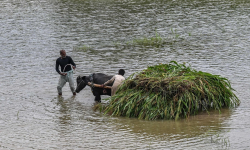
Farmers transport a heap of crops on a buffalo cart after heavy rainfall in the flood-affected area of Punjab’s Kasur district on August 24, 2025. — AFP
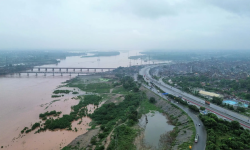
A general view of river Ravi after flood water increased on Aug 26, 2025. — Murtaza Ali/White Star
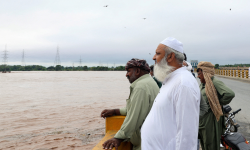
Men stand on a bridge over the Chenab River, following the monsoon rains and rising water level in Wazirabad, in Punjab on Aug 27, 2025. Reuters/Akhtar Soomro
This aerial photograph shows partially submerged houses in the flood-affected area of Haqu Wala village in Punjab’s Kasur district on August 24, 2025. — AFP
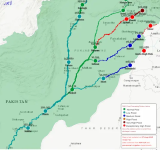
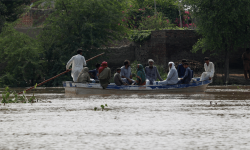
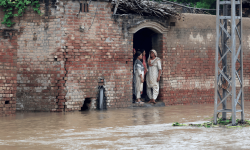
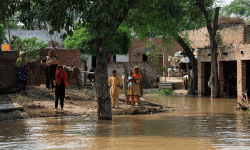
Authorities in Punjab have so far evacuated thousands of people from areas along the rivers as Chenab, Ravi and Sutlej rivers faced “exceptionally high” floods after India released water into Pakistan, officials said on Wednesday.
Punjab is facing an unprecedented flood emergency due to a combination of heavy rains and India’s decision to release water from at least two dams. Both countries have been ravaged by intense
monsoon rains and
flooding in recent weeks.
What we know so far:
Today, India opened all gates of major dams on rivers in occupied Kashmir following heavy rains, and warned Pakistan of the possibility of downstream flooding,
Reuters quoted an Indian government source as saying.
Subsequently, the water ministry issued a flood alert, seen by
Dawn.com, for flooding on three rivers — Sutlej, Ravi and Chenab — which flow into the country from India.
At the same time, heavy rains in the upper catchment areas of the Chenab River have swollen downstream flows, placing thousands of citizens at risk. The Punjab government has
called in the army in eight districts to assist civil authorities in rescue and relief operations.
As of 3pm, Chenab at the Qadirabad and Khanki headworks, Ravi at Jassar, and Sutlej at Ganda Singh Wala were in an “exceptionally high flood” condition, according to the data by the Met Office’s
Flood Forecasting Division (FFD).
Jassar Headworks had already been declared as facing exceptionally high flood at 2am.
The water outflows at Khanki and Qadirabad were recorded at over 1 million cubic feet per second (cusecs), with a “rising” trend.
The outflows at Jassar and Ganda Singh Wala were over 200,000 cusecs, with “falling” flows in the former and steady in the latter.
This screengrab shows flood levels at various locations in Pakistan’s rivers at 3pm on Aug 27, 2025. — Flood Forecasting Division website
Marala Headworks, which had been in “exceptionally high flood” at 2am, was now at “very high” flood level, with declining outflows of around 500,000 cusecs.
Balloki and Shahdara on Ravi, as well as Suleimanki Headworks at Sutlej, faced a medium-level flood. The water outflows in the two Ravi locations were less than 100,000 cusecs, while those at Suleimanki were a bit over 100,000 cusecs.
Speaking to
Dawn.com, climate change and sustainable development expert
Masood Lohar termed the floods in the eastern rivers — Sutlej, Ravi and Beas — “unusual”.
He said that a similar situation also persists in the western rivers, as the water level in Chenab reached 1m cusecs, which again was “very unusual”.
This, Lohar noted, poses a high risk to several areas in Punjab, particularly those located downstream, including Lahore, Bahawalpur, Sialkot and Kasur.
“Infrastructure, agricultural land and even entire cities can be wiped off,” he warned, adding that such a situation has never been seen before because water has even entered the previously abandoned riverbeds.