Pakistan Weather News / Updates

Anyone stupid enough to buy on a flood plain is to blame.

All flat land near rivers will flood one day or another.

And only in a banana republic would the PM or CM/nani/PM ki banjhi/timu-mother-of-nation need to approve or sign off a housing society
 
What humanitarian grounds? Releasing water and making the flooding even worse!!!
They have no choice but to release water because they are facing excess of water in their dams!

If anything we only have ourselves to blame for not learning since the 2010 and 2022 floods that devastated us!
 
She is not even in country for long days
 
To view this content we will need your consent to set third party cookies.
For more detailed information, see our cookies page.
 
To view this content we will need your consent to set third party cookies.
For more detailed information, see our cookies page.
 
Imran Khan appeared in RUDA ads, a project made literally on the banks of Ravi.
 

Thousands evacuated in Punjab as India opens floodgates, rains swell rivers to ‘exceptionally high’ levels


Dawn.com | Imran Gabol
August 27, 2025
1756293812532.png

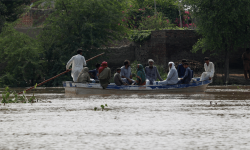
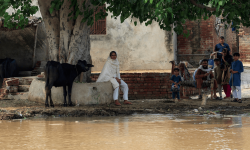
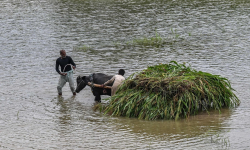
Farmers transport a heap of crops on a buffalo cart after heavy rainfall in the flood-affected area of Punjab’s Kasur district on August 24, 2025. — AFP

1756293844796.png

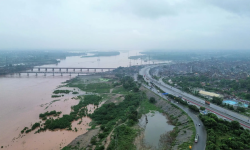
A general view of river Ravi after flood water increased on Aug 26, 2025. — Murtaza Ali/White Star

1756293878850.png

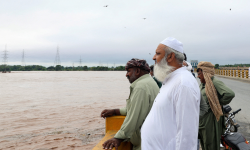
Men stand on a bridge over the Chenab River, following the monsoon rains and rising water level in Wazirabad, in Punjab on Aug 27, 2025. Reuters/Akhtar Soomro

This aerial photograph shows partially submerged houses in the flood-affected area of Haqu Wala village in Punjab’s Kasur district on August 24, 2025. — AFP


Authorities in Punjab have so far evacuated thousands of people from areas along the rivers as Chenab, Ravi and Sutlej rivers faced “exceptionally high” floods after India released water into Pakistan, officials said on Wednesday.

Punjab is facing an unprecedented flood emergency due to a combination of heavy rains and India’s decision to release water from at least two dams. Both countries have been ravaged by intense monsoon rains and flooding in recent weeks.


What we know so far:


Today, India opened all gates of major dams on rivers in occupied Kashmir following heavy rains, and warned Pakistan of the possibility of downstream flooding, Reuters quoted an Indian government source as saying.


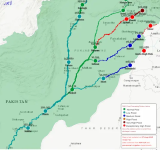
Subsequently, the water ministry issued a flood alert, seen by Dawn.com, for flooding on three rivers — Sutlej, Ravi and Chenab — which flow into the country from India.

At the same time, heavy rains in the upper catchment areas of the Chenab River have swollen downstream flows, placing thousands of citizens at risk. The Punjab government has called in the army in eight districts to assist civil authorities in rescue and relief operations.

As of 3pm, Chenab at the Qadirabad and Khanki headworks, Ravi at Jassar, and Sutlej at Ganda Singh Wala were in an “exceptionally high flood” condition, according to the data by the Met Office’s Flood Forecasting Division (FFD).

Jassar Headworks had already been declared as facing exceptionally high flood at 2am.

The water outflows at Khanki and Qadirabad were recorded at over 1 million cubic feet per second (cusecs), with a “rising” trend.

The outflows at Jassar and Ganda Singh Wala were over 200,000 cusecs, with “falling” flows in the former and steady in the latter.

This screengrab shows flood levels at various locations in Pakistan’s rivers at 3pm on Aug 27, 2025. — Flood Forecasting Division website


Marala Headworks, which had been in “exceptionally high flood” at 2am, was now at “very high” flood level, with declining outflows of around 500,000 cusecs.

Balloki and Shahdara on Ravi, as well as Suleimanki Headworks at Sutlej, faced a medium-level flood. The water outflows in the two Ravi locations were less than 100,000 cusecs, while those at Suleimanki were a bit over 100,000 cusecs.

Speaking to Dawn.com, climate change and sustainable development expert Masood Lohar termed the floods in the eastern rivers — Sutlej, Ravi and Beas — “unusual”.

He said that a similar situation also persists in the western rivers, as the water level in Chenab reached 1m cusecs, which again was “very unusual”.

This, Lohar noted, poses a high risk to several areas in Punjab, particularly those located downstream, including Lahore, Bahawalpur, Sialkot and Kasur.

“Infrastructure, agricultural land and even entire cities can be wiped off,” he warned, adding that such a situation has never been seen before because water has even entered the previously abandoned riverbeds.
 
The headworks of Chashma, Taunsa, Guddu, Sukkur, and Kotri on the Indus River were in “low” flood as of the last FFD update at 12pm. Islam Headworks on the Sutlej River was also in low flood.
 
1756293946628.png


This screengrab shows flood levels at various locations in Pakistan’s rivers at 3pm on Aug 27, 2025. — Flood Forecasting Division website
 
At 12:30pm, the spillways of Tarbela Dam were to be opened to release water, according to a post by the National Disaster Management Authority (NDMA).

The authority expected the water levels to reach 250,000 cusecs as a result and urged the public to avoid going near waterways in adjoining areas of the Indus River, where increased water flows were likely.

The Provincial Disaster Management Authority (PDMA) said late on Tuesday that India had opened all the gates of its Thein Dam on the Ravi River. The announcement came a day after Pakistan received a second warning from India that it intended to release water from the rapidly filling Madhopur Dam, Reuters reported. Both dams are located on the Ravi River, which flows from Indian Punjab into Pakistan.
 

Over 32,500 people evacuated so far from river areas: Rescue 1122​

Meanwhile, over 32,500 people have been evacuated so far from areas alongside various rivers in Punjab, the Rescue 1122 service said as relief and rescue operations continue.

“Around 32,589 people have been evacuated safely from areas along the banks of the Indus, Chenab, Ravi, Sutlej, and Jhelum rivers,” Punjab Rescue 1122 spokesperson Farooq Ahmad said in a statement.

“Yesterday, around 5,970 people were evacuated from areas that could potentially face flooding,” Ahmad said.

Giving a district-wise breakdown, Ahmad said 2,275 were evacuated from Kasur, 914 from Okara, 846 from Pakpattan, 785 from Bahawalpur, 323 from Vehari, 270 from Bahawalnagar, 259 from Narowal, 74 from Hafizabad, 27 from Lodhran and 15 from Chiniot.

Rescue teams in the above districts, as well as in Sialkot, Gujranwala, Gujrat and Mandi Bahauddin, had been placed on high alert.

The spokesperson, in a statement, said around 987 people have been rescued from potential flood areas today, including 719 from Nankana Sahib, 124 from Hafizabad, 103 from Narowal, 27 from Gujrat and 14 from Gujranwala.

Asserting that the teams are “working day and night in flood-hit areas”, Ahmad said around 436 boats were engaged in rescue efforts, out of which 74 are in Kasur, 28 in Okara, 20 in Vehari and less than 20 each in Hafizabad, Pakpattan, Bahawalnagar, Bahawalpur, Sialkot, Narowal, Gujrat, and Mandi Bahauddin.

Another 400 rescue boats will be utilised as backup, the Rescue 1122 official added. Nearby districts have also been instructed to help in case of any emergency.
 

Pakistan’s monsoon misery: Nature’s fury, man’s mistake

Natural disasters are acts of God, but we cannot ignore the human blunders, according to PM Shehbaz.

AFP
August 27, 2025

1756294873833.png

Floodwaters gushing through mountain villages, cities rendered swamps, mourners gathered at fresh graves — as Pakistan’s monsoon season once again delivers scenes of calamity, it also lays bare woeful preparedness.

Without better regulation of construction and sewer maintenance, the annual downpours that have left hundreds dead in recent months will continue to kill, experts say.

Even Prime Minister Shehbaz Sharif appeared to agree as he toured flood-stricken Khyber Pakhtunkhwa province last week, where landslides killed more than 450 people.

“Natural disasters are acts of God, but we cannot ignore the human blunders,” he said.

“If we keep letting influence-peddling and corruption control building permits, neither the people nor the governments will be forgiven.”

Pakistan is among the countries most vulnerable to climate change, with limited resources for adaptation.

In the devastated mountain villages the prime minister visited, and beyond, residential areas are erected near riverbeds, blocking “natural storm drains,” former climate change minister Sherry Rehman told AFP.

Entrepreneur Fazal Khan now recognises the “mistake” of building too close to the river.

His home in the Swat Valley was destroyed first by 2010 floods and then again in the 2022 inundation that affected nearly four million Pakistanis.

“On August 15, once again, the floodwater surged through the channel and entered our home,” the 43-year-old father said.

1756294805824.png

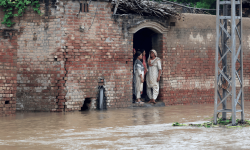
Residents stand at the entrance of a house on a flooded road, due to the monsoon rains and rising water level of the Sutlej River, in Hakuwala village near the Pakistan-India border in Punjab’s Kasur district on August 24, 2025. — Reuters
 

Man-made mistakes​

Since it began in June, this year’s monsoon has killed around 800 people and damaged more than 7,000 homes, with further downpours expected through September.

While South Asia’s seasonal monsoon brings rainfall that farmers depend on, climate change is making the phenomenon more erratic, unpredictable and deadly across the region.

By the middle of this month, Pakistan had already received 50 per cent more rainfall than this time last year, according to disaster authorities, while in neighbouring India, flash floods and sudden storms have killed hundreds.

Extractive practices have also compounded the climate-related disasters, with cash-strapped but mineral-rich Pakistan eager to meet growing American and Chinese demand.

Rehman, the former minister, said mining and logging have altered the natural watershed.

“When a flood comes down, especially in mountainous terrain, a dense forest is very often able to check the speed, scale and ferocity of the water, but Pakistan now only has 5pc forest coverage, the lowest in South Asia,” she said.

Urban infrastructure, too, has faltered.

Days after villages were swept away in the north, a spell of rain in the south brought Pakistan’s financial capital, Karachi, to a standstill.

The coastal megacity — home to more than 20 million people — recorded 10 deaths last week, with victims electrocuted or crushed by collapsing roofs.

A Human Rights Commission of Pakistan (HRCP) report said brown water inundating streets is not only the result of rain but “clogged drains, inadequate solid waste disposal, poor infrastructure, encroachments, elitist housing societies… and so on.”

Published in the wake of 2020’s deadly floods, the report still rings true today.

1756294925364.png

Residents stand at the entrance of a house on a flooded road, due to the monsoon rains and rising water level of the Sutlej River, in Hakuwala village near the Pakistan-India border in Punjab’s Kasur district on August 24, 2025. — Reuters
 

‘Negligence’​

According to the commission, the problems are “inherently political” as various parties use building permits to fuel their patronage networks — often disregarding the risks of constructing on top of drainage canals.

In some areas, “the drain has become so narrow that when high tide occurs and it rains simultaneously, instead of the water flowing into the sea, it flows back into the river,” urban planning expert Arif Hasan said in an interview after the 2022 floods.

In the sprawling, rapidly swelling city, the various authorities, both civil and military, have failed to coordinate urban planning, according to the rights commission.

As a result, what infrastructure does get built can solve one problem while creating others.

“Karachi isn’t being destroyed by rain, but by years of negligence,” said Taha Ahmed Khan, an opposition lawmaker in the Sindh provincial assembly.

“Illegal construction and encroachments on stormwater drains, along with substandard roads… have only worsened the crisis,” he added.

Karachi Mayor Murtaza Wahab says he has been asking Islamabad every year for help financing the revamping of drainage canals, to no avail.

“It’s easy to suggest that drainage capacity should be enhanced, but the cost is so high that it might require spending almost the entire national budget,” he told AFP.

1756296624591.png

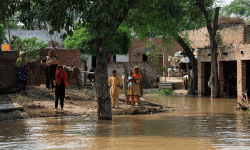
Residents sit outside their houses near the flooded water due to the monsoon rains and rising water level of the Sutlej River, in Bhikhiwind village near the Pakistan-India border in Punjab’s Kasur district on August 23, 2025. — Reuters

Yet during June’s budget vote, the opposition accused the city of having spent only 10pc of funds earmarked for a massive development project.

The five-year plan, designed with international donors, was supposed to end the city’s monsoon suffering by the end of 2024.

But nearly a year later, there is no respite.
 
To view this content we will need your consent to set third party cookies.
For more detailed information, see our cookies page.
 

Users who are viewing this thread

Pakistan Defence Latest

Back
Top